
Compliance
Workforce Planning for Indian Startups: A Practical Framework
Stop hiring employees on guesswork. Read the practical guide for workforce planning for startups, covering forecasting, costs, compliance, and the right time to hire next.

Richa Thakur
Content Writer · 5 min read · · Updated
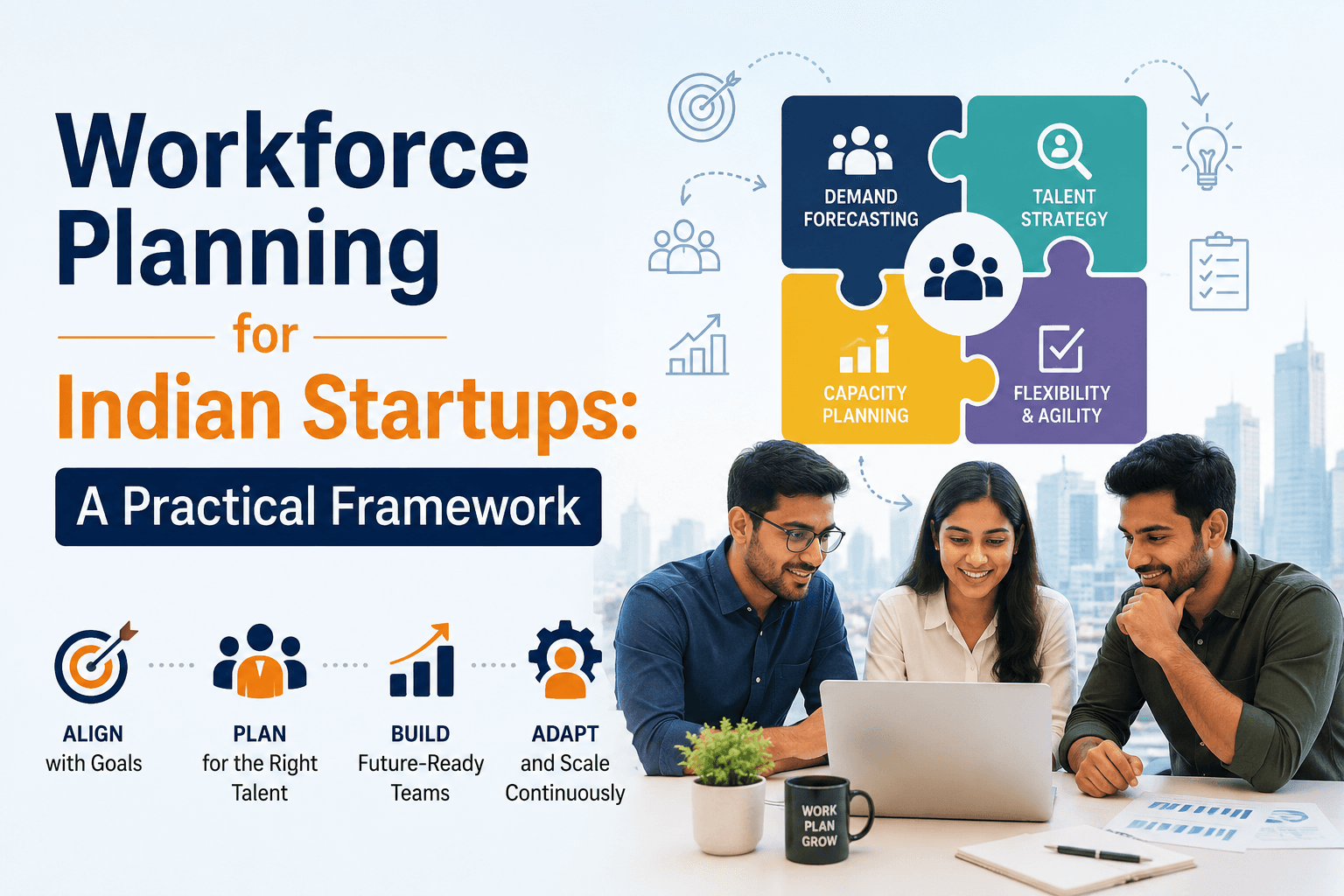
Most Indian startups don't fail because they hired too few people. They fail because they hired the wrong people at the wrong time. A funded startup hires fast after a round, and six months later finds itself stuck with high payroll costs, missed growth targets, and no measurable outcomes to show for it.
The real cause is hiring people who don't match the roles the business actually needs. Look at it through a bigger lens. A Bengaluru startup closes its Series A, hires aggressively, and within months, payroll becomes one of its highest costs. It's a common pattern among startups that scale headcount without a proper workforce planning framework, and it's often what sinks them at the early stage.
If you think workforce planning is something only big enterprises do, think again. Even enterprises with HR teams end up making the wrong hires. That's why implementing a strategic workforce planning process for startups matters. It separates deliberate growth from expensive guesswork.
In this guide, we'll cover what workforce planning is, why it's essential for emerging startups, how it differs from recruitment, how to build a framework for Indian startups, and the common mistakes most startups make along the way.
What is workforce planning?
Workforce planning is how a company decides what talent it will need, and when, before the need becomes urgent. The goal is simple to state and hard to do: the right people, with the right skills, in the right roles, at the right time. In practice, it means looking at three things together: where the business is headed, who's already on the team, and the gap between the two, and then deciding how to close that gap before it slows you down.
Key elements of workforce planning
Demand forecasting: What roles and skills the business will need to hit its goals
Skill assessment: What your current team can actually do today
Capacity planning: Whether you have enough people to meet the workload ahead
Scenario modelling: How the plan shifts if you grow faster, slower, or pivot
Performance analytics: The metrics that tell you whether the plan is working
Why is workforce planning significant for startups?
Workforce planning is essential for startups because it directly aligns limited capital with the exact talent needed to reach key milestones. By forecasting skill gaps and headcounts, startups can avoid mis-hires, cut operational disruption, and stay agile enough to scale.
Human capital is both the main driver and the highest cost in a startup. Planning it deliberately changes three things:
It ties headcount to milestones, not to funding
The classic mistake is hiring against the bank balance ("we just raised, let's grow the team") instead of against what the next milestone actually requires. A startup that needs to ship a v2 product doesn't need 10 generalists; it needs three senior engineers and a designer. Planning forces that specificity.
It buys time on the roles that take time to fill
Senior and specialised hires in India routinely take 60–90 days to close. If you start looking when the seat is already empty, you've lost a quarter. Planning means the pipeline is warm before the need is urgent.
It exposes the build-vs-buy choice early
Half the "open roles" on a startup's hiring plan don't need a new hire at all; they need an existing employee reskilled or a contractor for six months. You only see that when you map skills against milestones on purpose.
What is the core difference between workforce planning and recruitment?
Workforce planning and recruitment are used interchangeably, but they answer different questions. Workforce planning asks what talent the business needs and when. Recruitment answers how to bring that talent in.
Recruitment starts once a decision has been made. Workforce planning is the decision that founders and HR leaders make about where the company is going before a single role is posted. Skip the planning, and recruitment becomes a series of reactions to empty seats.
Here is the table representing the core difference between workforce planning and recruitment:
Category
Workforce Planning
Recruitment
Focus
Long-term planning (12-18 months)
Short-term execution (Immediate vacancies)
Objective
Align talent supply with the broader business goals
Discover, interview, and hire the right people for the required job role
Action
Analysing gap, forecasting, training, and restructuring
Screening, filtering, testing, and evaluating
Nature
Proactive
Reactive (Often responds to an empty seat)
How to create a successful workforce planning process?
A workforce planning process connects your hiring to your business goals instead of your bank balance. For a startup, it comes down to five practical steps.
1. Align with Strategic Goals
Start with where the company is heading over twelve to eighteen months:
Don’t plan in an HR vacuum; collaborate with business unit leaders, finance, and the operations team to understand the company's 12–18-month goals.
It can be related to global expansion, digital transformations, and project launches.
Transform these goals into specific headcounts and specific capabilities.
2. Audit Current Workforce
Understand who you have, what skills they possess, and what the gaps are. You can’t plan without knowing what is lacking in your team:
For assessing the current workforce, go beyond simple headcount.
Assess your team's skills, who's stretched too thin, who's ready to take on more, and where you have single points of failure (the one person who understands billing or payroll).
To create a centralised talent inventory, use performance metrics, HR analytics, and skill map technologies.
3. Forecast Future Demand & Supply
Project the roles you'll need against the team you have, and pressure-test it with three questions:
Which roles must you add, and which can wait a quarter?
Where can automation or AI absorb work instead of hiring?
What does each future role cost, fully loaded, not just salary?
4. Develop an Action Plan
Once you've identified a gap, you have more options than "post a job." A useful way to think through them is the talent-levers model widely used in workforce planning:
Buy: Recruit new hires externally
Build: Upskill or reskill someone already on the team
Borrow: Use freelancers, agency workers, or outsource the process
Bind: Improve retention and keep your top performers
Bounce: Manage exits and layoffs responsibly
Balance: Restructure teams
Bot: Automate repetitive tasks to reduce headcount needs
For an early-stage startup, the first instinct is almost always "Buy," but "Build" and "Bot" are usually cheaper and faster, and they protect runway.
5. Measure & Adapt
Workforce planning is an ongoing process, not an annual event. Review your plan monthly or quarterly against what's actually happening.
Track the metrics that matter: time-to-hire, retention rate, and attrition.
Adjust your strategy as industry trends and business needs shift, so the plan stays relevant.
Workforce planning for Indian startups: what's different?
For Indian startups, workforce planning comprises three main factors that separate it from generic advice. It includes the statutory compliance threshold that may trigger as your organisation grows, the salary gap between Tier 1 and Tier 2, and the choice between contract hiring or full time hiring. Whenever you’re doing manpower planning for startups, account for these three key aspects.
Compliance: the thresholds that change as you grow
Indian compliance isn't a single switch; obligations trigger at specific headcounts. The three that catch startups off guard:
At 10 employees, POSH becomes mandatory
Under Section 4 of the POSH Act, 2013, any workplace with 10 or more employees must constitute an Internal Committee (IC), put a written anti-harassment policy in place, and run regular awareness training. (Below 10, the Act still applies; complaints just go to the district Local Committee instead.) The threshold counts everyone on the rolls, including interns and contract staff.
(Source: Sexual Harassment of Women at Workplace (Prevention, Prohibition and Redressal) Act, 2013)
At 20 employees, EPF registration is triggered
The Employees' Provident Funds Act, 1952 applies once you cross 20 employees, and you must register with the EPFO within one month of crossing that threshold. Both employer and employee then contribute 12% of basic salary plus dearness allowance.
(Source: https://www.epfindia.gov.in/site_en/index.php)
From day one (if DPIIT-recognised), you can self-certify
A startup recognised under the Startup India initiative can self-certify compliance across 6 labour laws (including the EPF Act, the Payment of Gratuity Act, and the Contract Labour Act) for up to 5 years from incorporation, with no routine inspections, only complaint-driven ones. You'll still need to register under your state's Shops and Establishments Act within 30 days of starting operations.
(Source:https://www.startupindia.gov.in/content/sih/en/startupgov/self-certification.html)
Note: This is a general summary, not legal advice. Statutory thresholds and rates are revised periodically, and some obligations vary by state. Confirm the current position with a qualified advisor before acting.
Contract Design
Standardising the contracts minimises the operational and legal risks.
Ensure offer letters and employee agreements explicitly assign all work, code, and development to the company
Include Non-Disclosure Agreements (NDAs), non-compete, and non-solicitation clauses. It is enforceable under the Indian Contract Act.
Don't accidentally turn a contractor into an employee. If you set fixed work hours, mandate a uniform, or control how the work is done day-to-day, courts can reclassify your contractor as an employee, which retroactively triggers PF, gratuity, and other dues.
Keep contractor agreements focused on deliverables and outcomes, not attendance and supervision.
Startups can attract talent by offering equity. Ensure a defined vesting period (e.g., 4 years with a 1-year cliff) and draft a clear ESOP pool policy.
Cost Structuring and Optimisation
A startup hiring plan in India requires a basic salary, variable pay (bonuses), and mandatory statutory compliance costs.
Full-time hiring in India includes basic salary, statutory overheads (PF, ESI, or Gratuity), and recruitment costs.
Startups save significantly on talent overhead costs by utilising contract staffing or EOR (Employer of Record) services to convert fixed costs into manageable operating costs without requiring a formal Indian entity (required especially for international founders).
To preserve your cash runway, structure CTC (Cost to Company) for a higher variable performance-linked bonus component to tie compensation directly to company milestones.
Common workforce planning mistakes startups make
Startups often disrupt workforce planning by misaligning the hiring process with business strategy, hiring without a structured process, and neglecting legal and statutory compliance.
These pitfalls often drain cash flow, delay product rollouts, and create a toxic work culture that drives away top performers.
Hiring without a strategy: Bringing on staff proactively rather than strategically can cause role redundancies, mis-hires, and skill gaps within an organisation.
Overrelying on Personal Networks: Hiring friends and close family members based on referrals and connections leads to groupthink, a lack of diversity, and individuals lacking specific skills for the required job role.
Neglecting Compliance: Improvising with random contract templates and classifying employees as independent contractors invites severe legal cases and hefty penalties.
Failing to Define Role Clearly: Relying on the multi-tasker employee mentality can work for the initial stages. But over time, it will result in burnout and role ambiguity as the business expands.
Ignoring Onboarding: Without a successful onboarding process, new hires leave early due to a lack of the company's core values, vision, engagement, and strategy.
Retaining Underperformers: Failing to address the poor performance of early hires, often out of loyalty, can demotivate the new hires and strain the overall team.
Final Thoughts
Think back to the funded startup, how it started hiring employees aggressively, and six months later ended up drowning in payroll. The difference between outcome and the process was never the number of people hired, but how it hired people without a strategic workforce planning framework.
Workforce planning for startups in India revolves around three factors: statutory compliance, cost, and contract design. So before you hire the next employee, follow the plan. Check whether the role fits the stage, budget, and runway, because at the end, workforce planning isn’t about hiring more or fewer people; it's about hiring the right people at the right time.
Workforce planning falls apart when your people data lives in five spreadsheets. Human Maximizer keeps your org structure, headcount, skills, and HR analytics in one place, so when you're deciding whether the next role is a hire, a reskill, or a contractor, you're looking at real numbers instead of guessing.
Frequently Asked Questions
How do startups plan their workforce?
By working backward from goals, not forward from headcount. Map where the business is heading over the next 12–18 months, translate that into specific roles and skills, audit what the current team already covers, then close the gaps through hiring, reskilling, or contracting, and revisit the plan each quarter.
When should a startup start workforce planning?
A startup should focus on workforce planning from day one. With time, when the business expands, organisations should restructure and redefine the operational workforce that aligns with the industry trends and company visions.
How many employees should a startup hire?
There's no magic number, and chasing one is how startups overhire. Early on, 1-5 focused hires who can each own a function will get you further than a bigger, vaguer team. Hire against your next milestone, not your headcount ambition.
How do you forecast hiring needs for a startup?
Tie it to runway and revenue, not gut feel. Start from your financial runway and growth targets, work out which roles each milestone actually requires, and budget each one fully loaded (salary plus statutory costs). Keep the model flexible; plans shift, and the forecast should shift with them.
How do Indian startups manage rapid hiring?
Speed comes from preparation, not heroics. The startups that scale hiring well tend to do three things: use an ATS to screen volume without bottlenecking, lean on ESOPs to close the cash-gap when they can't match corporate salaries, and keep a few recruitment-agency relationships warm for hard-to-fill senior roles.
Keep reading

Compliance
HR Policy for Engineering Teams
Why rigid policies destroy developer output and learn how to implement flexible, data-driven HRMS software for engineering teams to boost...
19 min read
Compliance
48 hour fnf settlement
48 Hour FnF Settlement: How to transform the 2026 Labour Code into a recruitment advantage. Use our Labour Code compliance software...
12 min read
Compliance
Design an Effective HR Leave System
How to build a compliant HR leave management system that automates statutory tracking, reduces payroll errors, and simplifies leave policy enforcement.
12 min read