
Employee Engagement
What are HR Metrics? Importance, Key Metrics & Tools
Important HR workplace metrics to evaluate talent acquisition, employee performance and training effectiveness. Improve productivity, engagement, and operational efficiency.

Richa Thakur
Content Writer · 5 min read · · Updated
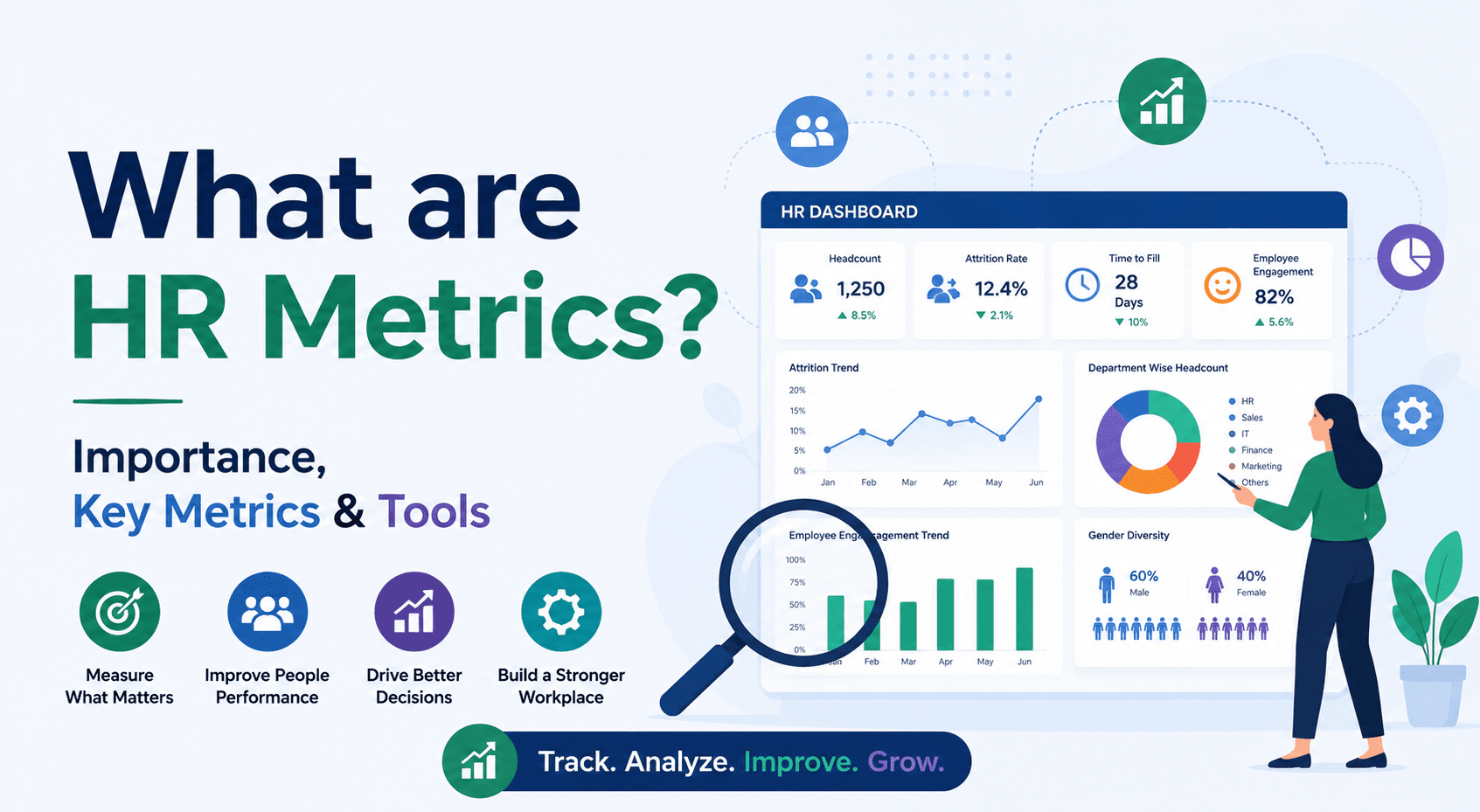
Workforce planning is the essential foundation for recruitment plans and enables HR leaders to evaluate, interpret and plan workforce supply and demand. The HR world is evolving constantly with data-driven and timely insights. These analytics now affect hiring, retention, compliance, productivity and workforce planning.
But the HR metrics gap can leave your business susceptible to poor decision-making and employees quitting the organisation, which can negatively impact team retention. But the good news? By utilising HR analytics for workforce planning, you can ensure a strong team with high-quality professionals and a low attrition rate.
This comprehensive guide will highlight all the important details about HR analytics, why it is necessary for business planning, and the useful HR analytics tool with best practices, so you can approach with certainty and precision.
What is HR Analytics?
Human resource analytics is a collection of data points that helps businesses and HR leaders to track the human capital rate of an organisation. It reflects how a business is performing in the current landscape and where it needs improvement.
In simple words, we can conclude that HR analytics tracks what strategies are working, whether there is a need for improvement, and what trends are capable of reshaping the organisation's future to measure HR success.
HR Analytics can be measured through these types:
Descriptive: What happened in an organisation with the help of reports on turnover?
Predictive: What might happen by identifying employees at risk of leaving?
Prescriptive: What steps should be taken to optimise training programs?
By using data and metrics, HR can replace intuition with data, improve employee experience and connect HR initiatives to business profit and growth.
What is the Importance of HR Metrics in Workforce Planning?
HR metrics can be defined as the difference between guessing and knowing. In workforce planning, HR analytics metrics can save time, reduce manual errors, prevent surprise talent shortages, and help in aligning every candidate with real business goals.
Without planning, HR leaders are left to intuition and guesswork, whereas with strategic workforce planning, organisations can achieve the desired result through data-driven insights. Let’s understand how HR metrics support workforce planning in modern times.
Strengthen Engagement & Retention
To understand the mindset of employees, whether they are connected or visualise a future with your company? You need to measure engagement scores, retention rates, and turnover rates. These metrics help analyse how employees feel in the workplace, their growth opportunities, and the culture or team dynamics that need attention.
Simplify Employee Lifecycle Management
One of the best ways to ensure smooth transitions and sustainable workforce stability is refining onboarding, training and career development processes to set employees' lifecycle for success. For streamlining the employee lifecycle, you can track metrics like tenure distribution, internal mobility, and quality of hire, which simplifies how you manage people from their first day to their last.
Hire the Top Talented Candidates
To build a stronger and more integrated team, HR must focus on searching for the right candidate who aligns with their organisation’s vision and culture. Workforce planning metrics
Such as hiring time, reason for resignation and capabilities that can help to sharpen your hiring strategy.
What metrics should HR track for workforce planning?
After understanding the fact that HR metrics are essential for workforce planning, the next question hits like countless spreadsheets: Which metrics should I actually track? Do we have the right people in the right roles, at the right time, for the future?
For strategic workforce planning, HR should move beyond standard HR scorecards and switch to key HR metrics. Your organisation needs metrics that can predict rather than provide a report. Here are the essential metrics that every HR must track to connect headcounts to business outcomes.
1. Time-to-Hire
Time-to-hire is a critical HR metric that measures the number of days between the moment an employee applies for a job and the period of accepting an offer letter. Extending hiring time can risk your operational tasks and revenue loss.
By reducing the time-to-hire, HR can attain:
Secure top talents before competitors
Improves candidate experience
Eliminates lost productivity and reduces costs
2. Employee Engagement Scores
It is a quantitative measure of how a candidate feels connected, motivated, and committed to their organisation. However, the moderate engagement score varies between 70-85% and below 50% considered a low engagement rate and needs immediate attention.
It's common to observe low team morale, productivity, and a high attrition rate with a low employee engagement score. HR can gather data through surveys, with multiple questions about job satisfaction, commitment, motivation, and alignment with the company values.
How to Calculate Employee Engagement Score?
HR can calculate the employee engagement score by:
Employee Engagement Score = Sum of All Employees' Responses ÷ Total Number of Responses
3. Productivity Rate
Employee productivity rate is the measurement of a key performance indicator that measures how efficiently and effectively an employee converts input, such as time and resources, into a final output, such as good services, value and business outcome. Productivity rate indicates where automation or improvement is necessary while running the business operations.
Businesses need to calculate a productivity rate for:
Maximising efficiency
Achieving business goals cost-effectively
Evaluate teams and individuals' performance
4. Employee Absenteeism Rates
Employee absenteeism rate refers to the metric that measures the percentage of unplanned leaves from the scheduled workdays over a specific period of time.
Absenteeism rate identifies unplanned leave, frequent single-day absences and overall attendance records. HR leaders can measure the absenteeism rate for an individual, team or the company as a whole to determine the vitality of the company.
High absenteeism rate reciprocates burnout, disengagement, frustration and workplace culture challenges. Identifying these patterns in an organisation helps the HR leaders to customise workload or introduce flexible scheduling options to reduce burnout.
You can calculate the absenteeism rate by:
Employee Absenteeism Rate = Number of Absent Days During a Year ÷ Number of Available Work Days in a Year
5. Cost Per Hire
Cost-per-hire is a metric that HR uses to track the annual budget for recruiting a new candidate.
This includes advertising, recruitment fees, and onboarding costs. HR must balance the hiring budget effectively. A low cost per hire indicates a competent recruitment process, and a higher cost signals for reducing the hiring cost.
Why Cost-Per-Hire Metric Matters?
Helps in setting a hiring budget
Comparing hiring efficiency against industry benchmarks
Optimises the rate of investment
By using this formula, HR leaders can calculate the cost per hire rate:
Cost-Per-Hire = Total Recruitment Costs ÷ Number of Hires in a Period
6. Employee Net Promoter Score ( eNPS)
eNPS is a scoring system that evaluates employees' loyalty, satisfaction and engagement by rating an organisation on the scale of 1-10.
eNPS can be categorised as:
Promoters (9-10): Happy and enthusiastic employees who are most likely to recommend the organisation in their social circles.
Passives (7-8): Neutral team members who are only satisfied and not fully engaged, and might not recommend the organisation.
Detractors (0-6): Unhappy employees and unlikely to recommend the organisation in their network. It has a high attrition rate and may disfavour the image of an organisation.
To calculate eNPS:
Employee Net Promoter Score = Number of Promoters- Number of Detractors ÷ Number of Respondents x 100
7. Salary Scale Distribution
It refers to the systematic way used by organisations to categorise pay across different roles, experience levels, and responsibilities. It includes various components such as base salary, allowances, bonuses, benefits and deductions with additional perks.
This metric helps in identifying pay disparities, competitive compensation and internal fairness within an organisation.
HR managers and leaders can balance salary components strategically by measuring:
Salary gaps between multiple demographics, tenure levels, or designations
How organisations compare salary structures to the industry benchmarks
What is the total percentage of people in each salary range?
8. Revenue Per Head
Revenue per head is the measurement of the average revenue generated for each full-time employee working in an organisation. In achieving data-driven workforce planning, revenue per head evaluates productivity and how effectively a company utilises its human capital and assets to generate income and business profit.
A higher revenue per head signals a streamlined workforce, while a minimal number indicates overstaffing inefficiencies or the necessity for skill development.
Organisations can calculate a revenue per head by applying the formula:
Revenue Per Head = Total Revenue ÷ Total Number of Employees
HR Analytics Tools for Businesses
With the advancement of technology and digitalisation, mid-level businesses and larger enterprises are utilising modern and automated tools to get actionable insights. Here are the essential tools to extract deeper insights:
Excel: It is used for arranging, filtering and examining the employee data. Startups and small businesses used tables and queries to discover HR metrics at an affordable rate.
Tableau: A highly popular tool for transforming complex employee data into a simple navigational and user-friendly dashboard to identify employee productivity, performance and engagement in the workplace.
Power BI: It is a resourceful option for companies that want to customise their HR analytics or integrate with Microsoft ecosystems.
HR Dashboard: These are customised and personalised dashboard available on HRMS that aggregates data from different platforms and software to provide a complete workforce and productivity.
With predictive HR analytics, organisations can predict scenarios like risk of employee turnover, attrition rate. Workforce planning can balance workforce supply and demand. HR can analyse skill gaps and figure out various trends to fill the right job at the right time.
How to use HR Analytics for Better Workforce Planning?
In any industry, data acts as a compass for operating a business. The main challenge in human resource management is filtering out the resourceful insights rather than acquiring more data.
By shifting from reactive management to a proactive analysis, HR can ensure a workforce that aligns with sustainable growth.
Outline your Business Goals & Visions
Every industry has a different background and requirements. Using the one-size-fits-all formula for workforce planning can be challenging and lead to devastating business operations. For successful workforce planning, set specific quantitative goals, deadlines, and tools that align with your business needs and requirements to achieve desired goals.
Gather Valuable Data
Actionable data derives from your operational workflow and how it connects the business to the competitive market. The main metrics to track valuable data are engagement, value, retention, and success factors to determine the workforce planning.
Utilise Data in the Informed Decision-Making Process
Gathering data from different sources is worthless until you take a strategic action. For example, an HR leader uses data to identify why the employee attrition rate is increasing, but if they don’t utilise these insights to address the issues, this rate will increase and sway the talent management of an organisation.
Build a Skilled Team & Invest in the Right Software
Assemble a team that includes an HR professional, a data analyst, IT professional to ensure diverse insights. Other than this, invest in platforms that offer real-time reporting, navigational dashboards, and AI capabilities to simplify analysis and free up time for the strategic decision-making process.
Conclusion
In 2026, HR analytics is a significant step to gain visibility, control and agility in the competitive market. The organisations that fail to utilise these data-driven insights fall behind in talent, productivity and compliance.
If you’re looking to turn your organisational raw data into an actionable insight, choose Human Maximizer and get complete real-time visibility of company data and trends, with predictive analysis. It is designed to help businesses that are building data-driven and strategic decisions for hiring and performance.
Human Maximizer provides the complete visibility of employees' data, such as headcount, turnover, growth and tracking capabilities, all at a centralised place.
Frequently Asked Questions
Why is workforce planning important in HR analytics?
Workforce planning is essential in HR analytics due to its ability to transform raw data into predictive insights that automatically allow organisations to proactively align their talents with business goals. By using this data, they can predict whether the company has the right people with the right skills in the right roles at the right time.
When can an organisation measure HR metrics?
Organisations can measure HR analytics for workforce planning continuously and at specific intervals, such as monthly, quarterly, or annually or depending on the goal and the metric for the specific period of time.
What are the common challenges in HR analytics?
The common challenges faced in HR analytics by organisations are:
Integration issues with multiple systems
Manual errors and complicated spreadsheets
Inconsistent data entry and limited access to information
How does technology enhance HR analytics?
Technology enhances HR analytics by enabling data-driven decision-making, automating repetitive tasks, and providing real-time insights into workforce trends. By augmenting AI with the data, HR can forecast staffing needs, improve talent retention, and align HR initiatives directly with business outcomes.
Keep reading

Employee Engagement
Employee self onboarding
How to streamline your hiring process with employee self-onboarding software. Learn to automate documentation and improve new hire...
14 min read
Employee Engagement
Productivity Tracking Software
How to deploy productivity tracking software without damaging team culture. Discover strategies for transparent monitoring that boosts output and morale.
13 min read
Employee Engagement
The Day-One Contribution Framework: Why the 30-60-90 Day Onboarding Plan is Killing Engineering Velocity
Replace slow 30-60-90 day plans. See how a developer onboarding framework boosts engineering velocity and gets Indian tech teams coding on day one.
13 min read