
HR Strategy
Productivity Tracking Tools: Why Most Fail and What to Use Instead
Most productivity tracking tools measure the wrong things entirely. Discover the real reasons they fail, what HR-forward companies use instead, and a practical checklist to build a system that actually improves performance for remote, hybrid, and in-office teams.

Richa Thakur
Content Writer · 5 min read · · Updated
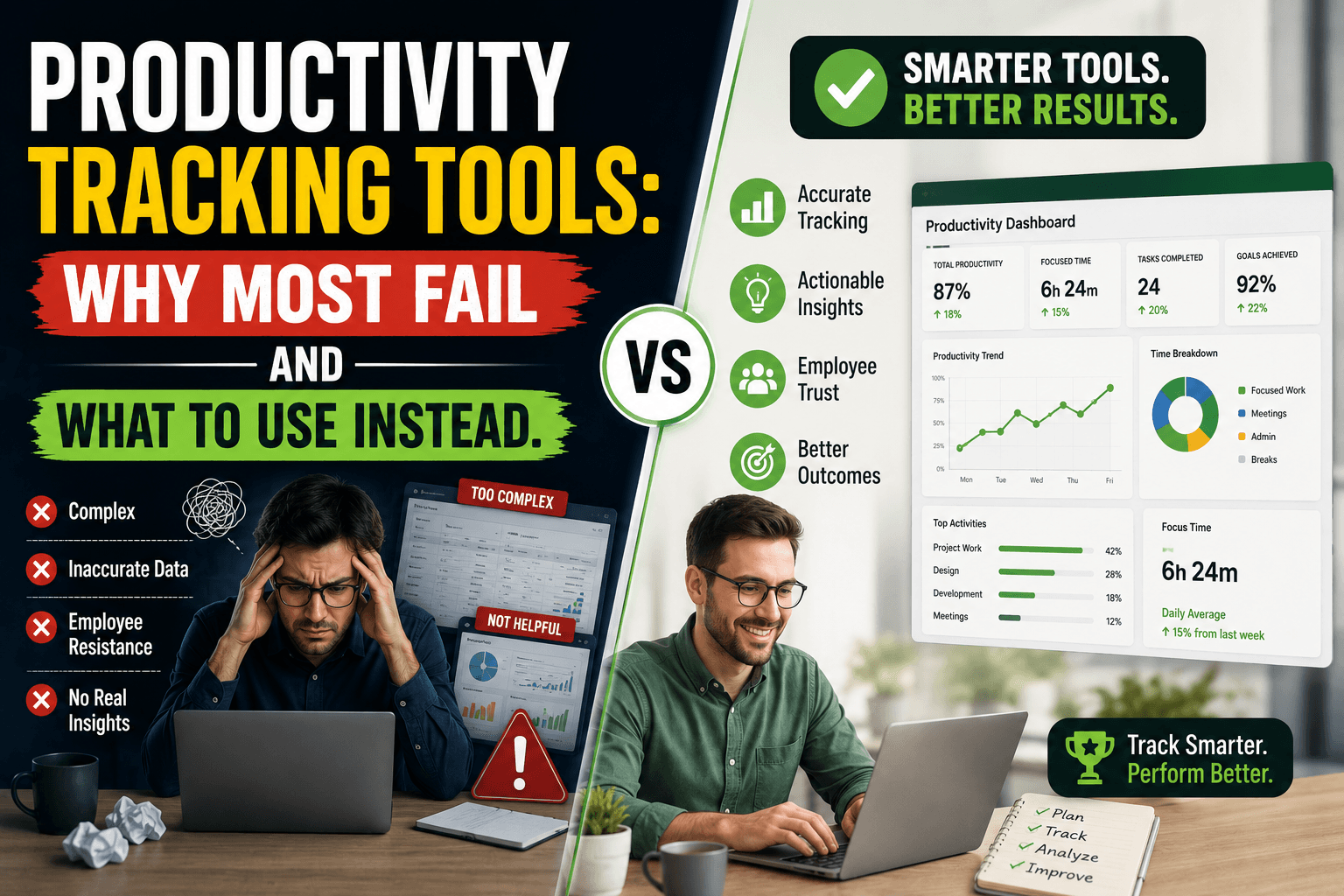
Employee monitoring has quietly become the default. In one industry survey, only 9% of IT professionals said their organisation does not monitor employees at all, which means roughly nine in ten now do, in some form. Yet over the same years that monitoring went mainstream, Gallup's State of the Global Workplace report shows engagement moving the wrong way: global engagement fell from 23% to 21%, one of only two declines in the past twelve years. More watching. Less engagement. The tools spread; the results did not follow.
Every year, businesses pour money into productivity tracking tools. They set up dashboards, deploy monitoring software, and log every hour. Output stays flat. Morale dips. Their best employees quietly start updating their resumes. The problem is not the investment. It is the direction.
Most productivity-tracking tools solve the wrong problem. They measure how people spend time rather than what people actually produce. In today's knowledge-driven, remote-first, and hybrid work environment, that gap between measurement and meaning is costing companies far more than they realise. Not just in wasted software subscriptions, but in the talent they lose, the trust they erode, and the culture they quietly destroy one screenshot at a time.
At Human Maximizer, a recurring pattern is this pattern repeatedly with HR teams who came to us after it had already played out. In one case, a mid-sized services company rolled out screenshot-based monitoring across a 40-person team. Within two quarters, three of its most senior people had resigned, the rest had visibly disengaged, and the productivity dashboard looked better than ever, because everyone had learned to game it. The data said things were fine. The business was quietly falling apart.
This guide exists to change that. We will walk you through what productivity tracking tools actually are, why so many of them fail, what happens when they do, what to use instead, and how to build a system your team will trust and your business will benefit from.
What are Productivity Tracking Tools?
Productivity tracking tools are software platforms or systems designed to monitor, measure, and report on how individuals and teams spend their working time. They exist to give managers and business owners visibility into workforce activity, project progress, and output.
These tools fall into five broad categories, and the category matters enormously when evaluating whether a tool will help or harm your team.
Time Tracking Software
Let employees log hours against specific tasks, projects, or clients. Tools like Toggl Track and Clockify are the most common examples. They are widely used for billing accuracy, project estimation, and personal time awareness. When used voluntarily and transparently, they can provide genuinely useful data.
Employee Monitoring Software
It is a different category entirely, even though it is often marketed under the same "productivity" umbrella. Platforms like Hubstaff and ActivTrak capture screenshots at set intervals, record app and website usage, track keyboard and mouse activity, and generate automated productivity scores. These are the tools at the centre of most workplace privacy debates, and for good reason.
Project Management Tools
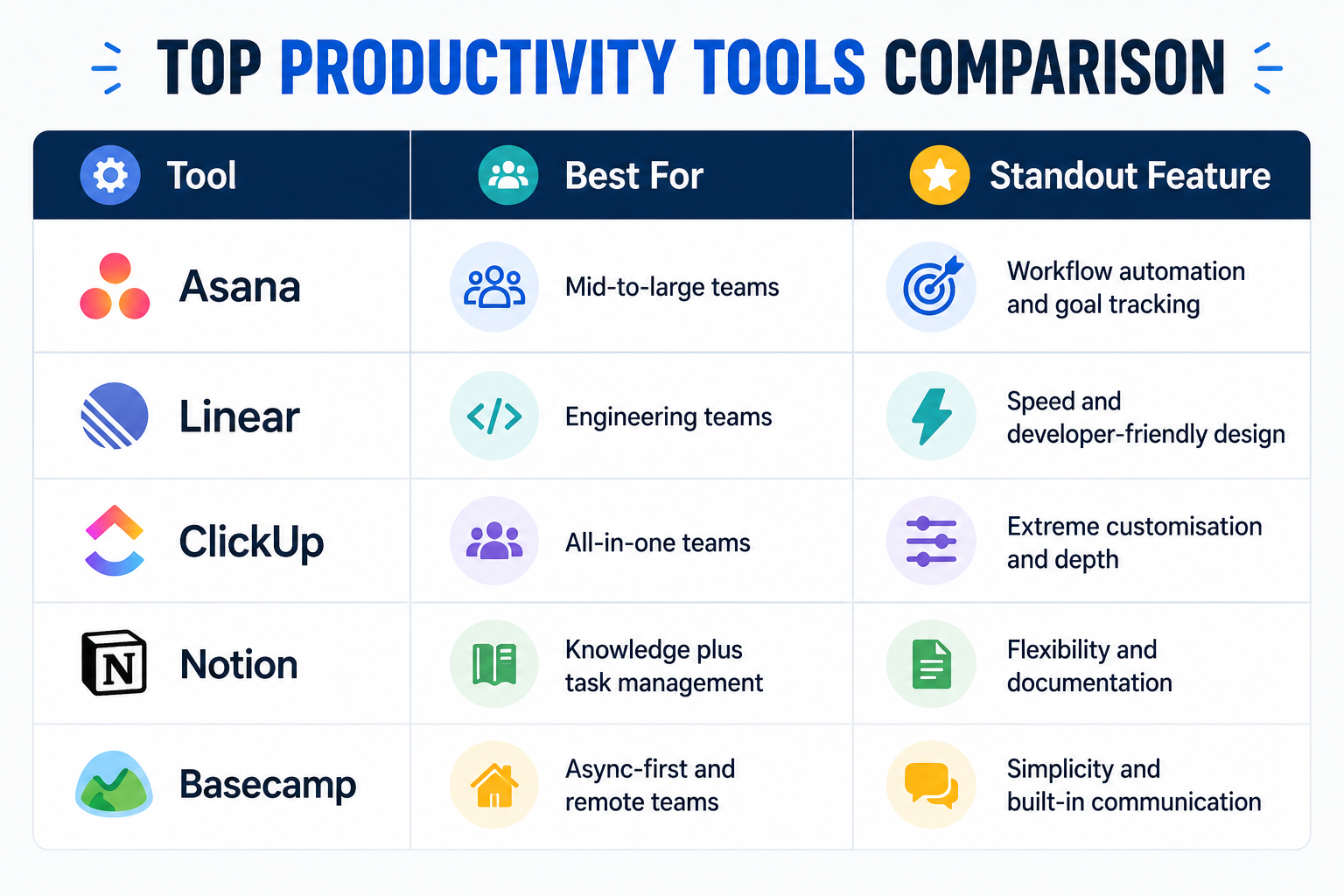
Asana, ClickUp, Linear, and Monday.com track task status, deadlines, and team progress. Unlike surveillance tools, these focus on deliverables and workflow rather than individual behaviour. They are among the most genuinely useful tools available for team productivity.
Performance Dashboards
Aggregates KPIs, sales metrics, support ticket data, and other business outputs into visual reports. Because they are outcome-focused by nature, they tend to be far more useful than activity-tracking alternatives.
Focus and Scheduling Tools
Tools like Clockwise and RescueTime help individuals and teams protect time for deep work. The critical distinction here is that these tools support productivity rather than monitor it, and employees typically use them by choice rather than under mandate.
Understanding which category a tool falls into is not a minor detail. It is the most important question you can ask before signing any software contract.
Why Do Most Productivity Tracking Tools Fail?
The standard answer to this question is that productivity tools fail because employees resist them or because implementation is poor. Both of those things can be true, but they are symptoms of a deeper problem. Most productivity tracking tools fail because the underlying theory of change is wrong.
The implicit assumption behind most employee productivity software is that if managers can see what people are doing at every moment, they can identify inefficiency and eliminate it. That assumption made sense in a factory in 1910. It does not make sense in a knowledge economy in 2025. Here is why.
They Confuse Busyness with Productivity
Think about the last genuinely difficult problem you solved at work. Were you typing constantly while you solved it? Almost certainly not. Some of your best thinking probably happened away from your screen entirely, on a walk, in a conversation, or at 6 a.m. before you opened your laptop.
A copywriter who stares at a blank screen for an hour and writes a breakthrough headline in ten minutes has produced more value than one who types steadily for three hours and produces forgettable copy. A software engineer who spends a morning reading documentation and thinking through an architecture problem before writing a single line of code is more productive than one who churns out code all day that has to be refactored next week.
In knowledge work, value is created in the mind before it ever reaches a keyboard. No tracking tool can see that process. When productivity software tries to capture output through activity metrics, it is measuring the shadow of work, not work itself. The data it produces is not just incomplete. It is actively misleading.
They Trigger Goodhart's Law
Goodhart's Law states that when a measure becomes a target, it ceases to be a good measure. Productivity tracking tools prove this principle every single day, across every industry and company size.
When employees know they are evaluated on keystrokes, they keep typing regardless of whether what they are typing has any value. When they know screenshots are being taken, they keep windows open and move their mouse regularly. When hours logged are being reviewed, timesheets get padded. The metric becomes the mission. Delivering real results gets quietly deprioritised because real results are harder to game than activity scores.
This is not a character flaw in employees. It is basic human psychology. People optimize for what they are rewarded for. If your tracking system rewards visible activity, visible activity is what you will get. The dashboard will look excellent. Business outcomes will not improve.
They Destroy Psychological Safety
Google's Project Aristotle, one of the most rigorous workplace performance studies ever conducted, analysed hundreds of teams over several years to identify what separates high-performing teams from average ones. The single most important factor was not talent density, compensation structure, or years of experience. It was psychological safety, defined as the shared belief that the team is safe for interpersonal risk-taking.
Intrusive monitoring tools systematically destroy psychological safety. When people feel watched and evaluated at every moment, they stop taking risks. They stop asking questions that might make them look uncertain. They stop flagging problems early because early-flagged problems are problems that happened on their watch. They stop proposing ideas that might not work out because failed ideas create a visible record.
What you are left with is a team that looks productive and performs at a fraction of its potential. The cost of that gap rarely shows up on any dashboard.
Why Productivity Tracking Tools Don't Work for Remote Teams?
Remote and hybrid work environments expose the flaws in traditional tracking tools more brutally than any other context. In an office, managers have organic, ambient visibility into the rhythm of a team. They can sense when someone is struggling, when energy is high, when a project is gaining momentum. In a distributed setting, that ambient visibility disappears, and too many managers respond by reaching for surveillance software as a substitute.
It is exactly the wrong response. Remote employees are already managing the psychological weight of isolation, the blurring of work and home life, the overhead of asynchronous communication, and the absence of the social reinforcement that makes office work energising. Adding a monitoring layer on top of all of that does not restore visibility. It signals distrust. And distrust is the single fastest way to disengage a remote workforce.
Stanford economist Nicholas Bloom's long-running research on remote and hybrid work finds that remote workers can match, and in some settings exceed, in-office productivity, but only under one condition: that they are trusted and given genuine autonomy over how they work. Surveillance tools strip both of those conditions away simultaneously.
They Treat Symptoms, Not Causes
When productivity is genuinely low, the instinct is to reach for a monitoring tool. But low productivity rarely has monitoring as its solution. The real causes tend to be things like unclear goals and constantly shifting priorities, too many meetings leaving insufficient time for focused work, processes that create friction without adding value, chronic overload leading to burnout, disengagement driven by poor management or lack of purpose, or people placed in roles that do not match their strengths.
A tracking tool addresses none of these. It adds a new layer of friction to a team already struggling under the weight of existing friction. In almost every case, it makes the underlying problems worse while creating the illusion that something is being done about them.
What Happens if Productivity Tools Don't Work?
When the wrong productivity tracking tools are deployed, the damage does not announce itself loudly. It accumulates quietly over weeks and months, and by the time leadership recognises what is happening, significant harm has already been done.
Your best people leave first.
High performers have options. They also have the self-awareness and professional confidence to recognise when they are being treated as suspects rather than trusted professionals. They leave. What remains is a workforce that either cannot leave or has decided that staying is acceptable despite the environment. Neither group is the foundation of a high-performance culture.
A culture of compliance replaces a culture of performance
Teams shift energy from doing excellent work to appearing to do excellent work. The difference is invisible on a productivity dashboard and devastating to actual business results. You get activity without output, motion without progress, and reports that say everything is fine while the business slowly hollows out.
Decision-making corrodes
When leaders make resourcing decisions, promotion decisions, and performance improvement decisions based on activity data rather than output data, they systematically reward the wrong behaviours and penalise the right ones. Over time, this reshapes the culture in ways that are very difficult to reverse.
Innovation disappears quietly
Monitored teams take fewer risks, propose fewer ideas, and collaborate less authentically. In competitive markets, this shows up eventually as product stagnation, lost deals, and an inability to attract the kind of creative talent that drives growth. It rarely gets attributed to the monitoring culture that caused it.
What Should I Use Instead of Traditional Productivity Tracking Software?
The shift that actually works is from tracking activity to measuring outcomes. This is not a philosophical preference. It is what the evidence consistently supports across decades of organisational research. Here is what that shift looks like in practice.
OKRs: Objectives and Key Results
OKRs are the most battle-tested framework for outcome-based performance management available. Google has used them since 1999. Intel, Spotify, LinkedIn, and thousands of high-growth companies at every scale have built their performance cultures around them. The reason is straightforward: OKRs force an organisation to get specific about what actually matters and to measure progress against those things rather than against proxies like time and activity.
The fundamental question shifts from "Did you work eight hours today?" to "Did you move the needle on what matters most this quarter?" That is a better question in every dimension. It is harder to game, more aligned with business outcomes, and far more motivating for the people answering it.
Implementation does not need to be complex. Set three to five objectives per team per quarter. Define two to four specific, measurable key results per objective. Hold weekly check-ins focused on progress and blockers rather than status updates. Score results honestly at the end of each quarter and use those scores to inform the next cycle.
Human Maximizer's HRMS includes a built-in OKR and goal-tracking module that connects individual objectives to team and company goals, giving HR leaders and managers real-time visibility into progress without any surveillance required. When every person on your team can see how their work connects to the organisation's priorities, motivation becomes intrinsic. You stop needing to monitor it.
Outcome-Focused Project Management
There is an important distinction between project management tools that track deliverables and deadlines, and employee monitoring software that tracks behaviour. The former is genuinely useful. The latter is where most of the harm happens. These tools show what is getting done, by when, and at what quality. They create natural accountability without surveillance. When a task is overdue, it is visible to everyone. There is no need for screenshot monitoring to know where things stand.
Structured 1:1 Meetings
No best productivity management tool replaces a well-run one-to-one conversation. This is not a soft preference. It is a hard operational reality. The most important information about why a team member is struggling, what is blocking their best work, and where they need support will rarely appear in a dashboard. It surfaces in conversation.
Weekly or biweekly one-to-ones between managers and their direct reports, run consistently with a clear structure, provide more actionable intelligence than any monitoring platform. A simple framework that works: begin with what is going well this week, move to what they are stuck on or need support with, check on progress against current goals, and close with what they need from you as their manager. Four questions. Twenty minutes. More signals than any dashboard.
Capacity and Workload Planning
A significant proportion of what looks like a productivity problem is actually an overload problem. When teams are consistently asked to deliver more than is humanly possible, output suffers not because of lack of effort or focus, but because of cognitive overload, decision fatigue, and the burnout that follows sustained overwork.
Human Maximizer's workload planning features give managers a clear visual picture of team capacity across projects and time periods, making it possible to spot overload before it becomes burnout and redistribute work before performance breaks down. This is what proactive productivity management looks like. It addresses the cause rather than surveilling the symptom.
Focus-First Tools for Individuals
One of the highest-leverage things a manager can do for team productivity is give people tools that protect their time for deep, focused work and then get out of the way. Tools like Reclaim.ai, which automatically schedules and defends deep work blocks, or Clockwise, which optimises calendars across an entire team to create shared focus periods, work because they are chosen by employees for their own benefit. That distinction changes how they are received and how effective they turn out to be.
Pulse Surveys and Engagement Data
If productivity is suffering and you want to understand why, the most direct path is simply to ask. Pulse survey tools gather regular, anonymised feedback on engagement, workload, blockers, and morale. Five well-designed questions answered honestly every two weeks will tell you more about your team's performance trajectory than three months of keystroke data.
Human Maximizer includes a built-in pulse survey and engagement module precisely because we believe that listening to employees is not a soft HR practice. It is a hard performance management discipline. Organisations that systematically gather and act on employee feedback consistently outperform those that rely on surveillance as a substitute for conversation.
The Human Maximizer Productivity Lens
Most productivity frameworks are built around systems, dashboards, and surveillance. The Human Maximizer Productivity Lens is built on a different premise entirely: your people are not resources to be optimised. They are human beings whose full capability becomes available only under specific conditions.
Those conditions are not mysterious. Decades of research in organisational psychology, behavioural economics, and neuroscience point to the same ones consistently. People do their best work when they have clarity about what matters and why their contribution connects to something larger. They do their best work when they have enough autonomy over how, when, and where they work to bring genuine judgment rather than just compliance. They sustain their best work when their energy is respected, meaning that recovery, focus, and boundaries are treated as performance requirements rather than signs of weakness. And they keep doing it, year after year, when their strengths are genuinely deployed rather than buried under generic job descriptions.
The Human Maximizer Productivity Lens is not a soft philosophy. It is a performance strategy backed by the most rigorous workplace research available. When organisations stop trying to extract productivity through monitoring and start cultivating it through clarity, autonomy, energy management, and strengths deployment, the results are consistent: lower voluntary turnover, higher output per person, stronger cross-functional collaboration, and teams that are genuinely invested in what they are building rather than merely appearing to be.
The tools you choose should reflect that philosophy. If a tool helps your people do better work, it belongs in your stack. If it primarily helps management feel more in control while doing nothing to improve actual output, it is costing you more than its subscription fee.
Ready to see what a Human Maximizer approach to productivity looks like in practice? Book a free demo, and we will walk you through how HR teams are replacing surveillance with systems their people actually thank them for.
How Can Businesses Effectively Track Team Productivity?
Effective productivity tracking is not about abandoning measurement. It is about measuring things that actually reflect value. Here is what that looks like operationally.
Define Clear, Measurable KPIs That Reflect Actual Output
The first step is getting specific about what productivity means in your context, because it is different for every team. For a customer support team, it might be the first-contact resolution rate and customer satisfaction scores. For a content team, it might be published output and organic traffic generated. For a sales team, it might be a pipeline created and revenue closed. For an engineering team, it might be sprint velocity and defect rate.
What it is rarely is hours worked, keystrokes logged, or time spent in specific applications. Those are inputs. KPIs should measure outputs and outcomes.
Use Visual Workflows and Task Management
Kanban boards, Gantt charts, and sprint boards give entire teams real-time visibility into where work stands without anyone needing to monitor individual behaviour. When progress is visible at the project and deliverable level, bottlenecks become obvious without surveillance. Responsibilities are clear. Deadlines are explicit. Completion is either visible or it is not.
Implement Time Tracking for the Right Reasons
Time tracking is a legitimate tool when it is used to improve future project estimates, to manage billing accuracy for client-facing work, or to give individuals personal insight into how their time is allocated. It becomes counterproductive when it is used as evidence of effort rather than as data for improvement. The intention behind the tracking shapes how it lands with employees and how useful the data turns out to be.
Make Communication the Infrastructure
The single most effective productivity tracking mechanism available to any manager is a consistent, well-structured communication rhythm. Daily brief standups to align on the day's priorities. Weekly one-to-ones to surface blockers and recalibrate goals. Monthly team retrospectives to examine what is working and what needs to change. Quarterly goal reviews to assess progress against OKRs and set the next cycle.
When this infrastructure is strong, productivity problems surface early and get addressed at the root. When it is weak or absent, problems fester invisibly until they become crises, at which point monitoring data is rarely what helps.
When is Traditional Tracking Appropriate?
Not all tracking is harmful, and it would be dishonest to suggest otherwise. There are specific contexts where time tracking and even some forms of activity monitoring serve legitimate purposes.
Freelancers and agencies that bill clients by the hour have a genuine need for accurate time records. This is not surveillance. It is an accounting function. The data serves the person being tracked as much as it serves anyone else.
Regulated industries, including healthcare, financial services, legal practice, and government contracting, often have compliance obligations that require detailed time records. These requirements exist for reasons that go beyond productivity management, and they are non-negotiable.
Project estimation improves meaningfully when teams have historical data about how long similar projects have taken. Time tracking data used retrospectively for planning purposes is genuinely valuable and carries none of the psychological costs of real-time surveillance.
Individual time awareness, when an employee chooses to track their own time to understand their own patterns, is a powerful personal development tool. The keyword is choice. The employee owns the data and decides what to do with it.
The line between legitimate tracking and counterproductive surveillance is drawn at this question: does the tracking primarily serve the person being tracked, or does it primarily serve the person doing the tracking? When the answer is the former, it tends to be welcomed. When it is the latter, it tends to corrode trust and performance simultaneously.
A Checklist for Implementing a Productivity Tool
Before purchasing or deploying any new productivity tracking solution, work through each of these steps honestly. The cost of skipping them is almost always higher than the cost of taking the time.
Define the specific problem you are trying to solve and what measurable success looks like at 30, 60, and 90 days. If you cannot answer this question clearly, you are not ready to choose a tool.
Research and trial two to three tools against the specific features you actually need, rather than the full feature list in the sales deck.
Assign a named owner for the implementation with a realistic rollout timeline and clear accountability for outcomes.
Configure basic settings, permissions, and integrations before involving your team. A poorly configured tool creates confusion that gets attributed to the tool's quality rather than to the setup.
Create quick-start guides and run both live and recorded training sessions. Adoption is not automatic, and the gap between purchase and actual use is where most implementations fail.
Run a pilot with a small group, gather structured feedback, and make adjustments before rolling out more broadly.
Set a clear cutoff date for old processes. Running old and new systems in parallel indefinitely guarantees that neither gets used properly.
Monitor adoption metrics and create an easy channel for ongoing feedback. Problems that do not surface do not get fixed.
Review outcomes honestly at 30 and 90 days and be willing to iterate, including being willing to acknowledge if the tool is not delivering the value you expected.
Final Thoughts
The productivity tracking tools that dominate the market today were designed for a different era of work. An era built on physical presence, repetitive tasks, and the assumption that time spent equals value created. That era is over, and the companies still operating as though it is not are paying a price that does not always show up clearly on a balance sheet.
In knowledge work, in creative roles, in the hybrid and remote environments that now define how most professionals work, the old model does not just underperform. It actively causes harm. It drives away precisely the people whose judgment, creativity, and initiative matter most. It replaces a culture of genuine performance with a culture of performance theatre. And it makes it harder, not easier, to build the kind of organisation that can compete over the long term.
The businesses that are winning today are not the ones watching their teams most closely. They are the ones who have done the harder work of defining clear goals, building deep trust, creating conditions for focused work, and then trusting their people to deliver. Those things cannot be purchased from a software vendor. They have to be built deliberately, one management decision at a time.
Productivity is not something you extract from people through surveillance. It is something you cultivate through clarity, autonomy, and genuine investment in the humans on your team. The Human Maximizer Productivity Lens exists to make that cultivation systematic rather than accidental, measurable rather than theoretical, and scalable as your organisation grows.
The tools you choose should reflect that commitment. If a tool helps your people do better work, it earns its place in your stack. If it only helps management feel more in control while doing nothing to improve what actually gets delivered, it is not a productivity tool. It is an anxiety management tool. And your organisation deserves better than that.
Build a productivity system your team will actually thank you for. Explore Human Maximizer's performance management, OKR tracking, and employee engagement features, and see what outcome-based productivity management looks like when it is built around people rather than surveillance. Book your free demo today.
Frequently Asked Questions
Do productivity tracking tools invade employee privacy?
Many do. Employee monitoring software that captures screenshots, records keystrokes, logs websites visited, and tracks mouse movement raises serious privacy questions that vary in their legal implications depending on jurisdiction, what has been disclosed to employees, and whether monitoring occurs on company-owned or personal devices.
The more important question, though, is not whether monitoring is legal. It is whether it is effective. The evidence consistently says it is not. Organisations that replace invasive monitoring with outcome-based measurement using clear goals, regular one-to-ones, and transparent project tracking get better performance results without the trust damage, the turnover risk, or the legal exposure. Privacy and performance turn out to point in the same direction.
What is the best free productivity tracking tool?
For individual time awareness, Toggl Track and Clockify both offer genuinely capable free tiers with clean interfaces and solid reporting. For team task and project management, Asana's free plan supports up to fifteen users with core features intact, and ClickUp's free tier is among the most generous in the market. For personal focus and habit tracking, RescueTime's free version provides surprisingly actionable data about how time is actually allocated across a workday. The best free tool is the one that measures what actually matters for your context, which means starting with a clear definition of the outcome you want to track before evaluating any specific platform.
How do I track remote employee productivity without micromanaging?
Start by reframing the question itself. Instead of asking how you track what your remote employees are doing, ask how you know whether they are achieving what your organisation needs them to achieve. Those are different questions with very different answers.
Set clear quarterly goals using OKRs or an equivalent framework. Use a shared project board so progress on deliverables is visible to the whole team without anyone needing to report to anyone. Run consistent one-to-ones focused on results and blockers rather than status. Build async communication norms, including weekly written updates, shared documentation practices, and clear expectations about response times, so the team has natural visibility into each other's work without surveillance filling that gap. When that infrastructure is strong, you already know what is happening because your team is communicating transparently. You do not need monitoring because you have something better: trust backed by structure.
What should I do if my team's productivity is genuinely low?
Resist the instinct to reach for a monitoring tool. It is an understandable instinct, but it almost always makes the underlying situation worse. Low productivity is a symptom. The cause is almost never a lack of oversight.
Start by having direct, honest conversations with the individuals involved. Is the workload unrealistic? Are priorities clear and stable, or are they shifting constantly? Is there a skills gap that training, mentorship, or better tooling could close? Is someone burned out, disengaged, or dealing with something outside work that is affecting their performance? Is there a process problem creating friction that has nothing to do with effort?
In most cases, a specific and addressable root cause will surface. Address that. If underperformance continues after genuine support has been provided and expectations have been clearly communicated, that becomes a performance management conversation. It still does not require a monitoring tool to navigate. It requires honesty, documentation, and a clear process, all of which a well-designed HRMS like Human Maximizer supports without surveillance.
Keep reading
HR Strategy
A Complete Guide to Measuring Productivity at Work
Are you struggling to measure productivity at work? Discover proven metrics, KPIs, frameworks, and tools HR leaders use to track employee and team performance.
5 min read
HR Strategy
Employee Productivity Tracking Software: A Guide to Measuring and Tracking Productivity
How to balance oversight with trust using employee productivity tracking software. Learn to measure output effectively without compromising team...
10 min read
HR Strategy
Task Management vs Project Management: The Costly Confusion
Confusing task management with project management quietly drains budgets, delays delivery, and burns out teams. Learn the difference and fix it.
5 min read