
HR Strategy
Task Management vs Project Management: The Costly Confusion
Confusing task management with project management quietly drains budgets, delays delivery, and burns out teams. Learn the difference and fix it.

Richa Thakur
Content Writer · 5 min read · · Updated
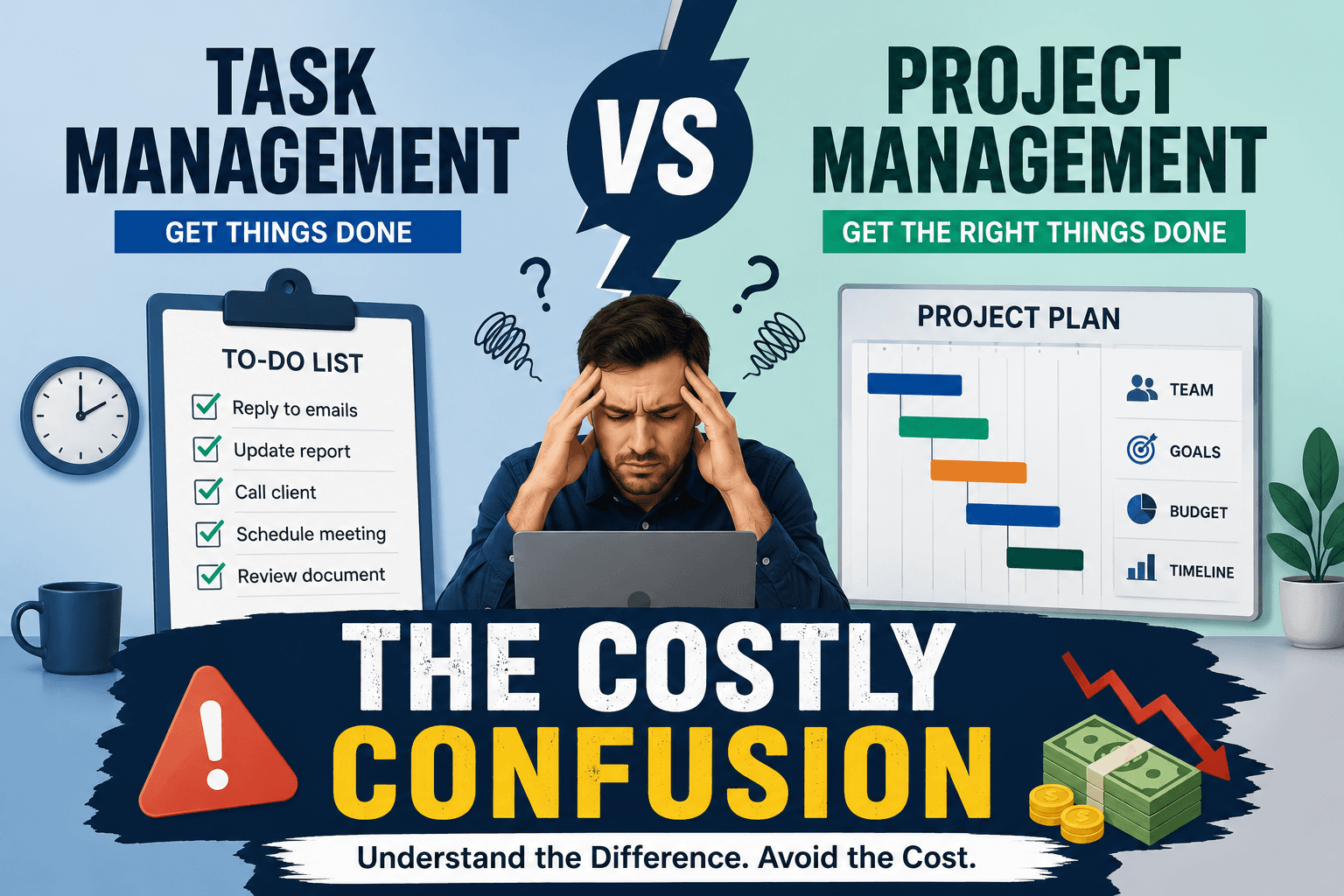
Task management and project management may sound similar, but treating them as the same can be one of the most expensive operational mistakes a growing business can make. Task management is about getting things done at the right time, whereas project management is the process of completing tasks in the right order, with the right resources, while meeting deadlines and business goals.
PMI's Pulse of the Profession research has found that organisations waste roughly $97 million for every $1 billion invested due to poor project performance. A surprising amount of that loss starts with one simple mistake: treating projects like a checklist.
In this article, you’ll understand the following details:
What is the main difference between task and project management?
When to use task or project management tools for operational tasks?
Which one is the right choice for your business and why?
What are the different ways to switch from task management to project management?
What is task management?
Task management is the systematic approach to tracking an individual’s tasks. The process involves planning, prioritising, and tracking the completion of the task from start to finish. It breaks a long-term project into smaller components with clear goals, actionable steps, defined deadlines, assigned ownership, and supporting context to ensure productivity.
A marketing executive uses Trello to outline multiple tasks in a structured form, such as writing a blog title, scheduling a LinkedIn post, crafting captions for social media platforms, and replying to five emails. Every task has a standard deadline, but no link to a larger business outcome.
Tools like Trello and Todoist sit at the task end of the spectrum, while Asana, Jira, Monday, and ClickUp stretch across both. More on that below.
What is project management?
Project management is the process of planning, organising, and leading a set of tasks to achieve a measurable outcome within a fixed scope, timeline, and budget. Unlike task management, which focuses primarily on an individual’s to-do list and tracks tasks, project management comprises team members, dependencies, and resources to deliver measurable results.
Let’s understand it with the help of an example:
Picture a marketing team running a 12 week Q4 lead generation campaign to achieve a 30% increase in qualified leads on a budget of ₹8 lakhs. The project links the content, ads, and analytics teams to deliver one outcome on one deadline.
Task management vs project management: the core differences
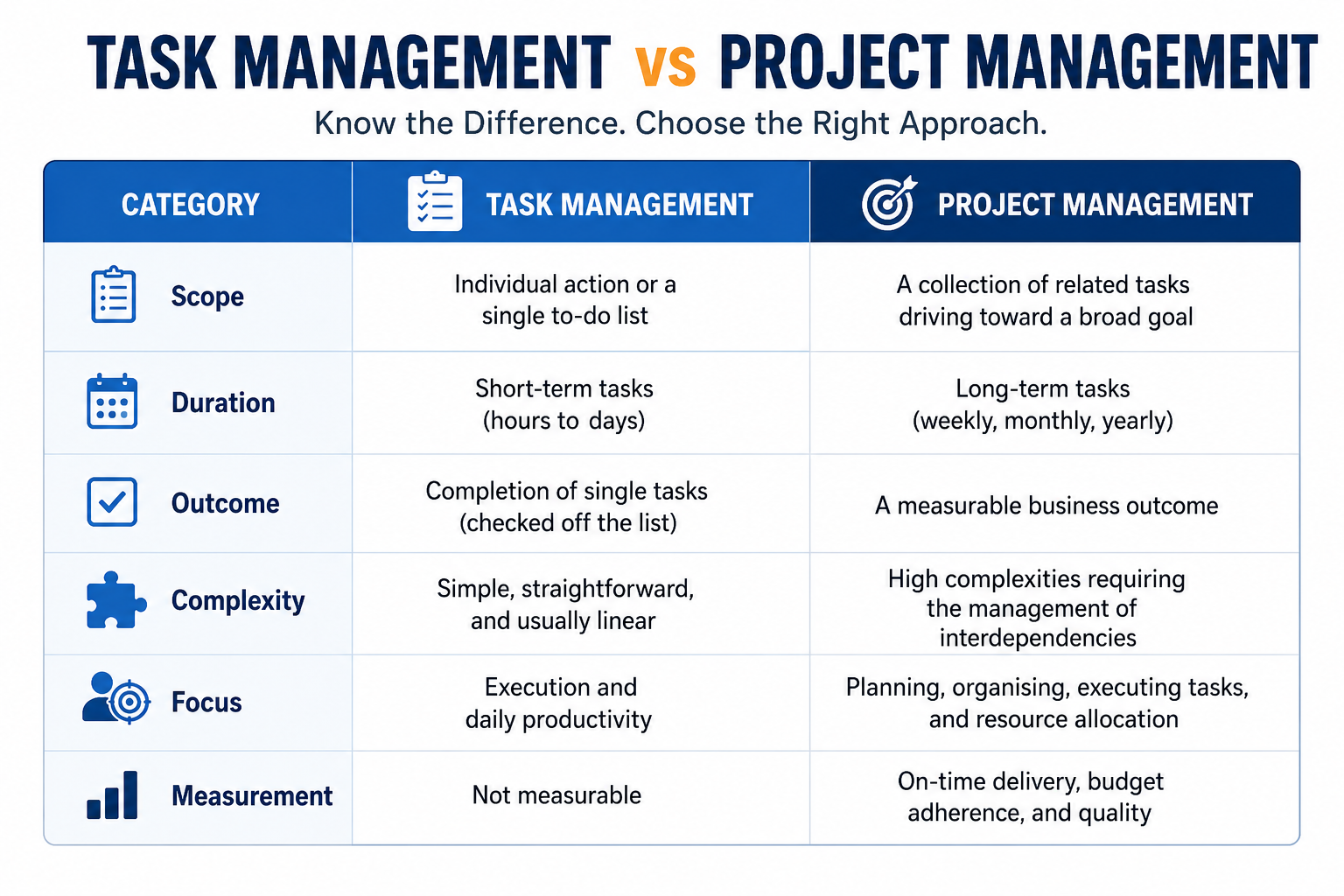
Task management focuses on the daily execution and completion of the to-do list of an individual. Project management takes the strategic view, coordinating related tasks, people, and budgets toward a measurable outcome.
Is Trello task management or project management?
Trello is primarily a task management tool with project management capabilities layered on top. It uses a Kanban-style board where work is visually organised into cards and columns to handle operational tasks.
Its core features include built-in checklists, due dates, and assigning tasks to specific members. Beyond this, Trello offers advanced capabilities such as roadmapping, workload tracking, integrations, and automations that help a group align on a shared objective.
If you need to track daily operations and to-do lists, Trello works well as a task management tool. For larger, multi-step objectives involving a team, it can function as lightweight project management software, though teams handling complex dependencies, budgets, and timelines often outgrow it.
Is Asana a task manager or a project manager?
Asana acts as both a task and project management tool for handling work operations through specific features. Asana functions as a task manager for individuals to track their daily to-do lists and specific daily operations. It works as a project manager for long term initiatives, mapping workflows, visualising timelines, and tracking progress against strategic goals
Here are the key features of Asana for handling workflows:
Task Manager: Categorise long projects into smaller components and mark the to-do list, assign to a specific department or member, set deadlines, and leave feedback.
Project Manager: You can organise tasks into shared initiatives. It provides precise overviews like Kanban boards, Gantt charts, and timeline views, so that managers can monitor progress, check workloads, and automate repetitive tasks.
When does task management become project management?
Task management becomes project management when individuals' to-do lists and daily activities transform into larger initiatives across multiple departments with defined goals. You've crossed into project territory when the work requires more than one person, stretches beyond two weeks, carries dependencies between tasks, and has a defined business outcome tied to a budget and timeline.
This transition requires you to move beyond simply executing a checklist and start orchestrating a bigger picture. Here is the checklist of important bullet points for moving from task management to project management:
Task Dependencies: When tasks are no longer standalone. Development and execution need to be performed for a larger initiative.
Resources & Budget Allocation: You must actively allocate resources, including time, people, and budget, to multiple deliverables to achieve measurable goals.
Stakeholder Coordination: When you manage communications and meet expectations through different departments, teams, and external clients.
Risk and Scope Management: You must actively anticipate challenges and restructure your project roadmap to overcome bottlenecks.
Which one to pick for your business: Task Management or Project Management
If you are struggling with the right software for your team, then outline your business requirements and measurable goals. If your business's focus is on daily operations, to-do lists, and routine work without complex dependencies, choose a task management tool.
If your business operations comprise long-term projects, multi-step goals, with pre-defined deadlines, a budget, and a business outcome, then choosing the project management tool is the way to achieve goals and results.
When to pick a task management tool?
Pick this if your goal is optimising daily productivity and executing straightforward work.
Core Focus: To-do list, tracking daily operations, recurring checklist, quick team updates.
Complexity: Simple tasks that don’t require other individuals or the team.
Best for: Daily operations, minor adjustments, content creation, and data entry for tracking performance.
When to pick a project management tool?
You can choose this tool when your business needs strategic oversight, planning, and alignment of multiple stakeholders.
Core Focus: Timelines, Budget, resource allocation, and team members
Complexity: Requires a department, group of people, including content, marketing, analytics, and finance teams, to perform a single project
Best for: Product launches, marketing campaigns, lead generation, and software development.
Task management vs project management: Which one is right for your team?
If you’re running a small business, have remote teams across multiple geographical areas, or operate an agency, you’re in the right place. There might be different scenarios where your team might have missed deadlines, or the project was poorly planned and executed.
For small businesses, remote teams, and agencies, the confusion between task management and project management might be challenging, but with clear objectives and steps, they can achieve their desired goals and results.
For small businesses
Small businesses require both the tools, depending upon their work goals and business requirements over a specific period of time.
When task management is enough:
Solo founders managing daily business operations
2-5 members are performing repetitive tasks such as invoicing, customer support, content creation, and publishing.
Businesses, where operational work is performed individually rather than collaboratively with team members.
Looking for budget-friendly options
When to choose project management:
When specific departments are categorised for specific tasks, such as lead generation for the marketing team, software development for the IT team, and sales targets for the sales team.
Clients expect progress visibility and status updates, not just final deliverables.
Managing projects across multiple clients and geographical locations.
For remote teams
Remote teams need project management tools more than an on-site workforce does; it eliminates the risk of work slipping through the cracks when no one shares a physical space.
Monitor projects and keep alignment across different time zones.
Replace scattered emails, WhatsApp messages, and team chats with a centralised record of project details and updates.
Let team members update tasks, leave feedback, and move work forward without scheduling multiple meetings.
For Agencies
Agencies that need a high volume of client deliverables, external freelancers, and billable hours absolutely need project management tools.
Need to coordinate with multiple concurrent client campaigns and handle feedback.
Requires digital traceability for heavy files and built-in proofing.
When they need to focus on media lists, press release calendars, and tight publishing deadlines.
How to switch from task management to project management?
The transition from task management (tracking daily activities, to-do lists) to project management (overseeing end-to-end strategy, budget, timeline) needs a shift from execution to delivering outcomes from a broader mindset.
Task management focuses on what to do, whereas project management prioritises when, why, and how much to do. Here are the key steps to switch from task management to project management:
1. Shift Your Mindset
Focus on deliveries, business value, ROI, and final outputs, rather than checking off daily activities and to-do lists.
Move from a reactive state to proactive risk management and scope control.
2. Learn the Project Management Framework
You don’t need a formal degree, but understanding the standard methodologies (such as Agile, Scrum, or Waterfall) is essential.
Consider taking certificates like the Google Project Management certificate and pursuing industry standards like CAPM (Certified Associate Project Management).
Read informational guides about the transition of a team leader into a project manager to bridge the knowledge gap.
3. Gain Practical Knowledge
Before holding a title, manage small initiatives in your existing role to build a portfolio.
Move beyond a simple to-do list and familiarise yourself with a project management tool.
Coordinate meetings, draft project charters, and offer to lead internal rollouts.
4. Choose a Project Management Tool
After mapping out the business objectives and working procedures, look for the right software that combines features for both tasks and project management.
Explore the different vendors and check their functionalities, capabilities, and unique features.
Compare pricing plans and subscription costs for each headcount to plan your budget accordingly.
Final Thoughts
In the future, the companies that stay competitive won't be the ones with the most tools, but the ones that know how to use those tools to plan, organise, and manage their work toward measurable goals.
When the team gets more distributed, projects get more complex, and businesses tighten their budget, the cost of mismatched tools impacts businesses even faster. Five people can run a business on a shared task list. At fifteen, work starts falling between people. At thirty, nobody can say which tasks belong to which outcome.
If your team is running everything out of a task list, the 5 Threshold Test takes ten seconds: people, time, money, dependencies, outcome. Cross three or more and you are already running a project. The only question is whether you are running it with the right tool.
Wherever your team sits on that spectrum, the foundation is the same: clear ownership, visible progress, and nothing lost between people. Human Maximizer gives you that centralised layer, so as your work grows from individual tasks into coordinated projects, tracking scales with you.
We offer advanced features to support your business:
Task Assignment: Assign a task to any employee by filtering their name or employee ID in seconds.
Set Reminders: Before missing deadlines, employees and managers receive a notification for pending tasks.
Track Progress: Get a visual graph and bars to review the task status.
Audit Anytime: With new updates and trends, modify and edit your existing tasks in one click.
Real-Time Reports: Check performance reports based on the work completion rate and turnaround time.
Mobile-Friendly: Create and manage your tasks from your mobile apps.
Frequently Asked Questions
Is task management the same as project management?
No. Task management focuses on tracking and executing daily operational tasks and to-do lists. On the other hand, project management tools handle the strategic orchestration of complex tasks, which involve multiple tasks, dependencies, budget, and team members to achieve a desired business goal.
When should I switch from task management to project management?
You should transition from task management to a project management tool when your work scales beyond an individual to multi-departmental teams. If your business operations include multiple stakeholders, task dependencies, a budget, and desired goals in a predefined timeline, then you should definitely switch to a project management tool.
A quick check is the 5 Threshold Test: more than one person, more than two weeks, a budget, dependencies between tasks, and a defined outcome. Three or more means it is time to switch.
What is an example of task management vs project management?
The examples of task management are writing a blog on industry trends, whereas the project management includes keyword research, creating an SEO strategy, aligning 12 writers, graphic design, editing, and promoting on social media platforms.
What happens when teams confuse tasks with projects?
When a team confuses tasks with projects, they miss deadlines, duplicate effort, and misalign strategies. Without a clear roadmap, team members pull in the wrong direction, and it can result in scope creep, team burnout, and a toxic blame culture.
Do small teams need project management or just task management?
It depends on the work, not the team size. Task management is usually enough for day-to-day operations, routine tasks, and individual to-do lists. But a small team running multi-step initiatives with dependencies, a budget, and a defined outcome, including small remote teams coordinating across time zones, will still benefit from project management. The deciding factor is complexity, not headcount.
Why is task management not enough for projects?
Task management tracks whether things get done, but projects also need budget control, dependency mapping, and risk visibility across people. A task list cannot show you that a delay in one task just pushed the entire delivery by two weeks. That gap is where projects fail quietly.
Keep reading
HR Strategy
A Complete Guide to Measuring Productivity at Work
Are you struggling to measure productivity at work? Discover proven metrics, KPIs, frameworks, and tools HR leaders use to track employee and team performance.
5 min read
HR Strategy
Internal Ticketing Systems for Indian Companies: A Complete Guide
What an internal ticketing system is, how it works, key features, and how Indian companies choose the right help desk software. A complete guide.
5 min read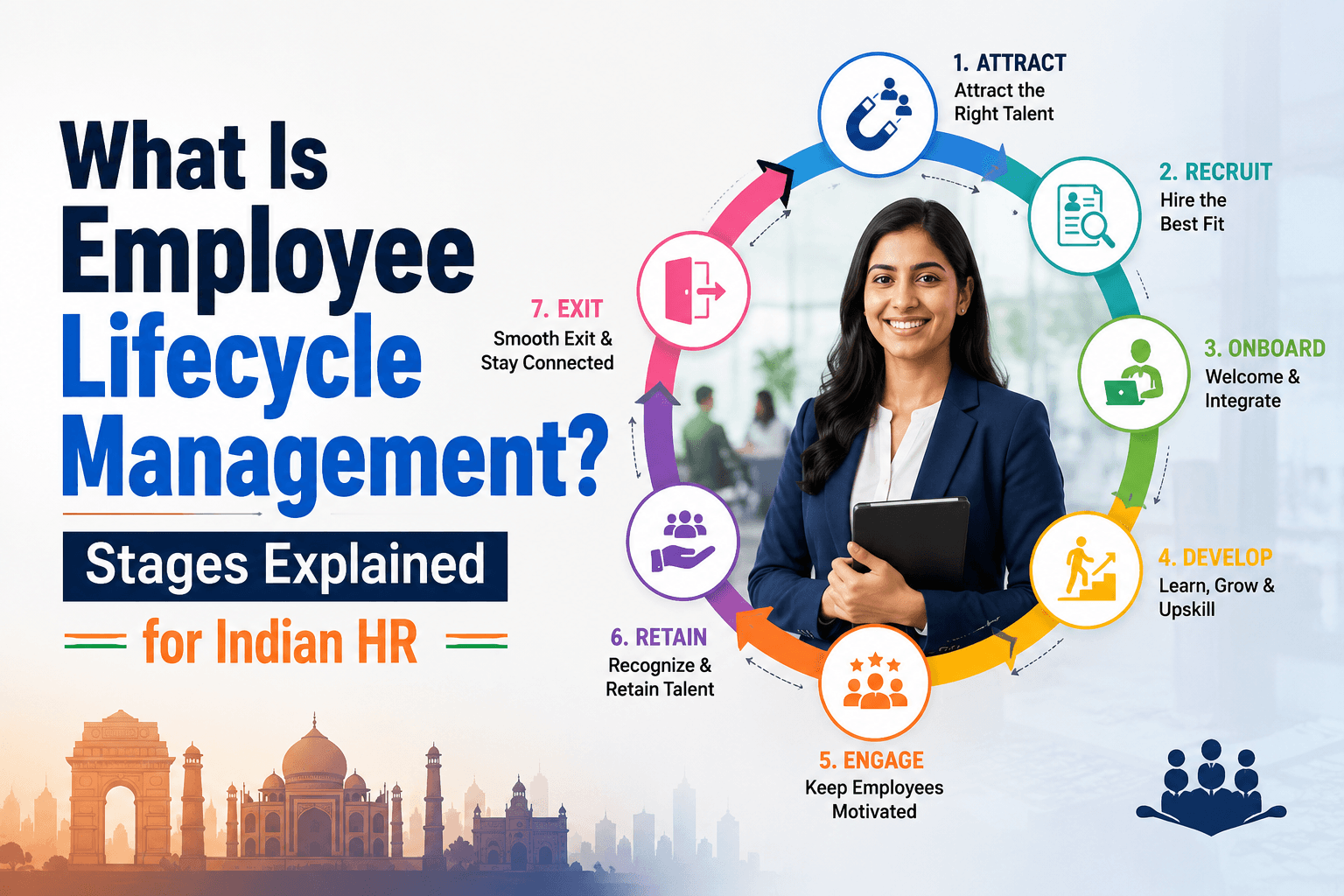
HR Strategy
What Is Employee Lifecycle Management? Stages Explained for Indian HR
Master end-to-end HR lifecycle management with our guide. Get actionable workflows for onboarding, compliance, and offboarding tailored for Indian firms.
5 min read