
HR Strategy
A Complete Guide to Measuring Productivity at Work
Are you struggling to measure productivity at work? Discover proven metrics, KPIs, frameworks, and tools HR leaders use to track employee and team performance.

Richa Thakur
Content Writer · 5 min read · · Updated
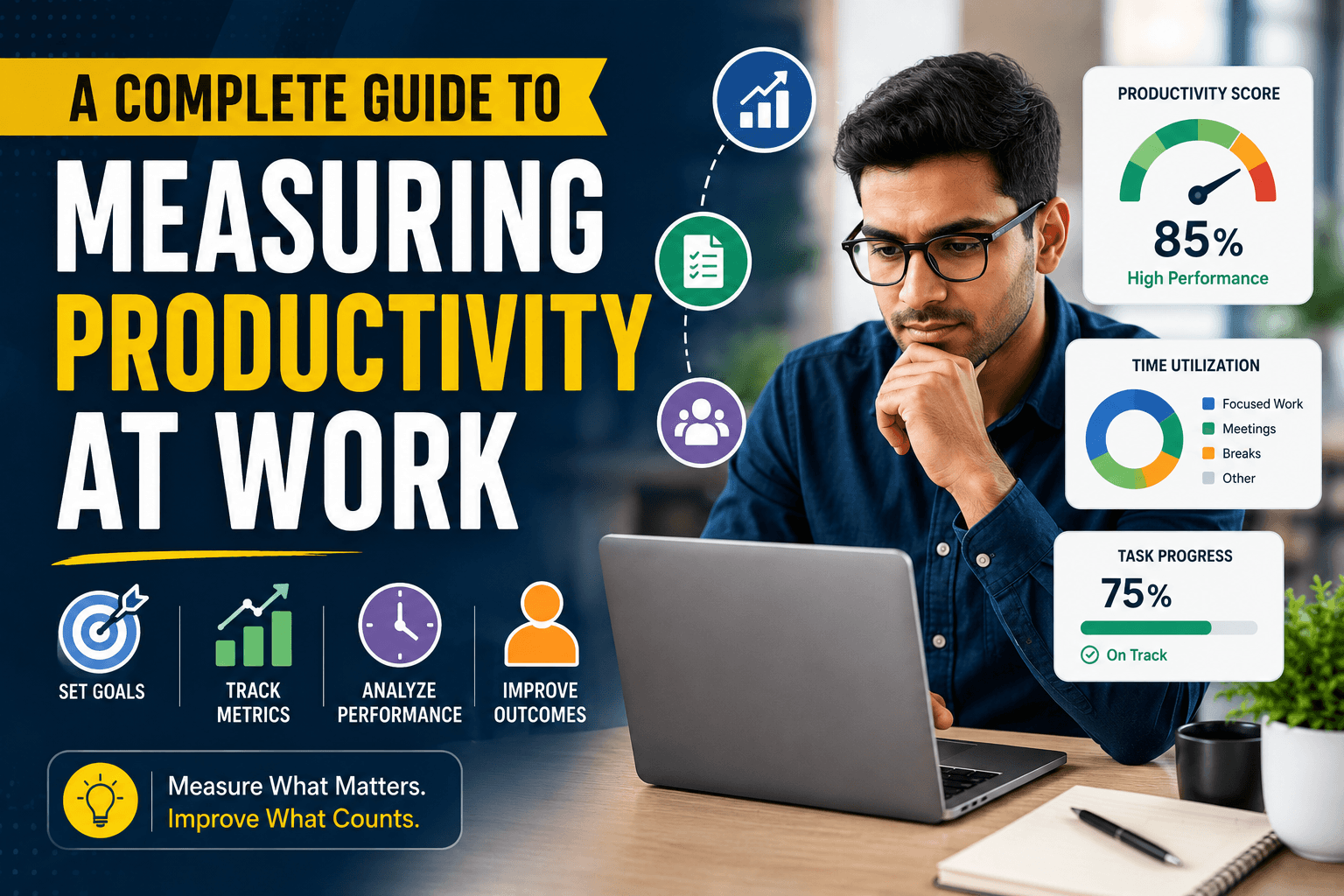
Most managers believe they know who their productive employees are. The signals feel obvious: someone always delivers ahead of schedule, someone else is perpetually behind. But instinct is not a measurement system, and in 2025, making HR decisions on gut feel is one of the fastest ways to lose high performers while continuing to invest in the wrong people, processes, and priorities.
According to Gallup's State of the Global Workplace report, only 21% of employees worldwide are engaged at work, a figure that fell from 23% the year before and has dropped only twice in the past twelve years. The bigger story is the middle: most employees are not actively disengaged; they are simply not engaged, doing the job without ever moving the needle. What makes this dangerous is not the number itself but the silence around it. That vast not-engaged majority does not announce itself. Most organisations have no reliable system to detect the drift until a deadline collapses or a resignation lands in the inbox.
Measuring employee productivity at work is not about surveillance or control. It is about creating clarity where ambiguity currently costs you talent, time, and revenue. When measurement is done with intention, it gives employees a clear line of sight to their own impact, gives managers the data to coach rather than guess, and gives HR leaders the intelligence to build a workforce strategy grounded in reality rather than assumption.
In this guide, you will find:
A clear definition of productivity in the modern workplace and why busyness is not the same thing as output
The business case for why measuring productivity is no longer optional for HR leaders
The key quantitative and qualitative metrics that actually reflect performance
How to measure individual and team productivity without creating unfair evaluation systems
A practical, step-by-step framework HR teams can implement without overhauling existing processes
The most common measurement mistakes that quietly undermine performance culture
What is Productivity at Work?
Productivity at work is the measurement of how effectively an individual, team, or organisation converts inputs, including time, effort, and resources, into meaningful outputs. But that definition, while accurate, barely scratches the surface of what productivity actually looks like in a modern workplace.
The most common misconception is that busyness is equal to productivity. An employee who sends 200 emails a day and attends 12 meetings a week might be exhausted, but that doesn’t mean they’re moving the needle. True productivity is about outcomes, not activity.
In simple ways, productivity = output ÷ input
There are different definitions of productivity for departments based on their job roles and responsibilities. For a sales team, output might be revenue generation; for a content team, it can be measured as the published articles that drive traffic. For a customer success manager, output might be retention rate and NPS. The formula stays the same; what changes is how you define output for each role.
There’s also an important distinction between efficiency and effectiveness:
Efficiency can be defined as completing tasks quickly and minimising waste, whereas effectiveness is doing the right things and working on tasks that actually drive business value.
A high-performing team requires both. The productivity measurement tool should account for both of the aspects.
Why is it Necessary to Measure Productivity?
Organisations that measure productivity well do not just have better data. They make better decisions, build stronger teams, and consistently outperform those that rely on observation and instinct alone.
Here are the reasons that show why companies measure work productivity:
Without measurement, you’re flying blind on resource allocation
Without productivity data, budget and headcount decisions are based on whoever makes the loudest case in a planning meeting. With it, you can see exactly where time and effort are generating returns and where investment is being absorbed by low-impact work. That difference compounds across every planning cycle.
Performance conversations become guesswork.
When a manager tells an employee they need to "step up" without specific data to back it, the feedback carries no weight and can actively damage trust. Measurement gives managers the language and evidence to have fair, constructive conversations that employees can act on rather than resent.
Early warning before the resignation letter
Output rarely falls off a cliff on the day someone resigns. It usually erodes quietly for weeks before the letter arrives, with missed details, slower turnaround, and lower initiative. A well-designed productivity measurement system does not just track performance in real time. It surfaces the early signals that give HR leaders a window to intervene, have the right conversation, and retain someone who was close to walking out the door.
Workforce strategy built on real capability data
McKinsey's Performance through People study, which analysed 1,800 large companies across 15 countries, found that the firms combining strong people development with disciplined management of that talent hold a measurable long-term performance edge over peers that do one without the other. Productivity data feeds directly into compensation benchmarking, succession planning, workforce capacity planning, and learning and development prioritisation. It is not a standalone metric. It is the connective tissue of your entire people strategy.
Visibility that employees actually want
From the employee's perspective, transparent measurement done well is not threatening. It is motivating. People want to know their work matters and that strong performance is seen and recognised. A measurement system that connects individual contributions to organisational outcomes gives employees exactly that visibility and becomes a retention tool in itself.
Why This Matters More in India Right Now?
Two things that make productivity measurement especially significant for Indian organisations are:
First, the opportunity is real and proven. McKinsey found that between 2012 and 2022, one in five Indian companies doubled their revenue every five years. That kind of growth is impossible to sustain on gut-feel people decisions; it demands knowing exactly where output is coming from and where it is leaking.
Second, the warning sign is already here. In Gallup's latest data, South Asia, primarily India, saw the largest decline in manager engagement of any region, an eight-point drop in a single year. Disengaged managers are precisely the ones who fall back on instinct instead of measurement, who praise the visibly busy and overlook the quietly effective. In a market growing this fast, with managers under this much strain, "I know who my good people are" is the most expensive sentence a leader can say.
What are the Key Metrics to Measure Productivity?
Before you can improve productivity, you must define and measure it, but are you tracking what actually drives results, or just what’s easy to count? This is where most organisations get stuck, not because the metrics don’t exist, but because they pick the wrong ones for their context. Here’s a breakdown of the most relevant productivity metrics, organised by type.
Output-Based Metrics
These measure what gets produced, regardless of how long it takes:
Tasks Completed Per Week/Month: A baseline measure for role-based productivity, useful for operational roles.
Revenue Per Employee: Total revenue divided by headcount. A blunt but useful efficiency signal, most relevant for sales teams and small businesses where every hire has to pull visible weight.
Unit Produced or Processed: Relevant in manufacturing, customer support, such as tickets resolved, and content production, including published articles.
Quality Metrics
Volume without quality is a vanity metric. Pair output metrics with:
Error Rate or Defect Rate: How often does work need to be redone?
Customer Satisfaction Score (CSAT): A direct reflection of frontline employee performance.
Net Promoter Score (NPS): For customer-facing teams, this ties individual and team behaviour to business outcomes.
Time-Based Metrics
This metric compares actual work hours spent on a task versus the outcome achieved:
Time-to-Completion: How long does it take to finish a defined task or project? It is useful for benchmarking and identifying bottlenecks.
Utilisation Rate: The share of an employee's available time spent on billable or productive work. Standard in consulting, legal, and professional services, less meaningful elsewhere.
CycleTime: For agile and product teams, the time from starting a task to completing it.
Goal and KPI Attainment
Translates broad strategic objectives into measurable results:
OKR Completion Rate: What percentage of quarterly objectives and key results are being hit?
Individual KPI Performance: Evaluates how much a team member is tracking against their specific targets.
Milestone Achievement: Particularly useful for project-based roles.
Engagement and Behavioral Indicators
These are often overlooked but highly predictive:
Absenteeism Rate: Chronic absence correlates strongly with disengagement and falling output. It is often the earliest visible symptom, not the cause.
Employee Net Promoter Score (eNPS): If employees wouldn’t recommend your company, output quality rarely stays high for long.
360-Degree Feedback Scores: Qualitative input from peers and managers that captures what raw numbers miss: collaboration, reliability, judgment.
The most effective productivity measurement framework doesn’t rely on a single metric. It combines output, quality, and engagement signals to build a three-dimensional picture of performance.
How to Measure Individual vs Team Productivity?
Individual and team productivity require different lenses. Combining the two leads to measurement errors and, more seriously, to people being evaluated unfairly.
Measuring Individual Productivity: When measuring an individual’s productivity, the starting point is role clarity. You can’t fairly measure someone’s output if their responsibilities aren’t clearly defined.
Setting Baseline Expectations: What does “good” look like for this role? You can establish benchmarks based on historical data, industry standards, or peer comparisons, not managers' intuition.
Using Role-Specific KPIs: A software engineer’s productivity shouldn’t be measured the same way as a recruiter’s. Engineers might be tracked on story points completed, bugs resolved, and code review participation. Recruiters on time-to-fill, offer acceptance rate, and quality of hire.
Tracking Progress Over Time: Productivity measured at a single point is almost meaningless. Trends, improvement, plateau, and decline are where the real insight lives.
Incorporating Self-Assessment: Employees who regularly reflect on their own output and set improvement goals consistently outperform those who don’t. You can build self-review into your performance cycles.
Measuring Team Productivity: Team productivity measurement adds a layer of complexity because individual contributions interact. One person’s bottleneck becomes the whole team’s delay.
Key Approaches for Teams
The honest challenge with the team measurement is attribution. When a deal closes, who gets credit: the SDR, the AE, the solutions engineer, or the marketing team that wrote the case study? Effective team productivity frameworks acknowledge shared contributions rather than forcing artificial individual accountability onto collective work.
Aggregate KPI Dashboards: Track the team’s collective performance against shared goals, total pipeline generated, support tickets resolved, features shipped per sprint.
Velocity Tracking: For agile teams, velocity measures how much work a team completes per sprint cycle. Over time, it becomes a reliable forecasting and capacity planning tool.
Collaboration Quality Metrics: How effectively is the team working together? Meeting efficiency scores, cross-functional project outcomes, and peer feedback all speak to team-level dynamics that raw output metrics miss.
Tools to Track Productivity at Work
The right tools don’t just collect data; they make productivity visible in a way that drives behaviour changes. Here are the various tools to track productivity at work:
Project and Task Management Tools.
Platforms like Asana, Monday, Jira, and ClickUp give managers real-time visibility into task status, project progress, and individual workload. They generate natural productivity data without tracking systems, tasks assigned vs task completed, deadlines met vs. missed, and bottlenecks in workflow stages.
The key discipline is how the team uses them. A project management tool that nobody updates is just expensive noise.
Time Tracking Tools
Tools like Toggl, Clockify, and Harvest let employees log time against specific projects or task categories. For knowledge workers, time tracking can reveal surprising inefficiencies, hours lost to unplanned meetings, context-switching costs, and administrative overhead that has crept into the workday.
Note: Time tracking works best when it’s opt-in and insight-driven rather than mandatory and surveillance-driven. When employees understand that the data helps optimize their workload, both adoption and accuracy improve with time.
HRMS and HCM Platforms
Project management tools tell you what tasks are moving. Time tracking tools tell you where hours are going. But neither gives you the full picture of why performance is shifting across your workforce.
This is where a modern HRMS platform fundamentally changes what HR leaders can do.
Human Maximizer consolidates performance data, attendance patterns, goal tracking, and engagement signals into a single people analytics layer built specifically for HR decision-making.
Instead of toggling between four different tools to understand why a team's output has declined over the past quarter, HR leaders get a unified view with the contextual data needed to diagnose root causes and take targeted action.
Communication and Collaboration Analytics
Tools like Microsoft Viva Insights and Slack analytics surface behavioral patterns, meeting load, after-hours work, and response time trends that correlate with both productivity and burnout risk. Used responsibly, they give people leadership early visibility into organisational stress points before they become attrition events.
Employees Feedback and Survey Platforms
Platforms like Culture Amp, Lattice, and Glint bring the qualitative side of productivity into the measurement picture. Engagement surveys, pulse checks, and manager effectiveness scores add the human layer that quantitative metrics miss and often predict productivity trends before they show up in output data.
How to Measure Remote Worker Productivity?
Measuring remote worker productivity requires a fundamentally different operating model, not just different tools.
The presence signals that once served as informal productivity proxies, arriving early, staying late, and being visible at their desk, carry no meaning when your team is distributed across time zones and working environments you cannot observe. Managers who struggle most with remote measurement are typically those still looking for those signals in digital form: who was online at 8 am, how fast did they respond to Slack messages, how many hours did their screen activity log show.
That approach does not measure productivity. It measures availability, and those are not the same thing.
What Actually Works for Remote Teams?
Outcome-based goal setting is the single highest-leverage shift an organisation can make for remote productivity management. Define what success looks like for each role in a given week, sprint, or quarter. Not how many hours someone works, but what they produce, what they move forward, and what they close. When output is clearly defined, location becomes irrelevant to the measurement.
Structured asynchronous check-ins replace the need for synchronous meetings as a visibility tool. Short, focused daily or weekly updates through your project management platform or HRMS give managers real-time awareness of progress and blockers without requiring calendar coordination across time zones. The question shifts from "what are you working on today?" to "what did you complete, what is still in progress, and where are you stuck?"
Result-based performance reviews evaluate goal attainment, project outcomes, and 360-degree peer feedback rather than attendance patterns or hours logged. This approach is both more accurate and more equitable for employees for whom fixed schedules are impractical.
Digital collaboration analytics, when used with a clear ethical framework, can surface patterns that indicate an employee is becoming isolated, overloaded, or disengaged before those signals show up in output data. The critical requirement is transparency: employees should know exactly what is being tracked, why it is being tracked, and how the data will be used. Organisations that conduct remote monitoring covertly do not just damage trust. They eliminate it.
Regular one-to-one conversations remain irreplaceable. No tool captures the context that a well-structured manager check-in surfaces: unclear expectations, personal challenges affecting focus, skill gaps that are slowing delivery, or motivation that has quietly eroded. Data tells you what is happening. These conversations tell you why.
What is the Step-by-Step Framework to Measure Productivity?
If you’ve ever felt overwhelmed by which productivity numbers to track, you’re missing the framework. Here’s a step-by-step framework to measure productivity:
Step 1: Define what Productivity Means for Each Role
Before choosing a single metric, get role-specific clarity. Work with department heads to answer: What does outstanding output look like for this position? What does acceptable look like? Where is the line?
You need to document it. Ambiguity in expectations is the root cause of most productivity disputes.
Step 2: Set Baselines
You need a starting point to measure progress against. You can pull out historical data, task completion rates, project delivery timelines, revenue, and whatever is relevant and establish current performance baselines. These become your benchmarks.
If you’re starting from scratch with no historical data, use your first 60-90 days of structured tracking as a baseline-building phase before drawing any conclusions.
Step 3: Choose the Right Metrics
Pick two to four primary metrics per role. Focus on output quality, goal attainment, and one or two role-specific KPIs. Adding more metrics than a team can meaningfully act on creates noise, not insight.
Map each metric to a business outcome. If you can’t answer Why does this metric matter to the business?”, drop it.
Step 4: Implement Your Tracking Infrastructure
This is where your HRMS, project management tools, and performance management platforms come in. The goal is to embed productivity tracking into existing workflows, not bolt it on as an additional administrative burden.
Employees who spend an hour a week manually logging productivity data into a spreadsheet are less productive because of the measurement system. Good infrastructure makes tracking nearly invisible.
Step 5: Create A Rhythm of Review and Feedback
Data without conversations is just a number. You can build a structured workflow:
Weekly: Team-level check-ins or progress against goals. Flag early blockers.
Monthly: Individual performance conversations focused on trends, not judgements.
Quarterly: Formal OKR review, recalibration of goals if needed, recognition of wins.
The review rhythm is where the measurement system pays off. This is where managers teach, not just evaluate.
Step 6: Act on What You Find and Close the Loop
This is the step most organisations skip. They collect data, hold reviews, identify problems, and then nothing changes.
Closing the loop means that if measurement reveals that a team is consistently missing deadlines because they’re under-resourced, advocate for headcount. If an individual’s output has dropped because they lack a specific skill, create a development plan. If a department’s productivity is suffering because of process bottlenecks, redesign the process.
Measurement without action is a threat. Action without measurement is guesswork. The goal is to do both consistently.
Final Thoughts
Measuring productivity at work is one of the highest-leverage investments an HR team can make, and when it is done with intention, precision, and genuine care for the people being measured, its impact extends far beyond performance management.
The organisations that get this right do not treat productivity measurement as a control mechanism or an exercise in accountability theatre. They treat it as a development tool: a way to help employees understand their own impact, give managers the evidence to coach rather than judge, and give leadership the clarity to make better decisions about their most valuable asset.
The framework in this guide is not a one-time implementation project. It is an ongoing practice that will evolve as your organisation grows, your team structures change, and your understanding of what drives performance deepens. Some metrics will prove more useful than expected. Some will turn out to be noise. Some conversations that your data makes possible will be uncomfortable, and those conversations will make your organisation measurably stronger.
Start with role clarity. Build your baselines. Pick metrics that connect directly to business outcomes. And keep the human being at the centre of every measurement decision you make.
If you are looking for an HRMS platform that brings performance data, goal tracking, engagement signals, and people analytics into a single unified layer, Human Maximizer is built for exactly that. Explore how HR teams use Human Maximizer to move from reactive performance management to continuous, data-driven workforce intelligence.
Frequently Asked Questions
What is the best way to measure employee productivity?
There isn't one universal metric, and that's the point. Define what strong output looks like for the specific role, set a baseline from historical or benchmarked data, then track the trend rather than any single snapshot. The best setups blend one or two output metrics with a quality and an engagement signal, so you see performance in three dimensions, not one.
How do you calculate productivity in the workplace?
At its most fundamental, workplace productivity is output divided by input. In practice, this means measuring the value of what an employee or team produces relative to the resources invested, typically time, cost, or headcount. For a sales team, output might be revenue generated per representative. For a content team, it could be published assets that drive measurable organic traffic. For a customer success team, retention rate and NPS scores may be the most relevant output indicators. The formula is consistent across contexts. What changes is how you define meaningful output for each specific role.
Why is measuring productivity important for businesses?
Productivity measurement gives businesses the data foundation they need to allocate resources effectively, identify performance gaps before they become operational crises, conduct evidence-based performance conversations, and build workforce plans grounded in real capability data rather than managerial instinct. Beyond the operational benefits, organisations that measure well also retain better: employees who receive clear, data-supported feedback and can see how their work connects to broader business outcomes consistently report higher engagement and longer tenure.
What metrics should managers use to track performance?
Managers should use a combination of output metrics such as tasks completed, revenue generated, and projects delivered on time; quality metrics including error rates, customer satisfaction scores, and rework frequency; goal attainment data through OKR and KPI completion rates; and engagement indicators like absenteeism trends and 360-degree feedback scores. The specific mix will look different across roles and functions. A product team's productivity framework will prioritise sprint velocity and feature delivery. A customer-facing team's framework will weight CSAT and response time more heavily. The principle is the same: combine quantitative output data with qualitative performance signals, and track trends over time rather than isolated moments.
Keep reading

HR Strategy
How to Measure Employee Productivity in 2026: A Guide for Indian Enterprises
How Indian companies are measuring what matters in 2026. Learn to track performance effectively using the right employee productivity software.
14 min read
HR Strategy
How to Measure Work Productivity in India: A Practical Guide for HR Leaders
How to measure employee productivity effectively in India. Discover key metrics and HR tools to track performance and drive growth in your organiz...
12 min read
HR Strategy
Internal Ticketing Systems for Indian Companies: A Complete Guide
What an internal ticketing system is, how it works, key features, and how Indian companies choose the right help desk software. A complete guide.
5 min read