
Employee Engagement
End the Day-1 Paperwork Pile With Employee Self-Onboarding
How to streamline your hiring process with employee self-onboarding software. Learn to automate documentation and improve new hire...

Chandan Watts
Technical Product Manager, Human Maximizer (Razor Infotech) · 14 min read · · Updated

The stack of forms a new joiner signs on their first morning is the least useful work an HR team does all week. It also swallows the most hours. Someone collects the PF nomination, the ESI declaration, the gratuity nominee, a Form 11, bank proof, and a fistful of self-attested photocopies, then retypes every field into payroll before the month-end cutoff. That retyping is where wrong bank digits and mismatched UANs are born, and first salaries land late. A well-built employee self-onboarding flow moves all of it before Day 1, and when we built ours at Human Maximizer we treated the statutory pieces, not the welcome email, as the real problem to solve.
Most guides on this topic stop at "let new hires fill their own details." That is the easy half. The hard half, and the one that actually decides whether your first payroll runs clean, is mapping Indian statutory compliance into that self-service flow before the person walks in. That is what this guide is about.
What Employee Self-Onboarding Actually Means (Beyond the Paperwork)
Employee self-onboarding is the practice of letting a new hire enter, upload, and confirm their own joining data through a secure portal, instead of an HR executive transcribing it from paper. The candidate accepts the offer, receives a login, and completes their personal details, identity documents, qualification history, bank details, and statutory declarations from their own phone or laptop. HR reviews and approves. Nobody re-keys anything.
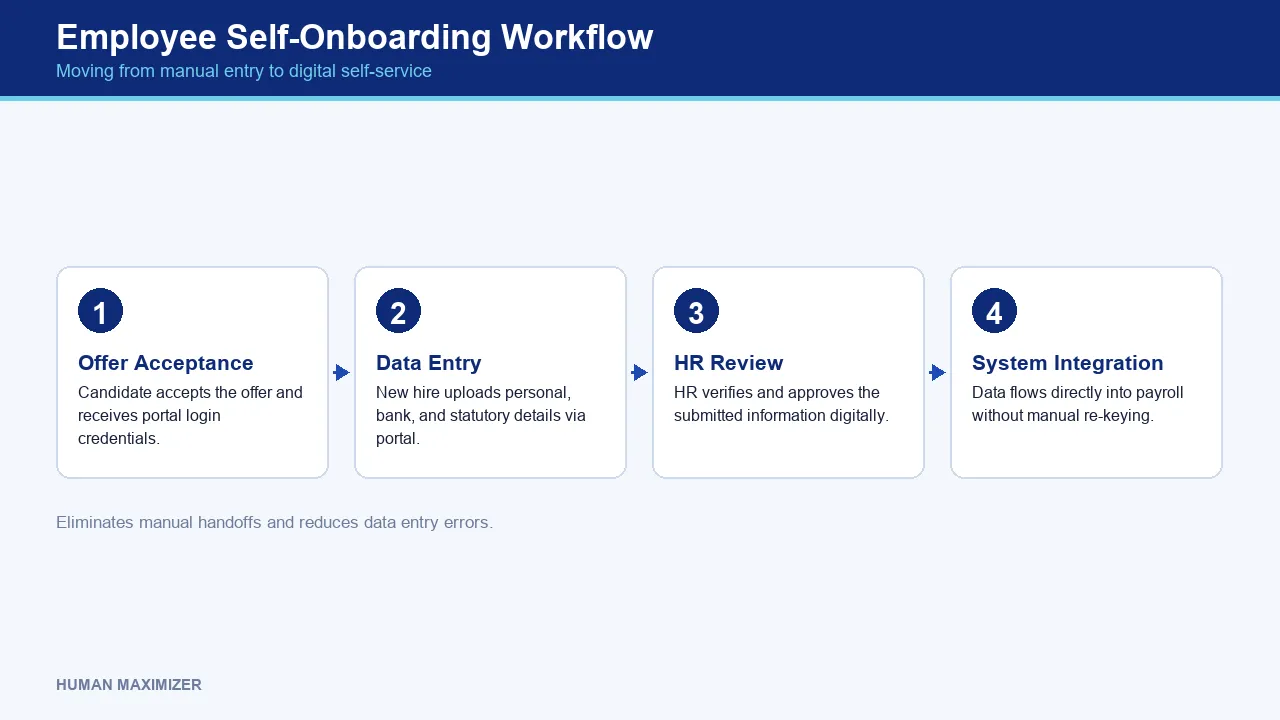
The shift matters because the manual version leaks time across a dozen small handoffs: chasing a missing Aadhaar copy, then following up on a gratuity nominee that was left blank. Onboarding built around the individual, rather than a rote enculturation ritual, tends to produce joiners who settle faster and stay longer. That effect is well documented in the newcomer-socialization research out of Harvard Business School. A portal that respects the joiner's time is the first signal of how the organization runs.
If you want the wider frame around this, our explainer on what an employee self-service portal does in 2026 covers how these portals extend well past onboarding into the full employee relationship.
The Day-Zero Handshake: Digitizing PF, ESI, and Gratuity Declarations
Here is the organizing idea I keep coming back to, and the one competitors skip. Call it the Day-Zero Handshake: every statutory declaration a new hire owes should be captured and e-signed before their first working day, validated as it is entered, so payroll can process it legally from the very first cycle. Not on Day 3. Not "we'll collect it this week." Before Day Zero.
Indian labour laws make this concrete in a way generic onboarding advice ignores. Three declarations carry the most compliance weight, and each maps to a specific field set in a good digital employee onboarding system.
Provident Fund (EPF Act, 1952)
The joiner needs to declare prior employment via Form 11 and nominate a beneficiary through Form 2, all of it hinging on a valid UAN. In a manual flow, the UAN is often chased for a week and the nomination is left blank because nobody explained it. A self-onboarding portal presents these as guided fields with helper text, so the joiner fills them once, correctly, at their own pace. Since the EPFO runs its member services on the UAN, getting it right at source removes a recurring downstream mess.
Employees' State Insurance (ESI Act, 1948)
For wage-eligible employees, the ESI declaration (Form 1) and dependent details need collecting before the first contribution falls due; the scheme is administered by ESIC. Dependent names, their dates of birth, the preferred dispensary: exactly the fields that get fat-fingered during transcription. Let the employee enter their own dependents and that accuracy problem largely disappears.
Gratuity (Payment of Gratuity Act, 1972)
The Form F nomination is the most forgotten document in Indian onboarding. It has no immediate payroll impact, so it slips, and then it surfaces years later at the worst possible moment. Building it into the Day-Zero Handshake means it is never an afterthought.
Naming the Acts matters, but I am deliberately not quoting effective dates or thresholds here. Those change, and a compliance date you get wrong is worse than one you leave to your statute reference. Confirm current rules against the EPFO and ESIC portals, or with a dedicated compliance team, before you configure your workflow.
Building the Pre-Boarding Checklist New Hires Finish Before Day 1
Yes, new hires can and should complete most onboarding tasks before they start. The question is what to put in front of them, and in what order. A pre-boarding checklist that respects the Day-Zero Handshake looks like this:
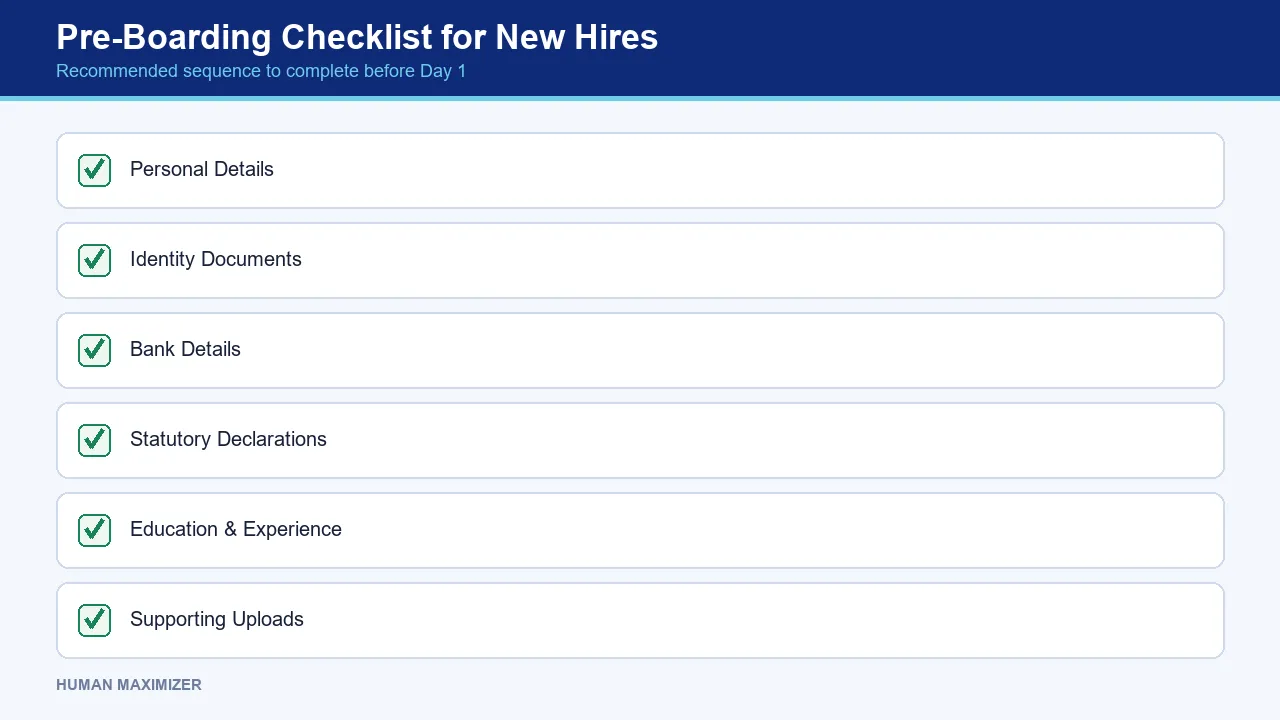
- Personal details come first: full name as per PAN, date of birth, gender, addresses, emergency contact, working email.
- Identity documents next: PAN and Aadhaar numbers, plus a labelled uploader for the actual copies.
- Bank details, with a confirm-account-number check, IFSC, and a cancelled cheque or passbook page.
- Statutory declarations: Form 11, UAN, ESI Form 1 with dependents, the Form F gratuity nominee.
- Education and experience, one repeating row per qualification and per past employer, so nothing is squeezed into a single box.
- Supporting uploads such as the offer-letter acknowledgement, the previous relieving letter, any role-specific certifications.
- Review and submit: the joiner sees everything in one place, adds an optional note, and submits.
The sequence is the point. Bank and statutory fields sit in the middle, after the easy personal details have built momentum and before upload fatigue sets in. When we interviewed HR managers and payroll specialists while building the product, the pattern that repeated was that people abandon forms halfway when the hard fields come first and cold, not that they refuse to fill them. Order fixes that.
Our deeper piece on how onboarding software stops Indian companies losing lakhs walks through the cost side of getting this sequence wrong.
Automating Data Entry and Document Verification
Once the joiner submits, automation earns its keep. Automated data collection means the fields the employee typed flow straight into their master record in Employee Data Management with zero re-keying. Document verification runs as the joiner uploads: file-type and completeness checks flag a blurry PAN or a missing page immediately, rather than three weeks later when payroll trips over it.
Let me show the exception path, because that is where these systems prove themselves. Suppose a new hire enters their salary account number, then mistypes it in the confirm-account-number field. The portal refuses to accept the mismatch on the spot. The joiner corrects it before submitting. In a paper flow, that same typo would sail into payroll and bounce a real salary credit, and the joiner's first impression of the company would be a failed payment. Catching it at the source, in the employee's own hands, is the entire value of self-onboarding. The first post-onboarding payroll cycle is where trust is won or lost, and this is how you win it.
On submit, the record status flips to "Pending" and HR and admins are notified. The reporting manager then fills the back-office side that the employee neither knows nor should set: department, designation, salary, shift, PF applicability, TDS. Two doors into the same record, each scoped to who actually owns the data.
E-Signatures, Data Security, and the Legal Edge
Electronic signing is what turns a filled form into a binding declaration. For a PF nomination or an offer acknowledgement, a digital signature creates a dated, attributable record without a courier or a scanner. India's IT Act recognizes electronic signatures, and Aadhaar-based e-sign is widely used for exactly this kind of consent capture.
Self-onboarding improves data accuracy and security in two ways that paper cannot match. When the employee is the single source of their own data, the game of telephone between a handwritten form and a typed field simply ends. And sensitive documents live behind access controls instead of in an open drive or a physical folder anyone can pull. Documents are served as controlled links, and the most sensitive data, like salary, loads only when someone with rights opens it, rather than sitting exposed in every page view.
With the DPDP Act, 2023 sharpening how personal data must be handled, minimising who touches a joiner's Aadhaar and bank details is a compliance posture, not just tidiness. Fewer hands on the data means fewer places it can leak.
Connecting an Automated Onboarding Portal to Payroll
An automated onboarding portal that does not feed payroll is just a fancier filing cabinet. Integration is the whole reason to build it. Because the joiner's statutory and bank fields enter the system once and stay linked to their record, Payroll can run them from cycle one with no separate data-entry step. The PF and ESI details declared during self-onboarding are already where the salary engine needs them.
This is where a unified platform beats a stack of disconnected tools. When onboarding, Core HR, attendance, and payroll share one record, a change entered at joining does not need re-syncing anywhere. A clean joiner record is a large part of what makes a payroll close uneventful. Integration quality between onboarding and payroll is usually what decides whether a go-live lands in weeks or drags on for months.
Client insight (illustrative): In the mid-market rollouts we have modelled, shifting statutory capture ahead of Day 1 saved close to 4 hours of payroll-prep work per new hire. The retyping and the correction calls that used to eat that time no longer happen.
Because onboarding is only the first stage of the relationship, it helps to see it inside the whole arc. Our guide to the stages of employee lifecycle management places self-onboarding where it belongs, as the front door to everything after.
Where Self-Onboarding Stops Short
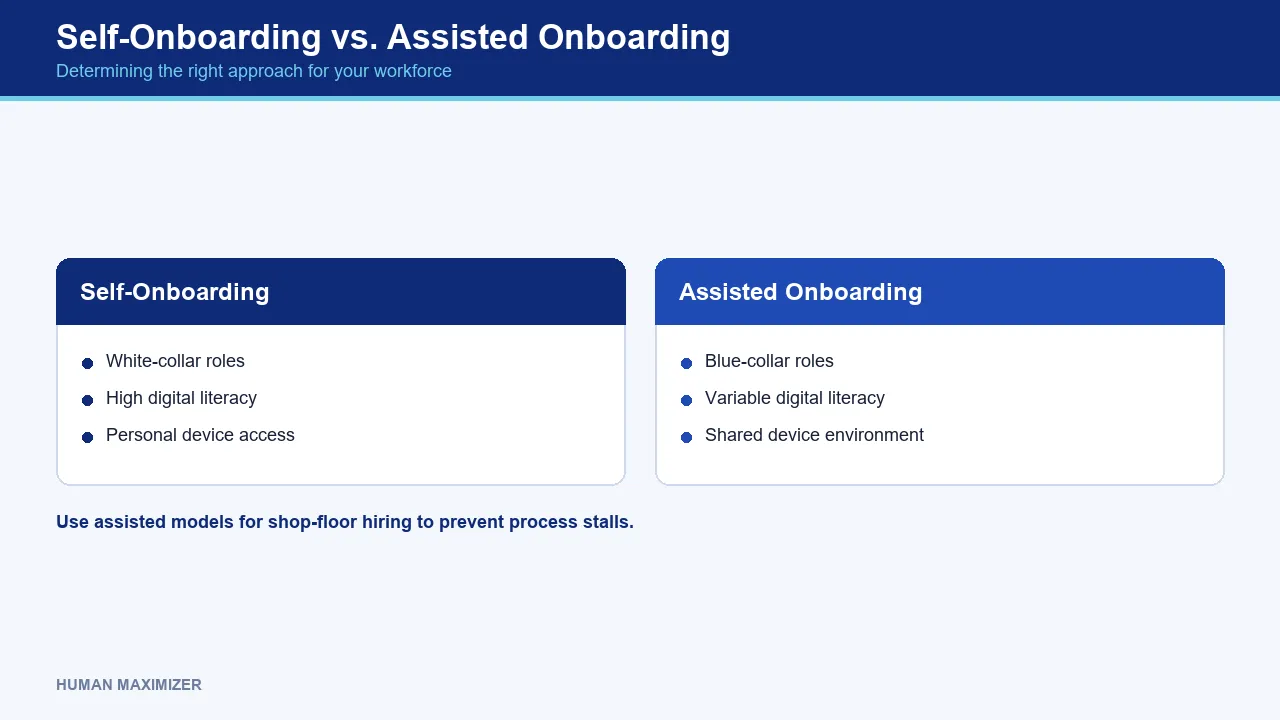
Honest limits, because no tool covers every case. Self-onboarding assumes a joiner with a smartphone or laptop and the confidence to use it. For blue-collar and shop-floor hiring, where digital literacy varies and devices are shared, a fully self-service flow can stall. There, an assisted model, where a supervisor helps capture data on a shared device, usually works better than forcing the portal on everyone.
Background verification is the other boundary. A portal can collect the documents and the consent, but the actual judgement on a discrepancy in a candidate's history is human work, and should stay that way. In practice the portal triggers a digital consent form before any check begins, which keeps the agency's data pull compliant with the DPDP Act, 2023. A flagged discrepancy still needs a person to weigh it.
Final compensation sign-off, PF-applicability calls, TDS structuring: those belong with HR and the reporting manager, not the new hire. The best systems scope those fields away from the employee by design, rather than trusting everyone to leave them alone.
Why Indian HR Teams Should Pivot Now
The case for paperless onboarding for Indian companies is not only speed. The onboarding experience shapes a new hire's first impressions and expectations, and the research consistently ties a strong first few days to higher commitment and lower early attrition. A joiner who spends their first morning hunched over photocopies has already learned something about how the company treats their time.
There is also a hard operational reason. As statutory reporting tightens and audits get more data-driven, a record that was hand-transcribed from paper is a liability you cannot fully trust. A record the employee entered and e-signed themselves, validated at source, is one you can stand behind. That difference compounds across every hire and every audit cycle.
At Human Maximizer, we built the eight-tab onboarding wizard around exactly this: the joiner captures their own data, statutory fields included, the system validates as they go, and payroll inherits a clean record. HR gets to spend Day 1 on the human part of welcoming someone, not on retyping their Aadhaar number.
Frequently Asked Questions
What are the benefits of employee self-onboarding for HR teams? It removes manual data entry and cuts transcription errors, and it gets statutory declarations done before Day 1 so payroll can run legally from the first cycle. HR shifts from data-entry clerk to reviewer, which frees the first day for actual welcome and integration rather than paperwork.
Can new hires complete onboarding tasks before their start date? Yes, and they should. Once the offer is accepted, the joiner can be sent a secure login to enter personal details, upload identity documents, add bank details, and complete their PF, ESI, and gratuity declarations. Completing these before Day 1 is the entire point of the Day-Zero Handshake.
What documents can be digitized during self-onboarding? PAN, Aadhaar, bank proof, the offer acknowledgement, previous relieving and experience letters, education certificates, and the statutory forms: PF Form 11 and Form 2, ESI Form 1, and the Form F gratuity nomination. Each is uploaded and e-signed rather than photocopied and filed.
How does self-onboarding integrate with existing payroll software? In a unified platform, the fields the employee enters during onboarding link directly to their payroll record, so PF, ESI, and bank details need no separate entry. When onboarding and payroll are separate tools, integration quality is what decides whether the first salary runs clean.
Bringing It Back to the Month-End Cutoff
The retyping we started with, the quiet hour someone spends transcribing a joiner's forms into payroll before the cutoff, is not a small task that got automated. It was the exact point where late salaries and audit gaps were manufactured, hidden inside a chore nobody measured. Move that data collection to the employee, validate it at source, and e-sign it before Day 1, and the cutoff stops being a scramble. Ready to run your next joiner through a compliant flow instead of a paper stack? See how Human Maximizer handles it.
About the Author & Reviewer
Chandan Watts — Technical Product Manager, Human Maximizer (Razor Infotech)
Chandan Watts is Technical Product Manager at Razor Infotech, building the Human Maximizer HR platform. After years leading customer-experience and team operations at JindalX and Radical Minds, he focuses on how teams actually work day to day — and how small workflow gaps quietly slow an entire team down.
Connect on LinkedIn
Reviewed & approved by Sameer Hameed — Founder & Chairman, Razor Infotech
Sameer Hameed is the Founder & Chairman of Razor Infotech, where he is guiding the creation of Human Maximizer. An entrepreneur across technology, real estate, mining and travel, he builds organisations on clarity, trust and responsible growth — on the belief that businesses grow only when the people behind them grow.
Connect on LinkedIn
Human Maximizer is built by Razor Infotech in New Delhi, India (founded 2019). About Human Maximizer.
Keep reading

Compliance
30 60 90 day onboarding plan
How to build a 30-60-90 day onboarding plan that accelerates revenue velocity. Learn to structure new hire goals for faster performance and retention.
17 min read
Employee Engagement
The Day-One Contribution Framework: Why the 30-60-90 Day Onboarding Plan is Killing Engineering Velocity
Replace slow 30-60-90 day plans. See how a developer onboarding framework boosts engineering velocity and gets Indian tech teams coding on day one.
13 min read
Employee Engagement
Productivity Tracking Software
How to deploy productivity tracking software without damaging team culture. Discover strategies for transparent monitoring that boosts output and morale.
13 min read