
Compliance
How the 48-Hour FnF Settlement Rule Became a Recruiting Weapon
48 Hour FnF Settlement: How to transform the 2026 Labour Code into a recruitment advantage. Use our Labour Code compliance software...

Chandan Watts
Technical Product Manager, Human Maximizer (Razor Infotech) · 12 min read · · Updated

Your best backend developer resigns at 4:00 PM on a Friday. In most Indian companies, what follows is a slow, awkward silence: a settlement that lands 45 days later, three follow-up emails from the ex-employee, and a Glassdoor review that costs you your next two hires. Now picture the opposite. Before they have unplugged their monitor, a pre-computed statement covering the 48 hour fnf settlement is already in their inbox: final salary, leave encashment, gratuity, deductions, all reconciled. That contrast is the whole argument of this piece. The 2026 Labour Code turned exit payouts from a back-office chore into something the smartest HR teams now treat as a hiring signal, and the systems that run it, including our Payroll module, are built to close that gap in hours rather than weeks.
Most coverage of this rule reads like a compliance warning. We think that framing undersells it. Candidates talk to each other. A clean, fast exit is one of the few employer-brand claims a company can actually prove, and the two-day deadline just made it a legal baseline instead of a nice-to-have.
The 48-Hour Mandate: Decoding Section 17(2) of the Code on Wages
Section 17(2) of the Code on Wages, 2019 sets the expectation plainly: wages due to a departing worker should be paid within two working days of their last working day, whether the exit is a resignation or an employer-initiated termination. Section 17(3) empowers the appropriate government to frame the rules around timing and mode of payment. This is not a gentle nudge toward faster payroll. It rewrites the clock.
The practical shock is the distance between the rule and current habit. On community forums, Indian HR practitioners are openly asking how to manage a two-working-day settlement when someone's last day falls near month-end payroll cut-off. That question captures the real tension. Most organisations still run FnF as a 30-to-45-day reconciliation exercise. Two days does not compress that timeline. It removes it entirely and forces the calculation to happen before the exit, not after.
The Cost of Delay: Legal Liability When You Miss the Deadline
A missed deadline under the new labour codes India framework is not a quiet paperwork lapse. Delayed wages attract liability, and once a former employee files a claim, you are defending a documented failure to pay on time, with the burden on you to show the delay was justified.
The financial exposure is the smaller problem. The reputational one compounds. In a market where engineers and senior sales talent move quickly, a reputation for slow settlements travels through referral networks faster than any recruiter can. One aggrieved leaver telling six peers that their money took two months is a direct tax on your offer-acceptance rate.
There is a quieter liability too. When settlements run late, HR keeps the record open, which means both your attrition data and payroll provisions stay unreconciled. A leaver still sitting as "processed but unpaid" for weeks is money you have accrued but not released, and an audit finding waiting to happen.
Scope of Dues: What Exactly Must Be Settled in 48 Hours?
The 48-hour window covers every earned component, not just the last salary line. Under a compliant full and final settlement process, that means:
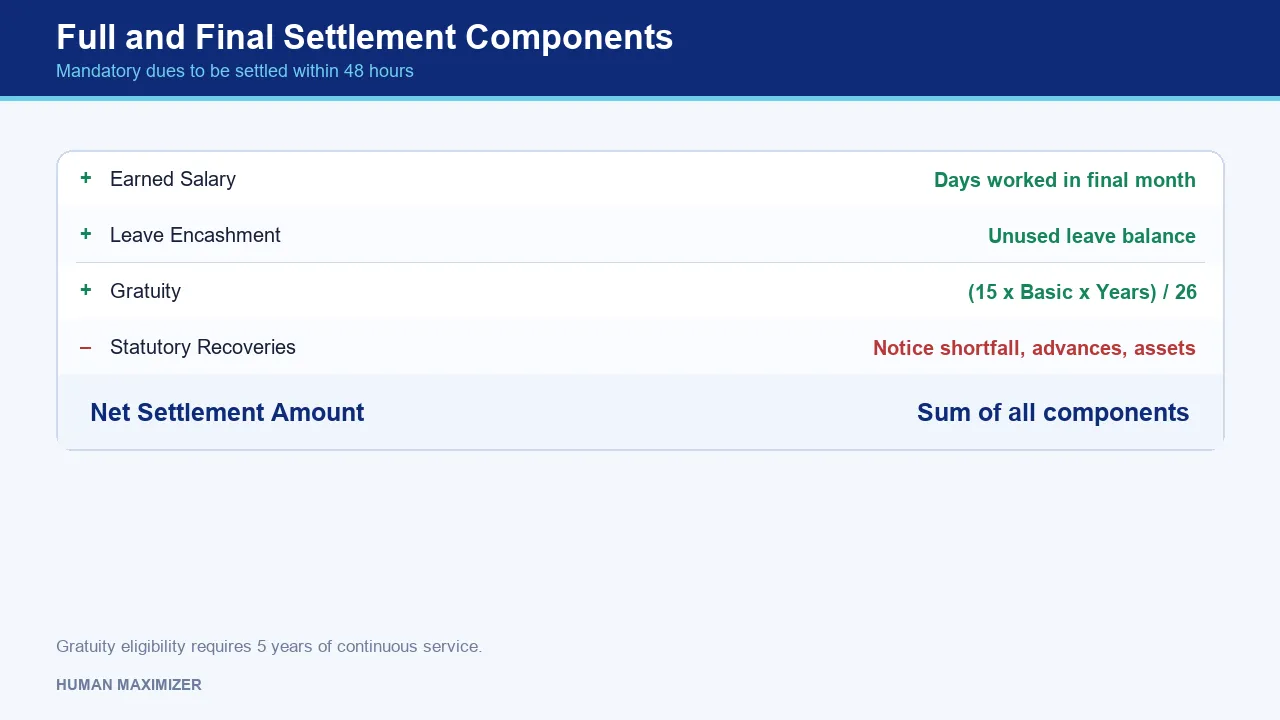
- Earned salary for days worked in the final month, including any pending attendance-linked pay reconciled through Attendance Management.
- Leave encashment for the unused balance, which is why an accurate, real-time Leave Management ledger matters more at exit than at any other point in the employee lifecycle.
- Gratuity, where five years of continuous service qualifies, waived on death or disablement.
- Statutory deductions and recoveries: notice-period shortfall, advances, and asset non-returns.
Gratuity is where teams stall, because they start the maths on the last working day. Model it instead, before the exit ever happens.
Gratuity, computed on the approval date. Take a leaver with six completed years and a basic of ₹40,000. The statutory formula is 15 days' wages × completed years ÷ 26:
15 × 40,000 × 6 ÷ 26 = ₹1,38,462
That number does not need the last working day to exist. Every input is known the moment the resignation is approved. Adjust the basic or the tenure to your own case and the conclusion holds: the settlement is computable in advance, which means the only reason it takes 45 days is that the process waited.
The IT-HR Synchronisation Gap: A 48-Hour Asset Recovery Checklist
Here is what most articles on this rule skip. Paying money in 48 hours is the easy half. The hard half is recovering what the company owns and clearing every internal sign-off inside the same window, because a settlement released before IT and Finance have cleared their lanes is a security and money risk.
The gap lives at the handoff. HR marks the resignation approved. IT does not learn about it until the leaver's manager remembers to raise a ticket. Finance discovers an outstanding travel advance on day 40. Each team's "done" is the next team's "not started," and the 48-hour clock does not pause for any of them.
A parallel-lane clearance checklist
Run these lanes concurrently from the moment the resignation is approved, not sequentially:
- IT lane: revoke SSO and email access on the last working day, recover the laptop and any issued devices, and log serial numbers against the employee record.
- Finance lane: close out advances, reimbursements, and recoverable loans.
- Admin lane: collect access cards and reconcile any company-issued assets or inventory.
- HR lane: confirm notice-period served versus shortfall, and lock the leave and attendance figures feeding the payout.
In the Resignation and Full & Final Settlement workflow we built, each of these is a tracked clearance lane with a named owner and a timestamp. A leaver leaving with an open IT or Finance clearance is flagged before payment, not discovered after. That single guardrail is the difference between a fast payout and a fast mistake.
From Legacy to Lightning: Rebuilding the Exit Workflow for 2026 Labour Law Compliance
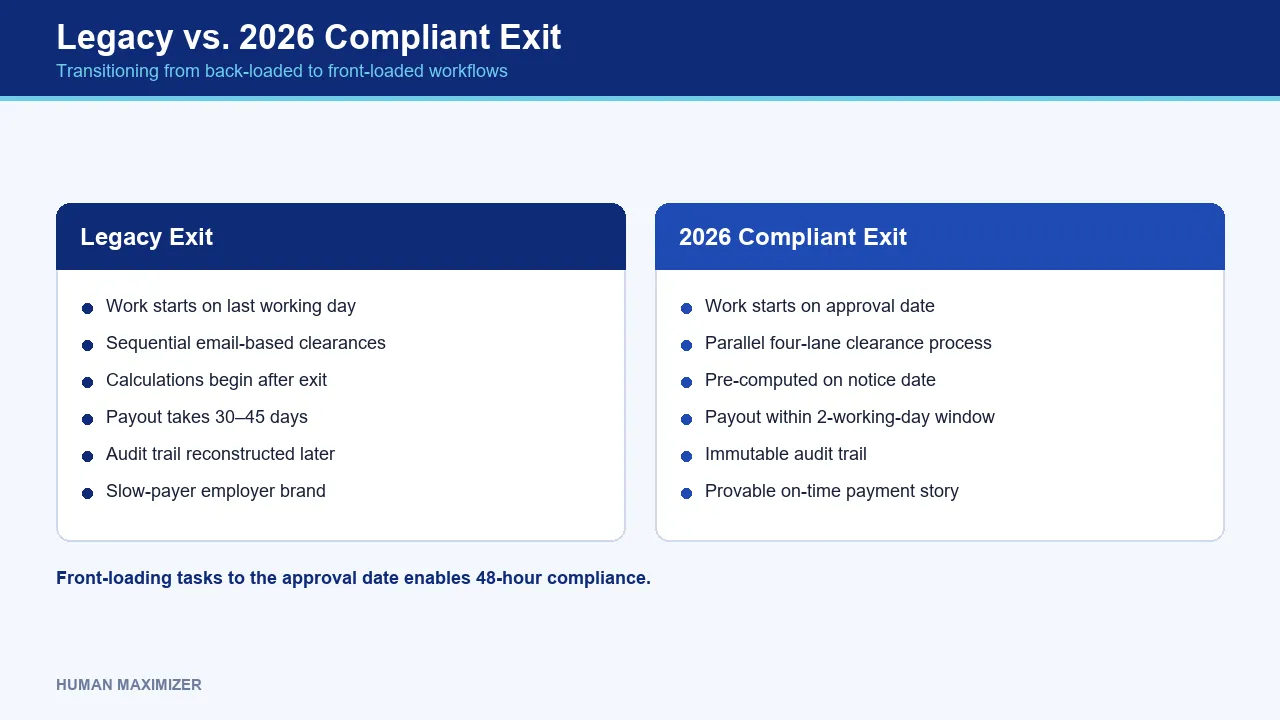
The transition from a legacy 30-to-45 day cycle is less about speed and more about when the work happens. Legacy exits back-load everything to the last working day. Compliant exits front-load it to the approval date.
| Legacy Exit | 2026 Compliant Exit | |
|---|---|---|
| When the work starts | Last working day | Resignation-approval date |
| Clearances | Sequential, chased by email | Four lanes fired in parallel |
| Gratuity & leave calc | Begun after the exit | Pre-computed on the notice date |
| Payout timing | 30–45 days | Within the 2-working-day window |
| Audit trail | Reconstructed later | Immutable once money moves |
| Effect on employer brand | Slow-payer reputation | Provable "we pay on time" story |
The mechanics we use follow the money without letting it move too early. When a resignation is approved, clearance requests fire across all four lanes at once, and leave encashment and gratuity pre-compute against the notice date. Payroll then works from an FnF batch: every processed-but-unpaid settlement sits in one workspace, an Overdue flag turns red on anything unpaid past 45 days, and a single approval gate signs off a batch before any transaction file is generated. Once a batch is processed, each settlement is marked paid with a transaction ID, the linked resignation flips to completed, and the affected employee is notified automatically. Nothing is editable after money moves, which is exactly what audit and finance want.
To see how this maps onto the traditional sequence of clearances and the final payroll run, our step-by-step FnF process guide walks the full workflow. The honest limitation worth naming: automation pre-computes and reconciles, but it does not decide a contested notice-period recovery for you. Where a manager and a leaver disagree on served days, a human still has to make the call, and the system's job is to surface that dispute early rather than settle it silently.
Implementation Roadmap: SMEs vs. Large Enterprises
The 48-hour rule applies regardless of company size, but the path to readiness is not identical. Trying to run an enterprise change programme in a 60-person firm wastes months; trying to run a spreadsheet exit at 2,000 headcount breaks on the first month-end collision.
For SMEs (under ~200 employees)
Speed comes from removing single points of failure. A process that depends on one person remembering to email IT is not a process yet. Move the four clearance lanes into a shared, trackable workflow, pre-load your leave and gratuity logic once, and route employee exit queries through a Ticket Management queue so nothing lives in a manager's WhatsApp. The same discipline that compresses a monthly payroll close compresses exit settlements just as hard.
For large enterprises (500+ employees)
The bottleneck is volume and coordination, not calculation. Batch processing becomes essential: group processed FnFs, approve them at a defined cadence, and use the overdue flag as a live compliance KPI with a target of zero. Standardise clearance SLAs across business units so one slow department cannot hold a settlement hostage. The metric that matters is clearance completeness at exit, tracked per resignation, because at scale the settlements that breach 48 hours are almost always the ones stuck on an unclosed lane.
Scope and Exceptions: Does the 48-Hour Rule Apply to Every Exit?
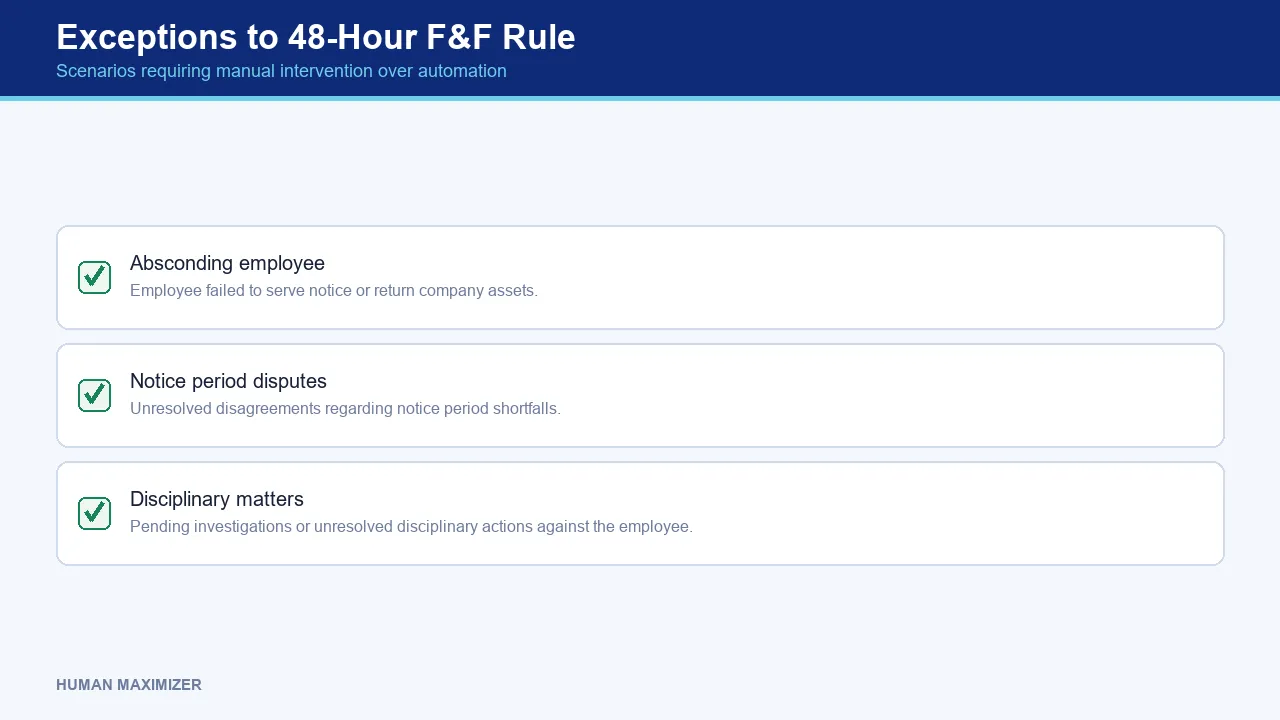
Not every separation resolves cleanly inside two days, and pretending otherwise sets teams up to fail. The timeline is the legal expectation, but genuine edge cases exist. Where an absconding employee never serves notice or returns assets, the settlement may legitimately depend on recovery and cannot be forced to a clean two-day close. Where a dispute over notice-period shortfall or a pending disciplinary matter is unresolved, HR needs a documented reason for any delay rather than a silent one.
The rule of thumb we apply: automate the routine majority of exits so your team's judgment is reserved for the genuinely contested few. Because these edge cases and the broader offboarding obligations sit inside the wider reform, the complete guide to the new Labour Codes 2026 is worth reading alongside this one for how appointment letters and fixed-term parity interact with exits.
Frequently Asked Questions
What does the 48-hour F&F rule mean for employers? It means final wages must be settled within two working days of the last working day, per Section 17(2) of the Code on Wages, 2019. In practice, that forces settlement calculations to happen before the exit date, since there is no room to start reconciling after the employee has left.
Which components are included in the 48-hour settlement? Earned salary for days worked, leave encashment on the unused balance, gratuity where five years of service qualifies, and any statutory deductions or recoveries such as notice-period shortfall and unreturned advances. Every one of these is computable from data you already hold on the approval date.
Does the 48-hour rule apply to all types of employee separations? It applies across resignation, termination, and retrenchment regardless of company size. Genuine exceptions, such as absconding employees or unresolved disputes, may justify a documented delay, but the two-day timeline is the default expectation, not an optional target.
How can HR teams automate the exit management process? Trigger clearance requests across IT, Finance, Admin, and HR the moment a resignation is approved, pre-compute leave encashment and gratuity against the notice date, and process settlements as an auditable batch with an overdue flag as a live KPI. That converts a 45-day reconciliation into a same-window release.
The Exit You Run Is the Offer You Make
Return to that Friday resignation. The developer who receives a clean, pre-calculated statement before packing their laptop does not go quiet. They tell peers that this company pays what it owes, on time, without a fight, and in a talent market that runs on referrals, that story recruits for you long after they have gone. The 48-hour rule did not just shorten a deadline. It made your worst-designed process visible to exactly the people you most want to hire next. Teams that treat it as a compliance chore will keep losing that signal; the ones that redesign the exit will find their offboarding quietly doing the work of a recruiter. If you want to see how a unified exit workflow handles this end to end, Human Maximizer is where we built it.
About the Author & Reviewer
Chandan Watts — Technical Product Manager, Human Maximizer (Razor Infotech)
Chandan Watts is Technical Product Manager at Razor Infotech, building the Human Maximizer HR platform. After years leading customer-experience and team operations at JindalX and Radical Minds, he focuses on how teams actually work day to day — and how small workflow gaps quietly slow an entire team down.
Connect on LinkedIn
Reviewed & approved by Sameer Hameed — Founder & Chairman, Razor Infotech
Sameer Hameed is the Founder & Chairman of Razor Infotech, where he is guiding the creation of Human Maximizer. An entrepreneur across technology, real estate, mining and travel, he builds organisations on clarity, trust and responsible growth — on the belief that businesses grow only when the people behind them grow.
Connect on LinkedIn
Human Maximizer is built by Razor Infotech in New Delhi, India (founded 2019). About Human Maximizer.
Keep reading
Compliance
Design an Effective HR Leave System
How to build a compliant HR leave management system that automates statutory tracking, reduces payroll errors, and simplifies leave policy enforcement.
12 min read
Compliance
Mastering Payroll Processing in India
The essential steps for accurate payroll processing in India. Learn how to manage statutory compliance, tax deductions, and timelines to pay staff...
8 min read
Compliance
HRMS software for business growth: Beyond Compliance
Why Indian CHROs are shifting from compliance to capital. Learn how to leverage HRMS software for business growth and turn HR into a P&L driver today.
14 min read