
Compliance
Mastering Payroll Processing in India
The essential steps for accurate payroll processing in India. Learn how to manage statutory compliance, tax deductions, and timelines to pay staff...

Chandan Watts
Technical Product Manager, Human Maximizer (Razor Infotech) · 8 min read · · Updated
It is 4:30 PM on the 25th of the month, and your HR manager is staring at a master Excel sheet that has become a fragile web of VLOOKUPs and manual adjustments. A remote employee in Bengaluru is asking why their Professional Tax deduction differs from their colleague in Mumbai, while the EPF portal is showing a login error. This scene is the silent crisis of growing Indian enterprises: payroll processing is often treated as a back-office chore until it becomes a compliance liability.
When payroll remains a reactive, manual task, it consumes your team’s focus and introduces human error that can take days to reconcile. At Human Maximizer, a common finding is that the most resilient teams treat payroll not as a monthly fire drill, but as a structured, automated flow that starts with verified data.
The Anatomy of an Indian Payroll Cycle
Payroll is not just a payment; it is the final output of an entire month of operational activity. A standard payroll cycle in India typically follows a linear progression from attendance capture to statutory filing.
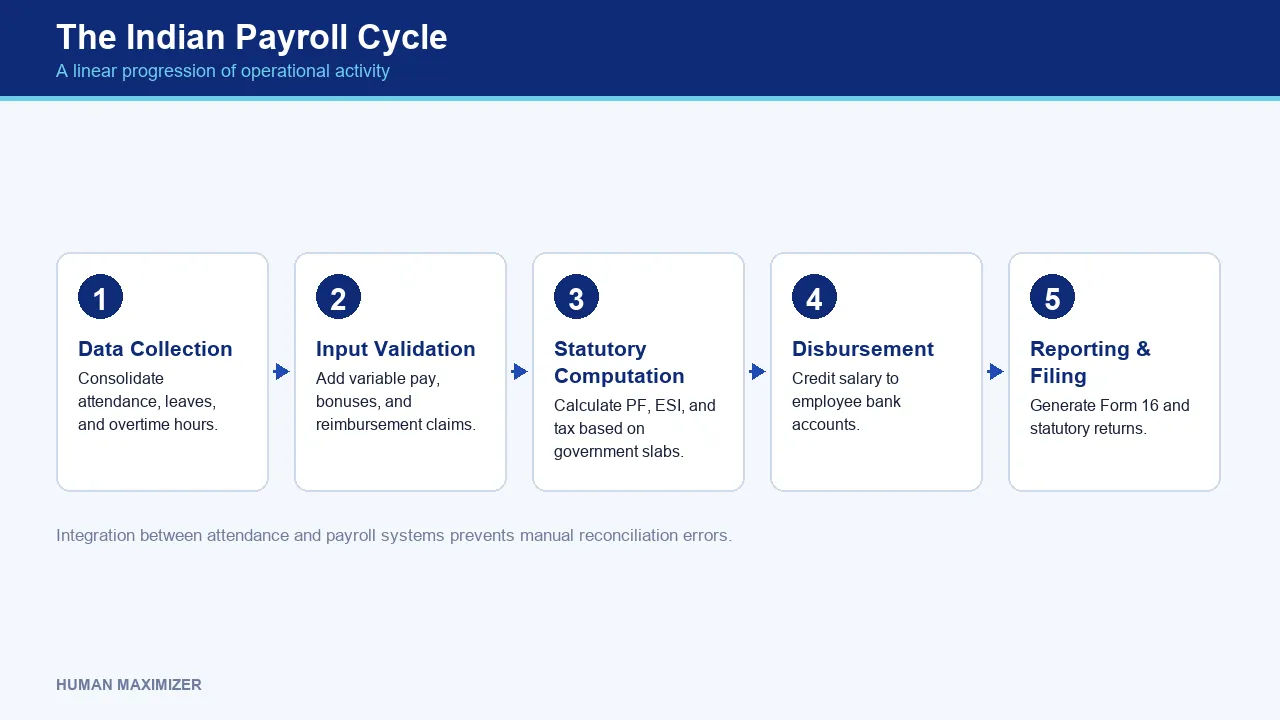
- Data Collection: Attendance, leaves, and overtime hours are consolidated.
- Input Validation: Variable pay, bonuses, and reimbursement claims are added to the fixed salary structure.
- Statutory Computation: The engine calculates PF, ESI, and tax deductions based on the latest government slabs.
- Disbursement: Salary is credited to employee accounts.
- Reporting & Filing: The final output is used to generate tax documents like Form 16 and statutory returns.
The failure often happens between steps one and two. If your attendance system and payroll engine are not unified, you end up manually reconciling "loss of pay" days. When each branch or department submits its own inputs via email or messaging apps, payroll reconciliation quietly becomes a full-time job. Using automated payroll software that synchronizes attendance data directly with salary computation removes this friction.
Common Payroll Pitfalls
| Failure Point | Real-World Consequence |
|---|---|
| Disconnected Attendance | Manual LOP calculation errors leading to payroll re-runs. |
| Static Tax Slabs | Non-compliance with state-specific Professional Tax updates. |
| Unverified Inputs | Overpayment of bonuses or reimbursements due to lack of audit trail. |
| Siloed Data | Delayed statutory filings and increased audit risk. |
Decoding the Salary Slip: CTC, Gross, and Net Pay
Understanding the components of a salary structure is essential for both the employer and the employee. The CTC (Cost to Company) is the total annual cost, but the take-home pay is what matters to your team.
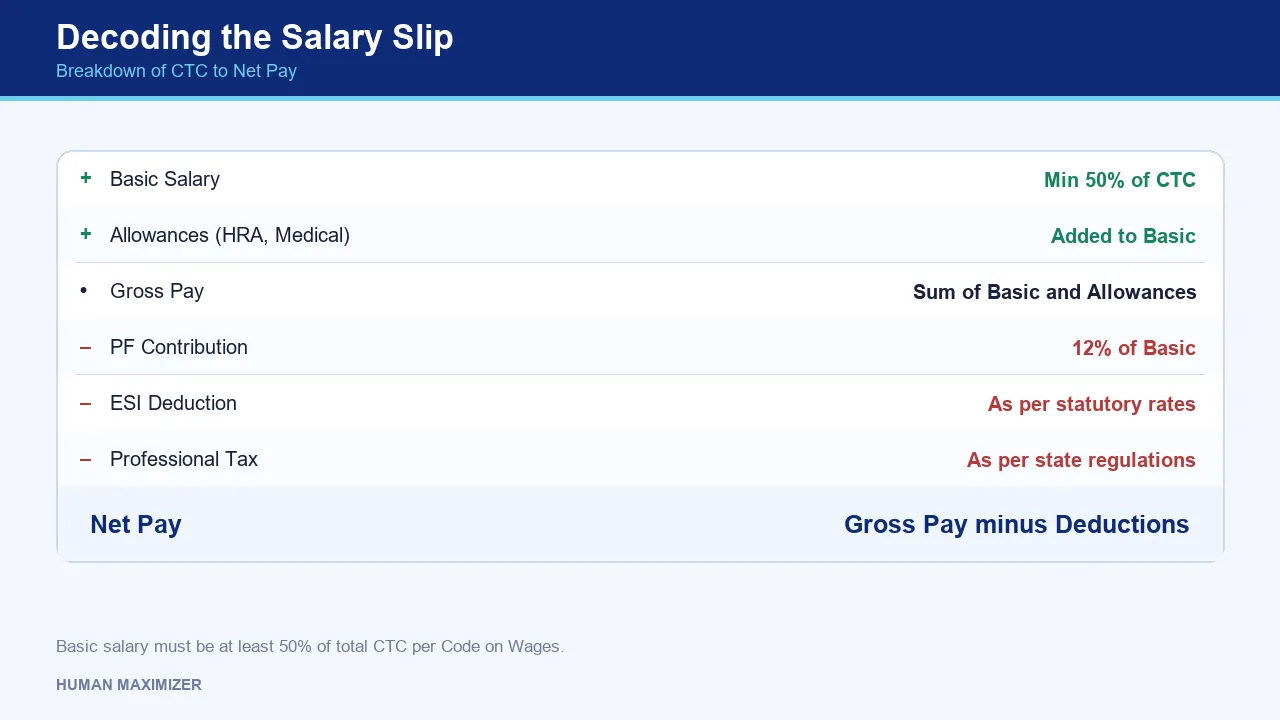
- Basic Salary: This is the foundation of your payroll. Basic pay must constitute at least 50% of the total CTC; violation triggers penalties under the Code on Wages enforcement framework.
- Allowances: Components like HRA (House Rent Allowance) or medical allowances are added to the basic to form the Gross Pay.
- Statutory Deductions: These are mandatory subtractions from the gross, including the PF contribution, ESI deduction, and Professional Tax.
- Net Pay: This is the final amount credited to the employee’s bank account after all taxes and statutory deductions are taken out.
Illustrative Math: If an employee has a monthly CTC of ₹50,000, the basic salary must be at least ₹25,000. After adding HRA and other allowances, the Gross Pay is calculated. From this, the employer deducts the employee's share of PF (12% of basic) and applicable Professional Tax. The remainder is the Net Pay.
The Compliance Minefield
Payroll management process in India requires strict adherence to statutory deadlines. Missing an EPF return or a TDS filing window can lead to penalties and unnecessary audits.
For many businesses, the complexity lies in state-specific requirements. For instance, the Professional Tax (PT) slab in Maharashtra differs from that in Karnataka. A manual spreadsheet approach fails here because it requires HR to manually update these rates every time a regulation shifts. A system that updates tax slabs and PF rules automatically ensures your statutory compliance for payroll is built into the engine, not layered on top as an afterthought.
Old vs. New Tax Regime: TDS Configuration
Since the introduction of the new tax regime, employees have the flexibility to choose between lower tax rates without exemptions or the traditional old regime. Managing this at scale creates a unique data challenge: every employee has a different tax liability based on their personal investment declarations.
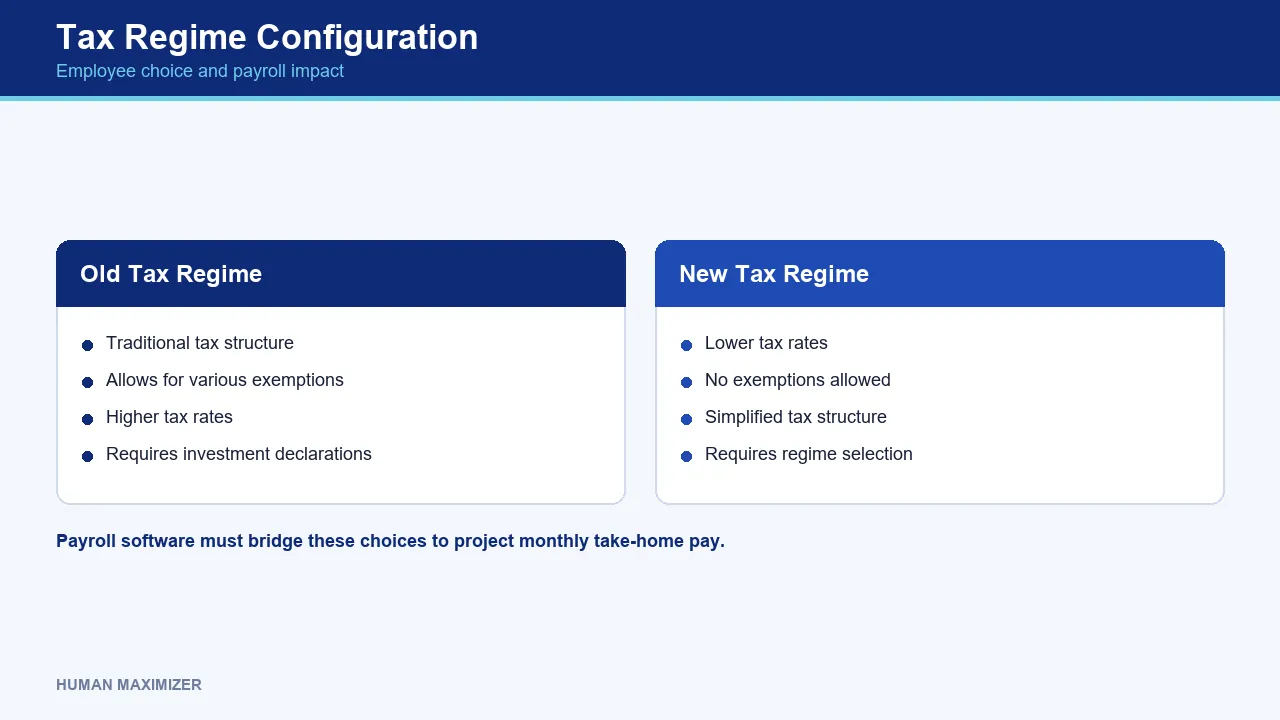
Your payroll software must act as the bridge here. It should allow employees to declare their investments, choose their regime, and view the projected impact on their monthly take-home pay. This transparency reduces the number of "why is my tax so high?" tickets that hit HR every February and March.
The Reconciliation Checklist: A Zero-Error Audit
To avoid the "25th-of-the-month panic," we recommend a standard reconciliation checklist. This is the framework that prevents errors before they occur:
- The Attendance Lock: Close all attendance records and leave adjustments 48 hours before the payroll batch runs.
- The Component Audit: Verify that all one-time bonuses or variable pay adjustments have been approved by the relevant managers.
- The Statutory Sanity Check: Compare the current month’s PF and ESI totals against the previous month’s trends to spot anomalous spikes.
- The Exception Flag: Review all employees on "Salary Hold" or those with zero-pay statuses before clicking the final button.
Scaling Payroll: In-House vs. Outsourced
Should you outsource or automate? For most mid-sized enterprises, outsourcing can create a "black box" where you lose visibility into your own payroll data. When you use automated payroll software, your HR team retains control while the system handles the repetitive calculations.
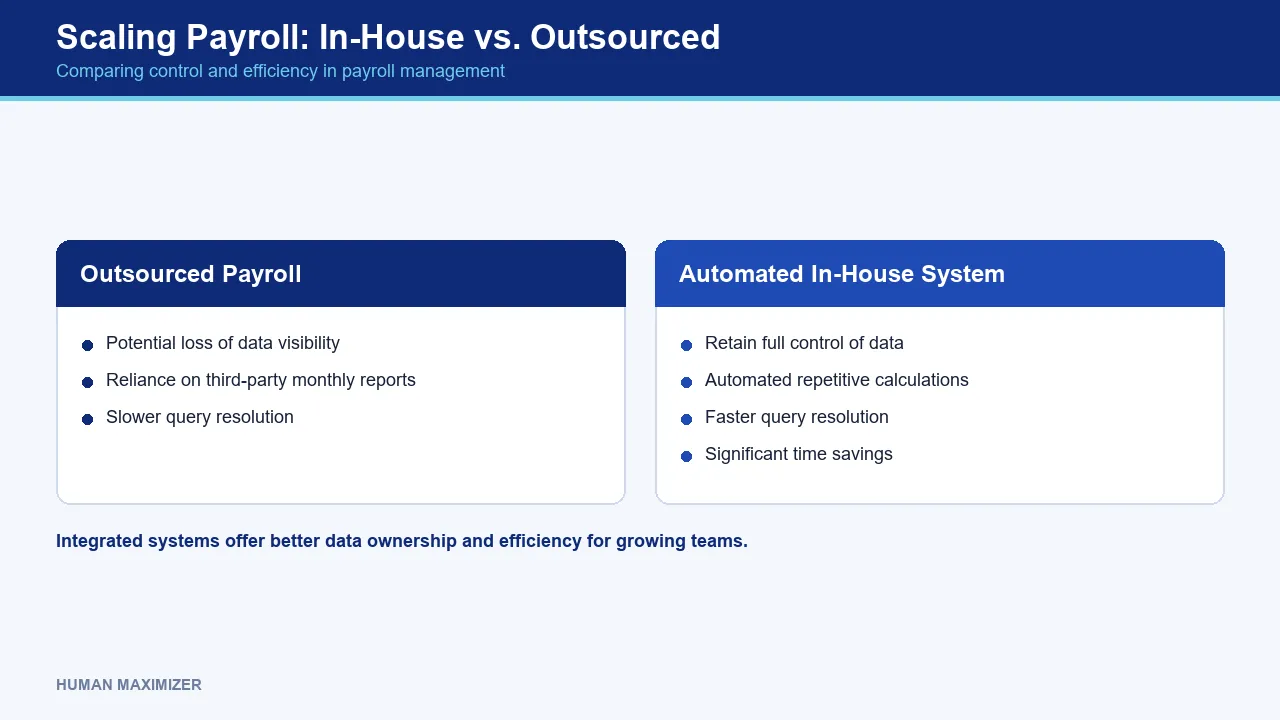
We spoke with HR leaders, managing directors and founders across Indian companies while building our platform. One manager at a growing logistics firm shared that they previously spent three days every month manually cross-referencing state-specific PT slabs for their drivers. By moving to an integrated system, they reduced that time to under an hour. Teams that own their payroll data through an integrated system resolve queries faster than those who rely on a third-party vendor’s monthly report.
Payroll for the Distributed Workforce
Handling payroll for hybrid or remote teams adds a layer of complexity to statutory compliance. You must account for the work location of the employee, as this dictates their Professional Tax and local Labour Welfare Fund (LWF) contributions. If you have employees moving between states, your system must track their primary work location accurately. Using a platform that treats location as a live payroll input, rather than just a static HR field, ensures that your tax filings remain compliant regardless of where your talent is based.
Executing Statutory Compliance and Payroll Processing Steps
Effective payroll processing in India demands a rigid sequence of operations to ensure statutory compliance. The process begins with the 'Lock-in' phase, where HR must finalize attendance, leave balances, and variable pay inputs by the 20th or 22nd of the month. This cutoff is critical to prevent manual errors during the computation phase. Once inputs are locked, the payroll engine must apply the correct statutory deductions based on the employee's location and salary threshold. For instance, ESI contributions are mandatory only for employees earning a gross monthly salary of ₹21,000 or less, while Professional Tax slabs vary significantly by state and must be calculated according to the specific local municipal act.
After computation, the payroll team must generate the statutory challans. EPF contributions must be deposited by the 15th of the following month, while TDS deducted from salaries must be deposited by the 7th of the subsequent month. Compliance is not merely about payment; it requires accurate filing of monthly returns, such as the ECR for EPF and the quarterly TDS returns via Form 24Q. Failure to adhere to these timelines invites interest penalties and potential scrutiny from the Labour Department or the Income Tax authorities. To maintain compliance, HR must ensure that every payroll run generates an audit trail, documenting the basis for every deduction. By automating the transition from salary computation to statutory reporting, businesses eliminate the risk of missing filing deadlines and ensure that state-specific tax variations are handled without manual intervention.
FAQ
How do I handle a payroll batch error in Human Maximizer? If the system flags an issue during the pre-check, you can view the specific error—such as a missing attendance record or pending leave—directly in the batch dashboard. You can then nudge the relevant manager to resolve the input, and once updated, the batch will automatically re-calculate the net pay.
Can I manage Full and Final (F&F) settlements within the payroll module? Yes, our Resignation & F&F module integrates with the payroll engine. When an employee exits, the system calculates the notice period pay, leave encashment, and any outstanding loan recoveries, allowing you to process the final settlement as a separate, audited payroll run.
How does the system handle state-specific LWF and PT rules? The platform maintains a database of state-specific statutory rules. When you assign an employee to a specific work location, the system automatically applies the correct Professional Tax slab and Labour Welfare Fund deduction for that state, ensuring compliance without manual configuration.
A Note on Limits
Automation is powerful, but it is not a replacement for judgment. A payroll system can accurately calculate a deduction, but it cannot resolve a dispute over a performance bonus or a misunderstanding about a leave policy. When an employee raises a query that falls outside standard policy, our Ticket Management module helps HR track the conversation through to a human-led resolution.
If your team is still spending the last week of every month chasing attendance data and reconciling tax sheets, we should chat. Moving to an integrated system turns payroll from a monthly burden into a consistent, audit-ready engine.
What is the deadline for depositing TDS deducted from employee salaries in India?
TDS deducted from employee salaries must be deposited with the government by the 7th of the following month. For the month of March, the deadline is extended to April 30th.
About the Author & Reviewer
Chandan Watts — Technical Product Manager, Human Maximizer (Razor Infotech)
Chandan Watts is Technical Product Manager at Razor Infotech, building the Human Maximizer HR platform. After years leading customer-experience and team operations at JindalX and Radical Minds, he focuses on how teams actually work day to day — and how small workflow gaps quietly slow an entire team down.
Connect on LinkedIn
Reviewed & approved by Sameer Hameed — Founder & Chairman, Razor Infotech
Sameer Hameed is the Founder & Chairman of Razor Infotech, where he is guiding the creation of Human Maximizer. An entrepreneur across technology, real estate, mining and travel, he builds organisations on clarity, trust and responsible growth — on the belief that businesses grow only when the people behind them grow.
Connect on LinkedIn
Human Maximizer is built by Razor Infotech in New Delhi, India (founded 2019). About Human Maximizer.
Keep reading
Payroll
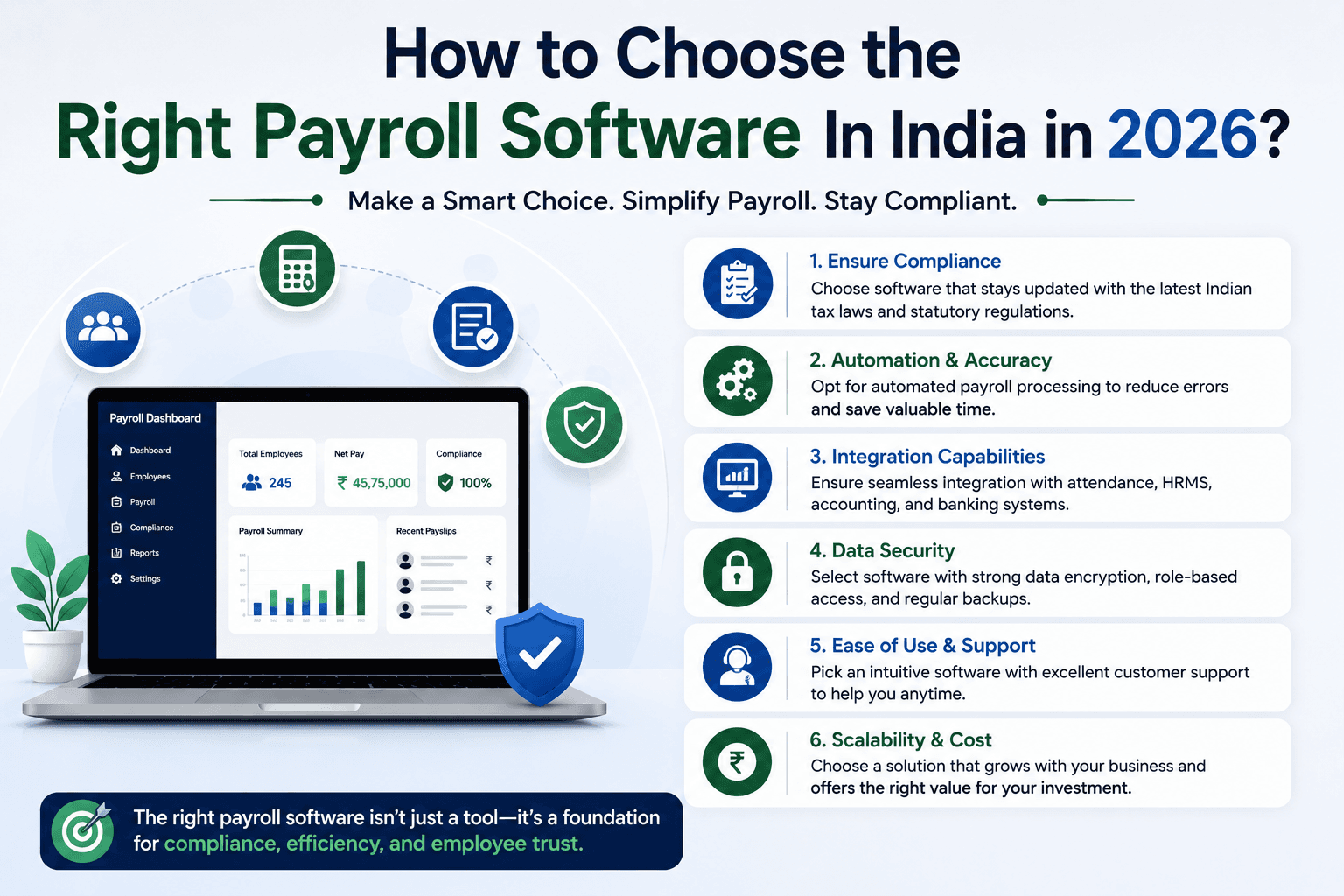
How to Choose the Right Payroll Software In India in 2026?
Facing issues in salary calculation? Choose the right automated payroll software. Learn the 7 questions to ask before buying in 2026, including hidden compliance costs and implementation timelines.
5 min read
Payroll
Payroll Consultant vs Payroll Software
Stop overpaying for manual processing. Discover if your business needs a dedicated payroll consultant or the efficiency of payroll software...
18 min read
Compliance
HRMS software for business growth: Beyond Compliance
Why Indian CHROs are shifting from compliance to capital. Learn how to leverage HRMS software for business growth and turn HR into a P&L driver today.
14 min read