
Payroll
Payroll Consultant vs Payroll Software: What Indian SMEs Get Wrong
Stop overpaying for manual processing. Discover if your business needs a dedicated payroll consultant or the efficiency of payroll software...

Nishant Tandon
Co-founder & Lead Partner, Razor Infotech · 18 min read · · Updated
Ask most Indian SME founders whether they need a payroll consultant or payroll software, and you will get an answer about cost. That is the wrong axis. The real question is which parts of your payroll are procedural and which parts are interpretive, because software is excellent at the first and structurally incapable of the second. A Payroll engine will compute a Professional Tax slab for Maharashtra flawlessly, ten thousand times, without complaint. It will not tell you whether an employee who relocated from your Bengaluru office to your Gurugram branch on the 14th owes Karnataka PT or nothing at all for that month. That is a judgment call about place of employment, and nobody has automated judgment yet.
At Human Maximizer we spend a lot of time inside that distinction. The consultant-versus-software debate is usually framed as outsourced payroll on one side and in-house payroll on the other, with a price tag attached to each. Framed that way, the SME picks whichever line item is smaller and then discovers, usually during an inspection, that they bought the wrong half of the problem.
The Procedural/Interpretive Split
Here is the organizing idea for this entire article, and it is worth stating plainly before anything else.
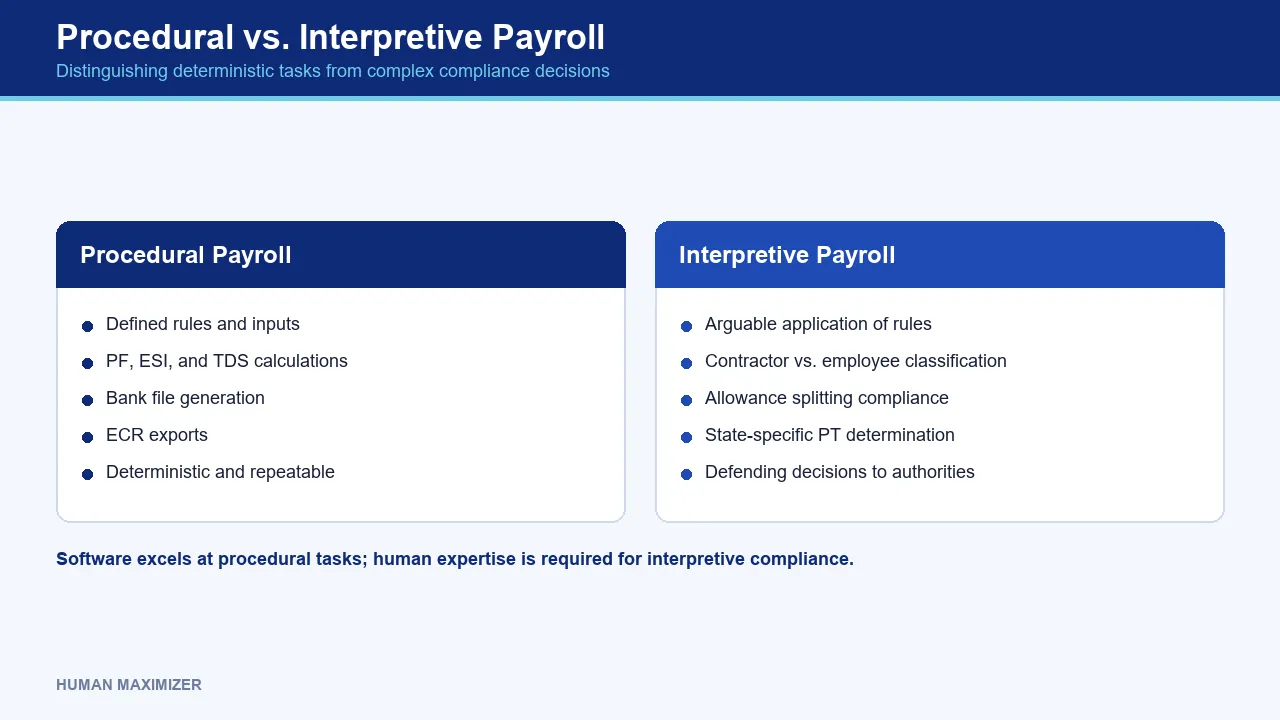
Procedural payroll is everything with a defined rule and a defined input. Employee PF at 12% of basic plus DA. The ₹15,000 monthly wage ceiling on the employer's statutory liability. ESI eligibility below ₹21,000 gross. LOP arithmetic. TDS slabs. Arrears on a mid-cycle revision. Bank file generation. ECR export before the 15th of the following month. All of it is deterministic: given the same inputs, the correct output is fixed, knowable, and repeatable. Humans are bad at this. They are slow, they get tired on the 28th, and they transpose digits.
Interpretive payroll is everything where the rule exists but its application to your facts is arguable. Is this contractor actually an employee under the PF Act? Does your "special allowance" count as wages after the Supreme Court's position on allowance splitting? Should this employee's PT follow the state of the registered office or the state where they physically work? How do you defend a three-year-old classification decision to an EPFO enforcement officer sitting across the table? Software has no view on any of it. It applies whatever you configured. If you configured it wrongly, it will apply the wrong thing with perfect consistency for thirty-six months, which is considerably worse than a human getting it wrong twice.
Nearly every payroll disaster we have looked at sat squarely in the interpretive column while the company was busy buying tools for the procedural one.
Where Software Alone Starts to Cost You
Headcount is a lazy proxy for payroll complexity, but it is the proxy every SME reaches for, so let us be more useful about it.
Under roughly 25 employees, single state
Software is almost always the right answer, and a payroll consultant is usually an expensive habit inherited from your first CA. One state means one PT schedule. One location means no place-of-employment ambiguity. Salary structures are simple. At this stage a payroll management system for a small business does nearly everything you need, and the residual interpretive work is an hour a year with your accountant.
Roughly 25 to 100 employees, multi-state or multi-entity
This is where the split bites. You now have PT in two or three states, possibly a branch in a state that levies none, contractors who look suspiciously like employees, and your first genuine arrears case. Automated payroll processing still handles the monthly grind, but somebody has to own the classification decisions. For instance, deciding whether your sales team's monthly travel allowance is a reimbursement against bills or a taxable wage component that pulls into PF wages: get that one wrong and you have understated contributions for every field employee, every month, since the day you set it up. Most SMEs at this size have nobody who owns that call. Payroll runs on time and quietly accumulates a liability nobody has priced.
Above roughly 100 employees, or any factory/contract-labour exposure
The interpretive surface expands faster than headcount. Contract labour registers. Shift-differential wage treatment. State-specific overtime multipliers, gratuity provisioning at 15 days' wages × completed years ÷ 26. You need both a system and an adviser, wired to each other rather than sitting in separate inboxes.
The headcount bands are not the point. What actually triggers the need for interpretive help is jurisdictional and structural complexity, not team size. A 40-person company operating across four states needs more advisory input than a 200-person company in a single Chennai office. Almost no article on this topic says so, because headcount is easier to write about.
The Compliance Gap Nobody Prices
Payroll software cannot represent you.
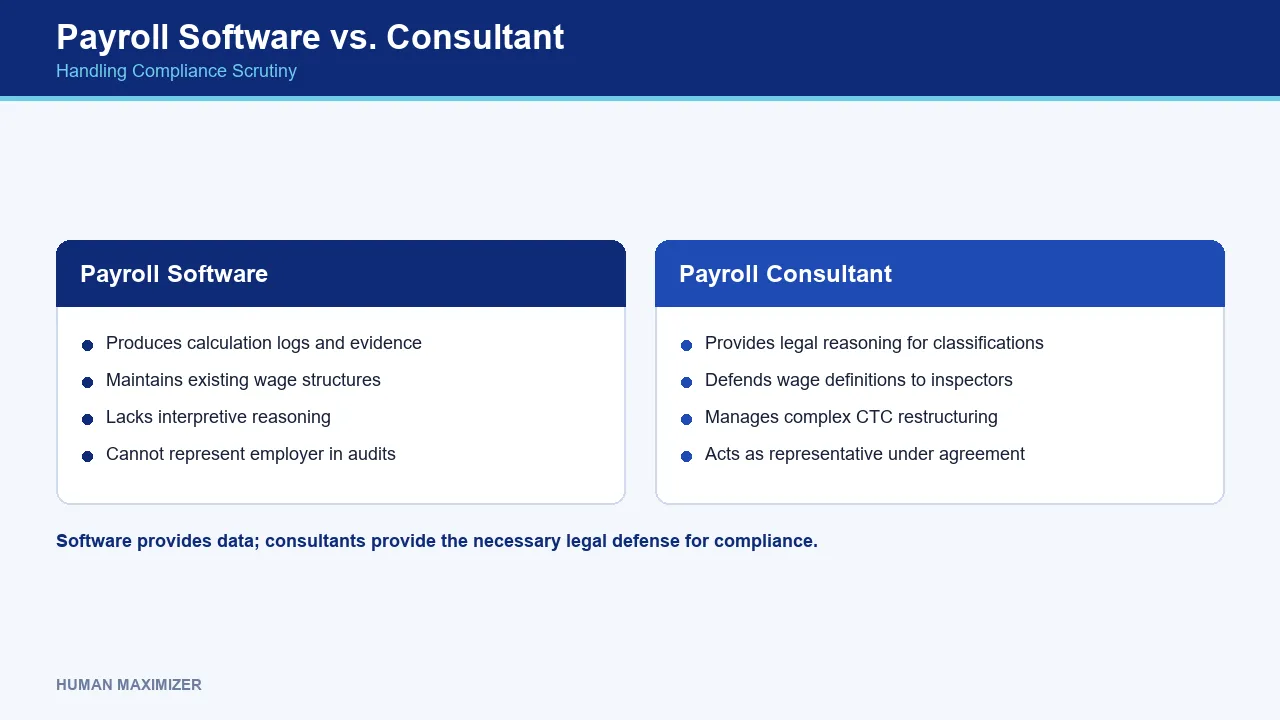
That sentence is the whole section, but it deserves unpacking, because it is the single most under-discussed fact in this comparison. When an EPFO enforcement officer issues a 7A summons, or an ESIC inspector questions your wage definitions, the thing that gets scrutinised is not your software's calculation log. It is your reasoning. Why did you treat this allowance as excluded from PF wages? On what basis did you classify these fifteen people as consultants? Who decided, and when, and against which circular?
A consultant can answer that in a room. A payroll bureau can answer it on your behalf under a service agreement. Software produces evidence, which is genuinely valuable, but evidence without an argument is just a large spreadsheet handed to someone who is already sceptical.
Here also lives the most expensive Indian payroll mistake. Under Section 9 of the Code on Wages, 2019, basic pay must constitute at least 50% of total remuneration, and falling short of that exposes the employer to penalties under the enforcement framework. Plenty of Indian SMEs have historically kept basic low and allowances high, precisely to suppress PF liability. Software will happily maintain that structure forever, having no opinion on whether it is defensible. Restructuring CTC across an entire workforce to comply, without triggering a take-home shock that costs you people, is an interpretive project with a software implementation attached, not the reverse.
Modelling the Real Cost, Out Loud
Cost comparisons in this category are usually vendor arithmetic. Let us do it visibly instead, with assumptions you can argue with.
Take a 60-person SME in a single state.
The software path. Per-user pricing in the Indian market is what it is; ours runs from ₹49 to ₹112 per user per month depending on tier, with a free entry plan, and you can check the current numbers on our pricing page. At the ₹82 tier, 60 users is ₹4,920 a month, or ₹59,040 a year. Add internal effort: assume your HR ops person spends four hours on each monthly close once the system is settled. At 48 hours a year and a fully-loaded cost of, say, ₹600 an hour, that is ₹28,800 of internal time. Call it ₹87,840 all-in.
The consultant path. Retainers for a 60-person book commonly sit in the ₹8,000 to ₹20,000 per month range depending on scope, though rates vary widely and most firms quote rather than publish. At ₹12,000, that is ₹1,44,000 a year. Your internal time does not go to zero, because someone still has to collect attendance, chase approvals, and answer employee queries. Assume half the hours: ₹14,400. Call it ₹1,58,400.
On those numbers, software wins on cost. Adjust the hourly rate to your own team, or the retainer to your actual quote, and the direction usually holds at this size.
But the comparison is incomplete, and here is what most cost comparisons miss entirely: the hidden cost of software is not the licence, it is the input discipline it demands. Software runs on data that arrives on time. If your managers approve overtime on the 3rd instead of the 27th, your automated payroll produces a confidently wrong result. Consultants absorb chaos; they chase, they call, they wait, and they charge you for the privilege in either fees or delay. Software does not absorb chaos. It propagates it, quickly and at scale.
That is the trade nobody puts in the table. What you are buying is not calculation but a requirement to run a tighter operation.
Who Owns the Error?
Run a payroll wrong and someone is accountable. Understanding who, in each model, changes the decision more than any feature comparison.
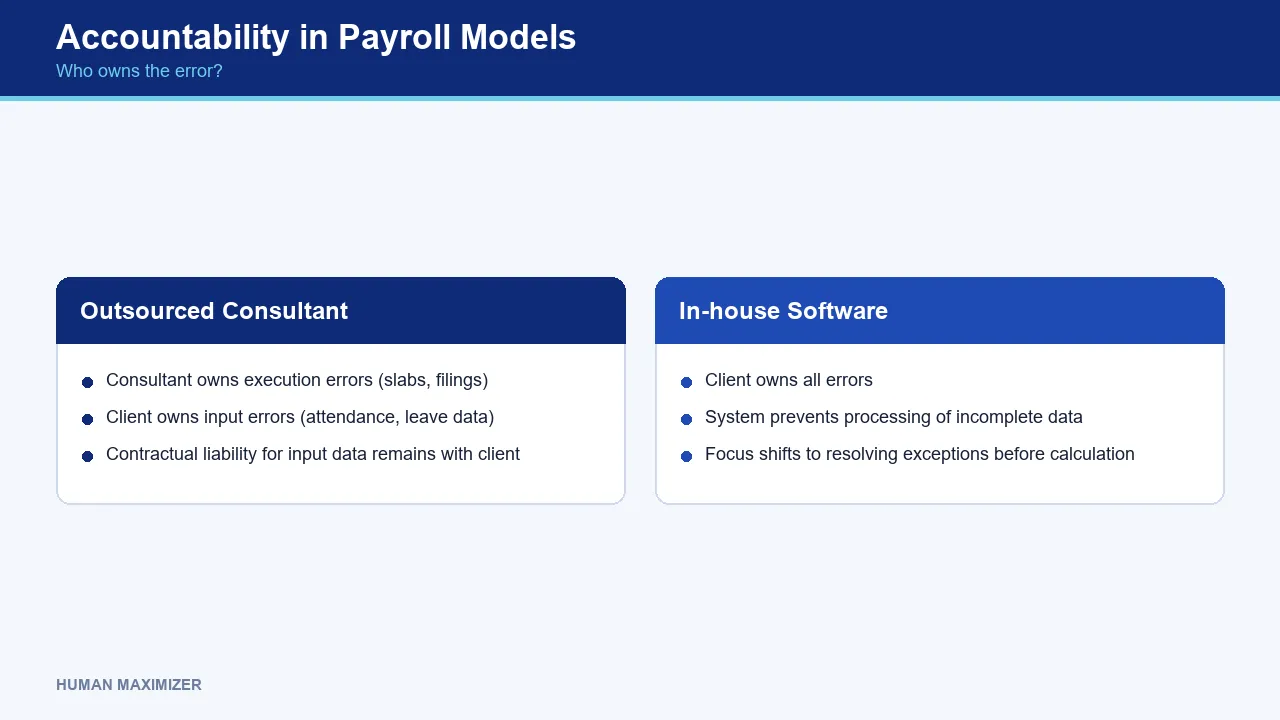
With outsourced payroll, the consultant or bureau owns execution errors: a wrong slab applied, a challan filed late, a return with a typo. What they almost never own is input errors, and the contract will say so. If you sent them attendance showing a full month for someone who was on unpaid leave for nine days, that overpayment is yours.
With in-house payroll on software, you own everything. That sounds worse until you notice how much of the error surface was already yours in the outsourced model.
Which points at the actual failure mode. Deductions go wrong far less often because someone misunderstood the PF rules and far more often because a regularisation request sat unapproved until the 29th. Teams often find, when they trace back a difficult close, that the root cause was never the calculation. It was an Attendance Management exception from the second week that nobody escalated, or a leave application still pending when the batch opened.
Which is why we designed the payroll batch to refuse to proceed on dirty inputs. A batch moves from Draft to Checking and runs a pre-check for pending leaves, pending regularizations, unapproved overtime, and missing attendance. If any are outstanding, the batch sits in Pending Resolution and the affected managers get nudged. No plausible-looking number gets computed on incomplete data. Teams that close cleanly are the ones that freeze inputs early and treat the exception list, not the calculation, as the actual job.
Our own implementation data reflects this: across 32 go-lives recorded through July 2026, the first payroll cycle after switching took about four hours, against two days on the previous system. Across a separate set of 24 clients over the same period, monthly payroll corrections dropped from 15 to 3. The corrections number is the more interesting one. It fell because exceptions surfaced before the run, not because the arithmetic got better.
Audit Season: What Each Model Actually Gives You
Quarterly Form 24Q, annual Form 16, EPF ECR files, ESI contribution files, TDS challans. Every one of these is procedural, and software should produce them without ceremony. Ours does: finance pulls ECR and ESI files straight out of the finalised batch, posts TDS challans, and generates 24Q quarterly and Form 16 annually. Employees download their own Form 16 and declare investments themselves, which removes a genuinely tedious email thread from your HR inbox.
What software gives you at audit time is completeness and traceability. Versioned salary structures, so a CTC revision creates a new revision while the old one stays intact. Timestamps. Role-based access logs. When an officer asks what this employee's basic was in August 2024, you have an answer in ten seconds rather than ten days.
What a consultant gives you is representation and narrative. They have sat in that room before. They know which questions are procedural and which are fishing. They can construct the defence of a classification decision made three years ago in a way that a PDF export cannot.
You want both, and they are not substitutes. We wrote about this trade-off from a different angle in our comparison of HRMS versus standalone payroll software, which is worth reading if you are also deciding how much of HR to unify.
The Split-Ownership Model
For most Indian SMEs between 25 and 200 people, the resolution of payroll consultant vs payroll software is not a choice at all. It is a division of labour, and the useful move is to write it down explicitly rather than letting it emerge by accident.
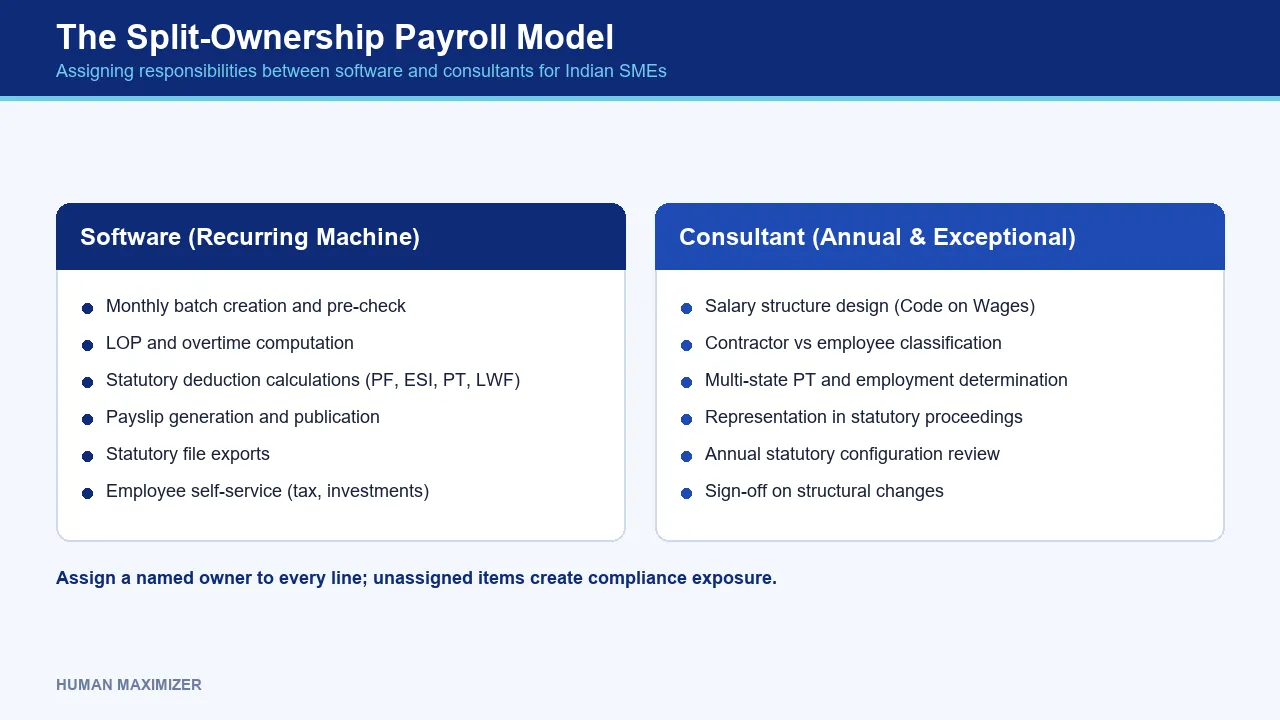
Take every payroll responsibility and assign it to one of two owners.
Software owns the recurring machine. Monthly batch creation and pre-check. LOP computation from attendance. Overtime at your configured multipliers. Statutory deduction calculation against current PF, ESI, PT, and LWF configuration. Payslip generation and publication. Statutory file exports. Employee self-service for payslips, tax regime selection, and investment declarations. Full and final settlement processing on resignation, which under the Code on Wages is expected within two working days of the last working day. Audit trail.
A consultant owns the annual and exceptional. Salary structure design against the Code on Wages basic-pay floor. Contractor-versus-employee classification. Multi-state PT and place-of-employment determinations. Representation in any PF, ESI, or income tax proceeding. Annual review of your statutory configuration against the year's notifications. Sign-off on any structural change, such as a company-wide CTC restructure or an acquisition.
Then add the connective tissue, which is where most hybrid arrangements quietly fail: the consultant should be reviewing the system's configuration, not its output. The cheap version of the hybrid model has a consultant checking the monthly payroll register. That is expensive proofreading of something that was already deterministic. The expensive version, the one that pays for itself, has them auditing your salary component definitions, your PT state mapping, and your exemption rules once or twice a year. Fix the configuration and every future month is right. Check the output and you catch one month.
You can run this as a plain checklist. Print the two lists above, put a named person against every line, and note the review date for each consultant-owned item. Any line without a name on it is your actual exposure. In practice, unassigned ownership causes more compliance trouble than genuinely difficult law does.
Where Software Should Not Be Your Answer
Some honest limits, because a vendor listing only upsides is not a useful vendor.
Retrospective mess. If you have three years of undocumented classification decisions, migrating to software does not clean them. It carries them forward with better formatting. Sort the history with a professional first, then implement. Our implementations run 7 to 10 days on average across 46 projects through July 2026, and the ones that slip past that window are almost always slipping on data quality, not on the software.
Genuine legal ambiguity. Where a state's rule is unsettled or your facts do not fit the standard pattern, configuring an answer into software gives you a position, not an answer. Configure it, then get the position reviewed by someone who will stand behind it.
Live enforcement proceedings. If you have an active 7A or an ESIC inspection underway, you need representation now and software later. Changing systems mid-proceeding complicates the record.
Tiny, static teams. Under about ten employees on fixed salaries in one state, honestly, a well-built spreadsheet and a competent accountant may be sufficient. The value of automation scales with variability, and if nothing varies, there is little to automate.
What This Looks Like in Practice
The following walks through the exception path rather than the happy path, because the happy path is not where systems earn their keep.
An employee moves from your Chennai branch to your Hyderabad office on the 12th. Two weeks later the payroll batch for the month opens.
The batch enters Checking and immediately stalls. There is a missing-attendance flag for the 12th and 13th, when the employee was travelling and neither location's biometric registered them, plus an unapproved regularisation request sitting with a manager who has been on leave. The batch does not proceed. It sits in Pending Resolution and the affected managers get nudged, which is the entire point: nothing is computed on data that is known to be incomplete. The manager approves the regularisation from the mobile app, the Leave Management record reconciles, and the batch clears to Ready.
Now the interpretive question surfaces, and it surfaces before finalisation rather than during an inspection eighteen months later. Which state's Professional Tax applies for this month? The system applies whatever the salary structure's PT state mapping says. That mapping is a decision somebody made. If your consultant has reviewed your multi-state PT logic in the annual configuration audit described above, the answer is already correct and defensible. If nobody has, the system will produce a confident number that may be wrong, and it will keep producing it every month until someone asks.
Split ownership working exactly as intended looks like this. The software caught the input exception and refused to guess. The human had already settled the interpretive question. Neither could have done both.
For teams setting this up from scratch, our step-by-step guide to implementing payroll software in India covers the configuration sequence in more detail than fits here.
Frequently Asked Questions
We already have a CA who does our returns. Do we still need payroll software? Almost certainly, and for a reason that has nothing to do with your CA's competence. Your CA works on the output you hand over, which means the accuracy of attendance capture, leave balances, and approval timing is still entirely yours. Software owns the input machine; your CA sits in the consultant column of the split-ownership model above, reviewing configuration rather than re-adding your register.
Our consultant charges a flat retainer. Isn't that simpler than paying per user forever? Simpler to budget, yes. But a flat retainer prices execution, not interpretation, and the two move in opposite directions as you grow: transactional volume rises with headcount while interpretive risk rises with the number of states and contract structures you touch. Ask your consultant what portion of the retainer covers representation in a 7A proceeding. That answer tells you what you are actually buying.
What breaks first when an SME runs payroll in-house on software? Configuration goes stale. A statutory change lands, nobody updates the setup, and the system applies the old rule with total consistency until an audit finds it. The second failure is input discipline, because software amplifies whatever data hygiene you already have, in both directions.
Can software replace a payroll bureau entirely? For execution, often yes. For representation, no. A bureau accepts contractual responsibility for filings in a way a licence agreement does not, which for some businesses is worth paying for on its own. That is precisely the line the split-ownership model draws.
Conclusion
Return to the employee who moved from Bengaluru to Gurugram mid-month. Their PF is straightforward, their ESI is straightforward, their TDS is straightforward. The only genuinely hard question is which state's Professional Tax applies, and that is an ownership question rather than a software, consultant, or cost question. In most SMEs the honest answer is that nobody owns it.
Write down the split. Give every interpretive line a name and a review date, give the procedural work to a system that refuses to run on bad data, and stop treating this as a purchase decision between two vendors. Under the enforcement posture the Code on Wages sets up, a wrong classification does not stay wrong for one month. It compounds quietly across every cycle until somebody with statutory authority asks you to explain it.
Ready to hand the procedural half to something that stalls instead of guessing? Take a look at how Human Maximizer runs a payroll cycle.
About the Author & Reviewer
Nishant Tandon — Co-founder & Lead Partner, Razor Infotech
Nishant Tandon is Co-founder and Lead Partner at Razor Infotech, with over a decade in IT, customer support and business operations, helping SMEs achieve cost efficiency, stronger customer experience and scalable, sustainable growth.
Connect on LinkedIn
Reviewed & approved by Sameer Hameed — Founder & Chairman, Razor Infotech
Sameer Hameed is the Founder & Chairman of Razor Infotech, where he is guiding the creation of Human Maximizer. An entrepreneur across technology, real estate, mining and travel, he builds organisations on clarity, trust and responsible growth — on the belief that businesses grow only when the people behind them grow.
Connect on LinkedIn
Human Maximizer is built by Razor Infotech in New Delhi, India (founded 2019). About Human Maximizer.
Keep reading
Payroll
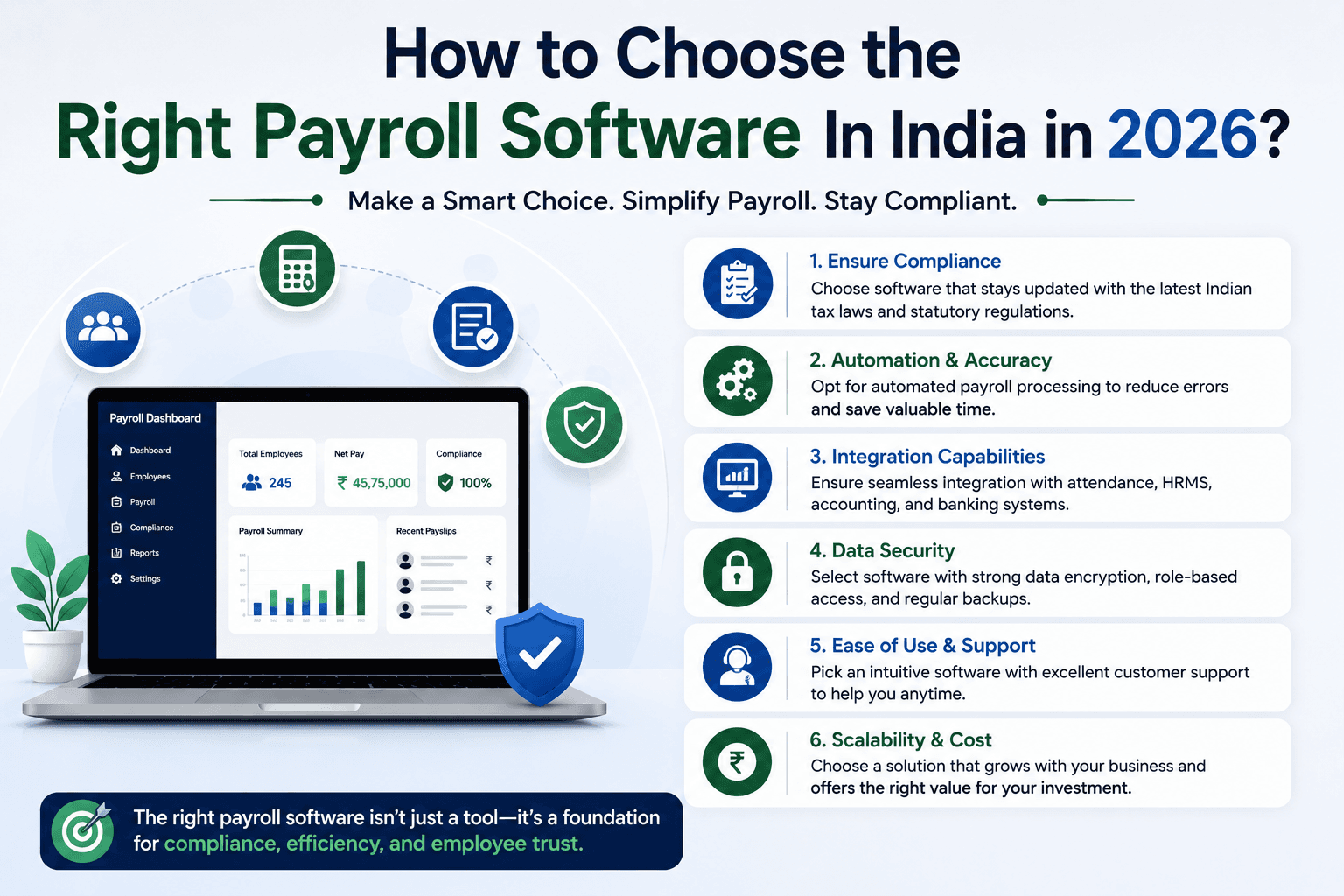
How to Choose the Right Payroll Software In India in 2026?
Facing issues in salary calculation? Choose the right automated payroll software. Learn the 7 questions to ask before buying in 2026, including hidden compliance costs and implementation timelines.
5 min read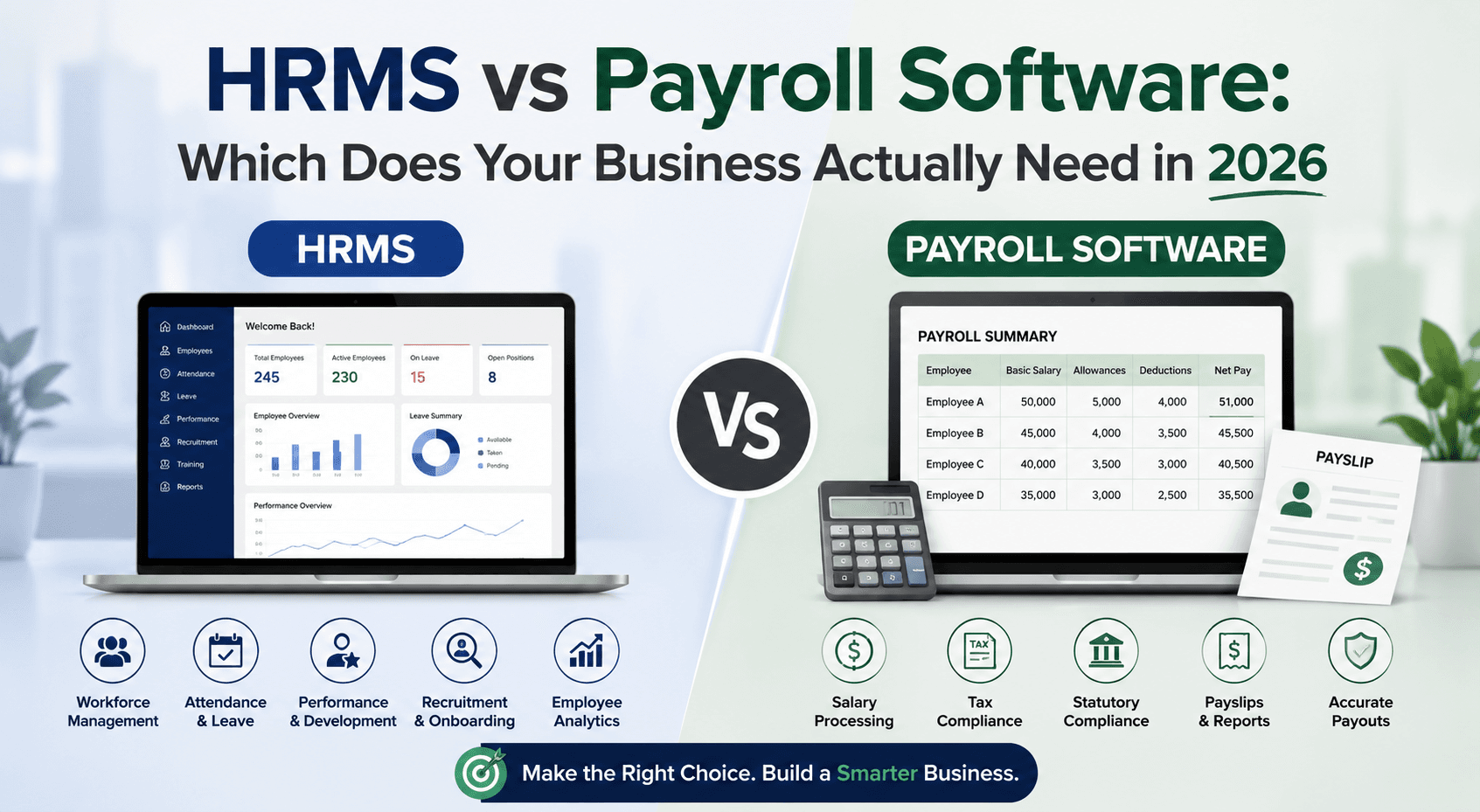
HR Strategy
HRMS vs Payroll Software: Which Does Your Business Actually Need in 2026
Are you confused about choosing HRMS vs payroll software in India for your business? Compare the main features and invest wisely in tools to get high ROI.
5 min read
Payroll
Ffs full form in salary
FFS stands for Full and Final Settlement — the last payout when you leave a job. What it includes, how it is calculated, and the deadline to pay it.
8 min read