
HR Strategy
HRMS vs Payroll Software: Which Does Your Business Actually Need in 2026
Are you confused about choosing HRMS vs payroll software in India for your business? Compare the main features and invest wisely in tools to get high ROI.

Richa Thakur
Content Writer · 5 min read · · Updated
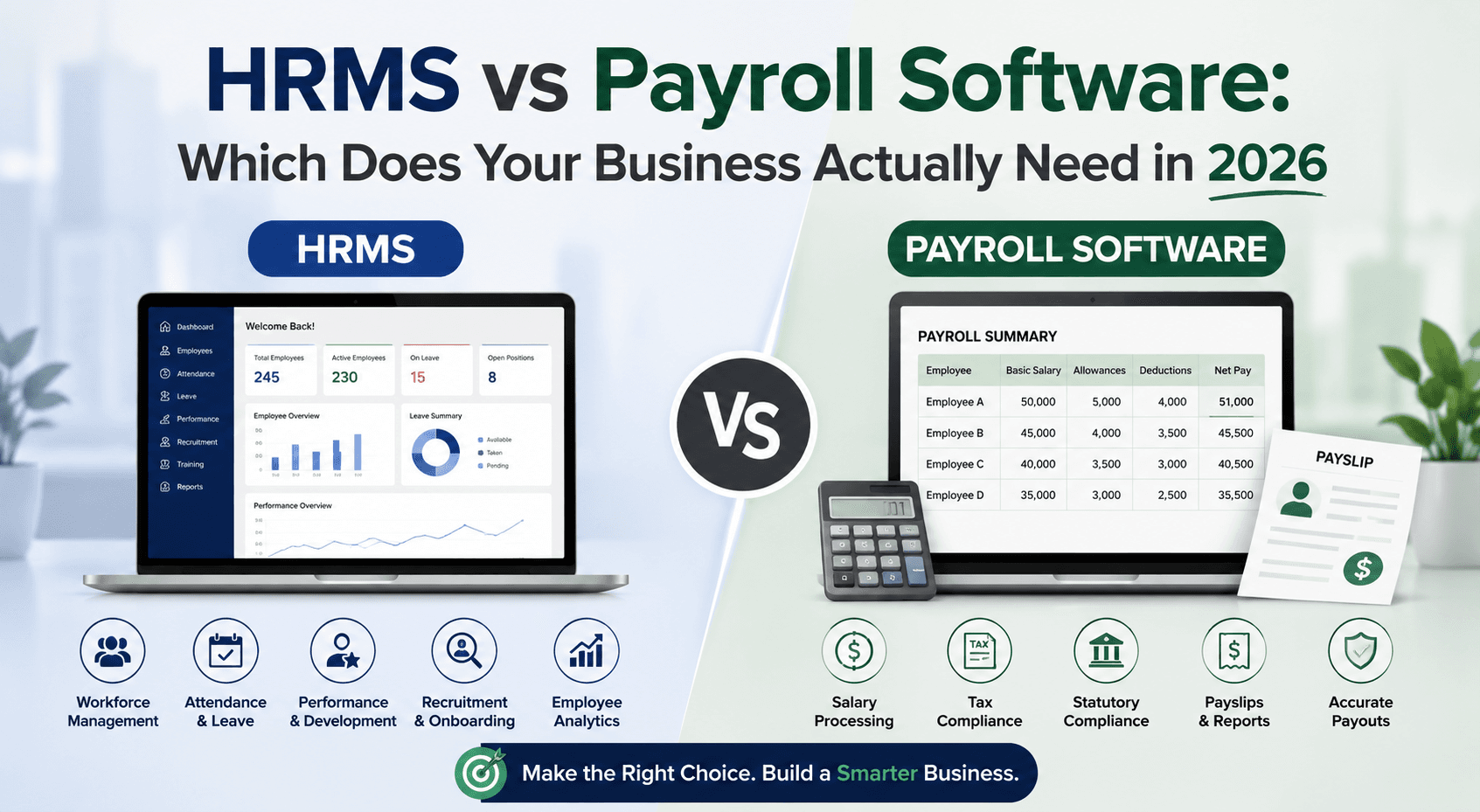
When the business grows, managing employees and administrative tasks becomes the main responsibility of the HR department. Imagine it’s the 28th of the month and payroll is due in two days. HR is frustrated with scattered data across Excel sheets, and employees are arguing over the leave balances. Does this situation sound familiar?
Organisational administrative tasks include tracking attendance, managing employee records, recruiting top talent, and calculating employees' salaries. These repetitive tasks lack the time for employee engagement and collaboration across the organisation.
If the HR switches to modern software, the confusion of HRMS vs payroll software in India is commonly seen. While these modern tools sound familiar, they perform different tasks. The decision of choosing the right software can transform the way your business runs.
This guide cuts through the confusion, so you can make the right decision to grow your business. In this comprehensive guide, we’ll understand the main difference between payroll and HRMS software, what its core features are, final costs, and benefits, so you don’t face any hurdles while operating business tasks.
As per the Folks 2026 State of HR Survey, a leading Canadian HR software solution says that HR professionals in SMBs spend most of their time on administrative and operational tasks. The survey shows that over 450 HR professionals across Canada report that a staggering 70% of HR time is required for operational tasks, making it difficult for HR to focus on strategic priorities and engagement.
What is Payroll Software?
Payroll software is a smart and digital software that manages, maintains and automates employee payment accurately on time. Apart from salary calculation, it handles statutory deductions, tax compliance and payroll processing.
By replacing manual calculations, spreadsheets, and fragmented sheets with automation, payroll management software provides a centralised space for salary calculation and ensures compliance with government regulations.
Key functions of payroll software are:
Automates net-to-gross pay calculations, including deductions for taxes, benefits and retirement contributions.
Updates tax laws, files taxes ad generates reports to meet legal requirements.
Allows employees to access and manage their own pay stubs and tax information.
Monitors working hours, leave balances and attendance records.
Deposits salary directly into the employees' bank accounts.
When Should You Choose Payroll Software?
Every organisation needs payroll software to manage employee payments based on their shift hours, working hours, and days. Here comes a payroll software that digitalises the complete process without any manual errors. Payroll suits businesses with:
For emerging startups requiring limited HR operations.
Focuses mainly on accurate and compliant salary processing
Uses manual methods or separate tools for performing HR tasks
Looking for an affordable option
For example, the Olive Branch restaurant in an English market town has been operating since 2017. Their team seasonally fluctuates between 10 and 18 and follows simple hospitality roles with compliance needs.
Payroll management software efficiently calculates salaries, manages compliance requirements accurately, making it suitable for the company's needs, strictly administrative, like pays, taxes and compliance and fulfils the demand for cost optimisation over feature maximisation.
What is HRMS?
HRMS, commonly known as HCM ( Human Capital Management) software. This software manages the entire employee lifecycle and HR operations. It performs the core HR tasks such as employee data management, tracking attendance and leave records, and processing payroll, along with evaluating performance and predictive analytics for productivity and sustainability.
A modern HRMS provides advanced talent management capabilities that comprise recruiting, onboarding, performance, goal planning, learning and succession planning. With the involvement of AI, HR leaders can replace traditional and outdated methods, including spreadsheets, paperwork and physical documentation, with automation that saves time and human efforts.
HRMS software not only improves work efficiency and reduces manual errors but also ensures the delivery of insight reports and metrics to make informed decisions for optimising workforce planning.
Professionals Utilise HRMS Software for Daily Tasks:
HR Leaders: HRMS automates the repetitive tasks from employee data management to recruiting and onboarding employees. With HRMS, they are capable of delivering complex data-driven insights into simple reports.
Managers & TL: Oversee team structure, track shift hours, approve leaves, track employees' performance and break durations to deliver feedback. They can assign tasks, check task status and give remarks.
Employees: Access to self-service portals to view and update personal and bank details, understand organisational data, and holiday lists. They can download payslips, utilise e-learning modules, guides and resources.
Candidates: Applicants can use dedicated HRMS portals to search jobs, track their application status and accept digital offers without paperwork.
When should you select HRMS for your Organisation?
With the scalability of businesses, demand for operational work increases. Using traditional methods will only create frustration, delays and inaccuracy. Therefore, in India, organisations consisting of 50 to 200 employees need an HRMS software to streamline administrative tasks in a centralised place.
Companies can invest in HRMS in certain cases:
Operating a business on a medium or large scale across different locations or departments.
Automating and streamlining the employee records with analytics.
Fostering employee development, engagement, performance and participation.
Making future decisions with HR metrics and reports.
Let’s understand how HRMS software benefits organisations with the help of a real-life example:
A pharmaceutical company with 500-plus employees operating across multiple locations. HR leaders were frustrated with the operational workforce related to leave policies, ensuring accurate payroll processing and managing employee queries.
By implementing HRMS software within their organisation, the operational tasks were automated, such as:
Payroll processing with full accuracy
Employee query resolution
Ticket raising
Does HRMS include Payroll?
HRMS and payroll are broad categories of human resource management. HRMS software manages complete employee data for administrative tasks, whereas payroll software's primary focuses on salary calculation, statutory compliance, and tax deductions.
With the modernisation and advancement, HRMS tools come with built-in payroll functionality.
With smooth payroll integration with HRMS, organisational attendance data can be reflected in the payroll calculation, reducing errors and duplication.
For smooth functioning, it is pivotal to choose a compatible and secure system that protects sensitive data from data breaches and cyber threats.
Let’s understand how the system works by combining HRMS with the payroll module:
When an employee updates bank details through the employee self-service portals in HRMS, that change will automatically reflect in the payroll process. This method not only reduces the manual errors but also speeds up the complete operations.
When should a business switch from payroll software to HRMS?
When a business is operating on a small scale, payroll software manages the employee payments, including OT, shift hours and days. But when the administrative tasks increase, the need for HRMS software arises, and companies must invest in the right software after evaluating the key features. Read the various reasons that lead businesses to switch to HRMS software:
Security Concern: Employees' sensitive data is crucial for payroll processing, and the security requirements are minimal in payroll software, which can be a primary target for cyber attackers.
Lack of Analytics: Payroll software only automates the complete employee payments and manages statutory compliance. It lacks the ability to provide HR metrics and insights. Whereas HRMS software helps managers and leaders to deliver feedback and take actions based on data-driven facts and analytics.
Manual Data Entry: To transfer attendance and leave data into the payroll system, HR spends a massive amount of time on manual data entry for payroll processing.
Fragmented Systems: Employees' data are scattered across multiple, non-integrated tools specifically for attendance and leave records, challenging the data management process.
No ESS Portal: Even with payroll software, employees approach HR managers for generating payslips, tax forms, or leave balances. But HRMS software offers a self-service portal enabling employees to view and update.
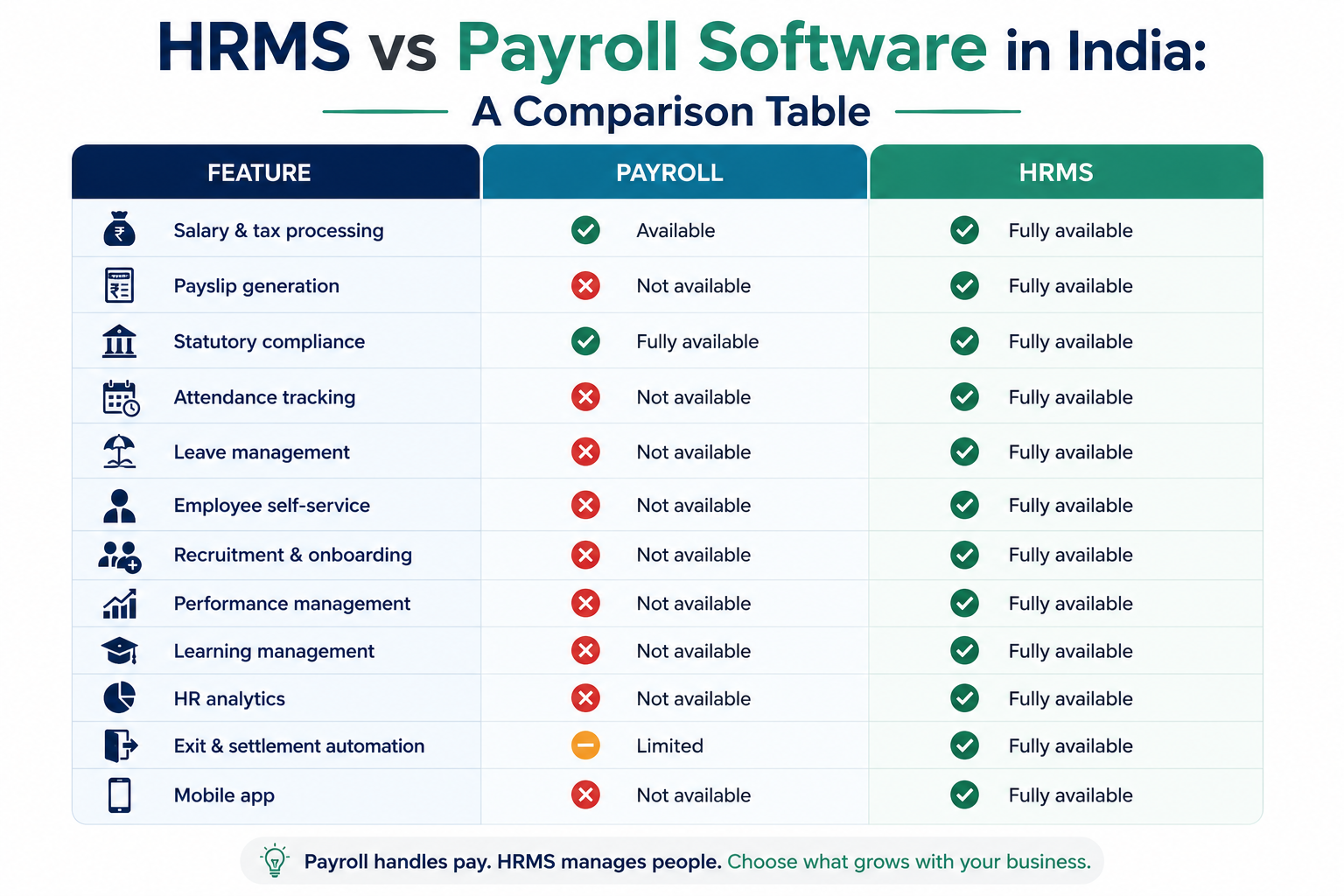
What features does HRMS have that payroll software doesn't?
Organisations rapidly use payroll software to pay their employees. What if your organisation requires operational work management with existing payroll software? Can your payroll software track sick leave requests, approve expense claims, or automate an exit payout?
Thinking of HRMS as an expensive payroll software, then it's like assuming a smartphone is an expensive calculator. To clarify this difference, you need to understand the advanced features of HRMS that payroll lacks.
Attendance Management with Biometric & Geo-Fence
Payroll software generally calculates employee wages based on the available data. HRMS tools add biometric, geo-fenced attendance management for onsite, hybrid, remote and field workers all directly into a payroll without CSV imports.
Core features of HRMS software are:
Displays the holiday calendar across different states in India
Automatically carry forward and encash calculation
Shift management and roaster planning
Geo-fence-based attendance for field and remote workers
Employee Self-Service Portals
HRMS tools provide a self-service portal to individuals that allows them to access their personal and banking details. Through ESS portals, they can view, edit or update details as per the requirements. It offers advanced features for generating and downloading payslips and tax forms.
Mobile Application
HRMS tools allow employees to manage their tasks from their mobile phones. HRMS tools support mobile apps for iOS and Android. Employees often approach the HR department for payslips, leave balances and holidays. With mobile accessibility, they can navigate easily and take actions.
Smooth Integration with Business Tools
A smart HRMS tool seamlessly integrates with existing platforms and business tools for performing operational workflows. HR leaders can create job postings and connect effortlessly on job portals such as LinkedIn, Naukri and Indeed.
Banking software is interconnected for direct salary transfers, while communication tools like Slack, Google Meet, and Microsoft Teams integrate with the software and navigate the workforce management efficiently.
Data Security & Privacy
HRMS software manages the employees' sensitive data, including personal, bank details, tax records, and employee salaries. All the essential data is end-to-end encrypted and secured from cyber threats. In case of accidental factors and disaster, the software consists of backup capabilities and recovery.
HR Analytics & Live Dashboards
Modern HRMS tools include real-time HR analytics and dashboards for workforce planning, attrition trend and headcount forecasting. Data-driven facts and reporting save long hours for audits, appraisals and board presentations. With the HR metrics and reports, managers and leaders can evaluate the team and individual performance.
Conclusion
Now, you know about how to choose from HRMS vs payroll software in India. For emerging startups and small businesses, payroll software ensures that employees' wages are accurate and paid on time. Alternatively, HRMS software streamlines the core HR tasks from recruiting to retiring, managing attendance, leave, shift, performance, and employee engagement all at a single platform.
Businesses seeking a scalable and sustainable service that promotes employee experience, helps in data-driven HR decisions, and strategic workforce planning, investing in HRMS software is a capital investment.
Are you looking for the right HRMS software that integrates a payroll solution to handle complex Indian business in 2026? Choose Human Maximizer for automating repetitive core HR tasks and handling PF, ESI, and TDS compliance efficiently. It is designed especially for Indian businesses requiring compliance management and support at an affordable rate. For more details, you can contact our team of professionals and inquire about additional details.
Frequently Asked Questions
Can payroll software replace HRMS?
No, payroll software can’t fully replace HRMS software in India. It is an essential tool to calculate employees' wages, ensuring compliance and tax deductions, but lacks in streamlining core HR functions such as performance review, task management, hiring and retiring.
Is HRMS necessary for small businesses in India?
Yes, HRMS is essential for small businesses in India as it processes payroll, manages remote teams, reduces errors and saves time. It offers a high ROI by reducing the need for large HR teams.
Can you use Excel for payroll?
Yes, you can use Excel for payroll, especially for small businesses with a limited number of employees. It’s a cost-effective and flexible option to calculate wages, performing basic deductions and formulas. However, it can cause manual errors and consume extensive time.
Which is the best HRMS and payroll software available in India?
The best HRMS software in India usually depends on the business size, requirements, processing time, and cost. If you’re looking for an HRMS software with an integrated payroll module, then Keka, Human Maximizer and greytHR are the best options to automate your entire workforce management.
Can small businesses use HRMS for operational workflows?
Yes, small businesses and startups can use HRMS software for automating their repetitive operational tasks. It reduces manual errors and protects businesses from legal penalties. There are modern, cloud-based HRMS tools available in the market which are especially designed for small businesses at an affordable rate.
When to upgrade from payroll software to HRMS?
Organisations can upgrade from payroll software to HRMS with the significant growth in headcount or when manual processes such as tracking, attendance, leave and onboarding in spreadsheets lead to frequent errors and compliance risks.
Keep reading
Payroll
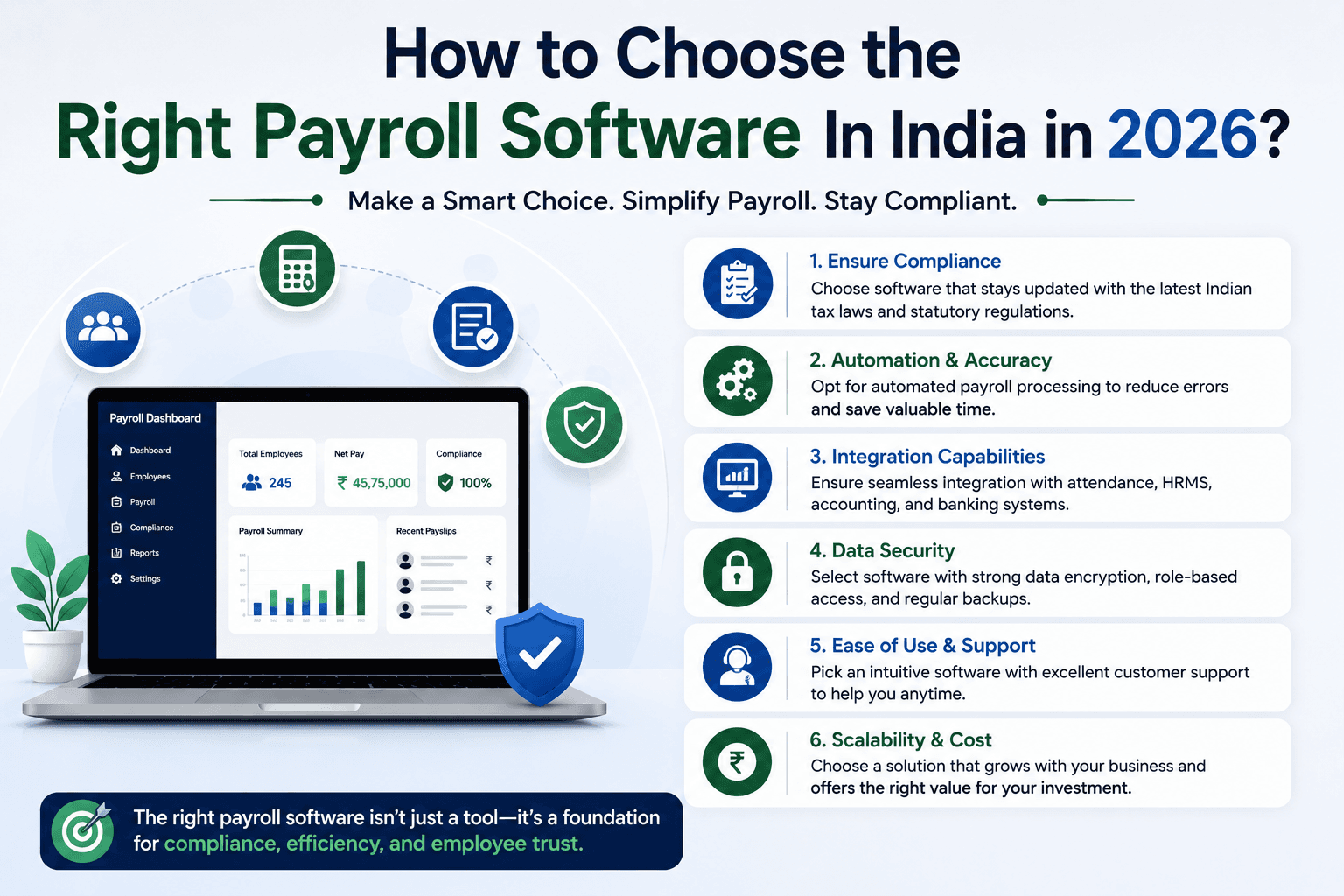
How to Choose the Right Payroll Software In India in 2026?
Facing issues in salary calculation? Choose the right automated payroll software. Learn the 7 questions to ask before buying in 2026, including hidden compliance costs and implementation timelines.
5 min read
Payroll
8 Payroll Trends Shaping HR Teams in 2026 (And How to Prepare)
In India’s midmarket enterprises, a familiar pattern is emerging this fiscal year. A company updates its salary structure to match revised market benchmarks, only to have the chang
9 min read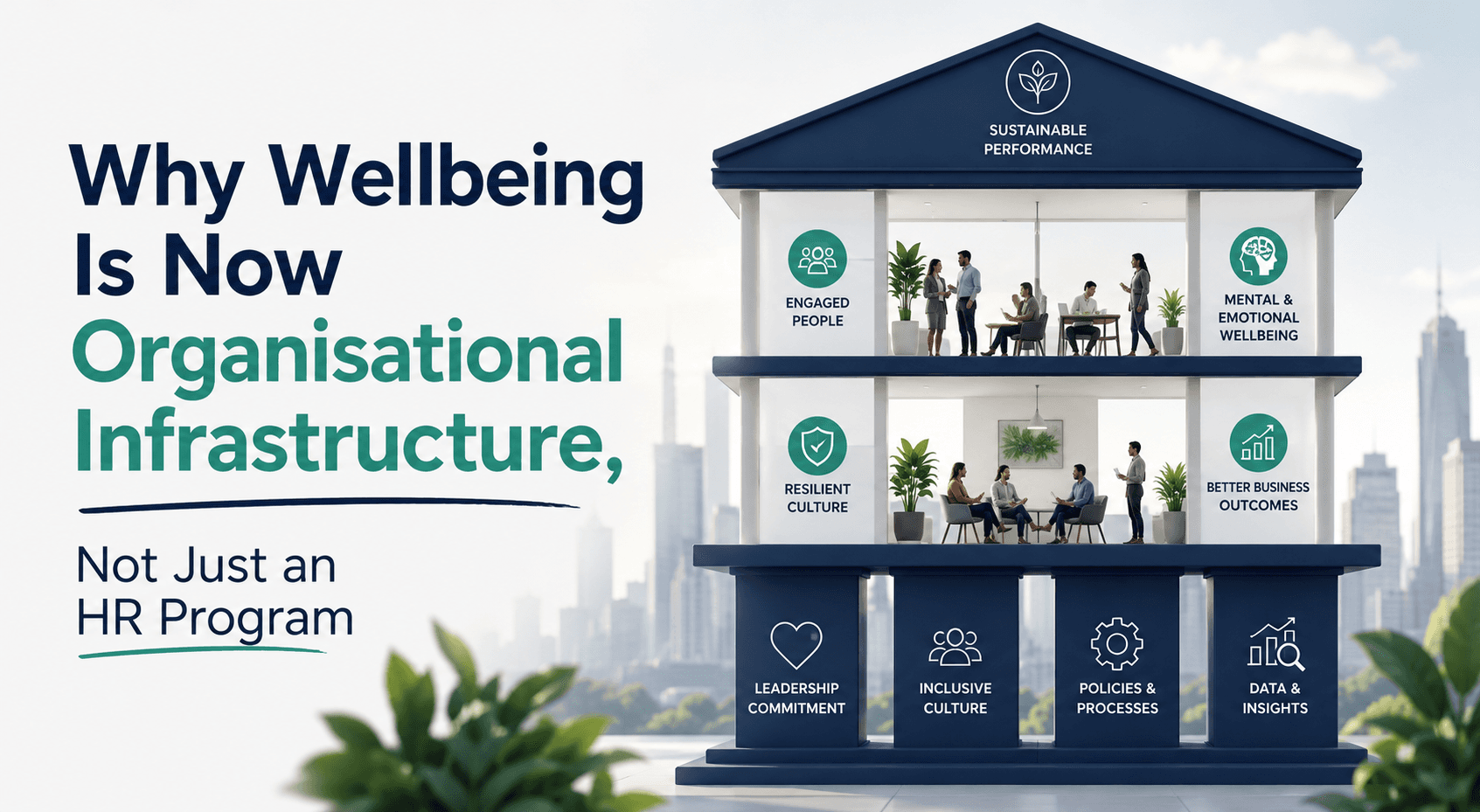
HR Strategy
Why Wellbeing Is Now Organisational Infrastructure, Not Just an HR Program?
Struggling with a high attrition rate? Build an organisational structure by promoting employee well-being through a positive work environment, increased job satisfaction, participation and engagement.
5 min read