
Payroll
8 Payroll Trends Shaping HR Teams in 2026 (And How to Prepare)
In India’s midmarket enterprises, a familiar pattern is emerging this fiscal year. A company updates its salary structure to match revised market benchmarks, only to have the chang

Chandan Watts
Technical Product Manager, Human Maximizer (Razor Infotech) · 9 min read · · Updated

In India’s mid-market enterprises, a familiar pattern is emerging this fiscal year. A company updates its salary structure to match revised market benchmarks, only to have the change trigger a cascade of reconciliation errors across PF, ESI, and Professional Tax calculations during the month-end close. The payroll team spends the next forty-eight hours manually tracing the drift between the HRMS and statutory portals, not because the math is hard, but because the inputs were fragmented. By the time the challans are paid, the team is already behind on the next cycle.
Indian companies are entering FY 2026–27 under increasing regulatory pressure. With budget revisions affecting tax slabs and statutory thresholds, the margin for error has vanished. This environment is forcing a shift in how HR teams handle their most sensitive process.
1. The Rise of Real-Time Payroll Integrity
Payroll is no longer a "batch-and-forget" monthly event. As organisations scale, the delay between a salary change and its reflection in the payroll system becomes a liability. Real-time payroll analytics are becoming the standard, allowing HR to identify anomalies—such as an unexpected drop in HRA or a missing statutory contribution—the moment a calculation is run, rather than at the midnight deadline. This shift reduces the "firefighting" nature of month-end closures.
Pro-Tip: Use a system that logs the "provenance" of every component change. If an HRA value shifts, you should be able to see if it was a manual override or a system-calculated update in one click.
2. Dynamic Statutory Compliance
Compliance is no longer static. With constant updates to PF ceilings and state-specific tax slabs, relying on hard-coded formulas is a risk. Forward-thinking teams are moving toward dynamic statutory formulas that allow for immediate adjustments without waiting for a software vendor update or manual spreadsheet overrides. When a government notification lands, the system should be ready to apply the change across the board on the effective date, not weeks later.
Pro-Tip: Audit your payroll engine against the Code on Wages, 2019 to ensure your definition of "wages" for PF/ESI calculations remains compliant with the latest statutory interpretations.
3. Transparency as a Retention Tool
Employees are increasingly sensitive to the "why" behind their take-home pay. Pay transparency is moving from a buzzword to a functional requirement. Modern payroll systems now provide granular breakdowns where employees can see exactly how their net pay is derived, including the impact of salary holds, arrears, or tax regime shifts. When employees understand their pay, the number of "payroll query" tickets drops significantly.
Pro-Tip: Provide a "Tax Regime Comparison" tool within the employee portal so staff can simulate the impact of the old vs. new tax regime on their own take-home pay before the declaration deadline.
4. The Shift Toward Agentic AI Processing
AI payroll processing is moving beyond simple automation. In 2026, we see payroll engines that function as agents: they don't just calculate; they audit. They flag if a mid-cycle salary revision lacks an approved document, or if an attendance exception conflicts with a statutory leave rule. This "agentic" layer acts as a silent auditor, ensuring that every batch is clean before a human even clicks 'Finalise'.
Pro-Tip: Configure your AI agent to flag "Salary Hold" aging—anything over 60 days should trigger an automatic notification to the HRBP to resolve the case.
5. Unified Data Ecosystems
Disconnected tools are the primary cause of reconciliation lag. When attendance, leave, and payroll live in different silos, data drift is inevitable. We consistently observe that the most stable payroll teams are those that consolidate these functions into one platform. When a manager approves an overtime request on a mobile app, the payroll engine should account for it automatically. No manual exports. No CSV uploads.
Pro-Tip: Map your RACI Dashboard to your payroll approval workflow so that every stakeholder—from finance to HR—knows exactly who is accountable for the final batch sign-off.
6. Self-Service for Statutory Queries
HR teams are reclaiming their time by pushing statutory clarity to the employee. Instead of manually explaining TDS calculations or PF eligibility, modern platforms use Ticket Management systems that categorize and route queries based on pre-set policy rules. This ensures that an employee’s question about their Form 16 reaches the right person instantly, with an SLA timer ticking in the background.
Pro-Tip: Create a "Statutory FAQ" library within your ticket system that auto-suggests answers based on the employee's query keywords, reducing the volume of repetitive tickets by up to 40%.
7. Intelligent Salary Holds
Managing salary holds used to be an ad-hoc spreadsheet task. In 2026, Salary Hold has become a first-class workflow. HR can now tag a hold with an effective date and a release trigger, ensuring that once a condition is met, the payroll engine automatically integrates the release into the next run. This eliminates the "forgotten hold" that leads to painful manual adjustments later.
Pro-Tip: Always attach a digital document or approval trail to a salary hold request so that the audit trail is preserved for the next internal or statutory review.
8. FNF Automation
Full and Final settlements are the most complex aspect of payroll because they rarely align with the monthly cycle. By separating FNF payroll into its own batch type, companies can move an employee from "Resignation" to "Settled" in days rather than waiting for the next month-end. This is crucial for maintaining a positive offboarding experience and closing statutory records accurately.
Pro-Tip: Use a dedicated FNF checklist that triggers asset clearance and final payout calculations simultaneously, ensuring no company property is left unrecovered.
When These Payroll Trends Have Limits
While automation is essential, every team should recognise three areas where technology must be supplemented by human judgment: 1. Ambiguous Labour Disputes: When statutory interpretation is disputed or subject to litigation under the Factories Act, 1948, an automated formula cannot replace legal advice; always consult a labour law expert. 2. High-Stakes Negotiations: For sensitive executive compensation or complex retention packages that fall outside standard structures, manual review is necessary to avoid system errors. 3. Complex Regulatory Discrepancies: In cases where portal-side data (like a mismatch on the EPFO site) requires manual intervention or physical office visits, software can flag the error, but the resolution requires human action.
Preparing for the Future
The goal of payroll automation trends 2026 is not just to speed up calculation, but to build a process so robust that it becomes invisible. Across India's mid-market enterprises, we see that the most successful teams are those that transition from manual reconciliation to automated, audit-ready workflows.
If your team is still spending the last week of every month chasing manual inputs or fixing reconciliation errors, the process is working against you. See how Human Maximizer handles your specific payroll complexity.
FAQ
How can I ensure my payroll process is compliant with the latest Indian labour codes? Focus on centralising all salary components, leave data, and attendance records into a single system that supports dynamic formula updates. This allows you to apply statutory changes across your entire workforce instantly without manual recalculations.
What is the biggest risk in payroll automation for Indian SMEs? The biggest risk is data drift between the payroll system and statutory portals like EPFO or ESIC. This usually happens when mid-cycle changes—like salary revisions or late attendance regularisations—are not synced in real-time, leading to discrepancies during the challan filing process.
How does real-time payroll help in reducing employee queries? Real-time payroll increases transparency by providing employees with immediate access to their salary breakdowns. When they can see how their net pay is calculated, including the impact of taxes and deductions, they are far less likely to raise tickets regarding their payslips.
About the Author & Reviewers
Chandan Watts — Technical Product Manager, Human Maximizer (Razor Infotech)
Chandan Watts is Technical Product Manager at Razor Infotech, building the Human Maximizer HR platform. After years leading customer-experience and team operations at JindalX and Radical Minds, he focuses on how teams actually work day to day — and how small workflow gaps quietly slow an entire team down.
Connect on LinkedIn
Reviewed & approved by Sameer Hameed — Founder & Chairman, Razor Infotech
Sameer Hameed is the Founder & Chairman of Razor Infotech, where he is guiding the creation of Human Maximizer. An entrepreneur across technology, real estate, mining and travel, he builds organisations on clarity, trust and responsible growth — on the belief that businesses grow only when the people behind them grow.
Connect on LinkedIn
Reviewed & approved by Nishant Tandon — Co-founder & Lead Partner, Razor Infotech
Nishant Tandon is Co-founder and Lead Partner at Razor Infotech, with over a decade in IT, customer support and business operations, helping SMEs achieve cost efficiency, stronger customer experience and scalable, sustainable growth.
Connect on LinkedIn
Human Maximizer is built by Razor Infotech in New Delhi, India (founded 2019). About Human Maximizer.
To see how onboarding, attendance, payroll and the rest work together in one platform, explore Human Maximizer.
Keep reading
Payroll
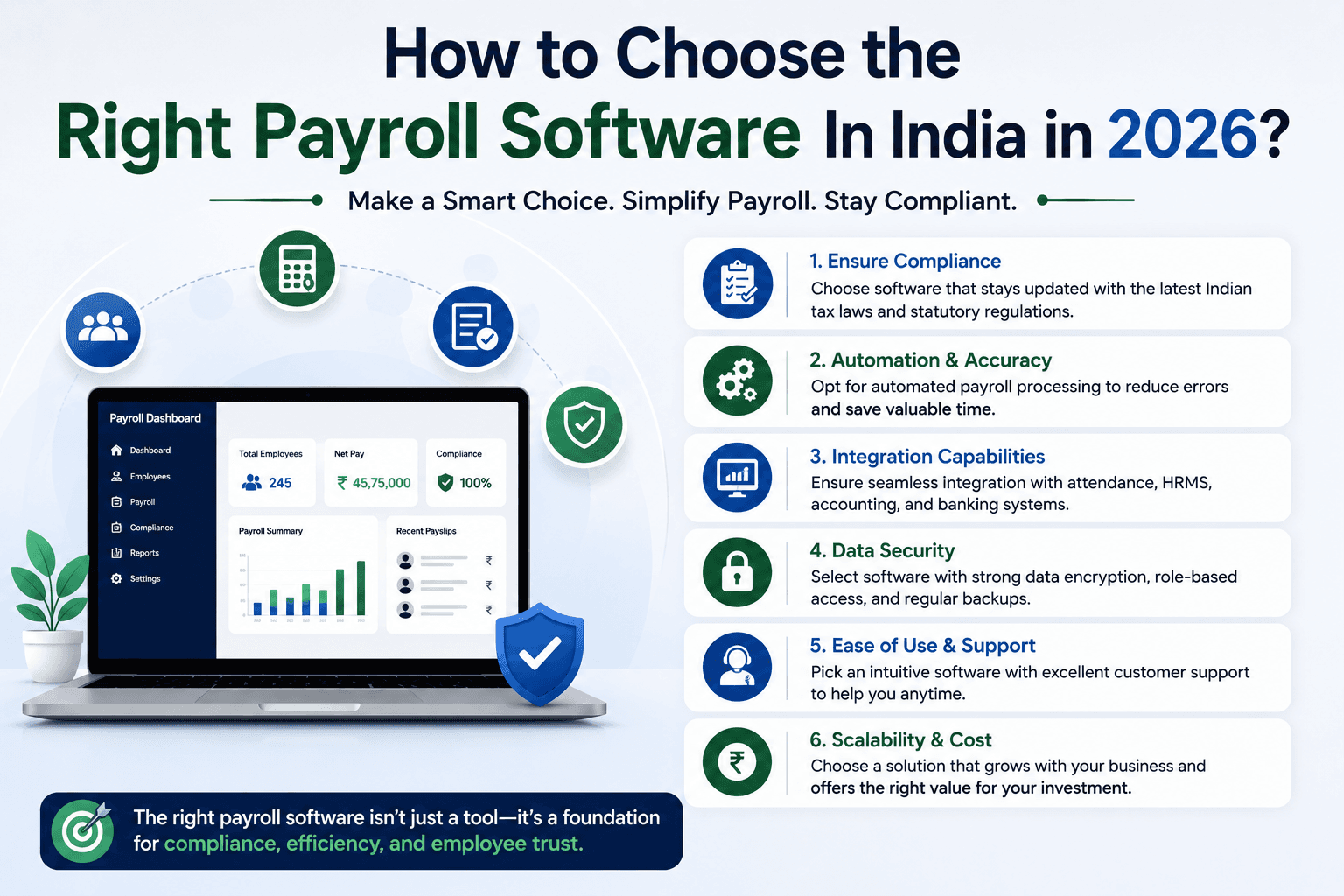
How to Choose the Right Payroll Software In India in 2026?
Facing issues in salary calculation? Choose the right automated payroll software. Learn the 7 questions to ask before buying in 2026, including hidden compliance costs and implementation timelines.
5 min read
Compliance
The HR Tax: Calculating the Real-World Cost of Disconnected Data in Your Payroll Cycle
Disconnected HR data quietly inflates every payroll cycle. How to work out your real payroll processing cost and the compliance risk inside it.
14 min read
Payroll
How to Set Up Payroll Software in India 2026?
Switching to a new payroll system? Understand the step-by-step process to set up payroll software. Schedule a demo with Human Maximizer to streamline pay, tax rules and benefits.
5 min read