
HR Strategy
Why Wellbeing Is Now Organisational Infrastructure, Not Just an HR Program?
Struggling with a high attrition rate? Build an organisational structure by promoting employee well-being through a positive work environment, increased job satisfaction, participation and engagement.

Richa Thakur
Content Writer · 5 min read · · Updated
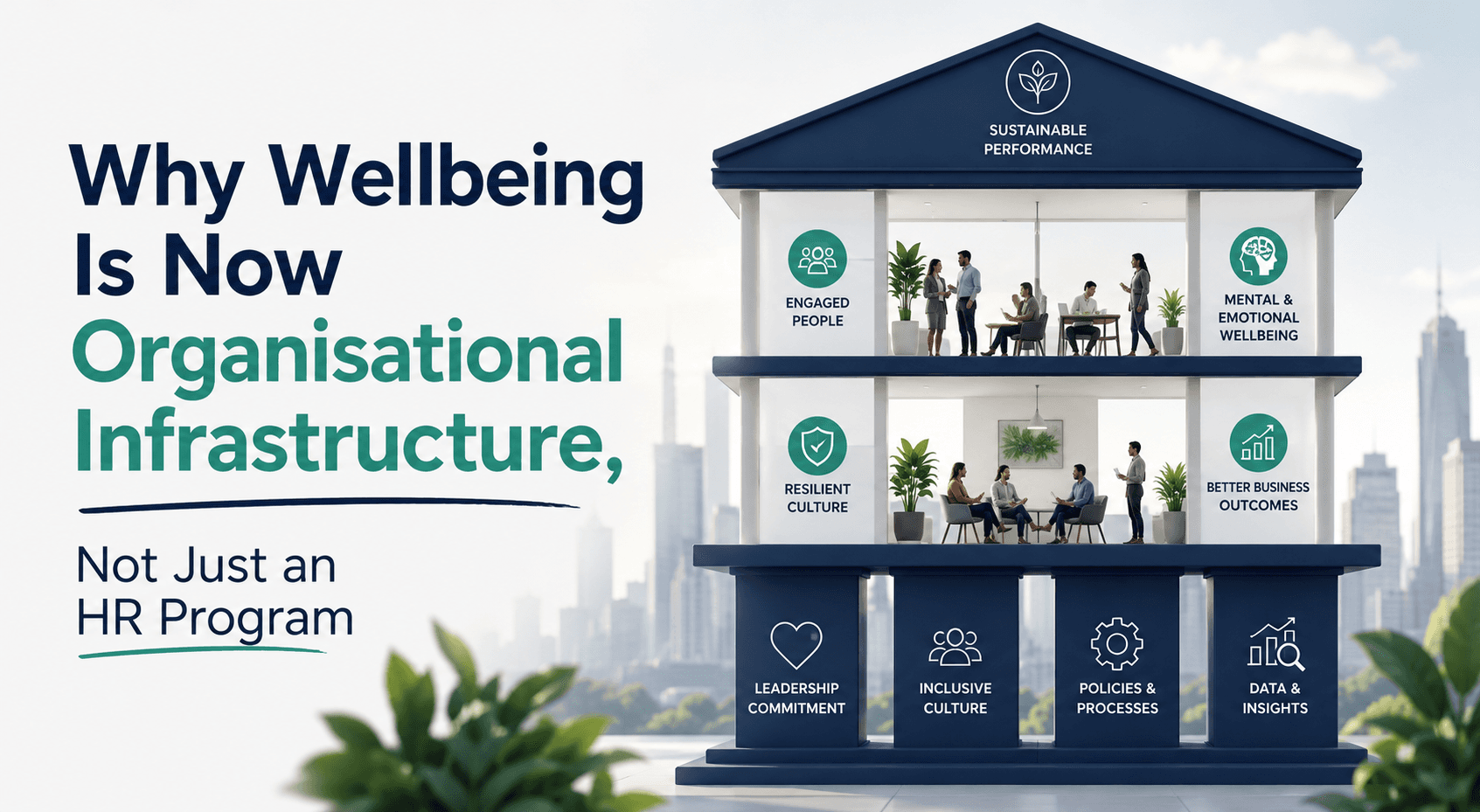
According to research conducted by the McKinsey Health Institute and associated literature, integrating well-being into leadership and company culture often yields significant productivity gains, ranging from 10% to 21%. In the modern work environment, employee well-being and organisational performance are interconnected. Businesses depend upon cognitive work and employee well-being as a business strategy, analytical clarity and sound judgments.
In most organisations, employee well-being remains anchored within the HR department. Well-being is measured through employee engagement, participation, surveys, programs and periodic feedback. These indicators only reflect the useful insights and metrics rather than fully capturing the organisational functioning and setup within the system.
Today, we’ll understand how outdated HR models are failing to provide employee well-being, and numerous ways to turn well-being into a business strategy.
Why the Old HR Model is Failing Employee Wellbeing?
The conventional HR model fails to offer a soft, optional perk rather than a strategic imperative, leading to a superficial imperative rather than addressing the root cause of burnout. Traditional HR approaches are non-reactive, inflexible and fragmented, which fail to meet the diverse requirements of the modern workforce.
Focusing on perks over culture: Companies often fail to eliminate the toxic culture of the work environment, such as work pressure burnouts.
One Approach: Generally, old models utilise initiatives that ignore the diverse needs of employees regarding health, family obligations and work schedules.
Reactive Rather than Proactive: Traditional HR reacts after the employees are burned out and frustrated, without implementing strategies beforehand.
Prioritising Compliance Over Care: The old HR model primarily follows rigid policies and legal compliance over employee experience and engagement.
How to Turn Wellbeing into a Business Strategy?
Employee well-being directly impacts business outcomes, including productivity, innovation and employee retention. Organisations have been increasing productivity through optimisation and investing in technology. But lacks in offering employee well-being, which results in lower productivity and unattainable results.
“Poor well-being brings poor innovation” It means if employees feel frustrated and ill at work, the product and outcome will likely be less innovative. HR leaders are considering employee well-being as a significant initiative rather than an optional perk for organisational workforce planning.
With the technology involvement, businesses are transforming their workforce strategies and offering pivotal support in reshaping the employee mental well-being.
Here are several steps to turn well-being into a business strategy to achieve business outcomes:
Create a Pillar of Complete Strategy
By providing all the facilities and benefits, organisations can definitely improve the retention rate and reduce frustration and burnout in employees. HR can take the initiative, like offering health screenings, ergonomic workstations, mental health training for managers, counselling, retirement planning, and a collaborative culture to ensure employees have purposeful work.
Build an Empowering Leadership Culture
Engage leaders as models by creating healthy boundaries. Equip managers to recognise burnout and listen to employee feedback. Instead of being a leader, promote a positive work culture and act as a performance coach.
Move From Perks to Strategic Systems
Create a formal, long-term commitment to well-being that is communicated across the company. Integrate into business goals by aligning well-being with performance objectives, such as reducing turnover or boosting innovation.
Implement supportive systems through flexible working hours and remote options to improve work-life balance. You need to take proactive measures to prevent employee burnout.
How Does Infrastructure Wellbeing Reduce Burnout, Turnover, and Presenteeism?
Infrastructure well-being can’t be attained by exploring the PDFs and e-learning resources. It’s a foundational and structural element of business operations. It reduces the burnout, turnover and presenteeism by identifying the root cause of stress, offering proactive encouragement and a collaborative culture.
As per the recent report by Gallup, 76% of employees experience burnout at their current workplace, and 28% say that they are burned out very often or always at the workplace.
Their analysis also shows that those who frequently experience work burnout are 63% more likely to apply for sick leave and 23% in the emergency room.
Employees' well-being can redefine their experience, including employee attraction strategies. Research by Gallup shows that employees who are happy and cherished in their lives are significantly less likely to seek another job. While organisations ignoring well-being are facing increased turnover risk and a weaker employee ratio.
How Managers Become the Real Delivery Mechanism for Wellbeing Infrastructure?
Traditional HR models, where personal issues or a list of programs were prioritised, are now outdated with the times. Today, managers are the linchpin. As per the Harvard Business Review, they say, “People don’t quit bad jobs, they quit bad managers.” In contrast, managers directly influence the daily mental and physical health of their teams.
Managers can evolve from a passive administrator of HR policies into an active, empathic leader. They should integrate supportive practices into daily operations. Here are the practical tools and techniques that can help managers deliver a mechanism for well-being infrastructure:
Build a Healthy Model Lifestyle: By taking regular breaks, setting professional boundaries around work hours, prioritising mental health, show an example of self-care for the team.
Lead Team: Share your own experiences, and challenge stigma or negative attitudes around mental health.
Set Up Training Sessions: Recognise the early signs of distress and burnout. Equip yourself and your team with training and awareness sessions, programs and workshops.
Final Thoughts
Employee well-being is a structured and evidence-based approach to address the real needs of your workforce and achieve your business strategy. Organisations can promote a resilient culture by regularly assessing risks, initiating openly and creating solutions for employee well-being.
A successful employee well-being can be achieved if organisations can streamline every aspect of work-life. HR can build a holistic, evidence-based approach by making well-being a shared responsibility. Create a positive environment consisting of valued, supported and empowered individuals.
Building a supportive workplace where employee engagement and well-being are priorities? Choose Human Maximizer to innovate your businesses and workforce with confidence and resilience. Get personalised assistance for resolving your queries. Reach out to our team of professionals and schedule a demo.
Frequently Asked Questions
What is the meaning of employee well-being?
Employee well-being refers to an individual’s overall mental, physical, emotional and mental health. It measures how employees experience their workplace.
How to improve employee well-being?
You can improve an employee's well-being by combining flexible work arrangements, creating a culture of recognition, and enhancing the mental health of employees. Other critical areas involve leadership capabilities.
What are the different areas of improvement for employees?
The different areas of improvement for employees include communication skills, time management, adaptability, leadership and technical proficiency.
How can managers promote employee well-being?
Managers can foster employee well-being by creating a supportive culture, prioritising open communication about mental health and work-life balance. Apart from this, managers can set realistic workloads, offer flexibility and provide necessary tools and equipment to reduce mental burnout.
Keep reading

HR Strategy
How to Automate HR Processes: A Step-by-Step Guide
Are manual HR tasks wasting your team’s time? Learn how to automate the HR process for the team with real-life examples. Schedule a demo with us today.
5 min read
HR Strategy
HR Trends in 2026: Redefining Work, Talent & Culture
What is redefining the workplace in 2026? Discover the top HR trends in 2026 with real-life examples and actionable steps.
5 min read
HR Strategy
Maximizing Revenue per Employee (RPE)
How to shift your focus from headcount to efficiency. Learn how to leverage HRMS software for revenue growth to optimize your mid-market performance.
14 min read