
Compliance
Statutory Compliance for Startups: The Floor, Not the Ceiling
EPF, ESIC and the registrations every Indian startup has to clear. Why statutory compliance is the floor your culture stands on, not the ceiling.

MD Moinuddin
HR Content & Research, Human Maximizer · 9 min read · · Updated

It is 11:00 PM on a Tuesday, and your lead investor’s legal counsel has just dropped a 40-page due diligence questionnaire into your inbox. The founders are confident in the product roadmap and the unit economics, but when the audit team asks for a complete trail of EPF filings from the last three quarters, the room goes quiet. The payroll intern, who has been managing everything via a patchwork of Excel sheets, realizes that the contributions for the last three months were never reconciled. What started as a minor administrative oversight is now a glaring red flag in your valuation process.
In India's startup ecosystem, a pattern is becoming painfully familiar. A venture secures its first round of funding, scales its headcount rapidly, and relies on manual, spreadsheet-based processes to handle legal obligations. They watch their hiring velocity climb while their regulatory health quietly degrades. Statutory compliance for startups serves as the "valuation hygiene" that determines whether your company survives the intense scrutiny of a Series A due diligence process.
The Compliance Floor: Mandatory Registrations for Indian Startups
Compliance begins with the foundational "floor"—the non-negotiable legal registrations that every business must hold to operate. Under the Companies Act, 2013, you are required to maintain statutory registers, hold board meetings, and file annual returns regardless of your scale.
Beyond corporate law, your tax footprint is equally critical. You must ensure rigorous Income Tax Act adherence by deducting TDS and maintaining precise accounting records. Furthermore, if your annual turnover exceeds ₹20 lakh—or ₹10 lakh for special category states—GST registration becomes mandatory. At Human Maximizer, we see many founders view these as secondary tasks to be handled "once we have an office." In reality, these registrations are the digital identity of your business. If these are not in order, every subsequent funding round faces an unnecessary, high-stakes hurdle.
Labour Law Essentials: EPF, ESIC, and the Startup Reality
Once you hire your first employee, you move from corporate compliance to the complex domain of labour law. This is where most startups stumble. The EPF and ESIC requirements are statutory mandates linked to your headcount and wage thresholds.
Many founders assume that because they are a "lean startup," they operate under a different set of rules. This is a dangerous myth. Whether you are a bootstrapped service provider or a venture-backed tech firm, the labour law compliance for startups demands constant vigilance. Managing PF and ESI contributions manually is a recipe for disaster, especially when state-specific rules vary. If your team is distributed across three cities, you are juggling three different regulatory environments. You need a system that maps these state-specific thresholds automatically, rather than relying on an intern’s memory or a static spreadsheet.
Compliance vs. Culture: Why Legal is the Floor, Not the Ceiling
It is easy to conflate statutory compliance with internal company policy. They are distinct. Statutory compliance is the legal minimum required to keep your doors open; internal policy defines your culture and operational flow.
When we talk to HR teams, we often find they are stuck in a reactive loop. They spend the majority of their time fixing compliance errors—the late PF filing, the missed TDS challan—and very little on the actual work of building a team. This is a structural failure. By automating the "floor" through payroll, you stop treating legal requirements as a fire-fighting exercise. You treat them as background infrastructure. Only when the regulatory floor is automated and invisible can you focus on the ceiling: building a high-performance culture that attracts top talent.
The Valuation Trap: How Compliance Gaps Kill Funding Rounds
Investors buy your risk profile alongside your product. Compliance gaps have been linked to significant failures in Indian startups, with some reports suggesting these lapses contribute to a substantial portion of venture collapses. During due diligence, an investor’s legal team is looking for a "clean" company. If they find that your payroll data does not match your statutory filings, or that your employment contracts are missing mandatory clauses under the Code on Wages, they will either demand a valuation discount or walk away from the deal entirely.
Think of statutory health as a balance sheet item. If you have "hidden" liabilities—like unpaid gratuity or non-compliant PF contributions—those are debts. They reduce your equity value. When a company moves from manual, error-prone record-keeping to a unified Core HR system, the "audit-readiness" of their data changes the entire tone of the due diligence process.
Scaling Without Chaos: Transitioning to Automated Compliance
Scaling is about ensuring your processes don't break under pressure. When you are a team of 10, a manual checklist works. At 50, it breaks. At 100, it becomes a liability.
At Human Maximizer, we believe the transition to automation should happen before you hit that 50-person wall. Our platform handles the heavy lifting by automating reporting directly from your payroll batch. When you run your monthly payroll, the system automatically generates the ECR files for the EPFO portal, the TDS challans for the tax authorities, and the ESI contribution reports.
If any of this sounds familiar, we should chat. By moving from spreadsheets to a unified platform, you turn compliance from a manual risk into a data-driven process.
The Founder’s Checklist: A Roadmap for Regulatory Health
If you are looking to secure your company’s future, start with this roadmap:
- Audit your current registrations: Do you have valid Shops & Establishments Act licenses for every state you operate in?
- Centralize your documentation: Are all your appointment letters, contract worker agreements, and statutory filings stored in a single, searchable Employment Documents Management repository?
- Automate the payroll-to-compliance bridge: Can you generate a compliant tax report in under five minutes? If the answer is no, your current process is a bottleneck.
- Establish a clear RACI: Use a RACI Dashboard to define who is responsible, accountable, consulted, and informed for every statutory filing.
When Automated Compliance Has Limits
Even the best software has boundaries. Here is when human judgment remains essential: * Complex Interpretation: If you are dealing with a grey area in the interpretation of a new state-specific labour code, rely on professional legal or Chartered Accountant consultation. * Strategic Classification: Deciding whether a worker is a "consultant" or "employee" is a high-stakes legal decision that requires counsel. * Data Residency and DPDP: While an HRMS can manage consent and access logs, the Digital Personal Data Protection (DPDP) Act requires that your legal counsel defines the data retention policy and ensures that sensitive employee data is stored in compliance with local residency requirements.
Frequently Asked Questions
What are the mandatory statutory registrations for Indian startups? Startups must typically secure a PAN, TAN, GST registration (if turnover thresholds are met), and comply with the Shops and Establishments Act in their respective states. You must also register for EPF and ESIC once you meet the minimum employee headcount requirements.
How does statutory compliance impact startup valuation? Investors view compliance as a measure of operational maturity. A clean, audit-ready compliance history minimizes "risk-based" valuation discounts and ensures that due diligence proceeds without major roadblocks.
How can HRMS software automate statutory compliance? An HRMS automates compliance by mapping your monthly payroll data directly to statutory filing formats, such as ECR files for EPF or quarterly TDS returns. This eliminates manual data entry errors and ensures that filings are completed within the mandatory timelines.
The lesson we see repeated is that compliance is a pulse, not a one-time event. If you wait until the due diligence questionnaire arrives to get your house in order, you are already behind. Book a 15-min Human Maximizer demo to automate the floor today so you can focus on building the ceiling tomorrow.
About the Author & Reviewers
MD Moinuddin — HR Content & Research, Human Maximizer
MD Moinuddin works on content and research for Human Maximizer at Razor Infotech, turning HR-tech and Indian compliance research into practical, plain-English guidance for growing companies.
Connect on LinkedIn
Reviewed & approved by Sameer Hameed — Founder & Chairman, Razor Infotech
Sameer Hameed is the Founder & Chairman of Razor Infotech, where he is guiding the creation of Human Maximizer. An entrepreneur across technology, real estate, mining and travel, he builds organisations on clarity, trust and responsible growth — on the belief that businesses grow only when the people behind them grow.
Connect on LinkedIn
Reviewed & approved by Nishant Tandon — Co-founder & Lead Partner, Razor Infotech
Nishant Tandon is Co-founder and Lead Partner at Razor Infotech, with over a decade in IT, customer support and business operations, helping SMEs achieve cost efficiency, stronger customer experience and scalable, sustainable growth.
Connect on LinkedIn
Human Maximizer is built by Razor Infotech in New Delhi, India (founded 2019). About Human Maximizer.
Keep reading

Compliance
New Labour Codes 2026: A Complete Guide for Indian HR Leaders
India's 4 new Labour Codes take effect in 2026 — what every HR leader must know about wages, social security, and compliance readiness.
12 min read
Compliance
The HR Tax: Calculating the Real-World Cost of Disconnected Data in Your Payroll Cycle
Disconnected HR data quietly inflates every payroll cycle. How to work out your real payroll processing cost and the compliance risk inside it.
14 min read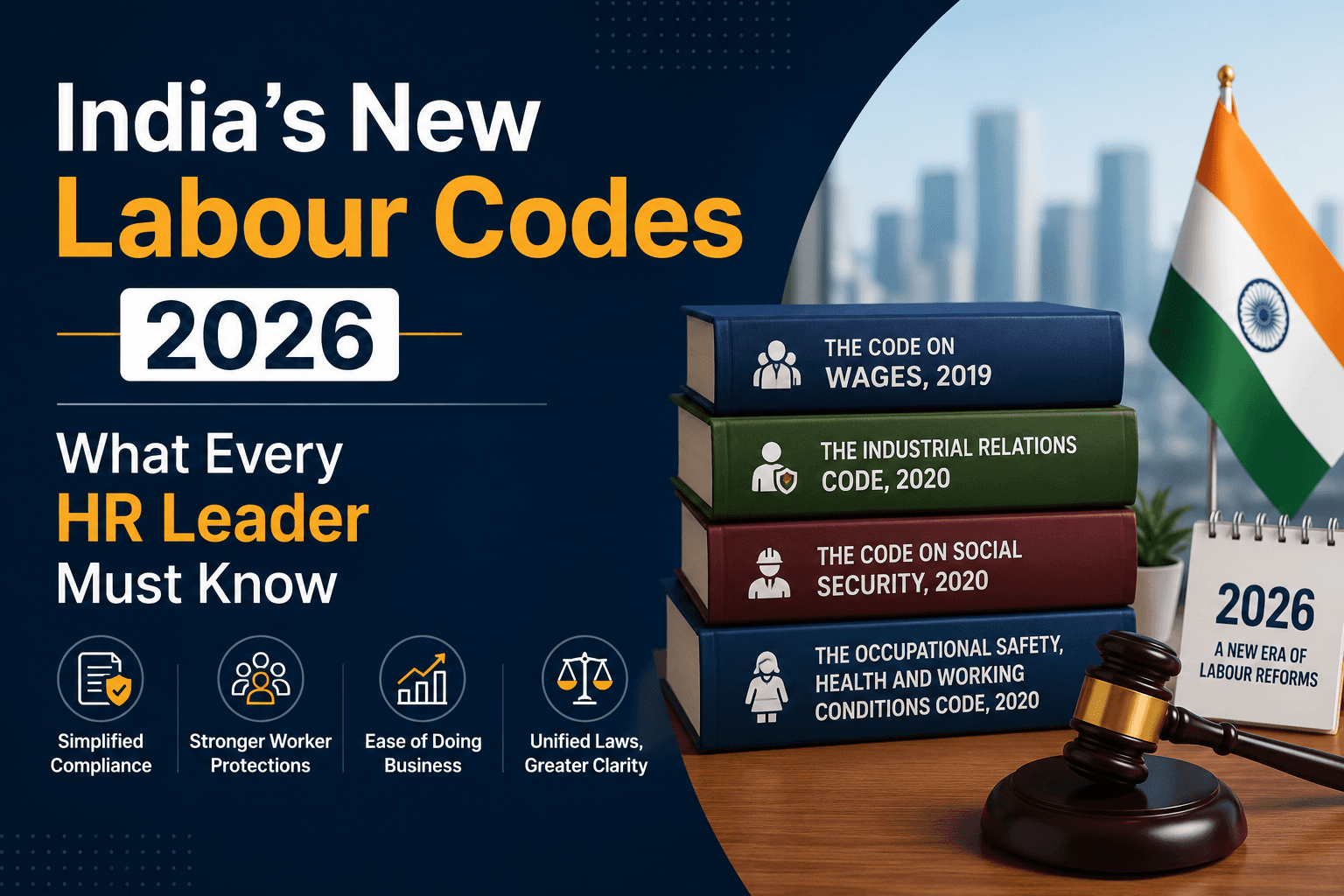
Compliance
India's New Labour Codes 2026: What Every HR Leader Must Know
India's Labour Codes 2026 have changed payroll, CTC, PF, gratuity, and exit rules for every employer. Get the complete HR compliance guide and checklist to stay ahead of the new labour laws.
5 min read