
Compliance
India's New Labour Codes 2026: What Every HR Leader Must Know
India's Labour Codes 2026 have changed payroll, CTC, PF, gratuity, and exit rules for every employer. Get the complete HR compliance guide and checklist to stay ahead of the new labour laws.

Richa Thakur
Content Writer · 5 min read · · Updated
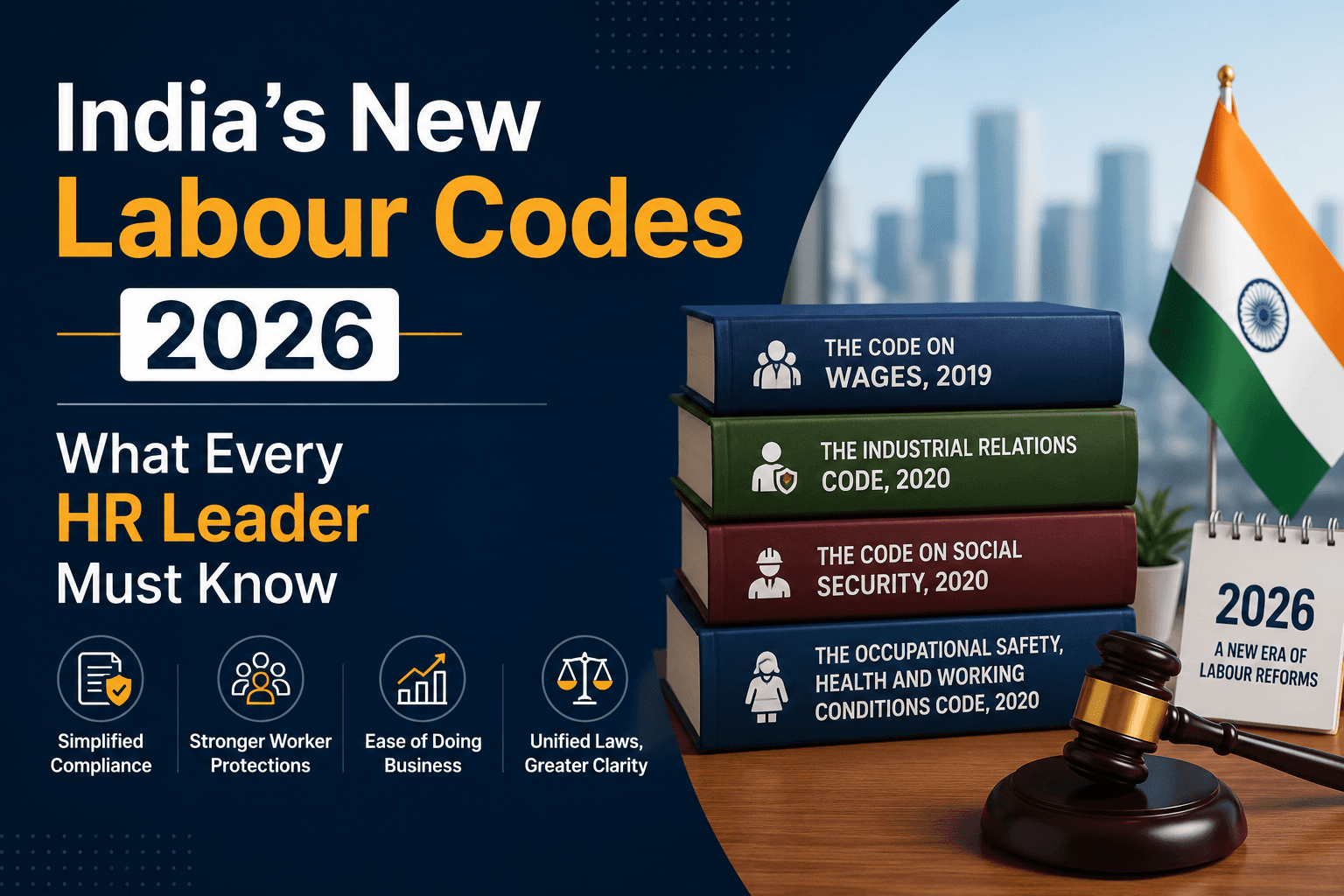
On a Friday afternoon in November 2025, a gazette notification changed everything. At around 4:30 PM on 21 November 2025, the Ministry of Labour and Employment published what will go down as the single most consequential reform to Indian employment law since independence.
In one notification, 29 separate labour statutes, some dating back to 1923, were repealed. Instead of this, four new labour codes came into force.
If you’re an HR leader in India, there is no gradual transition here. The Code on Wages, the Industrial Relations Code, the Social Security Code, and the Occupational Safety, Health and Working Conditions (OSHW) Code are now the law of the land. The codes took effect on 21 November 2025. Central and state rules are being finalised through 2026, so existing local rules continue to apply during the transition wherever a state has not yet notified its own.
In this article, we will cover the following details:
What are the four new Labour Codes?
How does the 50% basic pay rule reshape every CTC in India?
What changed for PF, gratuity, and gig workers?
The 48-hour full and final settlement rule and why manual processes will fail it?
A practical HR compliance checklist to act on right now
What are the Four New Labour Codes?
India’s four Labour Codes combine 29 archaic central laws to simplify compliance for employers and expand social security and safety for the workforce. It was implemented on November 21, 2025, and finalised with rules in mid-2026. The comprehensive framework operates across these key areas.
The new framework categorises all of this into four comprehensive codes:
The Code on Wages, 2019
Universal Minimum Wage: It guarantees minimum wages for all workers across both organised and unorganised sectors, including the unorganised, IT, and gig/ platform workers.
Equal Remuneration: Mandates gender-neutral pay and expressly prohibits discrimination in recruitment and wages.
The 50% Rule: It is the basic pay that constitutes at least 50% of an employee’s total compensation, which increases mandatory PF and gratuity contributions.
The Code on Social Security, 2020
Freelancers and platform workers are now eligible for social security benefits for the first time.
Fixed-term employment is now formally recognized as a hiring option.
Gratuity is payable on a pro-rata basis from Day 1 for fixed-term staff.
The Occupational Safety, Health and Working Conditions (OSH) Code, 2020
Women in Night Shifts: It permits women to work night shifts across industries, subject to their written consent and mandatory employer-provided security, such as CCTV and secure transportation.
Health Checks: Mandates free annual health checkups for employees over 40 years of age.
Inter-State Migrant Workers: It extends equal wages and welfare benefits to all migrant workers and provides portability of the Public Distribution System (PDS) rations.
The Industrial Relations Code, 2020
Dispute Resolution: It standardises grievance redressal with two-member Industrial Tribunals to allow for faster, direct resolution.
Layoffs & Retrenchment: It simplifies strike procedure and introduces mandatory worker re-skilling funds to support employees in the event of retrenchment.
It can be concluded that 29 acts consolidated into four, effective 21 November 2025, with full central enforcement from April 1, 2026.
The 50% Basic Pay Rule
The 50% basic pay rule in India 2026 is one of the changes that keeps Indian HR and Finance teams busy through 2026.
Under the Code of Wages, basic pay plus dearness allowance plus retaining allowance must constitute at least 50% of an employee’s total CTC. If your allowances push the basic salary below that threshold, the excess is automatically reclassified as wages for PF and gratuity calculations.
This matters because most Indian salary structures were deliberately engineered to do the opposite. For decades, companies inflated the allowance component, such as HRA, medical, LTA, and food allowance, to reduce the PF-eligible base. That strategy is now non-compliant.
Here are the new codes representing the old and new compliant structure:
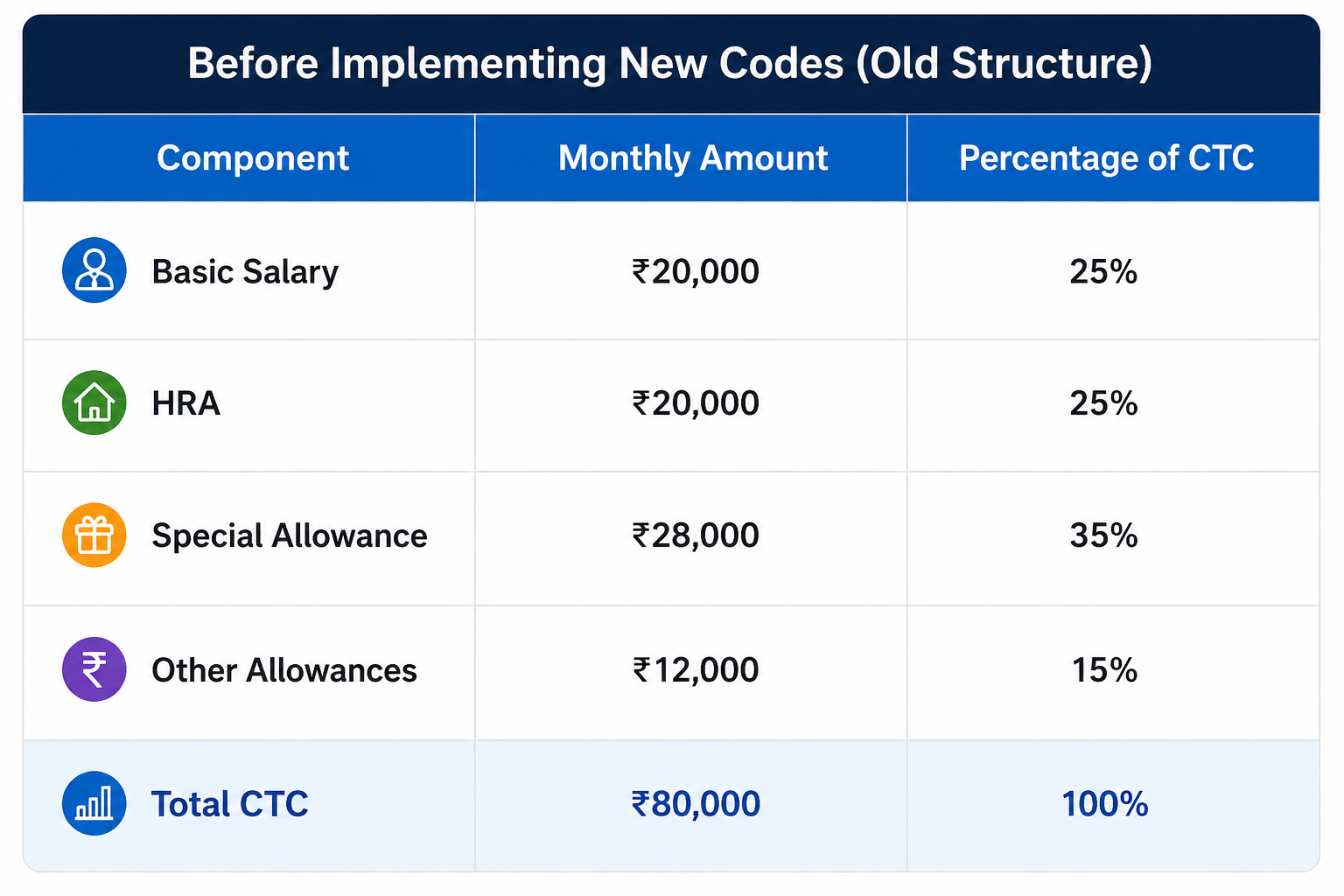
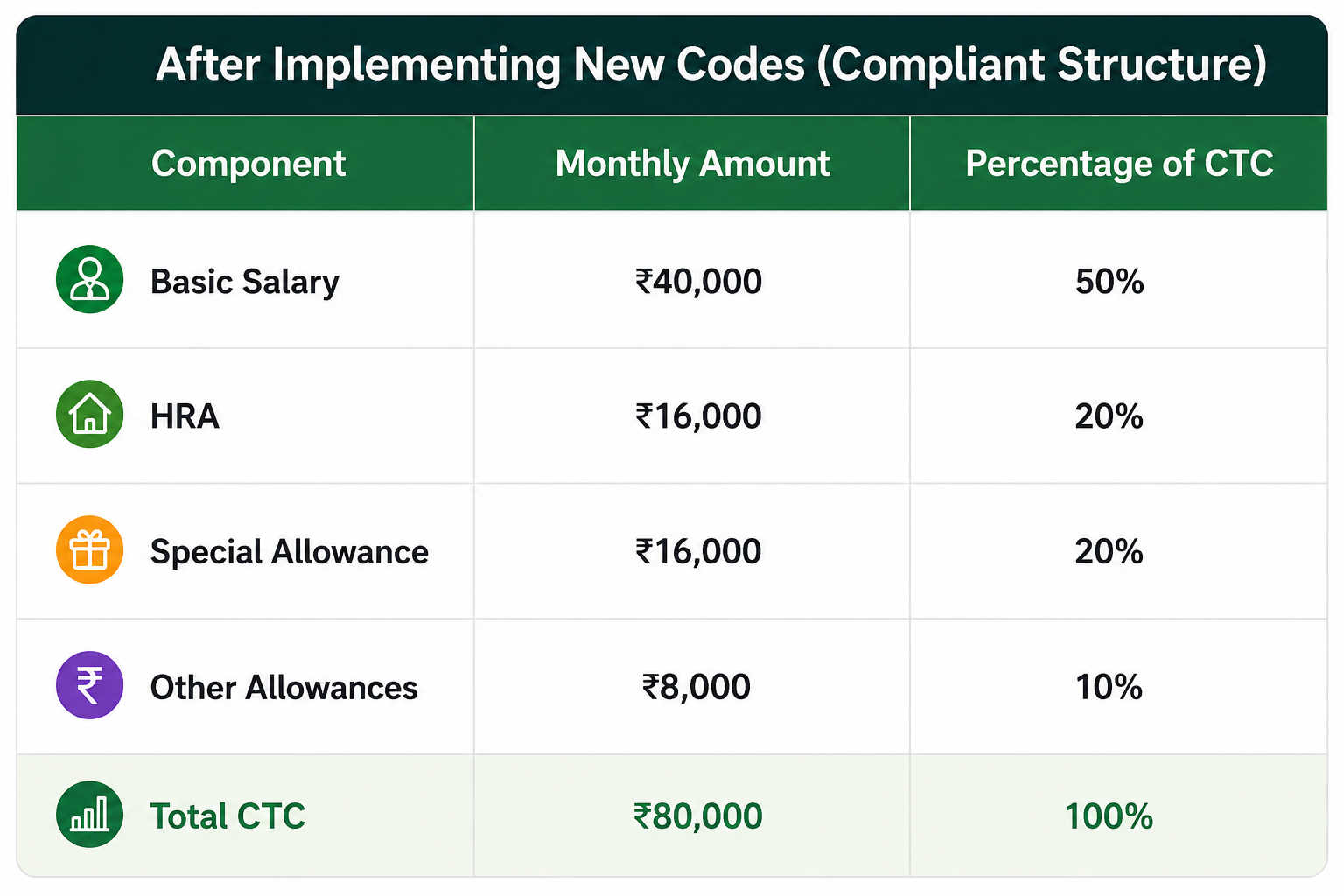
However, the gross CTC stays the same. The take-home pay does not. Higher basic salary means higher PF deductions for both the employee and the employer. It also means a higher gratuity base, which compounds significantly for long-tenured employees. Most employers will see statutory costs increase by 5-15% depending on their existing structures.
What HR must do immediately is audit every salary band, recalculate PF and gratuity provisions on the revised wage base, update HRMS calculation rules, and communicate proactively with employees whose take-home will change despite the same gross CTC.
PF, Gratuity & Social Security: What has Changed?
The 50% wage rule feeds directly into two of India's most significant statutory benefits:
Provident Fund
Both the employer and the employee PF contributions (12% each) are now calculated on the new, higher wage base. For employees who previously had low basic salaries with high allowances, this means meaningfully higher monthly PF deductions and increased employer cost.
Gratuity
It also calculates based on the new wage definition. The bigger shift is for fixed-term employees; gratuity is now payable on a pro-rata basis from Day 1, regardless of tenure. Previously, the five-year continuous service rule meant that most short-duration contract staff never qualified. That protection now applies from the first day of a fixed-term contract.
For employees on payroll before November 2025, a hybrid gratuity computation applies; pre-code service is calculated under the old rules, and service from November 2025 onwards uses the new wage base. Payroll software must handle this accurately, and professional advice on provisioning it is strongly recommended.
Gig and Platform Workers
The Social Security Code extends social security coverage to gig workers and platform workers for the first time. Employers and aggregators must register such workers on a centralised social security portal and contribute toward their benefits. Specific contribution rates are being notified through rules, but the legal coverage is now established.
For HR leaders at companies using gig workers or platform-based contractors, a worker classification audit is now essential. Misclassification carries a legal liability.
Industrial Relations & Fixed Term Employment
The Industrial Relations Code formalised fixed-term employment as a permanent hiring option across all industries, not just seasonal sectors. Any employer can now hire on a fixed-term basis for any role. The critical caveat is that fixed-term employees must receive the same wages, working hours, leave entitlements, and social security benefits as permanent employees in equivalent roles, along with pro-rata gratuity from Day 1.
This eliminates the main reason many companies used fixed-term contracts in the first place, cost arbitrage between contract and permanent headcount.
HR leaders need to audit their current fixed-term workforce to ensure benefit parity and overhaul contract templates to include all required provisions. On the broader IR front, the threshold for retrenchment requiring government permission has been raised, which gives larger employers more flexibility, and standing orders now apply to establishments with 300 or more workers, up from 100, reducing the compliance burden on mid-sized employers.
Workplace Safety & the OSHW Code
The OSHW Code introduces several changes with immediate operational implications:
Mandatory Appointment Letters
Every employee must now receive a formal appointment letter, including contract workers and fixed-term staff. Verbal or informal arrangements are no longer legally adequate. If any of your employees are without documented appointment letters, issuing them is now a compliance obligation, or just good practice.
Women and Night Shifts
The Code formally permits women to work night shifts (7 PM TO 6 AM) provided the employee gives explicit consent, and the employer ensures that safe transportation and adequate workplace facilities are in place.
This expands employment opportunities across IT, manufacturing, hospitality, and healthcare. HR teams should update shift policies, document consistently and verify that safety infrastructure is adequate.
Safety Committees
Establishments above a defined size must now form safety committees with employee representation. The exact thresholds vary by sector and state rules, so HR teams should check whether their establishments qualify and plan accordingly.
The 48-Hour Full And Final Settlement Rule
The 48-hour full and final settlement rule, set out in Section 17(2) of the Code on Wages, legally requires employers to clear all pending wages, earned salary, and leave encashment within two working days of an employee's last working day.
This mandate applies whether the separation is due to resignation, termination, or retrenchment. Most Indian organisations today take anywhere from 15 to 60 days to complete F&F settlement. The typical process involves multiple sign-offs across HR, Finance and the departing employee’s department, through manual calculations, pending approvals, clearance certificates and a final payroll run.
What needs to change?
Automate F&F workflows immediately. The 48-hour rule makes manual exit processes legally non-compliant by design. HR technology that triggers clearance requests at the moment a resignation is approved, pre-computes leave encashment and gratuity on the notice date, and releases payment automatically on the last working day is now a compliance requirement.
Pre-compute settlements before the exit date rather than starting calculations on the last working day. And review whether your payroll software supports exit payments outside the regular monthly payroll cycle. If it requires a month-end run to process exits, it needs to be upgraded.
This rule applies equally to resignations and terminations, so building a universal automated exit workflow is the right approach.
State-Wise Implementation: What HR Must Track?
In India, HR teams must track state-specific rules because labour is a concurrent subject. This means while central laws set broad frameworks, individual states determine the enforcement, timelines, and variations. Multi-state employers should take a central policy plus state supplements approach to stay compliant.
Leave and Working Hours
Shops and Establishment Acts: It dictates state-specific daily/weekly working hour limits, mandatory rest intervals, and overtime caps.
Leave Entitlements: Total annual leave obligations such as privilege, casual, sick and national and festival holidays that vary widely from state to state.
Payroll and Taxation
Minimum Wages and DA: Each state releases its own minimum wage rates and Dearness Allowance (DA) updates.
Professional Tax (PT): Slabs, deduction ceilings, and payment due dates differ based on where the employee works.
Labour Welfare Fund (LWF): Employee/Employer contribution rates, deduction periods, and remittance dates are state-specific.
Statutory & Social Security
Compliance Calendars: Due dates for PF, ESIC, and PT deposits differ depending on state and establishment size.
Registration and Licensing: State-level registration is required under the Shops & Establishments Act and the Contract Labour Act.
Implementation of the Four Labour Codes
Varying Notification Status: States have distinct schedules for notifying the rules under the four Central Labour Codes. In states where these rules are not yet notified, older local laws temporarily remain in effect.
50% Wage Rule: Ensure baseline salary structures comply with the wage definition limit set by the newer codes.
You can use modernised HR technology and state gazette trackers to automate these state-specific variations and establish a dynamic compliance calendar.
What is the HR Compliance Checklist?
An HR compliance checklist outlines the key areas that every business must monitor to avoid legal risk and ensure fair treatment of employees. It covers everything from hiring and onboarding to record-keeping and termination.
Payroll & CTC
Audit all salary structures to identify where basic pay falls below 50% of CTC.
Restructure non-compliant CTCs to meet the 50% basic pay rule.
Recalculate PF and employer contributions on the revised wage base.
Re-provision gratuity for all eligible employees on the new wage definition.
Compute hybrid gratuity for employees who were on payroll before November 2025.
Update HRMS and payroll structure calculation rules.
Exit & Full and Final Settlement
Automate F&F workflows to meet the 48-hour settlement requirement.
Configure payroll software to support exit payments outside regular payroll cycles.
Build pre-computation of leave encashment and gratuity into the exit trigger.
Contracts and Documentation
Issue formal appointment letters to every employee (mandatory under OSHW Code).
Overhaul fixed-term employment contracts to reflect benefit parity requirements.
Revise contractor agreements to assess freelancers and temporary worker classification risk.
Workforce Classification
Audit your contract and freelancer worker population for classification under the Social Security Code.
Register the applicable gig/platform worker on the centralised social security portal.
Review benefit entitlements of fixed-term employees against permanent staff benchmarks.
Policy and Safety
Update night shift policies to include women’s consent and safety provisions.
Assess whether your establishments require a safety committee under the OSHW code.
Review standing order obligations under revised thresholds.
State Compliance
Map all operating states against their rule notification status.
Build a state-specific compliance calendar.
Engage a labour law consultant familiar with multi-state implementation.
Final Thoughts
India’s new Labour Codes are not an incremental update. They are a structural overhaul of how employment works in this country, and the window for getting compliant is already closing. For HR leaders, the priority list is clear. Start with the 50% wage rule, as it affects every payroll and has downstream consequences for PF, gratuity, and employee take-home. Move to the 48-hour F&F settlement rule. It demands technology, not just policy. Then audit your contract worker population, update your appointment letters, and track your state’s rule notifications.
The companies that treat this as a one-time compliance exercise will scramble every time a new state notifies rules or an enforcement drive begins. The ones that build compliance into their HR systems and workflows will be better positioned, legally and as employers of choice.
The reform has arrived, and the question now is how fast your HR function can adapt. Human Maximizer is built for exactly this transition. Its CTC structuring engine flags salary bands that breach the 50% basic pay rule and recalculates PF and gratuity on the revised wage base automatically. It runs full and final settlements against the 48-hour timeline instead of a month-end cycle. And it keeps your compliance calendar current as each state notifies its rules, so your HR team spends its time on people, not paperwork.
Human Maximizer processes full and final settlements in real-time, outside monthly payroll cycles. Most HRMS platforms can't do this. See how 180+ mid-market employers are staying ahead.
Note: This guide is general information for HR teams, not legal advice. Labour Code rules are still being notified and interpreted, so confirm specifics with a qualified labour-law professional before acting.
Frequently Asked Questions
When did India’s new Labour Codes come into effect?
The four Codes were notified on 21 November 2025, repealing the existing central statutes. Central and state rules are being finalised through 2026, with local rules continuing to apply during the transition.
Which 29 laws were repealed?
They include some of India’s oldest employment statutes: the Payment of Wages Act 1936, Minimum Wages Act 1948, Factories Act 1948, Industrial Disputes Act 1947, EPF Act 1952, Gratuity Act 1972, and Contract Labour Act 1970, among others. Each was absorbed into one of the four new codes.
How does the 50% basic pay rule affect employees' take-home pay?
If an employee’s basic salary is currently below 50% of total CTC, restructuring will increase the basic salary and PF contributions, which are 12% of basic. This reduces monthly take-home even if gross CTC is unchanged, a conversation HR teams need to manage proactively with employees.
Are temporary workers now eligible for PF and gratuity?
The Social Security Code establishes legal convergence for temporary and platform workers. The specific benefits and contribution rates from aggregators are being defined through central and state rules, the legal framework is in place, and operational details are being finalized.
What happens if an employer misses the 48-hour F&F deadline?
Non-compliance can attract penalties under the relevant code. It goes beyond penalties; delayed settlements create legal liability and reputational risk, particularly in competitive talent markets.
Do the new Labour Codes apply to startups and small businesses?
Yes, though some threshold for standing orders, safety committees, and retrenchment permissions, that only comes in above certain headcount levels. The 50% wage rule, appointment letter mandate, 48-hour F&F rule, and fixed-term parity apply regardless of company size.
Can women work night shifts under the new labour codes?
Yes. The OSHW Code permits women to work night shifts (7 PM to 6 AM) across all industries, provided the employee gives written consent and the employer provides safe transport and adequate facilities. HR teams should update shift policies and document consent before rostering night shifts.
What should HR leaders do first to comply?
Start with the 50% basic pay rule, since it affects every payroll and cascades into PF, gratuity, and take-home. Audit your salary bands, restructure the non-compliant ones, then move to automating the 48-hour F&F process. Those two carry the most legal and financial exposure.
Keep reading

Compliance
Workforce Planning for Indian Startups: A Practical Framework
Stop hiring employees on guesswork. Read the practical guide for workforce planning for startups, covering forecasting, costs, compliance, and the right time to hire next.
5 min read
Compliance
HR Policy for Engineering Teams
Why rigid policies destroy developer output and learn how to implement flexible, data-driven HRMS software for engineering teams to boost...
19 min read
Compliance
48 hour fnf settlement
48 Hour FnF Settlement: How to transform the 2026 Labour Code into a recruitment advantage. Use our Labour Code compliance software...
12 min read