
Compliance
Why One-Size-Fits-All HR Policy for Engineering Teams Backfires
Why rigid policies destroy developer output and learn how to implement flexible, data-driven HRMS software for engineering teams to boost...

Chandan Watts
Technical Product Manager, Human Maximizer (Razor Infotech) · 19 min read ·

The attendance rule that works perfectly for your finance department will, sooner or later, flag your best backend engineer as a problem employee. Picture the shape of it: a production incident opens at 10:40 PM, the on-call developer pushes a fix by half past midnight, sleeps in, logs on at 11:30 the next morning. The incident channel says hero. The Attendance Management record says late arrival, second occurrence this month, escalate to manager. Nobody designed that contradiction. It arrived by default: one policy, written once, applied to everyone. When we look at how HR policy for engineering teams actually behaves inside Indian tech firms, this is the most common failure mode. Not a bad rule. A correct rule pointed at the wrong population.
That opening is an illustrative composite, stitched together from situations engineering managers describe again and again. No real employer, employee or incident is being reported.
What follows is a working method for writing policy that survives contact with an engineering org, grounded in Indian statutory reality rather than imported Silicon Valley handbook language.
The Productivity Tax: Why Standard HR Policy Fails Engineering Teams
Engineering work has three properties that most corporate HR policy silently assumes away. Output is lumpy: a week of reading code produces nothing measurable, then a day produces the fix. Availability is spiky and contractual, because on-call rotations, release windows and incident response create legitimate work at illegitimate hours. And the unit of production is the team rather than the person, since a merged pull request carries the reviewer's judgment as much as the author's.

Run a policy set that ignores all three and you levy a tax. It gets paid in small denominations. A senior developer spends twenty minutes writing a regularisation note explaining why she was offline on Wednesday afternoon, when she was in fact pair-debugging a memory leak on a call. A tech lead becomes an approval clerk. HR becomes the department that asks engineers to account for time they already accounted for in the sprint board.
There is a second cost, harder to see on any dashboard. Teams that ship reliably depend on people saying the uncomfortable thing early: this deploy looks risky, I do not actually understand this module, we cut a corner in the payment path last sprint. That willingness is fragile. A policy regime that reads ordinary engineering behaviour as suspicious drains it, not through fear of the rule itself, but because people learn the system interprets them uncharitably by default. Quiet engineers are expensive engineers.
The Exception Budget: Telling a Broken Policy From a Broken Habit
Site reliability engineering has a concept worth stealing wholesale. An error budget accepts that a system will fail some of the time, quantifies how much failure is acceptable, and treats breaching that budget as a signal to stop shipping features and fix the system. Policy deserves the same treatment.
We call it an exception budget. For every rule that can be overridden, you decide in advance what share of instances may legitimately need an override in a normal month. Then you measure. The inputs already sit in your HRMS, and the arithmetic is trivial: manager overrides divided by total rule instances.
Setting the threshold
Our working line is one in ten. Cross it and the rule has stopped describing policy and started describing a common exception, at which point the rule needs rewriting rather than enforcing. Stay under it and enforcement is doing its job, with the individual cases being genuine cases.
Treat one in ten as a starting heuristic, not a constant, and scale it to the team you are measuring. On a six-person squad, a single override is already one in six; the ratio swings wildly on small numbers, so read it over a quarter rather than a month. At sixty engineers the monthly figure is stable enough to act on straight away. Maturity moves the line too. A newly formed squad, a team mid-migration, or a product in its first stabilisation quarter will legitimately run hotter than a platform team maintaining a service that has not changed shape in two years. Set the threshold per rule and per team phase, write down the reasoning, then hold yourself to it.
Doing the maths on what the tax actually costs
Take a 40-engineer product org running a weekly on-call rotation plus fortnightly release nights. Assume each engineer trips an out-of-hours or short-day rule six times a month, and that each flag costs four minutes end to end: the notification, the engineer's explanation, the manager's approval, the regularisation entry.
| Input | Assumption | Working |
|---|---|---|
| Engineers in scope | 40 | — |
| Flags per engineer per month | 6 | 40 × 6 = 240 flags |
| Minutes per flag, all parties | 4 | 240 × 4 = 960 minutes |
| Monthly cost | — | 16 hours ≈ 2 working days |
Four minutes is deliberately conservative. It counts only clock time on the notification, the reply, the approval and the entry, and it prices the interruption itself at zero, which no engineer would accept. Put your own context-switching cost in. If a flag really costs fifteen minutes of recovered concentration, those 240 flags become 60 hours a month. If you insist it costs one minute, you still burn four hours producing information nobody will act on. Halve the flag rate and the conclusion holds. The real cost was never the minutes anyway. It was the message the flags send about who is trusted.
What a blown budget actually means
A policy over budget is a design defect, not a discipline problem. The fix is usually narrow: a different working-window definition for roles carrying a pager, an on-call flag on the roster that suppresses attendance alerts for that week, a comp-off rule that triggers automatically instead of on request. Agile HR policy management means treating the handbook as a versioned artifact with a changelog, reviewed each quarter against its own exception data, rather than a PDF that was true in 2021.
Shops and Establishments Compliance Is the Part Global Guides Skip
An exception budget tells you which of your rules are mis-specified. State statute tells you which rules you were never free to specify in the first place, and that is where policy design stops being a productivity question and becomes a legal one.

Almost every widely-read guide on engineering HR policy is written for the US and assumes an exempt/non-exempt distinction under the FLSA, where salaried engineers simply fall outside overtime rules. India has no equivalent carve-out that works the way founders assume it does.
Indian IT and product companies are governed primarily by their state's Shops and Establishments Act. These are state statutes, and they differ materially between Karnataka, Telangana, Maharashtra, Tamil Nadu and Gujarat. Each sets daily and weekly working-hour ceilings, mandates a weekly holiday and rest intervals, restricts spread-over, and prescribes overtime at a premium rate beyond the ceiling. Several states grant IT and ITeS establishments specific exemptions from some of these provisions, but those exemptions are conditional, are notified separately, and typically carry their own record-keeping and consent obligations. A company that assumes the exemption applies without checking the current notification for its own state is exposed, and that exposure surfaces during an inspection rather than during a good quarter.
On-call is the highest-risk area
An engineer carrying a pager overnight sits in a category most Indian HR systems have no field for. Is a 25-minute page at 2 AM working time? If it is, does it count toward the daily ceiling? If the ceiling is breached, is overtime owed at the statutory premium? Most firms have never asked, because the roster lives in PagerDuty, the working-hours record lives in HR software, and the two have never met. Keeping on-call rotations inside Roster Management rather than a separate scheduling tool at least puts the shift pattern and the attendance record in one system, so the question is answerable when someone finally asks it.
Compensation structure is a policy decision too
Engineering pay in India is allowance-heavy by convention, and the Code on Wages, 2019 constrains that: the statutory expectation is that basic pay is at least 50% of total remuneration. That is not a cosmetic restructure. Raise basic and you raise the base on which provident fund is computed, where the employee contribution is 12% of basic plus dearness allowance, with the employer's statutory liability pegged to a wage ceiling of ₹15,000 a month, and you raise gratuity exposure with it. Stock options and variable pay sit outside that calculation but interact with it. A policy document that promises engineers a compensation philosophy without reflecting this is writing a cheque the payroll run will bounce.
HR Automation for Tech Companies: Wire Policy to DORA, Not to Login Times
The four DORA metrics (deployment frequency, lead time for changes, change failure rate, time to restore service) are the closest thing engineering has to an agreed performance vocabulary. HR should read them, and should keep them well away from individual appraisal ratings.
That distinction is the whole point, and it is where well-intentioned integrations go wrong. DORA measures a delivery system. Tie an individual's increment to deployment frequency and you get more, smaller, riskier deploys. Tie it to change failure rate and you get engineers who quietly avoid the gnarly legacy service where failures live. A metric that penalises whoever surfaced the failure teaches people to stop surfacing failures, and the surfacing was the part you actually needed.
The productive integration runs the other way. Use engineering delivery data as context for the performance conversation rather than as its scoring function. If a squad's lead time tripled last quarter, the review cycle should ask what changed in the system: a departed maintainer, an unstaffed dependency, a review bottleneck sitting with one overloaded architect. That is a staffing and process finding, which is HR's actual job.
For the human side of the same picture, Productivity Lens is deliberately built as a rollup rather than a surveillance feed. A manager opening the team view sees where work is stuck and how break patterns cluster across the group, not a live window into anyone's screen; drilling into a specific person's page is a separate action, and that access is written to an immutable log. For a longer treatment of what engineering productivity metrics can and cannot tell you, our piece on developer productivity software goes deeper into the measurement traps.
Flexible Work Policies in India Need a Sharper Instrument Than a Mandate
Return-to-office debates get argued at the wrong altitude. The real question is which activities genuinely need co-location, not how many days a badge swipes. Code review does not. Incident response does not, and often runs better distributed across time zones. Onboarding a fresher, architecture disagreements that have gone three rounds on Slack, anything requiring a whiteboard: those do.
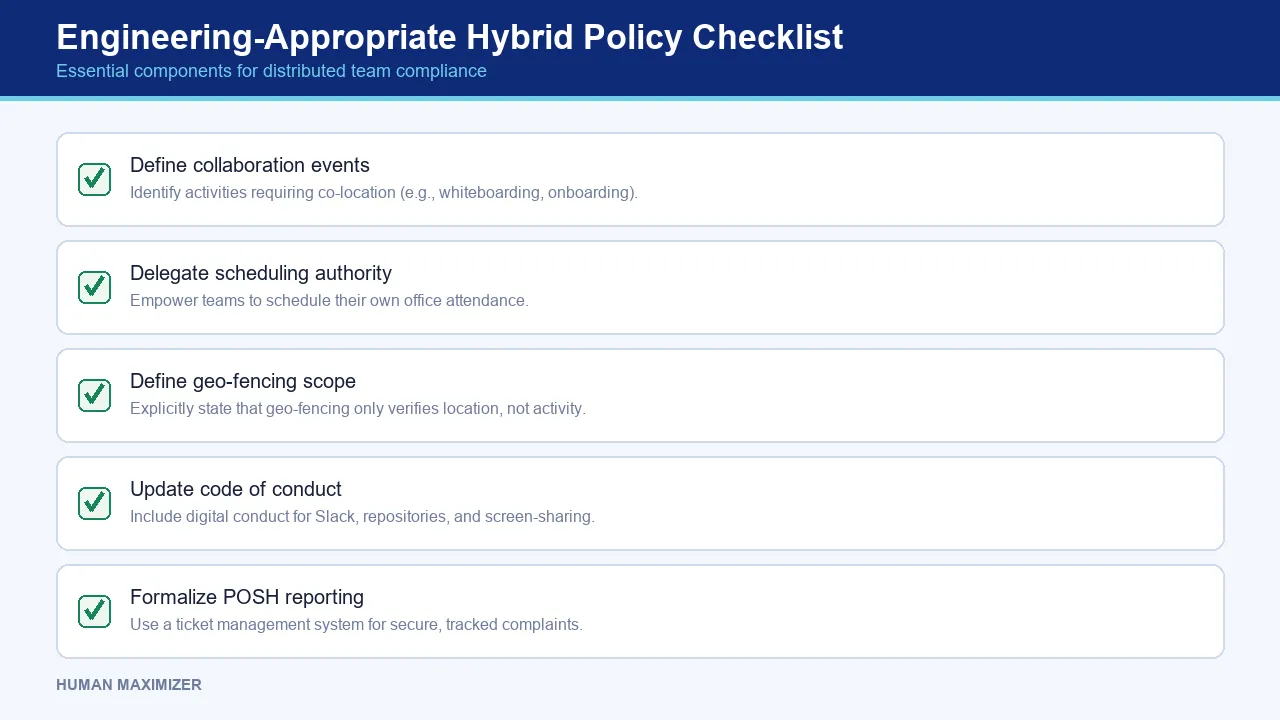
Write the policy around the activity
An engineering-appropriate hybrid policy names the collaboration events that pull people in, gives teams the authority to schedule them, then leaves the rest of the week alone. A blanket three-days-a-week rule applied to a squad whose members sit in Hyderabad, Kochi and Indore produces attendance theatre. People come to the office to be counted and put their headphones on.
Verification without surveillance
Field and hybrid teams still need a defensible attendance record, particularly where statutory hour registers apply. Geo-fenced check-in solves this narrowly: it confirms an employee was at the location assigned to them, and it detects a mocked or faked GPS location, which is the specific failure mode that makes location-based attendance untrustworthy in the first place. Geo-fencing answers where someone clocked in, and nothing beyond that. Say so explicitly in the policy, so nobody has to guess what else the system might be reading.
The distributed code of conduct
Ethics policy needs the same translation. A code of conduct written for a shared floor does not cover a five-person squad living in a Slack channel at 11 PM. Spell out what applies in the places work actually happens: review comments and their tone, incident-channel conduct under pressure, screen-sharing and recording consent, what is off-limits in a repository or a config file. POSH obligations do not stop at the office door either, and your internal committee needs a reporting route that does not require walking up to someone's desk. Routing that through a tracked queue such as Ticket Management, with SLA timers and defined escalation, replaces the WhatsApp message to a sympathetic manager with something that leaves a record and cannot quietly die.
A Developer-First Handbook: The Clauses Most Are Missing
Most engineering handbooks are a generic HR handbook with a section on laptops bolted to the end. Here is the set of clauses we would want to see in one, each resolving an ambiguity that engineers currently resolve by guessing. Copy them, argue with them, cut what does not apply.
- Working window, not working hours. Define a core overlap band for collaboration and state that hours outside it are unmonitored, with the state's statutory ceiling named explicitly.
- On-call terms in writing. Rotation length, compensation or comp-off basis, the maximum consecutive weeks a person can carry the pager, and what happens to the next morning after a night page.
- Deploy-day attendance suppression. A named rule that release and incident windows do not generate attendance exceptions, plus the roster flag that triggers it.
- Review-cycle inputs. Which delivery signals inform performance conversations, and an explicit statement that no DORA metric maps to an individual rating.
- Blameless incident policy. Postmortems cannot be cited in appraisals. Write it down or nobody will believe it.
- Focus-time protection. A meeting-free block the calendar system enforces, and permission to decline meetings that violate it without escalation.
- Open source and side-project rules. What an engineer may contribute to on their own time, what IP assignment covers, how approval is requested.
- Tooling and access on exit. Repository, cloud console and production access revocation timelines that run in parallel with the settlement process rather than after it.
- Documentation as a deliverable. If runbooks and design docs matter, say they are assessed. Otherwise they will not get written.
- The exception budget itself. Publish the override thresholds and the quarterly review date, so the handbook is visibly a living document.
Clause four does more work than it looks. Engineering teams read policy the way they read an API contract: they will find the edge case, and where the contract is silent they will assume the worst available reading. Being explicit about what cannot be used against them buys more trust than any values statement.
Scaling the Hiring Pipeline Without Losing the Thread
Growth is where policy discipline usually collapses. Twenty offers go out in a quarter, four different managers run four different interview loops, and the handbook everyone agreed on last year is now applied in four dialects.
Talent pipeline management for engineering carries one structural difference from other functions: the assessment is technical, the evaluators are the same senior engineers you are trying not to interrupt, and every hour spent in a loop is an hour off the roadmap. Standardising the scorecard and the stage gates inside the HRMS keeps interview load predictable enough for engineering leads to plan around it.
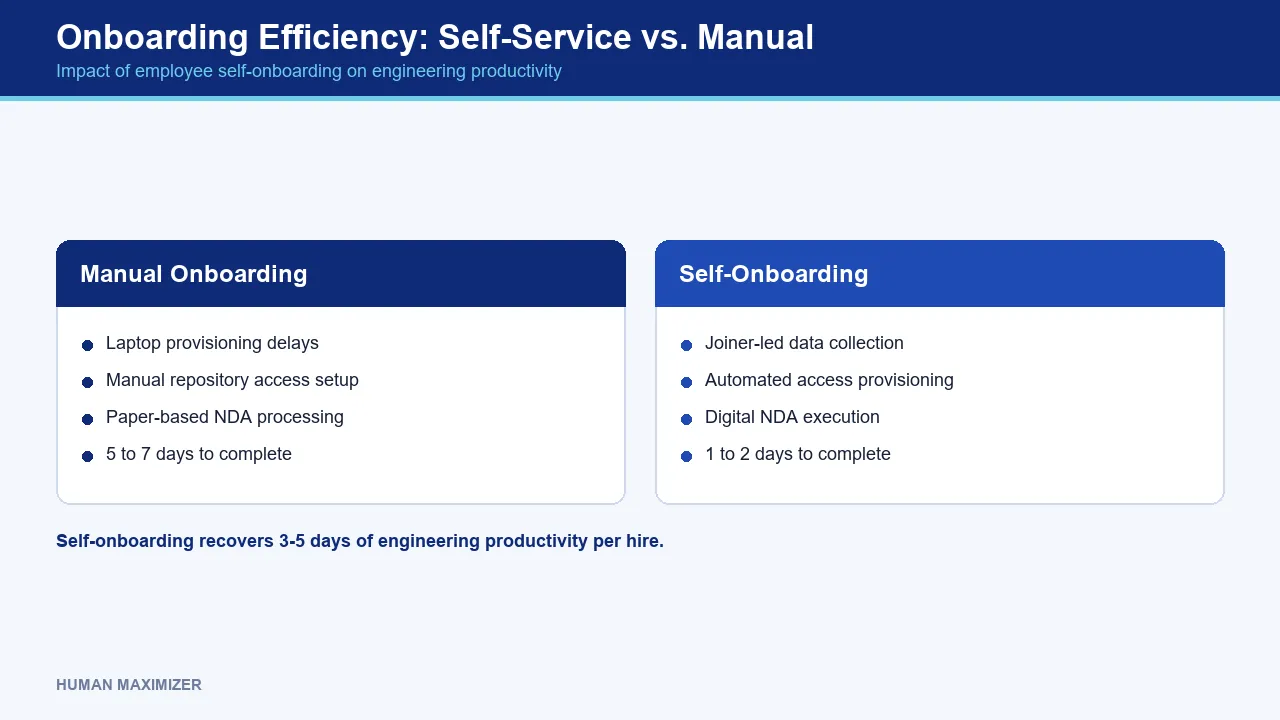
Then there is onboarding. Engineering hires are unusually expensive to onboard badly, because a developer waiting on laptop provisioning, repository access and a signed NDA contributes nothing while drawing full salary. Handing the data collection to the joiner through employee self-onboarding is the lever we have measured most directly: our aggregate puts onboarding at one to two days, where it previously ran five to seven. (That range is our own internal figure, drawn from Human Maximizer client implementations reviewed across 2025 and 2026, not a third-party industry benchmark; treat it as our data, not as an established market average.) Three to five recovered days per hire, at ten engineering hires a quarter, makes its own argument. If you are weighing whether one system should own all of this or whether to stitch tools together, our analysis of why all-in-one HRMS deployments stall as Indian startups scale covers the tradeoff honestly.
Where This Approach Runs Out of Road
Adaptive policy is no universal solvent, and we would rather say that here than repeat the overreach this article is arguing against.
Differentiated policy creates a fairness problem the moment it becomes visible. If engineers get flexible hours and the support team on a fixed shift roster does not, you need a defensible reason grounded in the work, communicated before the grapevine gets there. Some firms decide the internal equity cost outweighs the productivity gain. That is a legitimate call.
Statutory obligations are also not negotiable by policy design. You cannot write your way out of a state's working-hour ceiling, a POSH committee requirement, or provident fund liability because it is inconvenient for a sprint. Where an exemption exists for IT establishments, it comes from a notification with conditions attached, and confirming its current status for your state is work for someone qualified to read it.
One more honest limitation, on the measurement side: dashboards drift. A pattern worth planning for is that the gap between what the system reports and what is actually true about a project opens widest around the second month after rollout, once the novelty of logging has worn off and manual updates start getting skipped. Any policy that leans on data accuracy needs a periodic reconciliation against reality, or it will confidently tell you the wrong thing.
Frequently Asked Questions
How do you design HR policies that don't hinder engineering productivity? Start from your exception data rather than from a template. Measure how often each rule requires a manager override; anything crossing roughly one in ten instances is mis-specified for the population it governs, adjusted for how small or how new the team is. Rewrite that rule around the actual work pattern, whether that is on-call rotation, release windows or asynchronous review.
What are the essential HR policies for an Indian engineering firm? Working-hour and overtime terms aligned to your state's Shops and Establishments Act, a written on-call compensation policy, a pay structure consistent with the Code on Wages expectation that basic pay is at least half of total remuneration, a distributed-team code of conduct with POSH coverage, and a blameless incident policy that keeps postmortems out of appraisals.
How can HRMS tools automate engineering team management? Practically, by connecting the roster to the attendance record so on-call weeks stop generating false exceptions, by routing HR queries into a tracked queue instead of direct messages, by syncing team goals so status does not need a meeting, and by carrying attendance into payroll without re-entry. The automation worth having removes clerical steps rather than making judgment calls about people.
How do you balance remote flexibility with visibility? Separate the two questions. Visibility for compliance means a defensible attendance record, which geo-fenced check-in provides without watching anyone. Visibility for management means knowing where work is blocked, which comes from delivery signals and honest standups. Conflating them is what produces surveillance nobody asked for.
Conclusion
Go back to that on-call developer who shipped a fix at half past midnight and logged in late the next morning. Under a policy written around an exception budget, the roster already knows she was carrying the pager, the attendance record never raises a flag, her comp-off applies without her asking, and the state's hour register reflects the night correctly if an inspector ever wants to see it. Nothing about how she works changed. The system simply stopped mistaking her for a problem.
The cost of leaving it alone is quiet and compounding. Engineering attrition in India rarely announces itself as a policy grievance; it arrives as a resignation from someone who got tired of explaining themselves, while the compliance exposure sits in a state statute nobody has read since incorporation. Ready to stop taxing your engineers for doing the job at the hours the job demands? Talk to our team at Human Maximizer about what your exception data is already telling you.
About the Author & Reviewer
Chandan Watts — Technical Product Manager, Human Maximizer (Razor Infotech)
Chandan Watts is Technical Product Manager at Razor Infotech, building the Human Maximizer HR platform. After years leading customer-experience and team operations at JindalX and Radical Minds, he focuses on how teams actually work day to day — and how small workflow gaps quietly slow an entire team down.
Connect on LinkedIn
Reviewed & approved by Sameer Hameed — Founder & Chairman, Razor Infotech
Sameer Hameed is the Founder & Chairman of Razor Infotech, where he is guiding the creation of Human Maximizer. An entrepreneur across technology, real estate, mining and travel, he builds organisations on clarity, trust and responsible growth — on the belief that businesses grow only when the people behind them grow.
Connect on LinkedIn
Human Maximizer is built by Razor Infotech in New Delhi, India (founded 2019). About Human Maximizer.
Keep reading

Compliance
48 hour fnf settlement
48 Hour FnF Settlement: How to transform the 2026 Labour Code into a recruitment advantage. Use our Labour Code compliance software...
12 min read
Compliance
Design an Effective HR Leave System
How to build a compliant HR leave management system that automates statutory tracking, reduces payroll errors, and simplifies leave policy enforcement.
12 min read
Compliance
Mastering Payroll Processing in India
The essential steps for accurate payroll processing in India. Learn how to manage statutory compliance, tax deductions, and timelines to pay staff...
8 min read