
Compliance
From Passbook to Safeguard: Designing an HR Leave System That Survives an Audit
How to build a compliant HR leave management system that automates statutory tracking, reduces payroll errors, and simplifies leave policy enforcement.

Chandan Watts
Technical Product Manager, Human Maximizer (Razor Infotech) · 12 min read · · Updated
Leave is the one HR record that quietly becomes a legal document the day an employee resigns. Every casual day, every carried-forward earned leave, every comp-off logged over eighteen months (roughly the look-back window an inspector can reasonably ask you to produce for statutory records) collapses into a single line on a full-and-final settlement. Get that line wrong and you are not looking at a rounding error. You are looking at a labour dispute and a mis-stated payout, with a paper trail that an inspector under the state Shops and Establishments Act is entitled to demand. This is why we treat an hr leave system as a compliance engine rather than a convenience tool, and why the shift beyond manual tracking matters more in India than most buyer's guides admit.
Most vendors sell leave software as an approvals inbox. Apply, approve, done. That framing misses where the real risk sits, which is at the exact moment leave data leaves the leave module and lands in payroll, settlement, and an audit file.
The Compliance Trap: Why Spreadsheets Fail Indian Labour Law
A spreadsheet does exactly what you tell it, which is the problem. It will happily let a Chennai employee accrue earned leave at a Karnataka rate because nobody updated the formula when the person transferred. It has no opinion on whether sick leave should be paid, whether comp-off has an expiry, or whether unused earned leave is legally encashable on exit. Those rules live in a person's head, and heads forget.
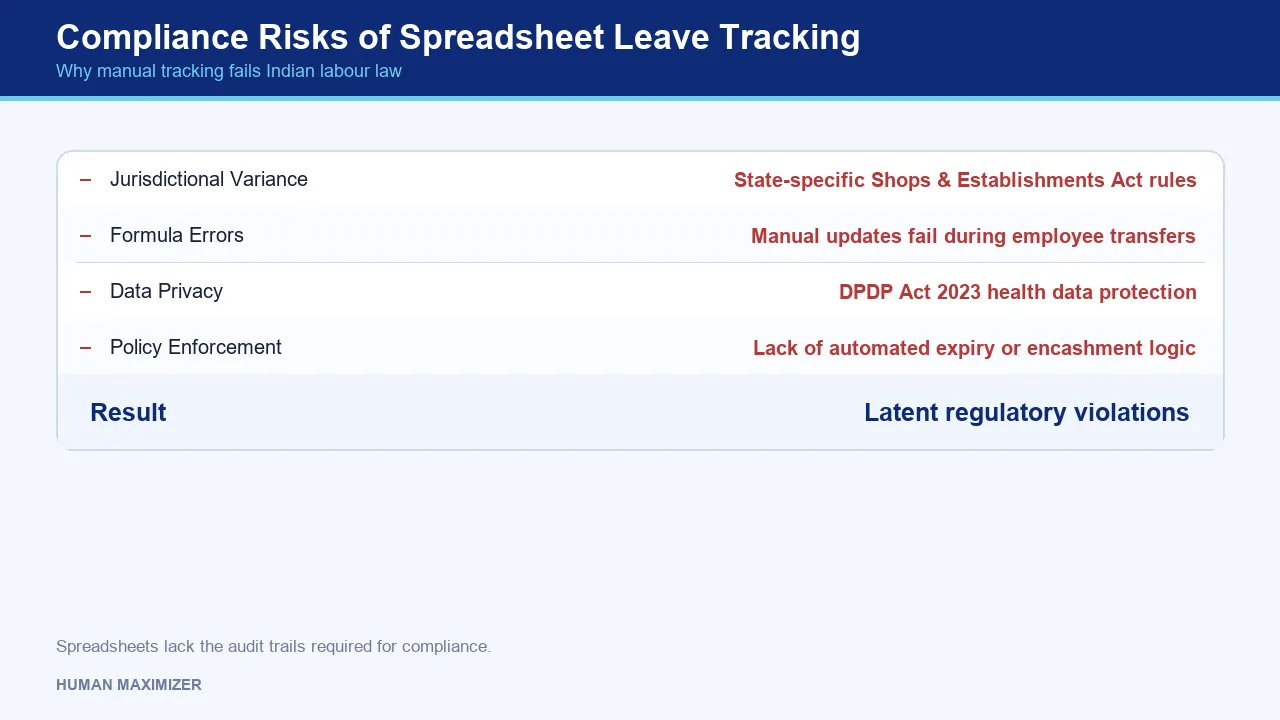
The deeper issue is jurisdiction. India does not have one leave law. It has the Shops and Establishments Act, a state subject, so the annual leave entitlement, the accrual method, the carry-forward cap, and the encashment obligation genuinely differ between Maharashtra, Tamil Nadu, and Delhi. A single spreadsheet template applied across three branches is not a shortcut but three latent violations waiting for an inspection. Because most leave categories are not equally covered across private-sector workers, the responsibility falls on the employer to build fair, compliant policies that hold up state by state.
There is also a data-protection angle people skip. Sick-leave records carry health information, which under India's Digital Personal Data Protection Act, 2023 sits in a higher-obligation category than a shared drive can defend. An access-controlled system with an audit trail is far easier to justify to a regulator than a WhatsApp group.
Configuring an HR Leave System for State-Specific Compliance
The move from spreadsheet to leave compliance software India-wide starts with configuration, not import. Before a single balance is uploaded, the system needs to encode the rules that actually govern each location.
Good leave policy software lets you set, per branch or per employee group:
- Leave types with distinct rules — casual, sick, earned, comp-off, and unpaid, each with its own quota, accrual, and carry-forward behaviour, because Indian labour standards treat them differently and they cannot be blended.
- State-mapped entitlements — so an employee's applicable Shops and Establishments Act entitlement follows their work location, not a company-wide default.
- Advance-notice and documentation rules — enforced at the point of application, so a request that violates policy never reaches a manager's queue in the first place.
The test of whether configuration is real is simple. When a state revises its leave entitlement, does the rule update in one place and propagate everywhere, or does someone have to remember to edit thirty spreadsheets? Statutory compliance is a property of the system's design, not of anyone's diligence on a busy Friday. If you are still weighing what a full system should cover, our guide to what an HRMS actually is for Indian businesses sets the wider context.
Automated Accruals: Diverse Employee Types and Carry-Forward Rules
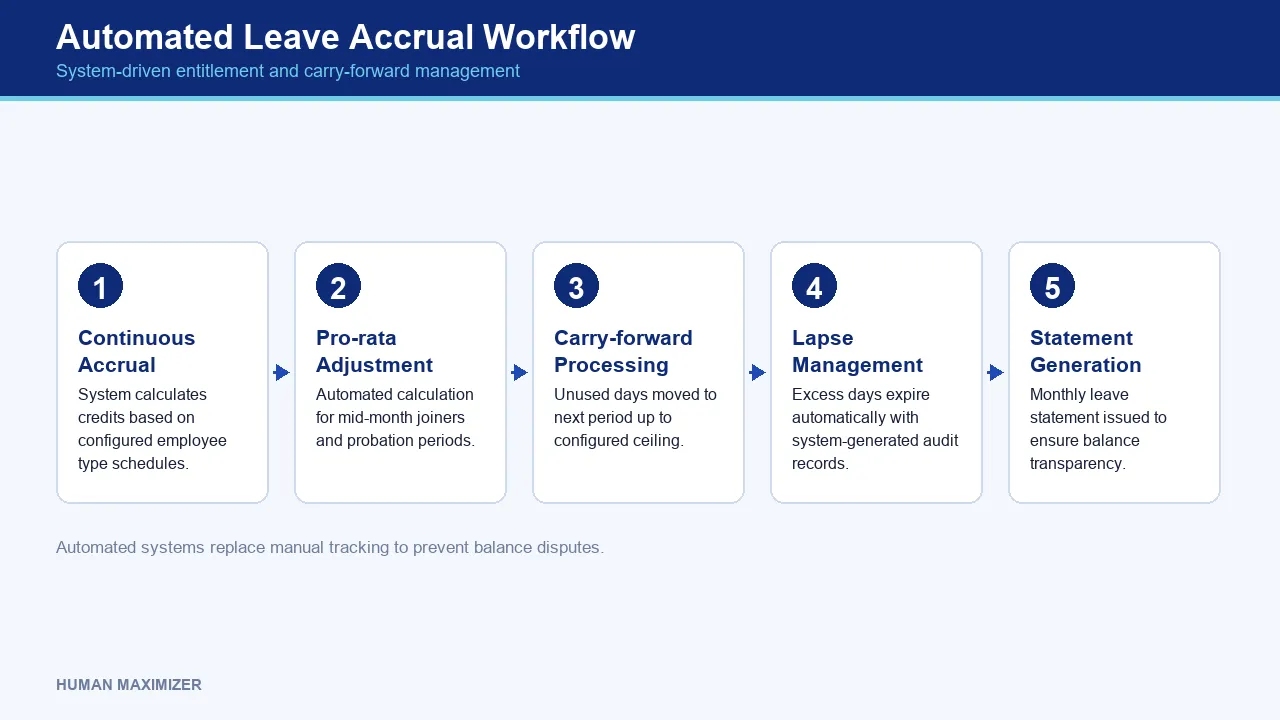
Accrual is where manual tracking silently drifts. A full-time employee, a probationer, and a contract worker rarely accrue on the same schedule, and their carry-forward caps differ. Doing this by hand across a growing headcount is how balances quietly go wrong months before anyone notices.
Handling different accrual schedules
An automated leave tracking system calculates entitlement continuously against the rules you configured. Earned leave that accrues monthly credits itself. Probation policies that withhold accrual until confirmation apply automatically. Pro-rata calculations for mid-month joiners stop being a manual division problem.
Carry-forward and expiry
Carry-forward is not generosity but a rule with a cap and often an expiry. The system moves unused days into the next period up to the configured ceiling, lapses the excess, and records why. That record is what protects you when an employee later disputes a balance. Every credit, use, and lapse should be visible in a monthly leave statement so the current employee leave balance is never a matter of anyone's memory.
If any of this sounds like your month-end, we should chat about how leave policy automation actually behaves once it is enforcing rules instead of just recording them.
The Payroll Bridge: Where Leave Becomes Money
This is the section competitors underweight, and it is the one that costs real rupees. Leave data is meaningless until it crosses into payroll. Loss-of-pay days reduce salary. Unused earned leave becomes an encashable liability on exit. Get the handoff wrong and the error surfaces on a payslip three weeks after the bad input, buried under a hundred others.
Payroll integration means approved unpaid leave flows directly into that month's loss-of-pay calculation without a re-keyed number. It means pending leave can block a payroll run until it is resolved, so a run never closes on an unsettled balance. And it means leave encashment rules are applied against a balance the system actually maintained, not one reconstructed from a spreadsheet on the employee's last day.
Encashment is where the Code on Wages now intersects with leave. A payout is typically calculated on the employee's wage, and since basic pay must constitute at least 50% of total CTC or trigger penalties under the Code on Wages, a leave payout computed on the wrong wage base is both a settlement error and a statutory exposure. The link between leave, attendance, and salary is exactly why we argue leave should never sit in a separate tool from payroll; if you are weighing that, our breakdown of whether your business needs a full HRMS or standalone payroll walks through the tradeoff.
Multi-Tiered Approval Workflows That Actually Reduce Work
The point of an approval workflow is not control for its own sake but removing the administrative back-and-forth that eats a manager's week. A request should route to the right approver, escalate if it stalls while someone is travelling, and support partial approval when a manager can grant three of five requested days.
Multi-tiered routing matters most in operations that run shifts or projects, where a single leave can strand a roster. When approvals are tied to real-time coverage visibility, a manager approves knowing who is left on the floor, not after a WhatsApp scramble. The administrative saving is not abstract. When approvals stop living in separate files from attendance and payroll, the month-end reconciliation that used to swallow a Friday afternoon largely disappears, because the numbers were already correct at source.
The Leave Audit-Readiness Checklist
Here is the ownable part, and it is deliberately something you can act on today, whatever software you run. We call it the audit-readiness checklist because it maps to exactly what an inspector or an exiting employee's lawyer can ask you to produce. Run your current hr leave system against it.
- Jurisdiction test. For any employee, can you show their applicable state entitlement and prove the system applied it? If the answer is a manual lookup, that is a gap.
- Trail test. For any leave taken in the last year, can you produce the request, the approver, the timestamp, and any partial-approval reason in under a minute?
- Encashment test. For a hypothetical resignation today, can the system compute the encashable balance and the wage base it used, without a spreadsheet rebuild?
- Propagation test. When a rule changes, does it update once and apply everywhere?
- Privacy test. Are sick-leave records access-controlled and logged, in line with DPDP Act obligations?
A leave system that passes all five is audit-ready. One that fails even two is a liability wearing the costume of a working process. This checklist is worth keeping next to your policy document; it turns a vague "are we compliant" question into five things you can verify.
Where Automated Leave Management Still Needs a Human
Automation has honest limits, and pretending otherwise is how buyers get burned. A system enforces the rules you gave it; it cannot decide policy. When a state issues a new leave entitlement, a person still has to interpret the gazette and configure the change. No leave tool reads notifications and updates itself, and any vendor claiming that is overselling.
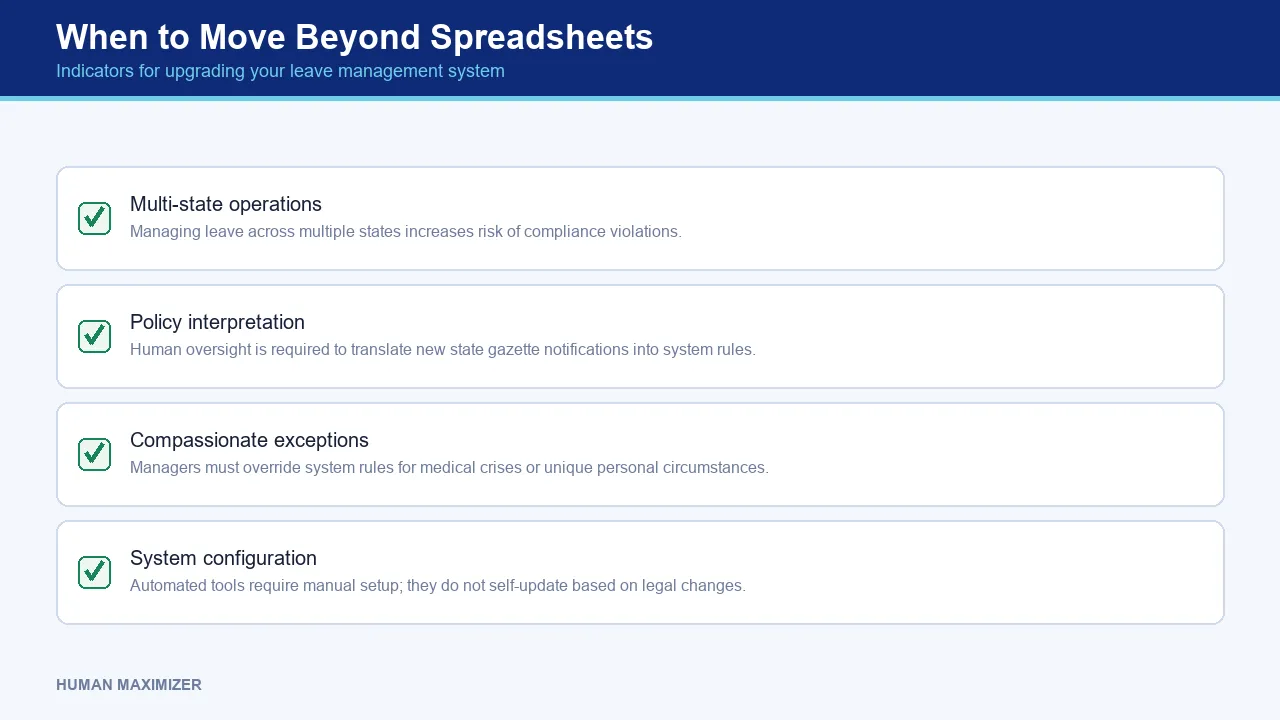
Compassionate cases also resist rules. An employee out of balance during a genuine medical crisis is a judgement call a manager should make, with the system recording the exception rather than blocking it. And for a genuinely small, single-state team, a well-built spreadsheet is a defensible start. The trigger to move, more often than not, is the moment you operate across more than one state, because that is when one template quietly becomes several violations.
How Human Maximizer Fits
While building Human Maximizer, we spoke with HR leaders, managing directors and founders across Indian companies, and the leave conversation kept returning to the same fault line: the handoff to payroll. So our Leave Management and Payroll modules share one record. A comp-off earned for holiday work credits automatically; an approved unpaid day flows into that month's loss-of-pay without re-entry; a pending request can hold a payroll run until it is cleared. The leave bank shows every employee their earned, used, pending, and carried-forward days as a running statement, which cuts the "what's my balance" queries that clog HR inboxes. A dedicated in-house compliance team tracks state statutory changes so the rules you configure reflect current law. If you are mapping this against alternatives, our guide to choosing HRMS software in India covers how to evaluate leave depth specifically.
Frequently Asked Questions
How does an HR leave system ensure statutory compliance? By encoding state-specific rules once and enforcing them automatically at application, accrual, and payout. The system checks each request against the applicable Shops and Establishments Act entitlement and keeps an audit trail of every action, so compliance does not depend on anyone remembering a rule.
What are the benefits of integrating leave management with payroll? Approved unpaid leave flows straight into loss-of-pay, and unused earned leave is encashed against an accurate balance the system maintained. Payroll integration removes the re-keyed numbers that cause silent settlement errors and lets a run be blocked until pending leave is resolved.
Can a leave system handle manual overrides for compassionate leave? Yes, and this is where a good system earns its keep. A manager can approve leave that exceeds a balance in a genuine emergency, and the system logs it as a recorded exception with a reason rather than silently corrupting the balance. The override is visible on the audit trail, so an act of judgement never becomes an unexplained anomaly at settlement time.
When should an Indian SME move off spreadsheets? Practically, the moment you operate in more than one state. That is when a single template stops being a shortcut and becomes multiple compliance gaps, each surfacing at the worst possible time, on someone's final settlement.
The Line on the Settlement
Come back to that resigning employee and the single line on their full-and-final settlement. In a spreadsheet world, that number is reconstructed under time pressure on a Friday evening, and its accuracy depends on eighteen months of manual discipline nobody actually kept. In a system built as a compliance engine, the number is just the closing balance the ledger already held, computed on the right wage base, with every credit and lapse behind it on record. The difference between those two is not software preference; it is whether your next labour audit is a document you produce in a minute or a reconstruction you defend from memory. See how Human Maximizer handles the leave-to-payroll handoff.
About the Author & Reviewer
Chandan Watts — Technical Product Manager, Human Maximizer (Razor Infotech)
Chandan Watts is Technical Product Manager at Razor Infotech, building the Human Maximizer HR platform. After years leading customer-experience and team operations at JindalX and Radical Minds, he focuses on how teams actually work day to day — and how small workflow gaps quietly slow an entire team down.
Connect on LinkedIn
Reviewed & approved by Sameer Hameed — Founder & Chairman, Razor Infotech
Sameer Hameed is the Founder & Chairman of Razor Infotech, where he is guiding the creation of Human Maximizer. An entrepreneur across technology, real estate, mining and travel, he builds organisations on clarity, trust and responsible growth — on the belief that businesses grow only when the people behind them grow.
Connect on LinkedIn
Human Maximizer is built by Razor Infotech in New Delhi, India (founded 2019). About Human Maximizer.
Keep reading
HR Strategy
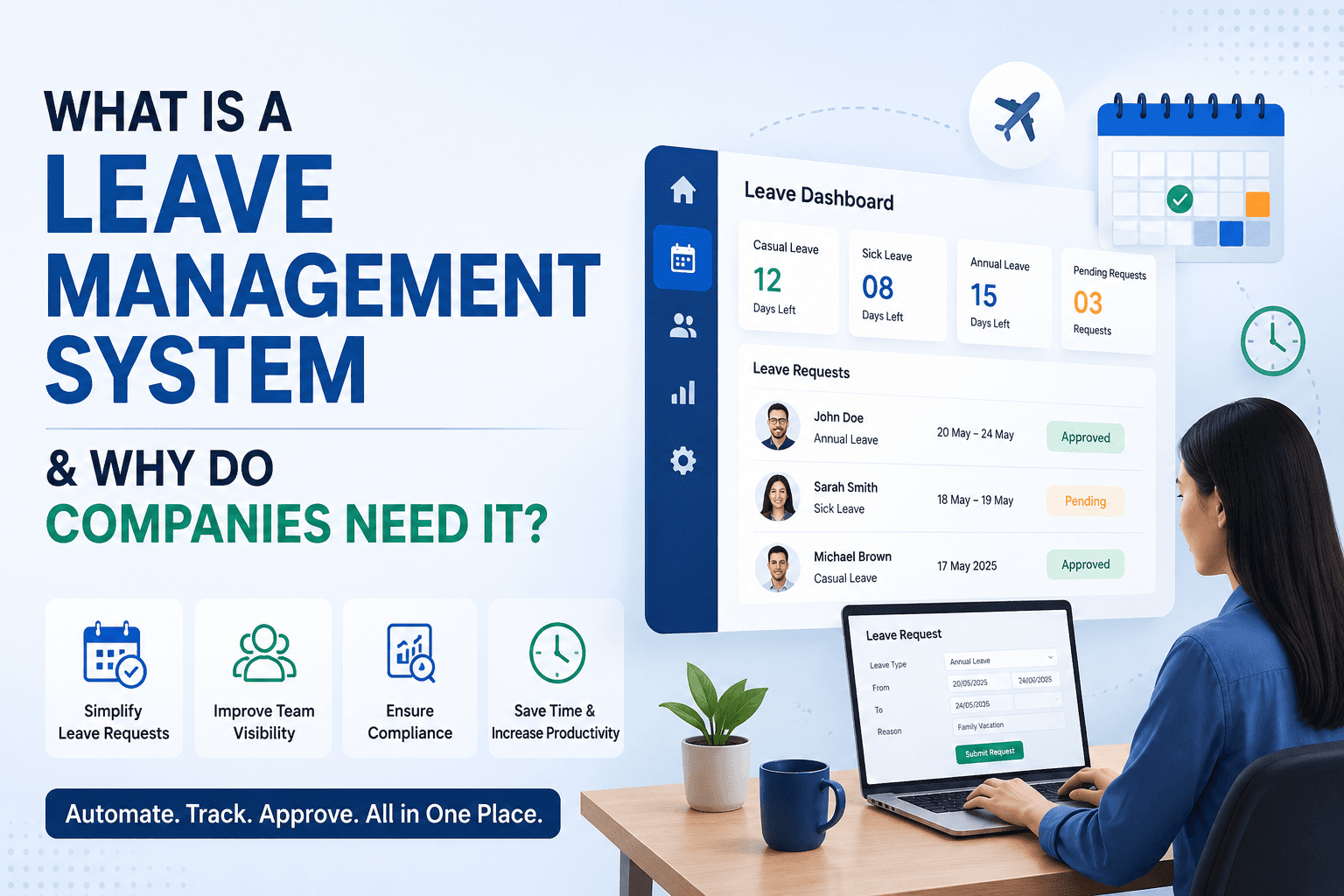
What Is a Leave Management System & Why Do Companies Need It?
Still tracking leave in emails and spreadsheets? See how a leave management system helps Indian companies apply, approve, and track leave, with payroll integration and full compliance.
5 min read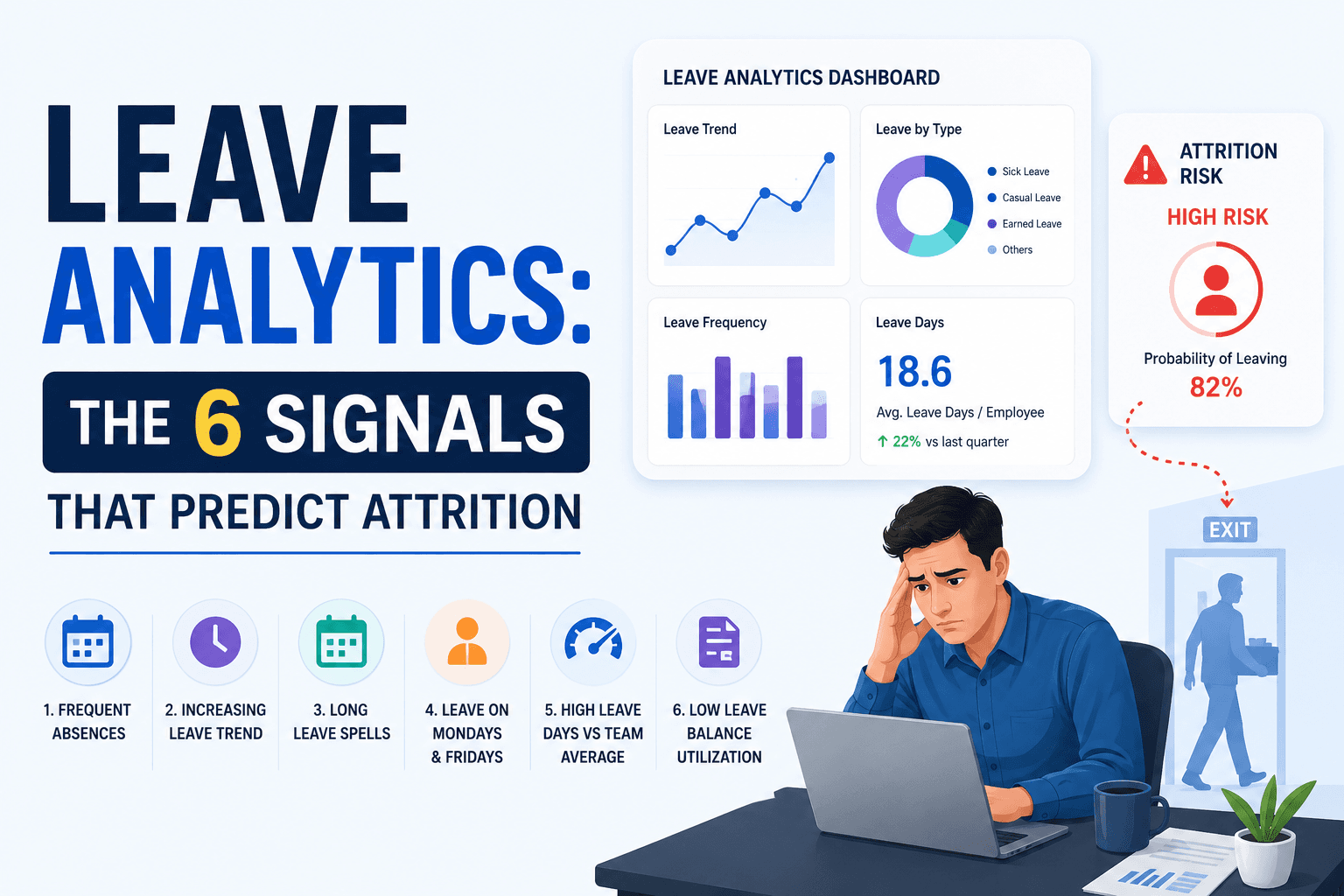
HR Strategy
Leave Analytics: The 6 Signals That Predict Attrition
Leave patterns predict attrition 60 to 90 days before a resignation. Here are the 6 signals every Indian HR team should track using leave analytics in 2026.
5 min read
Compliance
Mastering Payroll Processing in India
The essential steps for accurate payroll processing in India. Learn how to manage statutory compliance, tax deductions, and timelines to pay staff...
8 min read