
HR Strategy
How to Create a Leave Policy for a Startup in India: A Guide
How to build a compliant leave policy for your Indian startup. Discover essential leave types, legal requirements, and best practices for HR teams.

Chandan Watts
Technical Product Manager, Human Maximizer (Razor Infotech) · 18 min read · · Updated

In Gurugram's technology sector, a pattern is becoming familiar. A software startup crosses its first fifteen hires, secures a fresh seed round, and continues running its operations on a casual, verbal agreement. To maintain agility, the founders rely on informal Slack approvals and a shared spreadsheet to track time off. Then, a lead developer requests a sudden three-week sabbatical to prevent burnout, exposing a chaotic registry of WhatsApp screenshots that fails to account for regional labor laws. The insight is immediate: informal policies create severe compliance and operational risks the moment a team begins to scale.
What began as an agile culture of freedom quietly transforms into a legal hazard. It happens fast. At Human Maximizer, we run into this exact inflection point when speaking with founders who are transitioning from early-stage chaos to structured growth. The reality is that an unstructured approach to time off does not build trust. Instead, it builds confusion and compliance risks.
Designing a clear leave policy for startups in India is not about copying a generic template from a search engine. That is a shortcut to litigation. It is about building a framework that matches the unique operational pace of your business while keeping your organization safe from regulatory penalties.
The Startup Trap: Why Informal Leave Policies Are a Legal Liability
Many early-stage teams view formal HR policies as bureaucratic overhead that slows down execution. This is a dangerous assumption. While informal workarounds feel harmless, they create massive vulnerabilities the moment your team expands or an employee departs on tense terms.
An undocumented policy leaves room for inconsistent implementation. If one manager approves a long-term absence while another rejects a similar request, you risk accusations of bias. Additionally, without written rules, calculating full-and-final settlements during an employee exit becomes a playground for disputes. Establishing a clear leave policy is more than an administrative task; it directly influences employee satisfaction and ensures compliance with the law. When designing a leave policy, the practical approach is to meet the statutory minimum in every state where you employ someone before layering on additional benefits.
Beyond employee relations, there is the matter of data security. Employee leave records contain sensitive personal data, especially when medical certificates are submitted for sick leave. Under the Digital Personal Data Protection (DPDP) Act, 2023, your startup acts as a Data Fiduciary. This means you bear the legal responsibility to implement reasonable security safeguards to protect employee health and personal records. Leaving these documents in shared, unsecured email threads or WhatsApp chats exposes your startup to significant liability. Moving to a secure, access-controlled system is no longer optional.
Decoding the Shops and Establishments Act: Your Statutory Baseline
The first major hurdle for founders is realizing that India does not have a single, unified national law governing leave for private-sector employees. Instead, leave is regulated at the state level.
The Shops and Establishments Act of the specific state where your office is located dictates your statutory baseline. This local legislation governs working hours and minimum leave entitlements. As a result, a startup based in Gurugram must comply with the Haryana Shops and Commercial Establishments Act. Meanwhile, its remote team members in Mumbai fall under the Maharashtra Shops and Establishments Act.
This regional variance creates immediate operational complexity. For instance, labor law may vary widely across the states regarding the minimum number of casual and sick leaves you must provide. Delhi mandates a different number of annual holidays compared to Karnataka. To maintain labor law compliance India, your policy must satisfy the minimum legal requirements of every state where your employees reside.
Pro-Tip: The Remote Employee Jurisdiction Rule
When employing remote workers in different states, their leave entitlements are governed by the Shops and Establishments Act of the state where they physically perform their work (their state of residence), not where your headquarters is registered. If you are based in Gurugram but have a remote engineer working from home in Bengaluru, that engineer is legally subject to the Karnataka Shops and Commercial Establishments Act.
Statutory Leave Minimums Across Key Startup Hubs
To help you navigate these regional differences, the table below outlines the statutory minimum leave requirements for the four most common startup hubs in India:
| State | Governing Act | Earned / Privilege Leave (EL/PL) | Casual Leave (CL) | Sick Leave (SL) | Carry-Forward Limit |
|---|---|---|---|---|---|
| Karnataka | Karnataka Shops & Commercial Establishments Act, 1961 | 1 day for every 20 days worked (approx. 15 days) | 12 days (combined CL and SL) | Included in CL/SL pool | Up to 30 days |
| Maharashtra | Maharashtra Shops & Establishments Act, 2017 | 1 day for every 21 days worked (approx. 15 days) | 8 days | Not statutory (covered under CL/PL) | Up to 45 days |
| Delhi | Delhi Shops & Establishments Act, 1954 | 15 days | 12 days (combined CL and SL) | Included in CL/SL pool | Up to 30 days |
| Haryana | Haryana Shops & Commercial Establishments Act, 1958 | 1 day for every 20 days worked (approx. 15-18 days) | 7 days | 7 days | Up to 30 days |
The Essential Leave Toolkit: EL, CL, SL, and RH Explained
To build a compliant framework, you must understand the distinct categories of leave recognized under Indian labor laws. A standard HR leave policy template typically divides time off into four primary buckets:
Earned Leave (EL) or Privilege Leave (PL)
Earned leave is time off that employees accumulate as they work. Under most state Shops and Establishments Acts, employees accrue a set number of days for every fixed period of active service. * The 240-Day Rule vs. Pro-Rata Accrual: Historically, legacy frameworks like the Factories Act, 1948 required an employee to complete 240 days of continuous service before they could use their accrued earned leave. This rule is outdated for modern workplaces. Today, modern HRMS configurations prioritize pro-rata accrual from day one. This approach helps startups offer better startup employee benefits and improves talent retention. * Carry-forward and Encashment: Unused earned leave must be allowed to carry forward into the next calendar year, up to a statutory cap. This cap is usually between 30 to 45 days, depending on the state.
Casual Leave (CL)
Casual leave is intended for unexpected personal matters or short-term urgent tasks. * Allotment: It is typically granted at the start of the year and cannot be carried forward. Unused casual leave lapses automatically on December 31st. * Restrictions: Most companies limit the consecutive number of casual leaves an employee can take to prevent sudden operational disruptions. This limit is usually no more than three days at a time.
Sick Leave (SL)
Sick leave is reserved for medical recovery. * Documentation: Your policy should clearly state when a medical certificate is required. A common practice is requiring a doctor's certificate for any sick leave extending beyond two consecutive days. * Accumulation: Like casual leave, sick leave typically lapses at the end of the year in most states, though some regional laws allow minor carry-forward.
Restricted Holidays (RH) and Gazetted Holidays
Startups must declare a list of national and festival holidays each year. While national holidays like Republic Day, Independence Day, and Gandhi Jayanti are mandatory, companies can offer a pool of optional or restricted holidays. This allows employees from diverse backgrounds to choose which regional or cultural festivals they wish to celebrate.
Understanding the statutory leave requirements India imposes on private firms ensures that your basic toolkit covers all these legal bases without leaving gaps.
Beyond the Basics: Maternity, Paternity, and Statutory Compliance
While Shops and Establishments Acts govern daily leave, broader federal statutes dictate long-term parental leave.
Maternity Leave
Under the Maternity Benefit Act, female employees are entitled to fully paid maternity leave. The Maternity Benefit Amendment Act of 2017 expanded this mandate to 26 weeks of paid leave for mothers expecting their first two children. * Eligibility: To qualify, the employee must have worked for your startup for at least 80 days in the 12 months immediately preceding her expected delivery date. * Compliance: Providing this is a strict legal mandate for any startup employing ten or more individuals. Failing to offer this benefit carries severe legal penalties.
Paternity Leave
There is currently no central statutory mandate for paternity leave in India's private sector. However, to remain competitive in the talent market and support a balanced workplace culture, most startups offer between 5 to 15 days of fully paid paternity leave.
The Math of Time: Accrual, Encashment, and Tax Implications
TL;DR: Leave encashment at retirement or resignation is tax-exempt up to ₹25 lakhs for non-government employees under Section 10(10AA) of the Income Tax Act.
Managing leave balances requires precise calculations to avoid errors during payroll processing and final settlements.
Accrual Mechanics
You must decide whether leaves accrue monthly or quarterly. Monthly accrual is the safest approach for startups. It prevents a scenario where a new hire takes their entire annual leave quota in their second month and resigns shortly after.
Leave Encashment and Exit Calculations
When an employee leaves your organization, any unused, accrued earned leave must be paid out during their full-and-final settlement. This payout is calculated based on their basic salary. Casual leave and sick leave are not subject to encashment and simply lapse upon separation.
Tax Implications
Under Section 10(10AA) of the Income Tax Act, leave encashment received at the time of retirement or resignation is tax-exempt up to a specific statutory limit. The Union Budget raised this exemption limit significantly to ₹25 lakhs for non-government employees, making it a highly valued component of startup employee benefits. Miscalculating these balances in a manual spreadsheet can lead to compliance audits and incorrect tax deductions. This creates unnecessary friction with both the tax department and your former employees.
Unlimited Leave vs. Structured PTO: What Actually Works for Indian Startups?
In an effort to mimic global tech cultures, some Indian startups have experimented with "unlimited leave" or open paid time off policy models. On paper, it sounds like the ultimate benefit: complete autonomy, zero tracking, and a culture of pure trust.
In reality, unlimited leave often backfires in the Indian market. Employees frequently express hesitation to use it, fearing subtle professional judgment or career stagnation. This ongoing debate has led some professionals to call unlimited leaves a misunderstanding in Indian startups, pointing out that it often leads to employees taking less time off than they would under a structured system.
Under Rule 24 of the Karnataka Shops and Commercial Establishments Rules, 1963, employers are legally required to maintain a register of leave in Form F (indiacode.nic.in). An untracked "unlimited" policy makes it impossible to produce these statutory records during a state labor inspection, exposing the startup to immediate penalties.
From an employer's perspective, unlimited leave introduces severe financial and operational liabilities. Under Indian accounting standards (Ind AS 19), companies must calculate and provision for leave encashment liabilities on their balance sheets. Without a defined cap, actuarial valuation becomes highly complex, leading to audit objections. Furthermore, during an employee exit, the absence of a clear accrued balance frequently leads to legal disputes over final payouts. It also deprives managers of an objective baseline to address chronic absenteeism or performance issues.
For most scaling teams, a structured, transparent, and fair leave policy is far more effective. It provides employees with a clear, guilt-free entitlement while giving the business predictable resource planning.
The Leave Compliance Risk Score (LCRS) Framework
To help founders evaluate their exposure, we developed the Leave Compliance Risk Score (LCRS). This diagnostic framework measures your policy's compliance gap based on three specific inputs:
- State Variance Factor (SVF): Number of states where you have remote employees without localized leave policies. (Score: 2 points per unmapped state).
- Record-Keeping Gap (RKG): Absence of statutory Form F or Form T registers. (Score: 5 points if missing).
- Policy Ambiguity Factor (PAF): Lack of a signed, written leave policy. (Score: 4 points if missing).
$$\text{LCRS} = \text{SVF} + \text{RKG} + \text{PAF}$$
Risk Tiers:
- 0 to 2 (Low Risk): Your startup is fully compliant and audit-ready.
- 3 to 7 (Medium Risk): Minor compliance gaps that could trigger penalties during a routine labor inspection.
- 8 or higher (High Risk): Severe exposure to labor litigation, balance sheet misstatements, and regulatory fines.
The Startup Leave Policy Template & Checklist
To help you transition from informal practices to a formal policy, you can copy and adapt the template below for your startup.
Copy-Pasteable HR Leave Policy Template
[Company Name] Employee Leave Policy

1. Purpose
This policy outlines the leave entitlements and guidelines for all full-time employees
of [Company Name] in India, ensuring compliance with state-specific Shops and
Establishments Acts.

2. Leave Categories & Allotments (Annual)
- Privilege / Earned Leave (PL/EL): 15 days (Accrued monthly at 1.25 days per month)
- Casual Leave (CL): 7 days (Credited upfront on January 1st; non-cumulative)
- Sick Leave (SL): 7 days (Credited upfront on January 1st; medical certificate
  required for absences exceeding 2 consecutive days)

3. Carry-Forward & Encashment
- Only Privilege Leave (PL) can be carried forward to the next calendar year,
  up to a maximum cap of 30 days.
- Unused Casual Leave and Sick Leave will lapse automatically on December 31st.
- Leave encashment is permitted only upon separation (resignation or termination)
  and will be calculated on the employee's basic salary.

4. Approval Process
- All leave requests must be submitted through the company's official leave management
  portal at least 3 days in advance, except in emergencies.
Founder's Implementation Checklist
- [ ] Identify the state of residence for every remote employee.
- [ ] Draft a written leave policy that meets the highest statutory minimum among those states.
- [ ] Distribute the policy and obtain signed acknowledgments from all employees.
- [ ] Set up statutory registers (Form F/Form T) to track accruals and usage.
- [ ] Integrate leave tracking with your monthly payroll processing to automate loss-of-pay (LOP) calculations.
Automating Compliance: Moving from Spreadsheets to HRMS
As your startup grows past 20 employees, tracking these distinct accrual rules and carry-forward limits on a spreadsheet becomes an operational bottleneck.
When we spoke with HR leaders, managing directors and founders across Indian companies while building our platform, one pattern kept repeating: informal workarounds feel harmless until the person who knew them leaves. The details are on our about page. When your HR executive or operations manager departs, they take the tribal knowledge of who was promised what leave with them. The new HR hire is then left to piece together a puzzle of email approvals and conflicting spreadsheet versions.
Implementing a dedicated leave management system solves this problem by embedding your policy rules directly into your daily workflow. An automated HRMS for startups ensures that: * Policy Guardrails are Enforced: The system automatically checks if an employee has sufficient balance or has given the required advance notice before allowing them to submit a request. * Regional Rules are Pre-configured: Different leave rules can be assigned to different office locations or remote clusters, ensuring automatic compliance with local laws. * Payroll is Synced: Unpaid leaves flow directly into your Payroll system, eliminating manual calculation errors at the end of the month.
Product Demonstration: Exception Handling
Below is an objective look at how a modern leave management system handles a common compliance exception, specifically a retrospective sick leave request that requires documentation.
[Step 1: Employee Submission]
Employee logs into the Human Maximizer mobile app and submits a
retrospective sick leave request for 4 consecutive days.

[Step 2: Automated Policy Check]
The system detects that the request exceeds the 2-day threshold
requiring documentation. It blocks submission and prompts:
"Medical certificate required for sick leave exceeding 2 days."

[Step 3: Document Upload]
The employee uploads a PDF of their medical certificate directly
through the mobile interface.

[Step 4: Manager Approval & Sync]
The manager receives a dashboard notification, reviews the attached
certificate, and clicks approve. The employee's sick leave balance
updates instantly, and the record is secured in compliance with
DPDP data-handling guidelines.
When Leave Management Has Limits
While an automated Leave Management system simplifies daily operations, technology cannot replace human judgment in every situation. Here are three specific scenarios where Human Maximizer's automated leave features have operational limits:
- Sabbaticals and Long-Term Medical Leave: Our system enforces standard monthly and annual accrual quotas, but it cannot automatically evaluate the personal circumstances behind a request for a six-month unpaid sabbatical. For custom sabbaticals, HR leaders must negotiate terms manually and use our bulk adjustment features to record the arrangement.
- Overlapping Festive Holiday Requests: During peak holiday seasons like Diwali or year-end closures, multiple team members may apply for leave simultaneously, creating resource constraints. To resolve peak-season scheduling conflicts, managers must discuss coverage directly with their teams before approving requests.
- Complex Cross-Border Employment Contracts: If your startup employs international contractors or workers under complex bilateral agreements, standard Indian statutory leave rules will not apply to them. For cross-border compliance, you should consult a legal professional or chartered accountant to draft custom contracts and manually configure independent leave profiles.
Frequently Asked Questions
What is the minimum leave entitlement for employees in India?
The minimum leave entitlement is determined by the Shops and Establishments Act of the state where your business or employee is registered. Generally, most states mandate a minimum of 12 to 15 days of earned leave annually, alongside a set number of casual and sick leaves, totaling around 21 to 30 paid days off per year.
Are startups required to provide maternity leave by law?
Yes, any startup or business in India that employs ten or more people must comply with the Maternity Benefit Act. Eligible female employees are entitled to 26 weeks of fully paid maternity leave, which must be supported by the employer.
Can a startup in India implement an unlimited leave policy?
While you can offer unlimited leave, you must still track and document that every employee takes at least the statutory minimum leaves required by their state's Shops and Establishments Act. Failing to maintain these records can result in penalties during a state labor inspection, which is why structured paid time off policies are generally preferred.
What happens to unused leaves at the end of the year?
Casual leave and sick leave typically lapse at the end of the calendar year and cannot be carried forward or paid out. Earned leave, however, must be allowed to carry forward to the next year up to the limit specified by local state laws, or encashed during the employee's final settlement upon exit.
The Path Forward
When that lead developer in Gurugram sends a late-night Slack message asking for a three-week sabbatical, the resolution should not depend on a founder's mood, a chaotic trail of WhatsApp screenshots, or a half-filled Excel sheet. It should rely on a clear, legally compliant leave policy that balances employee well-being with your startup's operational needs.
By establishing a structured framework that respects state-level statutory baselines, you protect your company from compliance risks while giving your team the transparent benefits they expect. Transitioning from informal agreements to an automated system does not destroy your startup's culture; it provides the stable foundation your team needs to scale securely.
Ready to stop managing leave on spreadsheets? Book a quick call with our team today.
About the Author & Reviewers
Chandan Watts — Technical Product Manager, Human Maximizer (Razor Infotech)
Chandan Watts is Technical Product Manager at Razor Infotech, building the Human Maximizer HR platform. After years leading customer-experience and team operations at JindalX and Radical Minds, he focuses on how teams actually work day to day — and how small workflow gaps quietly slow an entire team down.
Connect on LinkedIn
Reviewed & approved by Sameer Hameed — Founder & Chairman, Razor Infotech
Sameer Hameed is the Founder & Chairman of Razor Infotech, where he is guiding the creation of Human Maximizer. An entrepreneur across technology, real estate, mining and travel, he builds organisations on clarity, trust and responsible growth — on the belief that businesses grow only when the people behind them grow.
Connect on LinkedIn
Reviewed & approved by Nishant Tandon — Co-founder & Lead Partner, Razor Infotech
Nishant Tandon is Co-founder and Lead Partner at Razor Infotech, with over a decade in IT, customer support and business operations, helping SMEs achieve cost efficiency, stronger customer experience and scalable, sustainable growth.
Connect on LinkedIn
Human Maximizer is built by Razor Infotech in New Delhi, India (founded 2019). About Human Maximizer.
Keep reading
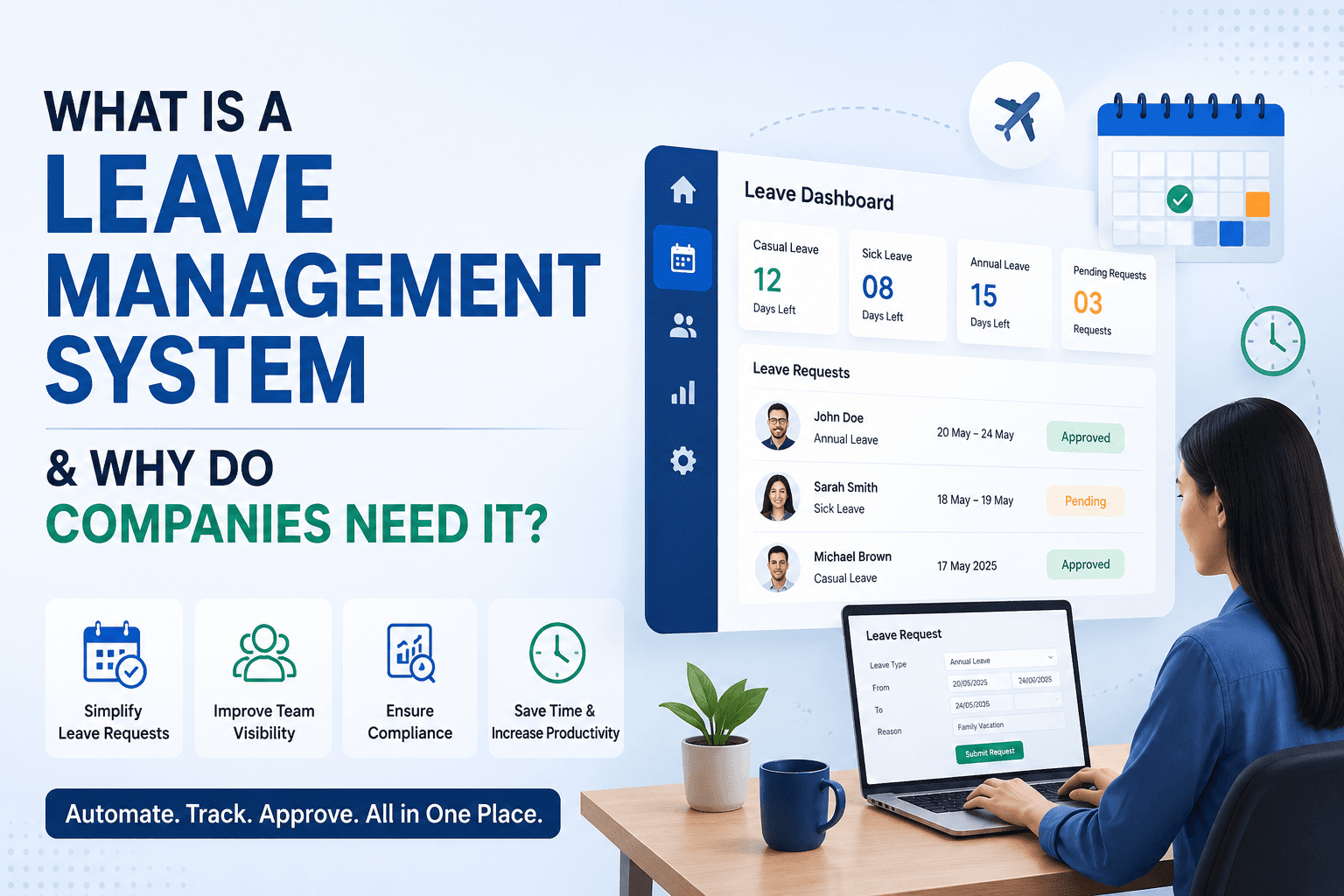
HR Strategy
What Is a Leave Management System & Why Do Companies Need It?
Still tracking leave in emails and spreadsheets? See how a leave management system helps Indian companies apply, approve, and track leave, with payroll integration and full compliance.
5 min read
Compliance
Design an Effective HR Leave System
How to build a compliant HR leave management system that automates statutory tracking, reduces payroll errors, and simplifies leave policy enforcement.
12 min read
HR Strategy
Why Attendance Tracking Is Failing in 2026 (And What Should Replace It)
Stop wasting time on manual inputs. Discover why legacy tracking fails in 2026 and how modern attendance management software automates Indian payroll.
12 min read