
Payroll
HR Software Evaluation Framework for Indian HR Leaders
Evaluate your HR tech stack beyond payroll. Use our HR software evaluation framework to choose a performance-driven HRMS for your Indian enterprise.

MD Moinuddin
HR Content & Research, Human Maximizer · 11 min read · · Updated

It is 10:00 AM on a Monday in Madurai. The server room of an apparel exporter with 5,000 workers is silent. Yet, the HR office is in chaos. The legacy HRMS has crashed. Thousands of employees logged in simultaneously to download their Form 16 documents. This is a classic monolithic bottleneck. It is a structural failure. It turns an HR department into a temporary IT helpdesk.
At Human Maximizer, we observe how these database bottlenecks disrupt daily operations. Many Indian mid-market enterprises build their operations on legacy enterprise resource planning (ERP) systems. These systems were designed for financial ledgers, not dynamic employee directories. Transitioning legacy Indian HR systems to cloud-native architectures is not merely a technical upgrade. It is a structural necessity. When an organization scales, a legacy database struggles to process concurrent requests.
According to research, payroll and operations are the most common capabilities of HR tech stacks, yet these tools are often built on top of database structures from the early 2000s. When you run a heavy payroll calculation while employees are checking in for their shifts, the database locks. This creates a lag that delays shift starts and corrupts attendance data. For enterprises looking to execute an HR digital transformation, evaluating the underlying engine is just as important as reviewing the list of HRMS features. Without a cloud HR systems India strategy, a growing enterprise builds on a foundation of technical debt.
Modular vs. Monolithic: Building for Performance and Scalability
In a monolithic architecture, every function shares a single database and application server. This includes attendance, payroll, performance, and recruitment. If the payroll module experiences a high load, the entire system slows down.
A modular system architecture solves this. It separates services. Each module runs independently, communicating through lightweight APIs. This design ensures that high demand on one service does not degrade the performance of another.
For example, during appraisal cycles, hundreds of managers access the Employee Performance Management system to complete reviews. In a monolithic system, this activity slows down the real-time biometric sync used for Attendance Management. In a scalable HRMS, these systems run on independent microservices. The performance reviews process in its own container, leaving the attendance sync unaffected.
When our team designed Human Maximizer, we separated these core functions to prevent resource contention. This architecture ensures high uptime even during peak transactional periods like month-end payroll processing.
Migration Performance Moving from a monolithic legacy system to a modular architecture shortens the payroll close by decoupling the real-time attendance sync from the core payroll calculation engine, preventing database locks during peak shift changes.
The Data Hub: Breaking Silos for Unified Compliance
Indian compliance is complex. It requires continuous recalculations. This is especially true for provident fund calculations under the Employees' Provident Funds and Miscellaneous Provisions Act, 1952 and employee state insurance under the Employees' State Insurance Act, 1948.
Many organizations rely on separate point solutions for attendance and leave data. This creates data silos. To bridge these silos, IT teams write custom middleware. This middleware is fragile. When a regional labor law changes or a new tax slab is introduced, the middleware breaks.
A common observation is that compliance deductions go wrong less from ignorance and more from inputs that arrived late. When each branch keeps its own inputs, reconciliation quietly becomes a full-time job. The reconciliation burden grows faster than headcount when each branch handles inputs its own way. A centralized data hub eliminates this manual overhead. It ensures that any change in leave status or shift timing updates the payroll engine automatically. This unified data layer is critical for maintaining transactional integrity across multiple legal entities.
Data-Driven vs. Record-Keeping: The Shift in Tech Stacks
Traditional HR software is transactional. It acts as a system of record. It records past events: an employee logged in, a leave request was approved, or a salary was paid. While this record-keeping is necessary, it does not help leaders optimize their workforce.
A data-driven architecture focuses on operational flow. It analyzes aggregated metadata to identify operational bottlenecks. For instance, instead of just tracking whether an employee is at their desk, a performance-based HR tech stack highlights where work is stuck.
This architectural shift supports the transition to adaptive workplaces. Academic research indicates that modern HR systems must contribute to building adaptive, resilient, and people-centric workplaces. By using metadata rather than invasive surveillance, systems measure team output without compromising trust.
To solve the bottleneck problem where systems crash under sudden administrative spikes, a data-driven architecture separates transactional databases from analytical queries. This is the foundation of our Productivity Lens. It is a dashboard feature that tracks team output through task completion rates and milestone progression using aggregated metadata — not screenshots, keystrokes, or screen recordings. By separating these analytical reads from the transactional database, HR leaders can identify where work is stuck without risking system crashes or compromising employee trust.
Want a system that handles architectural scaling automatically? Let's talk.
Under the Hood: What to Ask Your Vendor About Frontend and Backend Stacks
When conducting an HR software evaluation, technical leaders must look at the technologies used to build the platform. A contemporary tech stack directly impacts page load speeds and database reliability. Here is what you should ask your vendor during the evaluation process:
- Does the backend rely on languages designed for high concurrency and security? Ask if they use frameworks like Python Django or Node.js. Python Django is known for its security features and rapid development capabilities, making it ideal for handling complex business logic like salary calculations.
- Is the frontend built on modern libraries like React.js? A fast frontend allows HR managers to filter large employee directories or view the Organization Chart without waiting for full page reloads.
- How does the database handle relational data? PostgreSQL is a preferred choice for cloud HR systems India because it handles relational data with strict transactional integrity.
- Does the platform use a decoupled architecture? Keeping the user interface separate from the business logic makes it easier to deploy updates without disrupting daily operations. This prevents system-wide downtime during routine maintenance.
Security by Design: Protecting Employee Data in a Cloud-Native World
HR databases contain highly sensitive information. This includes bank details and government identification numbers. With the implementation of the Digital Personal Data Protection (DPDP) Act, 2023, data privacy is a legal mandate in India.
Any HR software architecture must be designed with security at its core. This requires encryption at rest using AES-256 and encryption in transit using TLS 1.3. Additionally, the platform must support multi-factor authentication and role-based access control.
Under the DPDP Act, 2023, organizations must be able to specify who has access to employee data and provide a clear audit trail of any data exports. A cloud-native architecture enforces these rules at the database level, preventing unauthorized access even if a user attempts to bypass the application interface.
The Performance-Centric Scorecard: Metrics for CTOs and HR Leaders
When evaluating HR software architecture, technical leaders must request technical specifications and measure vendors against these performance-centric metrics:
- API Response Time: The time taken for the system to respond to an API call should be under 200 milliseconds.
- Uptime SLA: Look for a guaranteed high uptime SLA backed by service credits.
- Concurrent User Capacity: The system must handle peak loads, such as shift check-ins or tax declaration deadlines, without degradation.
- Data Sync Latency: Attendance data from biometric devices or Geo-Fencing should sync with the database in real time, or at least within five minutes.
When Pure Automation Reaches Its Limit
While an automated architecture improves efficiency, there are scenarios where automated rules must yield to human judgment:
- Discretionary Exit Settlements: During the Resignation & F&F process, complex disputes regarding notice period recovery or custom bonus payouts often require manual overrides. An over-automated system that blocks manual adjustments delays the final settlement.
- Complex Local Labor Disputes: When dealing with union-negotiated settlements or specific regional factory disputes, rigid statutory rules within the software may not accommodate the specific terms of a local compromise. In these cases, the HR team must have the ability to apply manual payroll corrections.
Product Demonstration: Exception Handling in Real Time
To understand how a performance-centric architecture operates, let us look at how the system handles a common compliance exception:
- The Trigger: A regional government announces a retroactive change in the Professional Tax slab mid-month.
- The Monolithic Failure: In an older system, the HR team must wait for the vendor to release a patch. If the patch is late, payroll is run with incorrect deductions, leading to manual adjustments in the following month.
- The Modern Workflow:
- The compliance team updates the tax rule in the central policy engine.
- The Payroll module automatically flags any processed but unpaid salary slips that do not match the new rate.
- The system recalculates the deductions for the affected employees in real time.
- The HR manager receives an alert on the dashboard showing the exact difference before finalizing the payroll run.
This exception handling prevents compliance errors before the money leaves the company's bank account.
Frequently Asked Questions
What are the core components of a modern HRMS architecture?
A modern HRMS architecture consists of a decoupled frontend, a modular backend using microservices, and a secure database layer. It also includes an API gateway to manage integrations and a centralized data hub for unified reporting.
How does modular architecture improve HR software performance?
Modular architecture separates different functions into independent services. This prevents high traffic in one module, such as employees downloading tax forms, from slowing down other critical functions like real-time attendance tracking.
Why is a data-driven architecture superior to traditional ERP-based HR systems?
A data-driven architecture uses metadata to identify operational bottlenecks and predict workforce trends. Unlike traditional ERPs that only record past transactions, a data-driven system helps managers allocate resources based on verified skills and output.
What security standards must HR software architecture meet?
HR software must support encryption at rest and in transit, alongside multi-factor authentication. It must also comply with local regulations such as the DPDP Act, 2023, to protect sensitive employee data.
At Human Maximizer, we build systems that scale with your business. Book a 15-min Human Maximizer demo to see our architecture in action.
Let us return to that apparel manufacturer in Madurai. The server crash on Monday morning was resolved after the IT team manually restarted the database and restricted access to the Form 16 portal. However, the lost productivity and employee frustration could not be recovered. As organizations grow, the strength of their software architecture becomes clear. The question is not just what features your HRMS has today, but whether its architecture can support your organization's growth tomorrow.
About the Author & Reviewers
MD Moinuddin — HR Content & Research, Human Maximizer
MD Moinuddin works on content and research for Human Maximizer at Razor Infotech, turning HR-tech and Indian compliance research into practical, plain-English guidance for growing companies.
Connect on LinkedIn
Reviewed & approved by Sameer Hameed — Founder & Chairman, Razor Infotech
Sameer Hameed is the Founder & Chairman of Razor Infotech, where he is guiding the creation of Human Maximizer. An entrepreneur across technology, real estate, mining and travel, he builds organisations on clarity, trust and responsible growth — on the belief that businesses grow only when the people behind them grow.
Connect on LinkedIn
Reviewed & approved by Nishant Tandon — Co-founder & Lead Partner, Razor Infotech
Nishant Tandon is Co-founder and Lead Partner at Razor Infotech, with over a decade in IT, customer support and business operations, helping SMEs achieve cost efficiency, stronger customer experience and scalable, sustainable growth.
Connect on LinkedIn
Human Maximizer is built by Razor Infotech in New Delhi, India (founded 2019). About Human Maximizer.
Keep reading

Compliance
The Complexity Tax: Choosing the Best HRMS Software in India
Why bloated all-in-one HRMS software creates a hidden complexity tax that drains your team's productivity and how to streamline your HR operations...
16 min read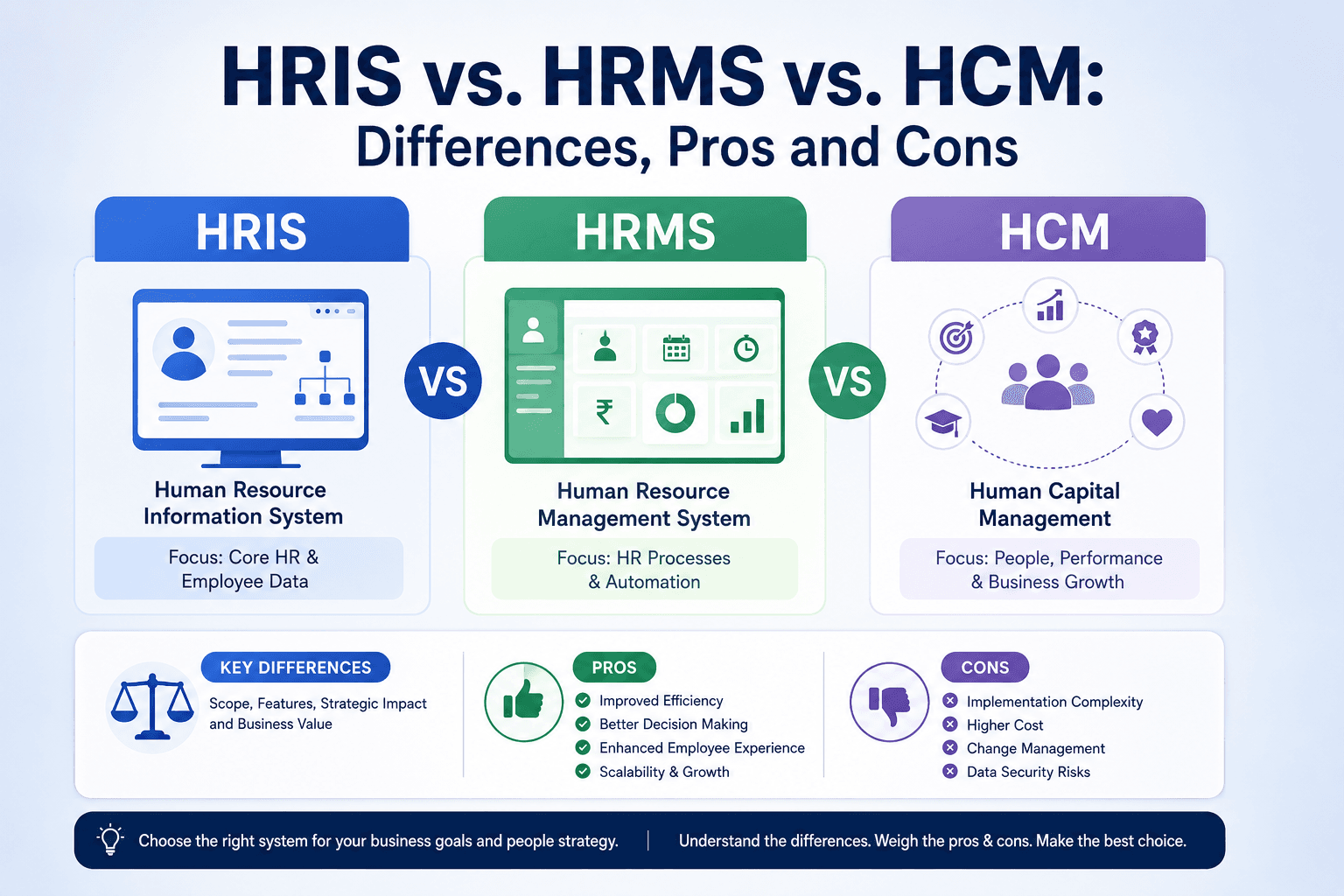
HR Strategy
What are the Differences Between HRIS, HRMS & HCM?
Understand the core differences between HRIS, HRMS and HCM, including their pros and cons. HRIS is commonly used for basic data management, HRMS automates HR tasks, whereas HCM supports the strategic planning within an organisation.
5 min read
Payroll
From Payroll to Productivity: Using HR Data to Predict Quarterly Revenue
Your payroll data already describes capacity. How to turn HR numbers into a quarterly revenue signal using workforce yield and India's statutory caps.
12 min read