
HR Strategy
Appraisal Software India: Beyond Annual Reviews
How to select the best appraisal software India has to offer. Streamline your performance review cycles and align employee goals with business growth.

Chandan Watts
Technical Product Manager, Human Maximizer (Razor Infotech) · 13 min read · · Updated

Most appraisal software in India solves a paperwork problem and then gets marketed as a performance solution. The forms go out on schedule, reminders fire, submissions land in a dashboard, and HR finally stops chasing forty department heads over WhatsApp on the last working day of the cycle. That is a real win. It is also the smallest one available. The employee reading that completed form in April is often reading a judgment about a project that was quietly shelved in month six, written by a manager who is reconstructing eleven months from memory and a few Slack threads.
When we were building the performance module at Human Maximizer, this was the complaint that came up again and again from the HR managers and payroll specialists we sat with: the appraisal was not late, it was stale. Digitising a stale process only makes it arrive faster.
So the question a growing Indian company should be asking is not "which tool has the most features." It is narrower, and more useful: what record does this system leave behind, and how quickly can we trust it?
Why Indian SMEs Are Abandoning the Once-a-Year Verdict
The annual cycle was designed for a workforce whose role definition stayed still for twelve months. Very few SMEs in India work that way now. A 60-person services firm in Coimbatore can re-shuffle delivery teams three times in a year because two clients renegotiated scope. An engineer hired for backend work spends two quarters firefighting an integration nobody scoped. When the appraisal finally arrives, it rates the job description, not the job.
Continuous feedback fixes something specific here, and it is worth being precise about what. It does not make people work harder. What it does is shorten the gap between an observation and a record of that observation, so the rating at year-end is an arithmetic summary of things already discussed rather than a surprise verdict delivered in a closed room. Employees rarely dispute a score they have seen coming. They dispute the one that appears in March describing a version of their job that stopped existing in August.
There is a second, quieter benefit. Frequent ratings force managers to develop a rubric they can actually defend, because they have to apply it four or twelve times instead of once. Annual-only cycles hide bad rubrics. A monthly or quarterly cadence exposes them within a period or two.
The Rating Trail: What Separates Real Appraisal Software From a Digitised Form
Here is the idea we keep coming back to, and the one worth carrying into every vendor demo. A rating is only as valuable as the trail behind it.
A Rating Trail is the unbroken chain that connects a company objective to a number on somebody's scorecard, and it has to survive being read by a stranger a year later. Ask any platform you evaluate to show you each link:
- The rubric it came from. Which KPI set, tied to which designation, at which version? If the rubric changed mid-year, the system should still know which version was in force when a given rating was entered.
- The period it covers. Daily, weekly, monthly, or annual. A score with no bounded period is an opinion.
- The rater and the timestamp. Who entered it, when, and was it edited afterwards.
- The weighting. How the individual KPI marks add up to the total, and whether quantitative KPIs had targets attached or were scored on feel.
- The consequence. What the rating triggered: an increment, a promotion, a development plan, a PIP.
Most tools give you links two and three. The expensive gaps are one and five.
Why this matters more in India than the global vendor pitches admit: appraisal records are the documentary spine of increments, promotions and, eventually, contested exits. Indian industrial and employment law leans heavily on whether an employer can show a documented, communicated, consistently applied process rather than a retrospective justification, and the statute texts sit at indiacode.nic.in and labour.gov.in. A ratings table with no rubric version and no audit stamp is not evidence, only a spreadsheet with an opinion in it.
That is also where disconnected point tools quietly cost money. When appraisal data lives in one system and increments are processed in another, somebody re-keys the outcome, and the mistake shows up in the salary register rather than in the review. The general pattern is straightforward: unified HCM platforms produce fewer payroll errors than point-solution stacks, because there are fewer places where a number is copied from one system into another. Our own reason for putting performance and payroll on one platform was narrower than any benchmark. In the conversations we ran with HR leaders, managing directors and founders across Indian companies before launch, the re-keyed increment came up repeatedly as the error nobody owned: HR assumed finance had the final rating, finance assumed HR had checked it, and the employee found out on the 7th.
Aligning Individual Goals With Company Objectives Without a Weekly Status Meeting
Goal tracking and OKR management is the section every vendor page has. The part that gets skipped is the failure mode: goals are set in April, cascaded once, and never touched, so by Q3 the individual objectives and the company plan have drifted apart with nobody noticing until the review.
Alignment is a maintenance problem, not a setup problem. What you actually want from the software is a mechanism that surfaces drift while it is still cheap to fix, one that makes the sales head's revised quarterly target visible to the six people whose objectives depend on it without a meeting being scheduled to announce it. Our Synergy module handles that specific job by syncing OKRs between managers and their direct reports automatically, so a revised parent goal propagates rather than sitting in one person's inbox.
The number worth watching is unglamorous, and you can compute it today: rating coverage, meaning subordinates rated in the closed period divided by total subordinates in that manager's tree, expressed as a percentage. No proprietary formula, no black box. A manager sitting below full coverage two periods running is telling you something true about either their bandwidth or their belief in the rubric.
If your appraisal cycle currently runs on reminder emails and a shared drive, we should talk about what the first cycle would look like on a system that keeps the trail for you.
360-Degree Feedback in an Indian Workplace: Useful, and Easy to Get Wrong
360-degree feedback software has a specific cultural friction in Indian organisations that global buyer's guides tend to skip. In a hierarchy-conscious workplace, upward and peer feedback is only honest if raters genuinely believe it cannot be traced back to them, and in a ten-person department, "anonymous" is arithmetic rather than a promise. Three raters and a distinctive writing style is not anonymity.
Two guardrails hold up in practice. Set a minimum rater threshold below which results are simply not released, and pool responses so no single rater's input is ever displayed on its own. Then resist the obvious temptation in year one: keep peer feedback developmental rather than wiring it straight into the increment number. Organisations that skip that step get a beautifully generous dataset and no information.
One more India-specific point. Performance and feedback records are personal data under the Digital Personal Data Protection Act, 2023, which makes retention periods and access rights configuration decisions with legal weight rather than admin preferences. Ask the vendor who can see a rating from three years ago, and whether that access is logged.
Skill Gaps and Development Plans: Turning Ratings Into a Deployment Decision
The rating that goes nowhere is the one employees stop taking seriously. A low score on a qualitative KPI should produce a development action with an owner and a date, not a note in a file.
This is where skill gap analysis earns its place. Once you have several periods of KPI-level data per designation, you can see patterns that no individual review surfaces: an entire designation scoring poorly on the same competency usually indicates a hiring profile or training gap, not fifteen underperformers. Our Know Your Employee module exists for the deployment side of this, helping managers match people to project requirements based on verified skills and past performance instead of who is visible and available.
A composite example, assembled from the kind of data these dashboards throw up rather than any one customer's account: a services firm sees that across two quarters, mid-level engineers score consistently low on client-communication KPIs while scoring well on delivery. Read one row at a time, that is eleven separate coaching conversations. Read at designation level, it is a single change to how those engineers are inducted.
Choosing a Performance Management System in India: Compliance, Pricing and Time-to-Value
The Indian market has real, established options, Synergita, Keka HR, HROne, SumHR and PeopleHR among them, and a fair comparison is between categories of tool rather than logos.
| Approach | Best for | The tradeoff |
|---|---|---|
| Standalone appraisal tool | Teams wanting a specific review methodology fast | Ratings live away from payroll and employee records; someone re-keys the outcome |
| Spreadsheet plus email reminders | Under 20 employees | No rubric versioning, no audit stamp, no defensible trail |
| Unified HRMS with a performance module | SMEs where increments, attendance and records must reconcile | Broader rollout; you configure more than one module |
Three questions separate a real evaluation from a demo.
Does pricing survive headcount growth? Most Indian vendors quote on request, which makes budgeting a negotiation. Ours is published: ₹49 to ₹112 per user per month on annual billing, with a free tier, on our pricing page. Whatever vendor you choose, model the cost at your headcount two years out, not today's.
Can it produce a compliance-grade report without a manual export? Almost nobody tests this before signing, and SHRM's HR Technology Survey 2024 explains why it bites later: 71% of HR leaders say their current HRMS cannot generate real-time compliance reports without manual data extraction. Ask for the report live, in the demo, with filters applied. We keep an in-house compliance team tracking Indian statutory changes for exactly this reason, because the gap between "the data is in there" and "I can produce it on demand" does not close on its own.
What is the realistic time-to-value? Configuring KPI sets per designation is genuinely quick. The timeline is set by sign-offs: agreeing rubrics with department heads and deciding what happens to mid-year joiners will eat more calendar than any configuration screen. Across the 50+ Indian businesses now running on the platform, that has been the pattern every time. And adoption is decided at the first live cycle on the new system, when managers discover whether bulk rating actually saves them an evening. Not at the kickoff call.
Where Appraisal Software Genuinely Falls Short
Software cannot fix a rubric nobody believes in. If your KPI marks do not add up to a meaningful total, or every qualitative KPI is scored on impression, automation just distributes the problem faster and with better formatting.
It also cannot arbitrate a contested rating. When a manager and an employee disagree materially about a score tied to an increment, that is a human conversation with an HR partner in the room, and it should end with a written outcome the system stores rather than a workflow that auto-closes.
And it should not be your only record for a termination decision. Ratings support such a decision; they do not constitute the process. For separations with statutory exposure, take proper legal advice, and keep the Resignation and Full & Final Settlement trail clean alongside the performance one.
Frequently Asked Questions
How does appraisal software automate an annual review cycle? It publishes a versioned KPI set per designation, opens the review period automatically on the chosen cadence, and lets managers rate their whole reporting tree one by one or in bulk via a pre-filled template. The system computes per-KPI and total scores, so HR is tracking coverage instead of collecting attachments.
Is continuous feedback actually better than an annual appraisal? For roles whose scope changes during the year, yes, because the record stays current and the year-end score contains nothing the employee has not already seen. Annual-only reviews remain workable for stable, highly standardised roles. Most Indian SMEs have fewer of those than they think.
Which performance management system suits a small business in India? For under roughly 30 people, an integrated module inside your HRMS almost always beats a standalone appraisal tool, because the increment has to reach payroll and the record has to sit with the employee file. Weigh published per-user pricing and how fast the first cycle can run, not feature count.
What should Indian companies specifically check before buying? Rubric versioning, an audit stamp on every rating, DPDP-aligned access and retention controls, a compliance report you can generate without an export, and a named person on the vendor side who owns your first live cycle.
The Form Was Never the Problem
Go back to that HR manager chasing forty department heads for pending forms. Collecting all forty on time is a scheduling victory, and it is worth having. But the reason the appraisal felt hollow to the employee was never the delay. It was that the rating described a job that had changed two quarters earlier, with nothing in the record to show when or against which rubric it was scored.
A system that keeps the trail turns that same cycle into something an employee can argue with on the facts, and something you can produce, intact and timestamped, the day a dispute or an audit makes you go looking for it. If you want to see what that looks like on real KPI data rather than a demo dataset, our team will walk you through it.
About the Author & Reviewer
Chandan Watts — Technical Product Manager, Human Maximizer (Razor Infotech)
Chandan Watts is Technical Product Manager at Razor Infotech, building the Human Maximizer HR platform. After years leading customer-experience and team operations at JindalX and Radical Minds, he focuses on how teams actually work day to day — and how small workflow gaps quietly slow an entire team down.
Connect on LinkedIn
Reviewed & approved by Sameer Hameed — Founder & Chairman, Razor Infotech
Sameer Hameed is the Founder & Chairman of Razor Infotech, where he is guiding the creation of Human Maximizer. An entrepreneur across technology, real estate, mining and travel, he builds organisations on clarity, trust and responsible growth — on the belief that businesses grow only when the people behind them grow.
Connect on LinkedIn
Human Maximizer is built by Razor Infotech in New Delhi, India (founded 2019). About Human Maximizer.
Keep reading

HR Strategy
Unbiased Performance Appraisal Software for Indian Startups
Eliminate algorithmic bias. Learn how unbiased performance appraisal software protects DEI and ensures fair employee evaluations in Indian startups.
13 min read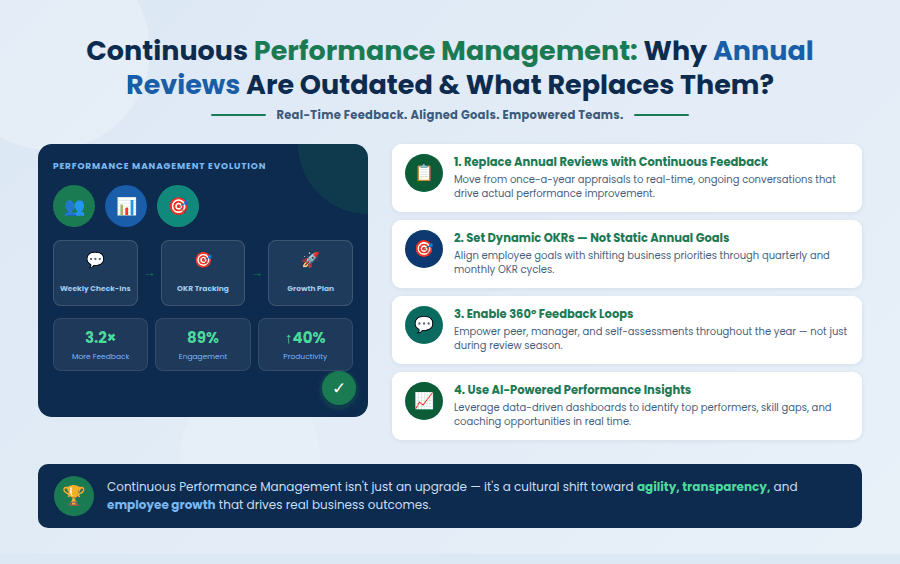
Employee Engagement
Continuous Performance Management: Why Annual Reviews Are Outdated & What Replaces Them?
Why the yearly appraisal fails Indian teams, what continuous performance management replaces it with, and how to run the shift without adding meetings.
5 min read
HR Strategy
Whem Shift Management: Ending Roster Chaos
Stop roster clashes with WHEM shift management. Get a step-by-step guide to automating your staff schedules while staying compliant with Indian labor laws.
14 min read