
Employee Engagement
Continuous Performance Management: Why Annual Reviews Are Outdated & What Replaces Them?
Why the yearly appraisal fails Indian teams, what continuous performance management replaces it with, and how to run the shift without adding meetings.

Richa Thakur
Content Writer · 5 min read · · Updated
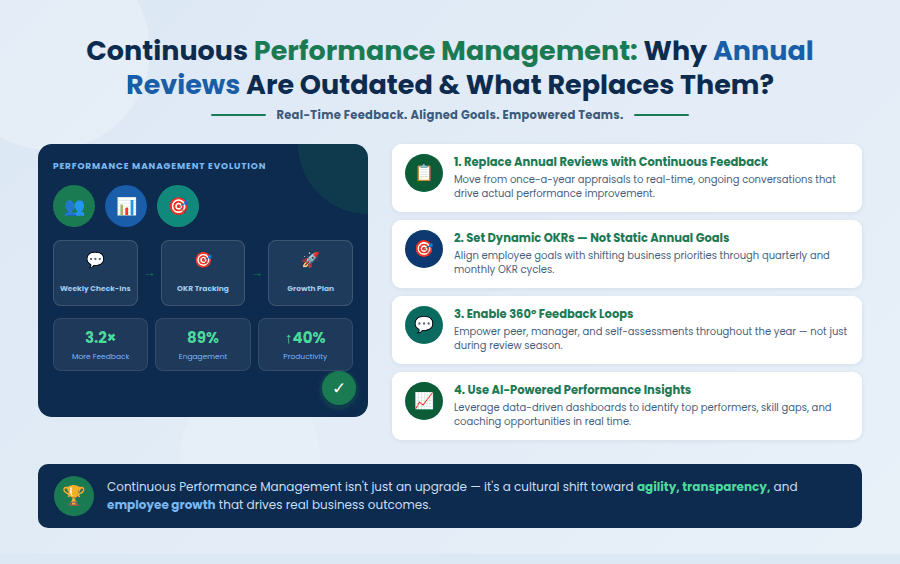
Are you still managing employee performance by reviewing past performances, assigning ratings, conducting meetings or debating on increments or performances?
We can consider it as a structural way for annual appraisals, but now the times have changed significantly, and traditional methods are no longer serving the business requirements. In the current landscape, organisations need agility, predictive insights, reports, and consistent review to accelerate operational workflows and become people-centric.
Therefore, companies are shifting from annual reviews to continuous performance management to get regular feedback, align goals, and foster development.
In this comprehensive blog, you’ll understand:
What are annual appraisals, and how do they limit performance evaluation?
How CPM works, its importance, benefits for employees and organisations?
How to move from annual reviews to continuous feedback to strengthen employee engagement?
Last-minute tips, role of AI in CPM
How Human Maximizer helps in eliminating traditional annual reviews by offering CPM?
What does Annual Appraisals Include?
Annual Appraisals are formal, yearly evaluations of employees' performance, achievements, contributions, weaknesses, and professional development conducted by managers. This process helps in aligning an employee's career aspirations and work achievements with structured communications, reviewing goals, setting future objectives, discussing feedback, appraisals, bonuses and promotions in a specific year.
Drawbacks of Annual Appraisals
Do you know why companies are ditching annual performance reviews? One of the biggest issues is the timeline. Rather than focusing on growth, annual reviews focus primarily on outcomes which no longer support the organisation's growth.
Here are the major drawbacks of adopting annual appraisals in recent times:
Generally, feedback is delivered after months, when the incident has already occurred and the impact and significance of the losses.
Dissatisfaction among the employees and bias towards individuals.
TL and managers struggle to gather data for a specific time period.
Slightly meaningful development, the discussions navigate towards a transactional and compromised approach.
What is continuous performance management, & How does it work?
Continuous performance management is an ongoing, year-round approach to employee development that replaces conventional annual reviews through regular check-ins, real-time insights, metrics and dynamic goal adjustments.
It focuses mainly on promoting continuous support and conversation between managers and team members. CPM increases engagement, productivity and performance that aligns with company goals and visions.
Key Stages of CPM
The process of performance management cycles operates continuously:
Planning: Set clear, actionable and realistic goals (SMART) that align with company strategy.
Monitoring: Consistent tracking of progress through regular, informal conversations, training sessions, and feedback to ensure goals remain on track.
Developing: Identifying the skill gaps, providing training resources, and tools to enhance employee capabilities.
Reviewing/Appraising: Performance evaluation of predefined goals daily, weekly, monthly and annually to discuss achievements and areas for growth.
Rewarding/Recognising: Appreciating high performers through compensation, appraisals, and bonuses to motivate employees.
Importance of CPM
Gallup, State of the Global Workplace 2025, states that only 21% of employees worldwide are engaged at the workplace. It is the second-lowest rate in a decade, with the U.S at a historic 11-year low of 31%.
As per the further reports, Gallup claims that employees who receive consistent, real-time feedback are 3 times more engaged at work compared to those who receive only once a year.
Not only this, but the companies that foster a strong culture of continuous performance management experience 14.9% reduces employee turnover rates than those with no feedback culture.
This continuous performance benefits the companies to achieve high ROI. Deloitte study conveys that companies with weekly continuous feedback systems report 21% higher profitability and 24% lower turnover compared to those with annual only reviews.
The above-mentioned reports and studies reflect how implementing continuous performance management is necessary for companies to achieve business outcomes.
Benefits of continuous performance management for Employees
When 80% of employees already prefer ongoing feedback over annual reviews (PwC, 2024), the case isn’t hard to make. But the real benefits of continuous performance management go far beyond preferences. It reshapes how employees experience growth, recognition, and their sense of purpose in the workplace.
Through regular feedback, sessions and recognition, it increases employee engagement. With CPM, the HR department can transform engagement from a recurring measure into a sustained data-driven performance.
Constant reviews and discussions prioritise employee growth. It reduces the turnover rate and supports retention.
When employees' goals align with business objectives, it strengthens cross-functional clarity and accountability for agile, growth-focused organisations.
Continuous performance discussions build transparency and foster relationships between managers and individuals.
It enhances psychological safety and commitment from judgment to collaboration.
CPM utilises metrics and data to provide feedback that culminates engagement, productivity and alignment for business growth and this results in increased ROI.
Enables HR leaders to shift from outdated workforce planning to strategic planning.
How to Implement Continuous Feedback in the Workplace?
You need a complete checklist with actionable steps and strategies to implement continuous feedback in the workplace. It requires a cultural and progressive change to make the transition better through regular feedback, delivering constructive reports, and incorporating self-assessments, prioritising short-term targets and using metrics to evaluate performance.
Here are the step-by-step points to implement continuous feedback to promote business growth and reduce attrition rate:
1. Audit Your Current Performance and Secure Leadership Buy-in
Before investing in anything new, map out what currently exists, such as reviews, feedback channels, manager behaviour and employee sentiment.
Run a pulse survey by asking the following questions, such as:
How often do you receive feedback?
Is it useful for your business?
Do you know how your work connects to company goals?
After that, map out managers' behaviours by tracking how frequently one-on-one meetings happen between managers and employees, what’s discussed, and whether notes and action items are documented.
2. Define a Clear Feedback Structure and Flow
Continuous feedback doesn’t mean providing feedback; it means intentional, regular touchpoints. Design a layer structure and a feedback flow, like weekly, monthly, quarterly, or annually, to review goals.
Conduct 5-10-minute check-ins and ask necessary questions like:
What’s going well?
Are there any blockers?
Review goal progress, discuss developments, address challenges, and revise predefined goals and strategies if business requirements are changed.
3. Shift from Annual KPIs to Agile OKR-Based Goal Setting Performance
Companies that manage objectives quarterly generate 30% higher returns than those addressing goals annually. To keep your team aligned, focused, and adaptable with evolving business priorities, replace the static KPI list with quarterly objectives and key results.
How to make goals work continuously?
You can make goals continuously by setting 90-day cycles to keep goals relevant, and allow wins to be celebrated more often, so that the team prioritises without waiting for the year-end.
Use a shared dashboard for the employees' and managers' convenience to view goal status in real-time, rather than waiting for the review time.
4. Train Managers to become Coaches, not Evaluators
One of the biggest failure points of CPM is untrained managers. Since 70% of team engagements depend on the managers, including how they initiate with the team, their work frequency. All these factors determine whether CPM works or fails.
Train managers for active listening and speaking skills.
Managers who focus on team strengths reduce active disengagement to 1%, while those who focus on weaknesses report it at 22% (Gallup)
Training is not an optional aspect in determining continuous performance management. It is the core foundational factor which is highly effective at providing quality coaching and feedback.
5. Adopt 360- Degree and Peer Feedback Along With Manager Reviews
Top-down feedback from the managers can only provide an incomplete report. 360-degree feedback helps in evaluating performance from peers, team leaders, and cross-functional colleagues to spot gaps, inconsistencies, and build a culture where feedback flows in all directions.
How to structure multi-source feedback?
Encourage employees to rate their work performance before a one-on-one session to create accountable and more productive conversations.
Prepare a list of questions beforehand and ask questions after every 2-4 weeks to gather workload sentiments, progress, and weak points.
6. Choose and Deploy the Right Technology Platform
Technology should support the process instead of replacing it. Choose a software that aligns with the business requirements and vision. Modern platforms allow organisations to track real-time goals, facilitate continuous feedback and provide complete visibility of team and individual performance.
7. Measure, Refine and Build a Culture of Continuous Improvement
Implementing a continuous performance management tool is not a one-time project. It’s a cultural shift to track whether a system is working through leading indicators, gather feedback, process timeline, and refine approach as the organisation expands.
Key metrics to track CPM success are:
Check-in completion rate
Employee engagement score
Goal completion rate
Voluntary turnover rate
How does Continuous Performance Management Strengthen Employee Engagement?
Shifting from a traditional annual review to continuous performance management is a strategic approach for organisations that not only delivers better performance outcomes but also reduces turnover and attrition rate. Let’s explore deeper how CPM improves employee engagement:
1. Foster Transparency & Clarity Among Employees
With the traditional annual review methods, the employees get stress, surprises and headaches rather than meaningful conversations. Employees spend weeks wondering about the annual review and reports.
CPM eliminates the annual reviews with regular check-ins that create timely and actionable feedback. Managers and team leaders get clearer direction with regular goal updates and progress reviews. Regular conversations promote transparency and clarity among employees, which builds trust and reduces anxiety.
2. Focus on Development Plans
Nowadays, with the advancement of technology and business expansion, organisations need clearer development plans than an ordinary calendar reminder. To foster a continuous performance management system, HR leaders and managers can build a rhythm and visibility to get desired results.
Unlike annual appraisals that prioritise reports, CPM emphasises growth and evaluation to receive ongoing coaching, skill development guidance and support to improve continuously.
3. Motivates Employees & Activates Participation
When employees feel recognised, supported and valued, the engagement rate radically increases. By implementing continuous feedback, organisations can create a culture of collaboration and participation, and make the discussions more meaningful and motivating.
4. Data-Driven Decision Making
Real-time performance provides a desirable result with HR metrics, analytics, and reports. Organisations that shift to continuous performance remark an improved retention, better culture and maximised productivity.
Through data-driven decision making, managers and leaders can address issues and gaps in a few weeks rather than waiting for a year. With real-time insights, individuals can stay engaged, grow faster and perform better within an organisation.
What is the Role of AI in Continuous Performance Management?
Over time, technology and artificial intelligence are evolving the operational and structural workflow management of organisations. It completely changes our perspective on working procedures and techniques.
AI uses machine learning, NLP, and predictive analytics to shift from the annual reviews to continuous, data-driven and personalised employee evaluation. It empowers managers with actionable insights to reduce bias, automate routine feedback, identify skill gaps, and align individuals' goals with the company's objectives.
Key Role of AI in Performance Management
Automates goal settings and alignment
Real-time feedback and coaching
Performance predictions and risk alerts
Personalised learning recommendations
As a result, organisations benefit from the AI involvement with accuracy, efficiency, fairness, continuous growth, and agility.
Tips to Shift from Annual Reviews to Continuous Performance Management
Earlier, annual reviews were considered the backbone of performance management, but they come with significant drawbacks that affect the organisations as well as employees. Delayed feedback, low relevance, complex process, bias, and weak engagement lead to the implementation of the continuous performance management system for evaluating the productivity and performance of employees.
Here are the last-minute tips for shifting from annual reviews to a continuous performance management system for smooth procurement.
Evaluate First: Test beforehand with the specific department, gather feedback, and refine the process.
Combine Formal & Informal: Incorporate annual reviews for pay, bonuses and continuous feedback for growth and training.
Utilise 360-Degree Model: Gather feedback, inputs from HR, peers, and cross-functional teams for performance evaluation.
Prioritise Growth: Instead of primary focussing on outcomes, ratings, focus on actionable suggestions.
Recognise Top Performers: Appreciate employees, celebrate small wins to keep morale up.
How Does Human Maximizer Support Continuous Performance Management?
Organisations are rapidly shifting towards a continuous performance management system. But they need technology to execute it at a scalable level. However, HRMS software offers a structured, consistent and sustainable solution to provide regular feedback and reports.
Human Maximizer centralises goals, regular feedback, data and check-ins to ensure alignment and innovation across teams to reduce administrative and manual errors.
Managers can set goals, track progress, evaluate performance, and HR teams gain complete visibility into performance trends, skill gaps and development requirements across the organisation.
Here are the key capabilities offered by Human Maximizer:
Plan Business Objectives: Set goals and track progress to review whether it aligns with business requirements.
Foster Transparency: Shows scheduled and unplanned check-ins, meetings between managers and employees.
Deliver Feedback: It offers real-time insights, metrics, analytics, to provide feedback and recognition tools.
Redesign Performance: Shifts from heavy discussions to coaching-focused check-ins.
Supports Scalability: With business expansion, we provide reminders, templates, and metrics that centralise every detail on a single platform.
Final Thoughts
Annual reviews and appraisals were quite popular when the business operations were static and slow. But when the business grows, it needs a strategic plan in a dynamic workplace. With the continuous performance management approach, organisations can transform their work strategy from evaluation to development. CPM offers a flexible and effective way to support employee engagement and business growth.
Looking for an agile, productive, flexible and scalable workforce management, then choosing the Human Maximizer is an alternative but a necessary tool for innovating your business goals. With the continuous support, growth, and mentorship, HR leaders can build a highly performative culture that drives sustainable growth for both business and employees.
Book your first demo with Human Maximizer and discover the full potential of our HRMS platform. Examine how our solution can streamline your business processes and enhance productivity and growth to drive success.
Frequently Asked Questions
1. Why are annual performance reviews becoming obsolete?
Annual performance reviews are becoming outdated because it focuses mostly on outcome than promoting growth. These outdated methods fail to deliver real-time performance at an accurate time.
2. How often should managers give employee performance feedback?
Managers should review performance rate weekly, monthly, and quarterly, based on the business goals and the individual’s responsibilities. However, by regularly providing performance reviews, they can address the issues before any major destruction.
3. How to build a continuous feedback culture in your organisation?
You can build a continuous feedback culture by regulating open communication, training managers, adopting a 360-degree feedback model, and integrating HRMS platforms with CPM systems to innovate business outcomes.
4. Which companies have switched from annual to continuous performance reviews?
Big companies like Adobe, Deloitte, Microsoft, Amazon, Accenture, Google and PWC are constantly making a shift towards continuous performance management.
5. Why do employees hate annual performance reviews?
Employees hate annual performance reviews due to infrequency, subjective and judgmental interrogations, and meaningful conversations and developmental coaching.
6. What is the difference between performance management and performance appraisal?
Performance management is an ongoing, regular process of real-time performance updates, status, and feedback, whereas performance appraisals are infrequent and occur once or twice a year, with a primary focus on ratings and evaluations.
Keep reading
HR Strategy
Appraisal Software India: Beyond Annual Reviews
How to select the best appraisal software India has to offer. Streamline your performance review cycles and align employee goals with business growth.
13 min read
HR Strategy
Why Legacy Appraisal Ratings Fail: Implementing Employee-Led Sovereign Performance Enablement
Replace outdated ratings. Learn how a modern performance appraisal system drives employee-led growth and boosts productivity in Indian enterprises.
12 min read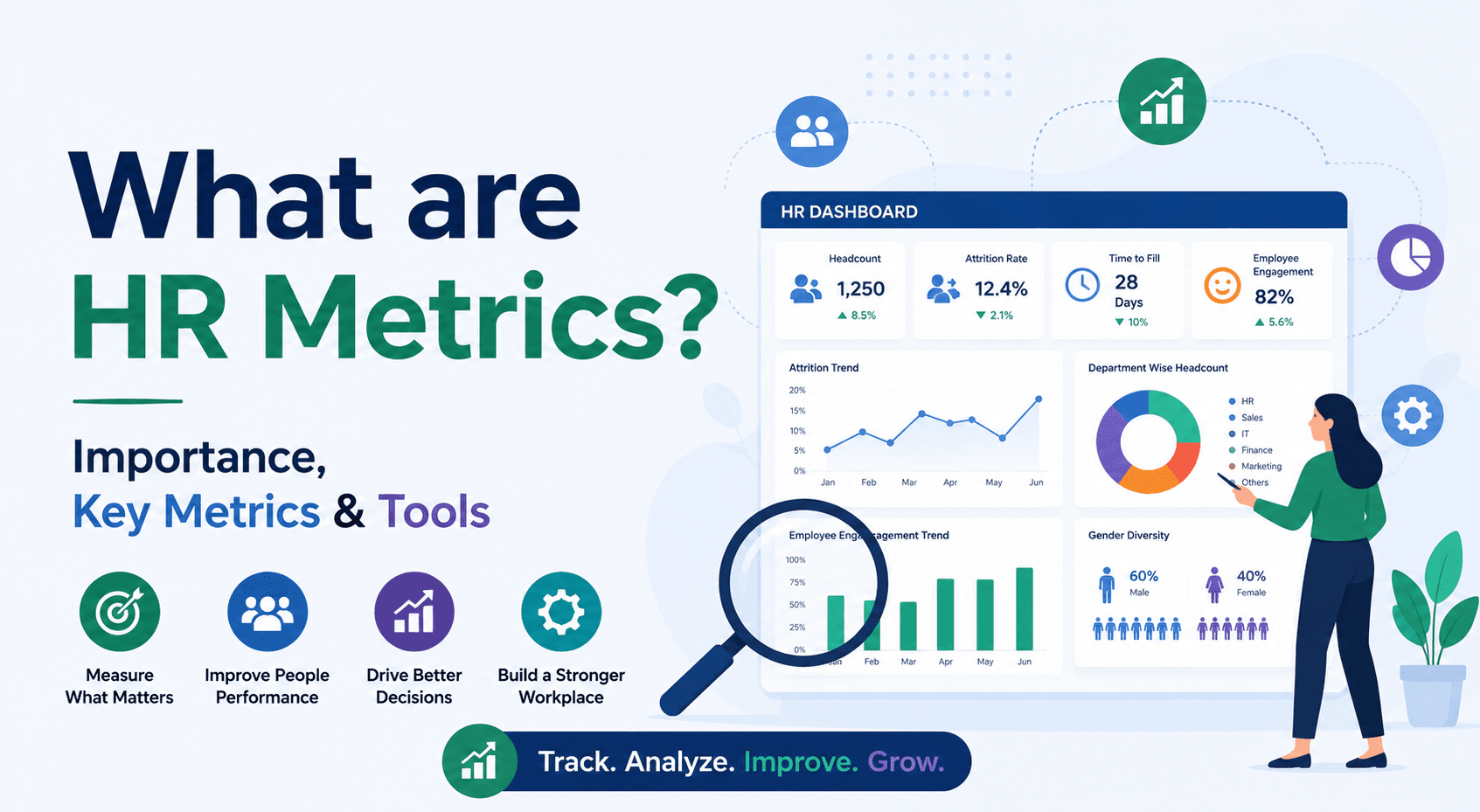
Employee Engagement
What are HR Metrics? Importance, Key Metrics & Tools
Important HR workplace metrics to evaluate talent acquisition, employee performance and training effectiveness. Improve productivity, engagement, and operational efficiency.
5 min read