
HR Strategy
Two Clocks, One Record: Your Employee Lifecycle Management System
Discover how to streamline every stage of the talent journey. Learn to leverage employee lifecycle management software to boost retention and HR...

Chandan Watts
Technical Product Manager, Human Maximizer (Razor Infotech) · 13 min read · · Updated
Most software sold as an employee lifecycle management system is a filing cabinet with a search bar. It stores records well enough, but it will not carry a person from offer letter to relieving letter, and in India it certainly does not carry the two deadlines that shadow every stage of the employee lifecycle. That is the gap we keep hearing about when HR leaders describe tooling that feels busy but never quite useful.
Here is the idea worth building the rest of this piece around. Every stage of an Indian employee's lifecycle runs on two clocks at once. One is the experience clock: how welcomed, how developed, how fairly exited a person feels. The other is the statutory clock: the PF registration that must exist before the first salary leaves Payroll, the ESI enrolment, the gratuity that comes due at a fixed tenure, the exit data that the DPDP Act now governs. Global lifecycle content obsesses over the first clock and ignores the second. Indian HR cannot afford to. We call this the two-clock view, and once you see the lifecycle through it, the reason your current system feels thin becomes obvious.
Why Lifecycle Management Is Your Real Defence Against Attrition
Attrition in Indian IT, BPO, and services is rarely a spike you catch late; it is a slow leak at the seams between stages. A candidate accepts, then waits ten days for a laptop and portal access, and a competitor's counter-offer lands in that silence. A two-year performer never gets a single documented conversation about growth, so they answer the next recruiter's call. The failure was in the handoffs, not in any single stage.

Replacing a salaried employee in India typically costs somewhere between half and twice their annual pay once you add recruitment costs and notice-period overlap to the months before a new hire is fully productive. That cost is almost entirely a handoff problem. Across the industry the pattern is well documented: one messy onboarding or one bad exit drains profit and dents your employer brand. Managing tasks reduces friction for HR; managing the lifecycle reduces churn before it starts. Those are different jobs, and only the second one protects retention.
The Seven Stages, Read Through Both Clocks
The lifecycle is the full arc an employee travels through your organisation, and every person moves through the same sequence whether or not anyone is managing it deliberately: attraction, recruitment, onboarding, development, retention, offboarding, and advocacy. That much is standard. What changes for an Indian HR leader is that each stage carries a statutory obligation riding alongside the human one.
Attraction and recruitment
The experience clock here is candidate perception; the statutory clock barely ticks yet, though your talent acquisition records will feed later compliance. This is where employer brand and a clean hiring funnel do their work.
Onboarding
Both clocks run hard and fast. The human side is belonging and time-to-productivity. The statutory side is PF and ESI enrolment, which must be live before payroll can legally run. Strong onboarding automation is where the two clocks first either sync or split.
Development and retention
Performance appraisal cycles and talent development sit here, alongside salary revisions that must respect PF wage-ceiling rules. The retention clock is engagement; the compliance clock is quieter but never off, because every revision carries a statutory consequence.
Offboarding and advocacy
The exit management process is where Indian companies most often get burned. Gratuity and full and final settlement carry hard timelines, and system access must be revoked cleanly. Exit is also where security risk concentrates: access left un-revoked, grievances left unheard. Ex-employee data now falls under the Digital Personal Data Protection Act, 2023, which governs how long you keep that data and how you dispose of it. Handle this stage well and a leaver becomes an advocate who feeds your attraction stage at almost no cost.
Where an Employee Lifecycle Management System Parts Ways With a Standard HRIS
An HRIS is a system of record. It holds the master data: names, IDs, salary, and documents. It answers "what is true about this person right now?" Useful, necessary, and not the same thing as lifecycle management.
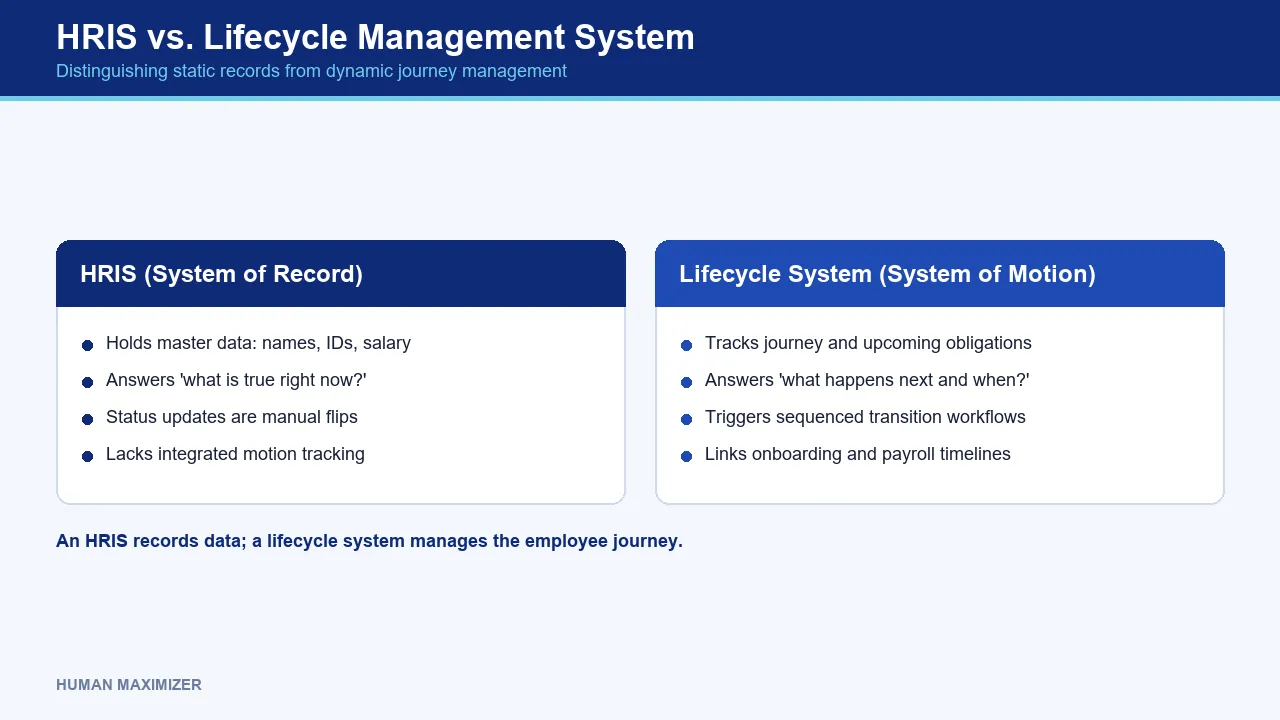
A lifecycle system is a system of motion. It answers "where is this person in their journey, and what has to happen next, by when?" The distinction sounds academic until a transition breaks. In a pure HRIS, an employee's resignation is a status field you flip to inactive. In a lifecycle system, that same resignation opens a sequenced set of obligations: notice-period tracking, knowledge transfer, gratuity calculation, full and final settlement, access revocation, and a relieving letter, each with its own owner and clock.
The practical test is simple. Ask your current tool a motion question. When did onboarding for this cohort actually complete, and did their PF numbers exist before their first payroll ran? An HRIS shrugs. A genuine end-to-end HR lifecycle platform answers, because the two clocks live in the same record. This is why we built the Human Maximizer lifecycle around a single record that carries the joining-through-separation story rather than scattering it across disconnected modules.
Closing the Paperwork Trap: PF, ESI, and Gratuity Inside the Journey
Here is the friction almost every global lifecycle article skips entirely. In India, the compliance clock does not wait for the experience clock. A new hire can feel wonderfully welcomed and still be a legal liability if their statutory enrolment lags their first salary run.
Let me show it as an exception, the way it actually surfaces in HR's week. Payroll is closing. One new joiner's Provident Fund number was never generated, because the onboarding paperwork stalled on a field nobody owned. In a disconnected setup, this is discovered during payroll reconciliation, or worse, during an inspection. In a connected lifecycle, the missing enrolment is flagged the moment the joiner's record is created, long before payday, because the Core HR record and the Payroll run read from the same source.
That is the whole argument for onboarding automation in the Indian context. It is less about sparing a new hire a second form and more about making sure the record that governs their PF enrolment through the EPFO's employer portal and their ESI enrolment through the ESIC portal is complete before any downstream stage can legally proceed. Gratuity works the same way at the other end of the journey: the tenure clock is running silently from day one, and a lifecycle system is what surfaces the liability before the exit stage, not after.
Illustrative scenario: picture a 300-person services firm where the exit checklist fires automatically the moment a resignation is logged, so gratuity and full and final settlement calculations begin on the first day of the notice period rather than the last. A settlement that used to straddle two monthly payroll runs closes inside one. We frame that as a composite of the automation pattern, not a single named account, but the mechanism is exactly what a connected exit record enables.
Reading the Lifecycle as Data: Aligning HR With Business Growth
Once the lifecycle lives in one record, it produces something a filing cabinet never can: honest signal. When your all-employees view shows joining trends beside an inactive-reason breakdown, leadership can finally tell voluntary churn (resigned) from the deeper warnings (abscond, or repeated exits under a zero-tolerance flag). That is workforce planning grounded in reality instead of gut feel.
This is where HR analytics earns its keep. Pair the exit reasons with your recruitment funnel and you get a closed loop: did the candidates you offered actually stay, and if they left, at which stage did the two clocks slip out of sync? Answer that across a few quarters and your employee retention strategies stop being generic well-being posters and start targeting the specific handoff that leaks people. Strategic alignment here is just the plain result of connecting what a hire cost to the reason they eventually left, in one place, so an HR leader can walk into a business review with the number that actually moves margin.
The Two-Clock Audit: A Table You Can Run This Week
If you take one thing from this, make it this audit. Walk each stage and ask both clock questions. No new software required to start.
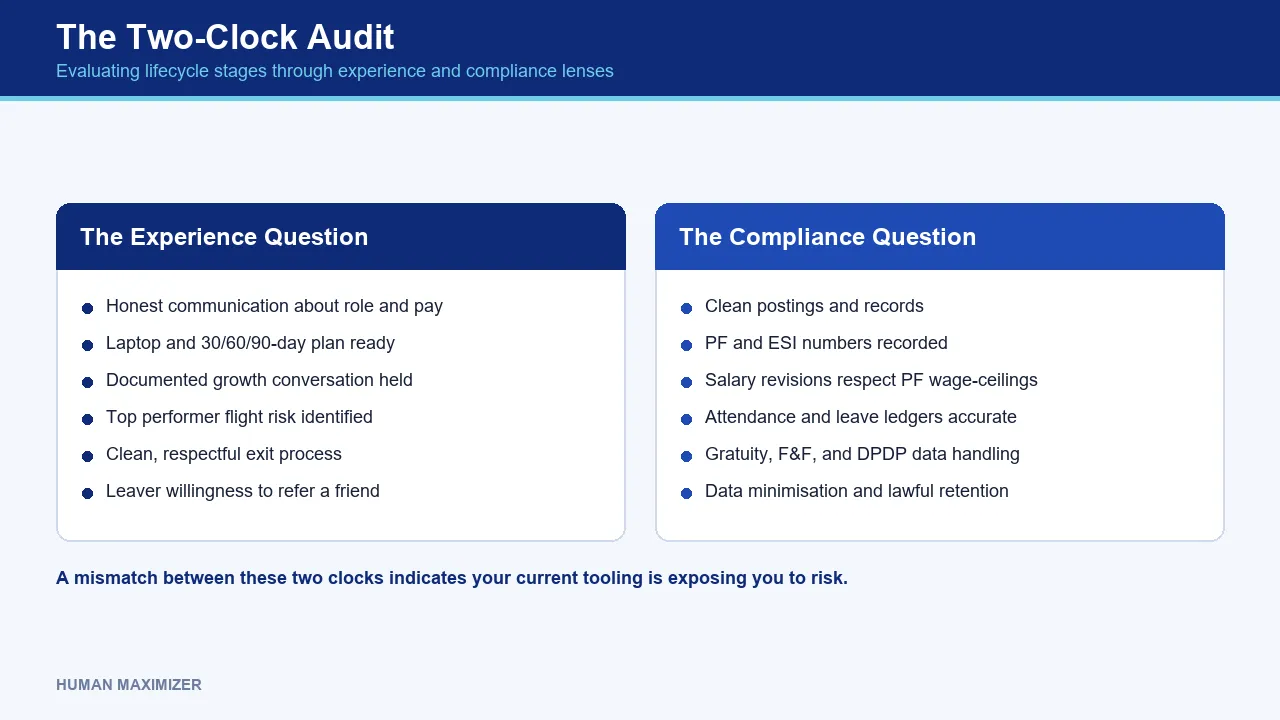
| Stage | The experience question | The compliance question |
|---|---|---|
| Attraction | Is candidate communication honest about role and pay? | Are postings and records clean for later compliance? |
| Onboarding | Does a new hire have a working laptop and a 30/60/90-day plan on day one? | Do PF and ESI numbers exist in the record before the first payroll? |
| Development | Has every employee had one documented growth conversation this cycle? | Do salary revisions respect PF wage-ceiling rules? |
| Retention | Do you know your top performers' flight risk? | Are attendance and leave ledgers accurate enough to survive an audit? |
| Offboarding | Does a leaver get a clean, respectful exit? | Are gratuity and full and final settlement inside their timelines, access revoked, data handled per the DPDP Act? |
| Advocacy | Would this leaver refer a friend? | Is retained data minimised and lawfully held? |
Any stage where you can answer the experience question but not the compliance one is a stage where your current tooling is quietly exposing you. That mismatch is the ownable insight of the two-clock view, and it is what an end-to-end lifecycle is meant to close.
A Mobile-First Lifecycle for India's Distributed Workforce
India's workforce is not sitting in one building. It is field sales in Rajkot, a plant floor in Coimbatore, support teams spread across cities, and managers who approve things from a phone between meetings. A lifecycle system that lives only on a desktop breaks at exactly these edges.
For this workforce, mobile-first is what keeps the lifecycle continuous, not a nicety bolted on later. A manager clears a joiner's onboarding step from the phone, an employee checks a leave balance without raising a ticket, and an appraisal note is logged inside Employee Performance Management before it is forgotten. The unified-platform benefit for business growth is simply that no stage waits on someone being at their laptop. When we interviewed HR managers and payroll specialists while building the product, the frustration that repeated most was rarely about missing features; it was work stalling because the one person who could move it forward was somewhere else.
When a Lifecycle System Reaches Its Limits
A lifecycle platform is not a substitute for judgment, and pretending otherwise sets teams up to fail. A sensitive termination, a genuine grievance surfaced in an exit interview, a compensation exception that fits no band: these want a human in the room, not a workflow.
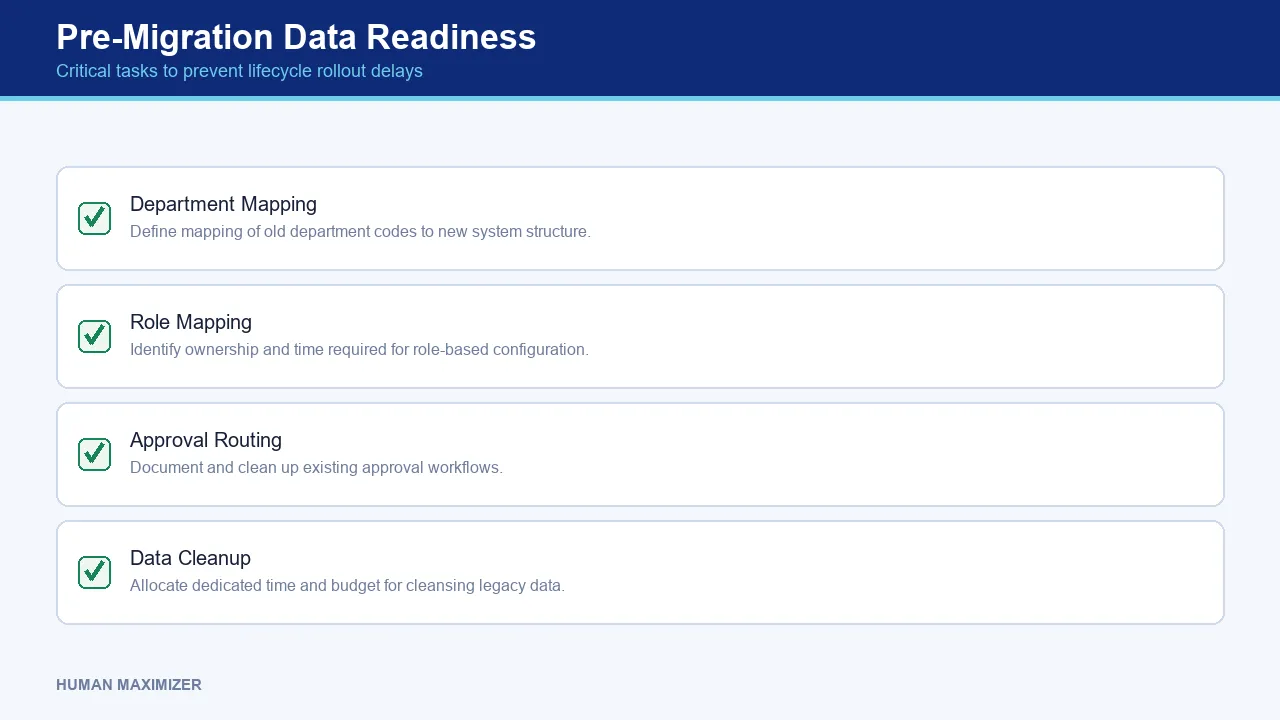
The other honest limit is migration. A common pattern is that lifecycle rollouts rarely stall on software configuration. They stall on the questions nobody owns, like who maps the old department codes to the new ones, and how long role mapping and approval routing actually take to clean up. Teams routinely underestimate the data cleanup and the sign-offs, then blame the tool for a timeline that slipped on housekeeping. Budget the cleanup honestly and the system delivers. Skip it and you have digitised a mess.
Calculating the Statutory Cost of Lifecycle Transitions
An effective employee lifecycle management system does more than track dates; it quantifies the financial impact of every transition. When an employee moves from onboarding to active status, or from employment to exit, the system must account for statutory liabilities that shift in real-time. Consider the transition of a new hire whose basic pay plus dearness allowance is ₹20,000. Under the EPFO guidelines, the employer’s PF contribution is capped at the statutory wage ceiling of ₹15,000. If your system calculates the 12% contribution on the full ₹20,000, you are over-contributing by ₹600 per month (12% of the ₹5,000 excess). Over a year, this creates a ₹7,200 discrepancy per employee.
Similarly, consider the exit stage. Under the Code on Wages, the full and final settlement must be completed within 2 working days of the last working day. If your system lacks automated triggers for this, manual delays often lead to non-compliance penalties. Furthermore, for employees completing 5 years of continuous service, the gratuity liability—calculated as 15 days' wages for every completed year of service divided by 26—must be provisioned accurately. If you assume a monthly wage of ₹30,000, the gratuity for one year of service is approximately ₹17,307. If your system fails to track the 'continuous service' clock, you risk under-provisioning these liabilities, leading to sudden cash flow shocks during mass exits. You can substitute your own wage figures and tenure data into these formulas to see how quickly minor tracking errors compound into significant financial exposure. A lifecycle system that integrates these statutory constants directly into the employee's digital journey ensures that your financial planning remains as accurate as your HR records.
Frequently Asked Questions
What are the key stages of the employee lifecycle? The common arc is attraction, recruitment, onboarding, development, retention, offboarding, and advocacy. In India, read each stage twice: once for the employee's experience and once for the statutory obligation attached to it, because both run at the same time.
How does a lifecycle system differ from a standard HRIS? An HRIS is a system of record that stores current facts about a person. A lifecycle system is a system of motion that tracks where someone is in their journey and what must happen next, by when. The lifecycle view manages transitions and their deadlines; the HRIS just holds the data.
Why is lifecycle management critical for employee retention? Because most attrition leaks at the handoffs between stages, not inside them. A delayed onboarding or a growth conversation that never happens is where good people start listening to recruiters. Managing the whole journey closes those gaps before they cost you the person.
How does automation improve onboarding in the Indian context? Beyond removing duplicate forms, onboarding automation keeps the compliance clock in step with the experience clock. It makes sure PF and ESI enrolment are complete in the record before the first payroll can run, catching statutory gaps early instead of during an inspection.
How does an employee lifecycle management system differ from a standard HRIS?
A standard HRIS acts as a static system of record, storing data like names and salary history. In contrast, an employee lifecycle management system is a system of motion that tracks an employee's journey from recruitment to exit, automatically triggering statutory compliance tasks like PF enrolment and final settlement deadlines.
The Handoff That Started This
Go back to that new hire waiting on a laptop while a counter-offer sits in their inbox. Both clocks were ticking. The experience clock said they felt forgotten; the statutory clock said their PF number still did not exist. A filing cabinet with a search bar can tell you neither of those things until it is too late to fix either. A system built around one record, carrying both clocks from offer to exit, tells you both on day one.
That is the difference between managing HR tasks and managing a lifecycle, and in a market where a leaver's data now falls under the DPDP Act and a botched exit invites a penalty, it is not a nice-to-have. Curious how the two clocks stay in sync across every stage? See how Human Maximizer runs the whole journey on a single record.
About the Author & Reviewer
Chandan Watts — Technical Product Manager, Human Maximizer (Razor Infotech)
Chandan Watts is Technical Product Manager at Razor Infotech, building the Human Maximizer HR platform. After years leading customer-experience and team operations at JindalX and Radical Minds, he focuses on how teams actually work day to day — and how small workflow gaps quietly slow an entire team down.
Connect on LinkedIn
Reviewed & approved by Sameer Hameed — Founder & Chairman, Razor Infotech
Sameer Hameed is the Founder & Chairman of Razor Infotech, where he is guiding the creation of Human Maximizer. An entrepreneur across technology, real estate, mining and travel, he builds organisations on clarity, trust and responsible growth — on the belief that businesses grow only when the people behind them grow.
Connect on LinkedIn
Human Maximizer is built by Razor Infotech in New Delhi, India (founded 2019). About Human Maximizer.
Keep reading
HR Strategy
Hr software employee productivity
How to boost workforce output through strategic HR software implementation. Learn the essential steps to drive adoption and efficiency...
13 min read
HR Strategy
Workforce Productivity Software
Why your current workforce productivity software might be masking critical performance gaps and learn how to gain true visibility into team output...
13 min read
HR Strategy
Employee productivity software
How to evaluate employee productivity software for your Indian business. Learn to balance performance tracking with team trust and data privacy needs.
13 min read