
HR Strategy
Beyond the Dashboard: Making HR Software Boost Employee Productivity
How to boost workforce output through strategic HR software implementation. Learn the essential steps to drive adoption and efficiency...

Insha Hamid
Head of HR in Research & Content, Human Maximizer · 13 min read · · Updated
Most HR software bought to raise output ends up measuring the wrong thing. It counts logins and idle minutes, then mistakes that motion for real work. The connection between HR software and employee productivity is genuine, but it does not run through a keystroke logger. It runs through the boring machinery underneath: leave that clears without three follow-up emails, attendance that reconciles itself, a new hire contributing in week one instead of week three. When we built Productivity Lens, the design question was deliberately narrow. Where is the work stuck, not whether someone is typing.
That distinction is the whole argument of this guide. Buy the surveillance version and you get resentment plus data people learn to game. Buy the empowerment version and you get autonomy, and cleaner productivity signals as a side effect. For Indian SMEs especially, where trust and hierarchy shape how any new system lands, getting that choice right matters more than the feature checklist.
The Productivity Paradox: Why HR Software Rarely Lifts Employee Productivity
Here is the paradox most growing companies walk into. A manager spends the first hour of the day tallying attendance against a spreadsheet, then fields a queue of leave-approval emails, while the team waits on the very person meant to unblock them. The tools bought to manage work become the thing stalling it. Add a monitoring layer on top and you have not fixed the bottleneck. You have only put a camera on it.

The frustration shows up in the data we sit closest to. Across the Indian businesses now running on Human Maximizer, the loudest complaint about "automated" HR software is that it still leaks work back onto a person: a report that needs manual extraction, an approval that lives in someone's inbox. When the reporting layer is broken, HR compensates with WhatsApp pings and end-of-month reconciliation marathons. None of that shows up as a line item. It is exactly where the week goes.
Digital transformation in HR fails here not because the software is bad, but because the implementation targets the wrong metric. Watching people is easy to build and easy to sell. It is also the least useful thing you can measure.
The Empowerment Gradient: A Sharper Way to Decide What to Automate
Instead of asking "what can we track?", ask where each feature sits on what we call the Empowerment Gradient. Picture a line. At one end are extractive features that take something from the employee and give nothing back: screenshot capture and idle-time scoring. At the other end are features that hand the employee more control and clarity: a visible leave balance, a self-service payslip. The useful discovery is that empowerment-end features also produce better productivity data, because people cooperate with a system that serves them.
The mirror test
Before you switch on any capability, run one check. Would this feature survive if the employee saw exactly what it recorded about them? A transparent leave ledger passes easily. A silent screen-recorder does not. Anything that fails the mirror test will eventually be gamed or quietly resented, and gamed data is worse than no data because you will trust it.
Where the real signal lives
The productive signal is almost never a single score. It is the task sitting stuck between two people for four days. A common pattern is that the gap between what a dashboard shows and the real project status widens fastest in the second month after go-live, once the novelty fades and manual updates lapse. Features that surface a stalled handoff beat features that rank individuals. One tells you what to fix today. The other just tells you who to blame later.
Is Employee Monitoring Software Legal in India?
This is the question that stops most productivity-tracking rollouts, and rightly. India now has a genuine data-protection statute in the Digital Personal Data Protection Act, 2023, which treats employee data as personal data requiring a lawful, disclosed purpose. Monitoring is not outright banned, but covert, purposeless surveillance is exactly the kind of processing that invites trouble. The safe posture is straightforward: monitor the work rather than the person, and collect only what your stated purpose actually needs.
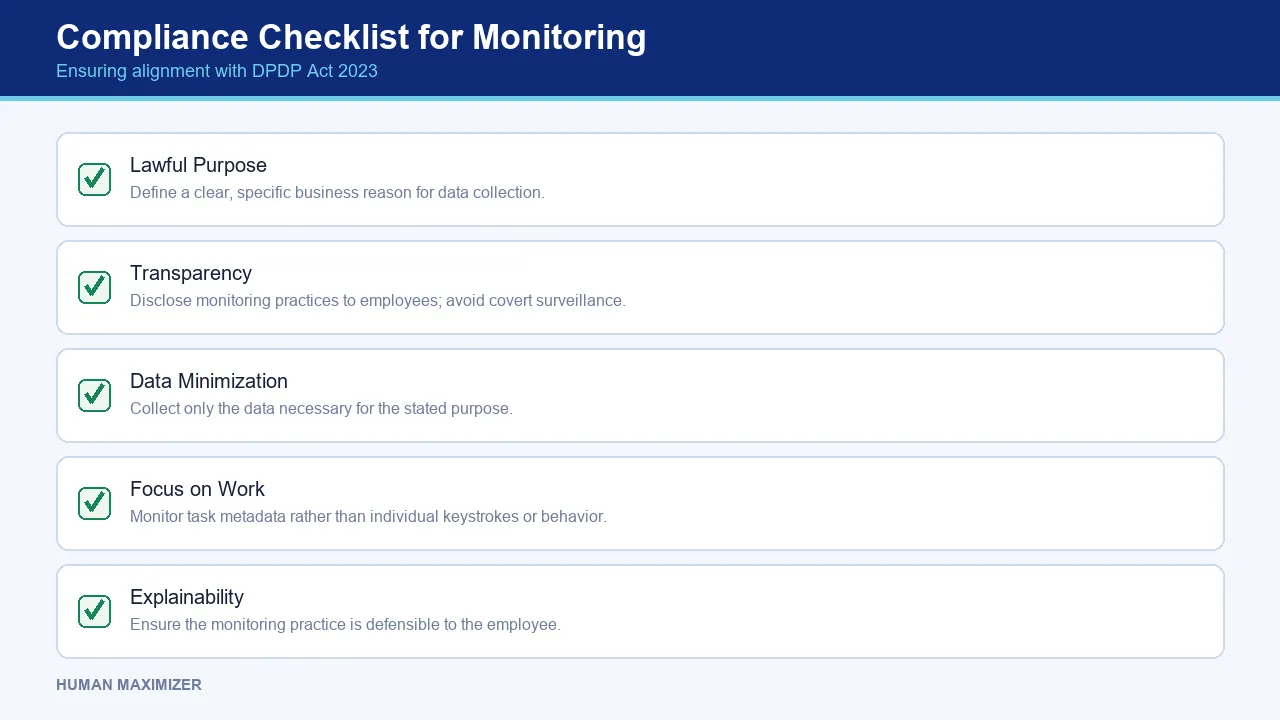
This is where global HR vendors go quiet, and where Indian labor laws and workplace culture diverge from the US template a lot of software is built on. Consent given under a clear hierarchy is easy to obtain and easy to distrust. So the design has to earn cooperation, not just extract a signature. Aggregated task metadata, which shows whether work is moving without recording what an individual types, sits far closer to the empowerment end of the gradient than any keystroke tool, and it is far easier to defend if a regulator or an employee asks what you are doing and why.
If you take one operational rule from this section: never deploy monitoring you would be uncomfortable explaining to the person being monitored.
Automating the Mundane: The HR Automation Setup That Actually Frees Time
Ask where HR automation setup returns the most hours, and the answer is rarely the flashy analytics. It is onboarding and the daily approval grind. A new hire's PF and ESI enrolment plus document collection can consume the better part of a fortnight when handled over email. Self-service flips it. With Employee Self Onboarding, the joiner fills their own details, uploads documents once, and the system routes them, so HR reviews rather than re-keys.
The same logic runs through the daily churn. Consider leave. When Leave Management enforces policy, quotas, and notice rules on its own, a request that used to bounce between inbox and manager and back settles into one trackable action, and the approved leave flows straight into attendance so nobody is marked absent by mistake. Payroll then reads that clean attendance instead of chasing corrections. That chain, rather than any single clever feature, is where the hours come back. Our own longer take on this sits in the piece on workforce productivity software if you want the deeper version.
From Surveillance to Signal: HR Analytics and the Metrics Worth Tracking
If you strip out vanity monitoring, what should HR analytics actually watch? Three families of employee productivity metrics earn their place. Flow, meaning whether work moves between stages or piles up at one. Cycle time, meaning how long a task takes from started to done and where the variance hides. And rework, meaning how often finished work comes back. High rework hides comfortably behind high activity, which is precisely why activity is a trap.
Notice what is missing: a proprietary "score." Operations teams need exception visibility far more than one big number. A dashboard that flags the two invoices stuck in approval is worth more than one that assigns every employee a percentage nobody can act on. Tie those signals to real goals through a tool like Employee Performance Management, and a slipping objective triggers a conversation in week one, not a surprise at the quarterly review.
The honest limitation here is that analytics show you where, never why. A stuck task can mean a process gap or a struggling colleague, and no dashboard can tell those apart. That still needs a manager who asks.
Empowerment Through Employee Self-Service
Employee self-service is the most underrated engagement tool in HR because it removes a hundred small indignities. The employee who no longer has to email HR to ask "what's my leave balance?" or "where's my payslip?" gets a quiet dose of autonomy several times a month. Multiply that across a workforce and you have shifted the relationship from dependence to control.
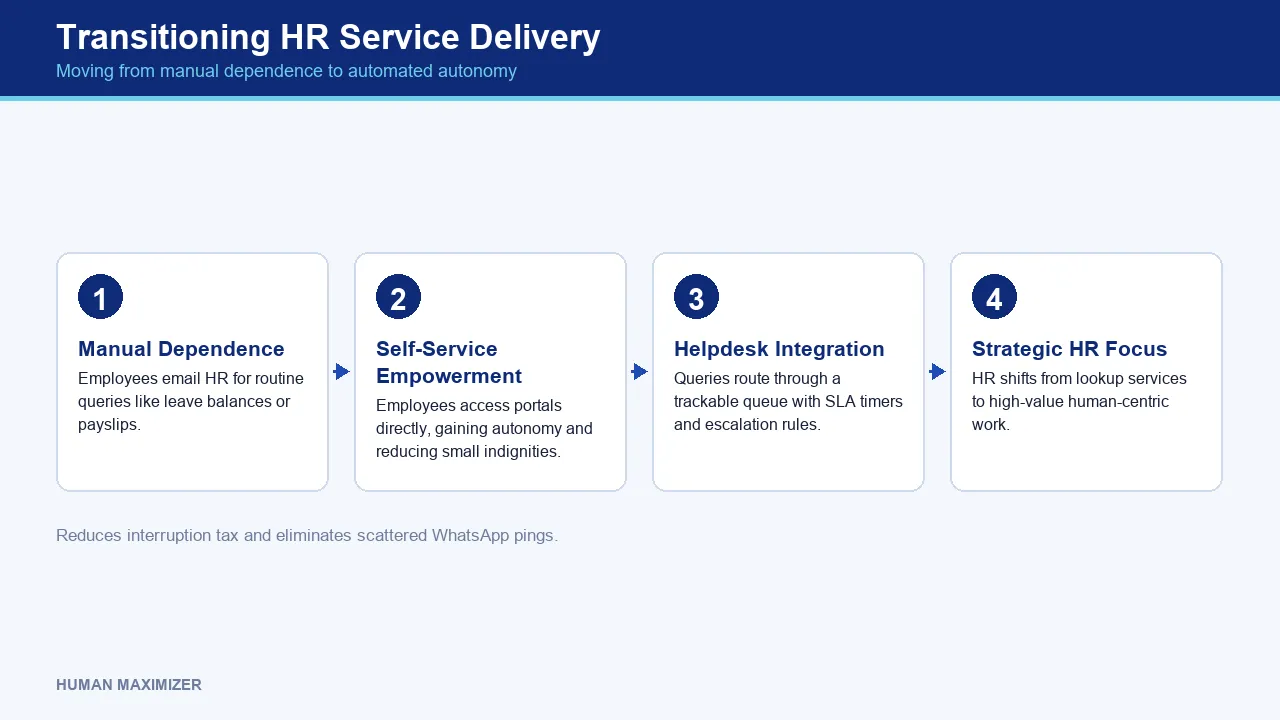
Self-service also cuts the interruption tax on HR itself. Route policy and payroll queries through a proper helpdesk with SLA timers and escalation rules, and the scattered WhatsApp pings become a trackable queue where nothing gets lost. HR stops being a lookup service and starts doing work only humans can do.
Choosing and Rolling Out the Right HRMS for Indian SMEs
A clean HRMS software deployment for an SME is less about features and more about sequence. Here is a roadmap that survives contact with a real Indian mid-market team.
Fix the record before you automate
Get one accurate source of truth for people and their statutory IDs before automating anything on top. Automation over dirty data just produces confident errors at speed.
Sequence the rollout by friction, not by feature
Automate the highest-friction workflow next, usually attendance-to-payroll or leave, because a visible early win drives HR tech adoption more than any training deck. Turn on analytics only after those workflows are trusted; a dashboard fed by half-adopted processes lies to you. And roll out by location or department rather than flipping everything on at once, because multi-site Indian firms carry genuinely different shift and compliance realities.
Choose the platform on whether it unifies these steps or forces you to bolt point tools together. The breakdown of the best HRMS software in India walks through that trade-off in detail. The short version: disconnected tools reintroduce the manual reconciliation you bought software to kill.
Proving the ROI of HR Technology to Leadership
Leadership funds outcomes, not modules. So model the return in front of them rather than quoting a vendor's brochure. Take a 200-person firm. Each employee raises roughly ten leave or query interactions a year, so about 2,000 a year. Handled over email and chat, assume each costs a manager and HR a combined six minutes of back-and-forth. That is 12,000 minutes, or 200 working hours, spent every year on routing that a self-service flow reduces to about a minute each. Adjust the six-minute figure to your own reality and the conclusion barely moves: you are recovering weeks of managerial time.
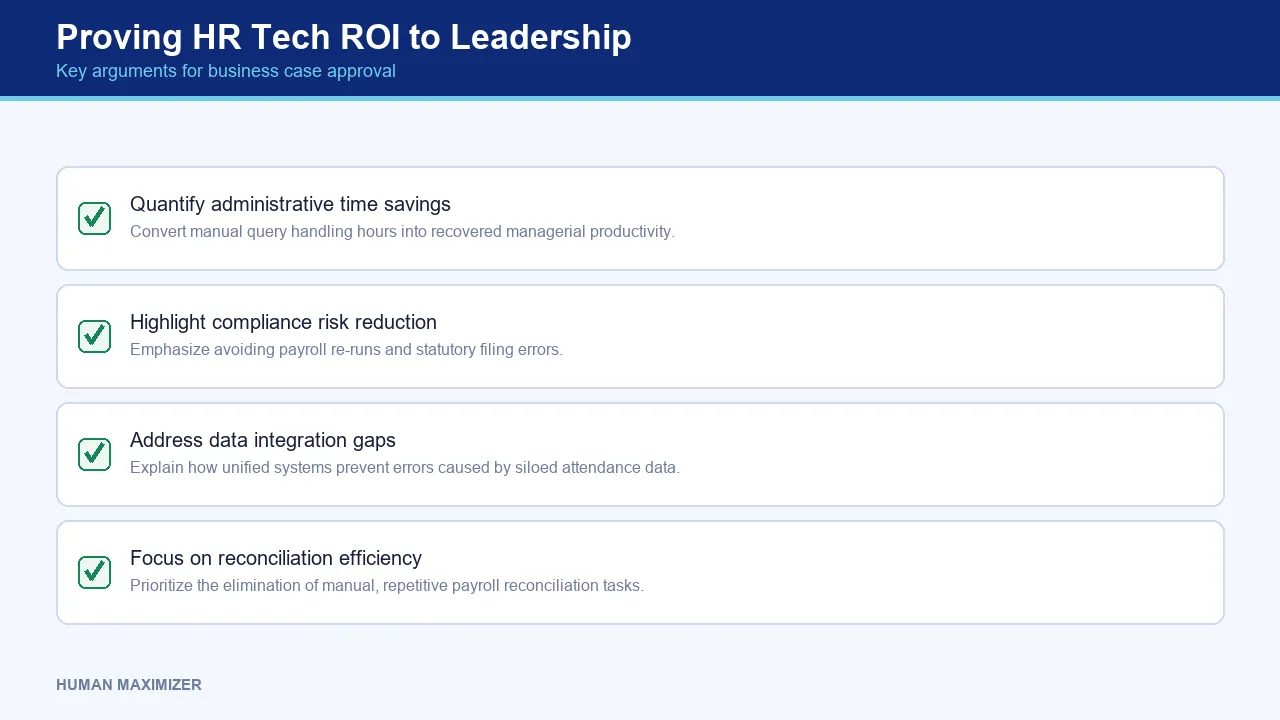
The compliance side compounds it. Every payroll error you avoid is a correction and a re-run, often against a statutory clock: PF and ESI dues file by the 15th of the following month whether your data is clean or not. Point tools that never share attendance data are where those errors breed. When we spoke with HR leaders, managing directors and founders across Indian companies while building the product, the recurring plea was not for more analytics. It was for the reconciliation grind to simply stop.
When HR Software Will Not Lift Productivity
Being honest about the limits is part of the pitch. A few situations where this approach genuinely underdelivers:
- Genuinely unpredictable creative work. Cycle-time and flow metrics assume a repeatable process. Research or early-stage design work does not have one, and forcing the measurement produces theatre.
- A culture problem the software gets blamed for. If managers use any new visibility to punish rather than unblock, employees route around the system, and no configuration fixes a trust deficit.
- Tiny teams. Under about fifteen people, a well-run shared sheet and a daily standup may genuinely beat the overhead of rollout. Buy the platform when coordination cost, not headcount, starts to hurt.
Automation removes friction. It does not manufacture judgment, and pretending otherwise is how good tools get a bad name.
Frequently Asked Questions
How should we handle productivity tracking for remote versus in-office staff? Use the same signals for both: task flow and cycle time, never desk hours. Counting hours-at-desk penalises remote staff unfairly and rewards presenteeism in the office. A work artefact moving through its stages looks identical wherever the person is sitting, which is exactly why it is the fairer thing to watch.
Do we need written employee consent to track work progress under the DPDP Act? You need a clear, disclosed purpose more than a buried signature. Tell employees what aggregated work data you collect and why, and keep it to work artefacts rather than personal screens. Consent tucked into an appointment letter nobody reads is weak protection if a dispute ever arises.
What is the smallest team where an HRMS actually pays for itself? Coordination cost matters more than headcount. Below roughly fifteen people, a shared sheet and a standup can genuinely win. Once approvals and payroll corrections start eating manager hours every week, the platform earns its keep quickly.
How do we stop managers using productivity dashboards to punish people? It is half design, half norms. Surface stuck tasks instead of individual rankings, and set the expectation that a flagged handoff is a prompt to unblock, not to reprimand. If the culture treats visibility as a weapon, people will quietly route their real work around any system you deploy.
The Choice Underneath the Dashboard
Go back to that manager tallying attendance by hand while the team waits. Adding a monitoring screen over that scene changes nothing about the stalled work; it only adds a watcher. Removing the manual tally, letting leave and attendance reconcile themselves, and surfacing the one stuck task does change it. That is the difference between software that watches your people and software that clears the road in front of them, and in India, where the next regulatory question about employee data is a matter of when rather than if, only one of those choices ages well.
We built the empowerment-end version for teams tired of the reconciliation grind. Curious how it looks on your own workflows? See what Human Maximizer does, and start with the process that steals the most hours from your week.
About the Author & Reviewer
Insha Hamid — Head of HR in Research & Content, Human Maximizer
Insha Hamid heads HR research and content for Human Maximizer at Razor Infotech, covering people operations and Indian workplace compliance — translating regulatory change and workplace research into guidance HR teams can act on.
Connect on LinkedIn
Reviewed & approved by Sameer Hameed — Founder & Chairman, Razor Infotech
Sameer Hameed is the Founder & Chairman of Razor Infotech, where he is guiding the creation of Human Maximizer. An entrepreneur across technology, real estate, mining and travel, he builds organisations on clarity, trust and responsible growth — on the belief that businesses grow only when the people behind them grow.
Connect on LinkedIn
Human Maximizer is built by Razor Infotech in New Delhi, India (founded 2019). About Human Maximizer.
Keep reading
HR Strategy
A Complete Guide to Measuring Productivity at Work
Are you struggling to measure productivity at work? Discover proven metrics, KPIs, frameworks, and tools HR leaders use to track employee and team performance.
5 min read
Payroll
From Payroll to Productivity: Using HR Data to Predict Quarterly Revenue
Your payroll data already describes capacity. How to turn HR numbers into a quarterly revenue signal using workforce yield and India's statutory caps.
12 min read
HR Strategy
Workforce Productivity Software
Why your current workforce productivity software might be masking critical performance gaps and learn how to gain true visibility into team output...
13 min read