
HR Strategy
Beyond the Annual Review: Cloud HRMS Software for Indian Teams
How modern cloud HRMS software transforms performance management in India by enabling continuous feedback, real-time goal tracking...

Nishant Tandon
Co-founder & Lead Partner, Razor Infotech · 14 min read ·
How many of last year's appraisal ratings could your managers defend with a date? Not a sentiment, a date: when the goal was agreed, when it moved, when it was reviewed. In most Indian companies running performance on spreadsheets and recall, the honest answer is none of them, because the record only exists in the week the form was due. That is the real argument for cloud HRMS software in performance management: not better dashboards, but whether a rating counts as evidence or as opinion. When we built Employee Performance Management at Human Maximizer, HR leads kept asking for one thing, and it was not prettier charts. They wanted a trail they could show a manager who disagreed with their own team's numbers.
There is a second half to this, and it is the half global HR blogs never write about, because they do not have to. In India, an appraisal outcome is a statutory event.
Why Indian SMEs Are Retiring On-Premise HR Management Software
On-premise HR software made sense when the only people who needed it sat in one building. A server in the admin room, a licence renewed every few years, an AMC, a consultant who knew the customisations and eventually left. The licence was rarely the part that hurt; the upgrade cycle was. Every statutory change meant a patch, a vendor visit, and a month where payroll ran on a version nobody fully trusted.

Cloud delivery moves that work to the vendor. Statutory updates arrive without a site visit, the mobile app is part of the product rather than a bolt-on, and a new branch in Coimbatore is a configuration, not a second installation. Our in-house compliance team tracks Indian statutory changes for the platform, which is the only sane place for that work to sit: one team reading notifications instead of four hundred HR managers each reading them separately.
Be careful with the cost comparison, though. Budget-oriented HRMS buying in India has a few recurring traps that rarely show up on a pricing page: reports, compliance modules or the mobile app gated behind a premium tier, implementation charged separately and substantially, and compliance depth that was built for a different country and localised later. A per-user price only means something once you know which modules it switches on. Ours is quoted per employee and varies by exactly that, which is why it reads as a range rather than a single figure. Our guide to choosing the best HRMS software in India walks through that evaluation module by module.
The Rating-to-Payslip Gap
Here is the measure I would put on the wall instead of an engagement score. Take your last appraisal cycle and count two things: the number of days between a rating being finalised by the manager and the revised salary appearing correctly on a payslip, and the number of times that figure was re-typed by a human on the way.
Call it the rating-to-payslip gap. It is calculable, it is uncomfortable, and it predicts almost everything else about your performance system.
How to measure it
Pick ten employees who got an increment last cycle. For each, write down the date the manager locked the rating, the date HR received the increment letter input, the date payroll received the revised structure, and the date the correct amount hit a payslip. Then count the hand-offs: appraisal sheet, increment approval mail, payroll master, bank advice. Four re-keyings is common. Six is not rare.
We wrote at more length about why "integration" and "the same database" are very different promises in our piece on the attendance-payroll sync myth.
Why the gap is wider in India than in the US or UK
A hike here does not simply change a net figure. It changes a compliance position. Four triggers fire the moment a rating becomes a revised structure:
- Provident fund. Employee contribution is 12% of basic plus DA, with the employer's statutory liability pegged to a wage ceiling of ₹15,000 a month and the ECR filing due by the 15th of the following month.
- ESI. Coverage applies below a monthly gross wage threshold of ₹21,000, so an employee at ₹20,500 gross who receives a ₹1,000 increase moves out of ESI coverage mid-year, with consequences for their family's existing claims.
- Professional tax. Slabs are set state by state and capped by the Constitution at ₹2,500 a year, and several states levy none at all, so a transfer across state lines changes take-home for reasons that have nothing to do with performance.
- Salary structure. The Code on Wages carries the expectation that basic pay is at least half of total remuneration, which constrains how you are allowed to build the increase in the first place.
None of that is visible on an appraisal form. All of it lands on the person who closes payroll.
An Increment Is a Compliance Decision as Much as a People Decision
Illustrative scenario, assembled to make the arithmetic visible rather than drawn from any single customer's file: an engineering firm in Rajkot with 200 people on roll finalises ratings on 28 March. Managers rate in a spreadsheet, HR consolidates, and the revised structures reach payroll on 11 April. At a generous 30 seconds per employee to re-key and sanity-check a revised structure, 200 records is a hundred minutes of typing. The typing is not the expensive part; the error rate is. At one mistyped or mis-slabbed row in every twenty, ten payslips are wrong in the April cycle, and the PF filing for April is due on the 15th. Adjust the error rate to whatever your own team actually achieves. The conclusion holds, because the deadline does not move.

Across 46 implementations recorded up to July 2026, ours took 7 to 10 days on average to go live; in the 24 where we tracked it, monthly payroll corrections fell from 15 to 3. Neither figure is about performance management as such. Both are about how many hands a number passes through, which is the same underlying problem.
When the rating record and the Payroll record live in the same system, the gap collapses to one approval. Attendance and payroll sync without manual re-entry, which removes the single most error-prone step between a judgement and a bank advice.
What Cloud HRMS Software Changes About Goal Setting and Reviews
Annual appraisal was a filing constraint masquerading as a design choice. Collecting forms from forty managers was expensive, so it happened once a year, and everything the system knew about a person compressed into a fortnight of memory.
Remove the collection cost and the cadence becomes a real decision. Performance Management in our platform runs on three layers: HR authors a KPI template per designation, managers rate their team for each review period (individually or in bulk via Excel, because a manager with thirty reports will not click thirty times), and the ratings roll up into team, department and designation views on an HR dashboard leadership can actually read. Cadence is configurable: daily, weekly, monthly or yearly, set by what the role needs. A warehouse supervisor and a product designer should not be on the same clock.
Goals that someone else can see
Goal setting fails quietly when objectives live in a document nobody reopens. Synergy syncs OKRs between managers and direct reports automatically, so the link between a team's KPIs and the company's objectives stays visible without a status meeting to re-establish it. That is the unglamorous mechanism behind continuous performance review: not more feedback events, just fewer places for a goal to hide.
Where a team needs to know whether work is stuck rather than whether people are busy, Productivity Lens tracks output through task completion rates and milestone progression using aggregated metadata, and shows where a deliverable has stalled. No screenshots, no keystrokes, no screen recording, and we have been deliberate about that boundary. Clients using it do report employees arriving on time and working more consistently once work status is visible at all.
Choosing your approach honestly
| Approach | Where it works | Where it breaks |
|---|---|---|
| Spreadsheets plus email | Under 30 people, one location | No audit trail; rating-to-payslip gap of weeks |
| On-premise HRMS | Single-site, stable headcount | Statutory patches need vendor visits; weak mobile access |
| Standalone performance tool | Strong review UX, 360-degree feedback | Increment outcomes still re-keyed into payroll by hand |
| Unified cloud platform | Employee appraisal, payroll and attendance on one record | Needs clean master data before migration; real adoption work for managers |
Mobile Self-Service, Field Teams and Scaling Without Re-Implementing
Employee self-service is where talent management stops being an HR activity and becomes a shared one. An employee checking their own KPI scorecard, watching how their ratings trend across periods, and seeing who was called out as a top performer does more for employee engagement than a quarterly survey, because it answers the question the survey is a proxy for: does anyone here notice what I do.
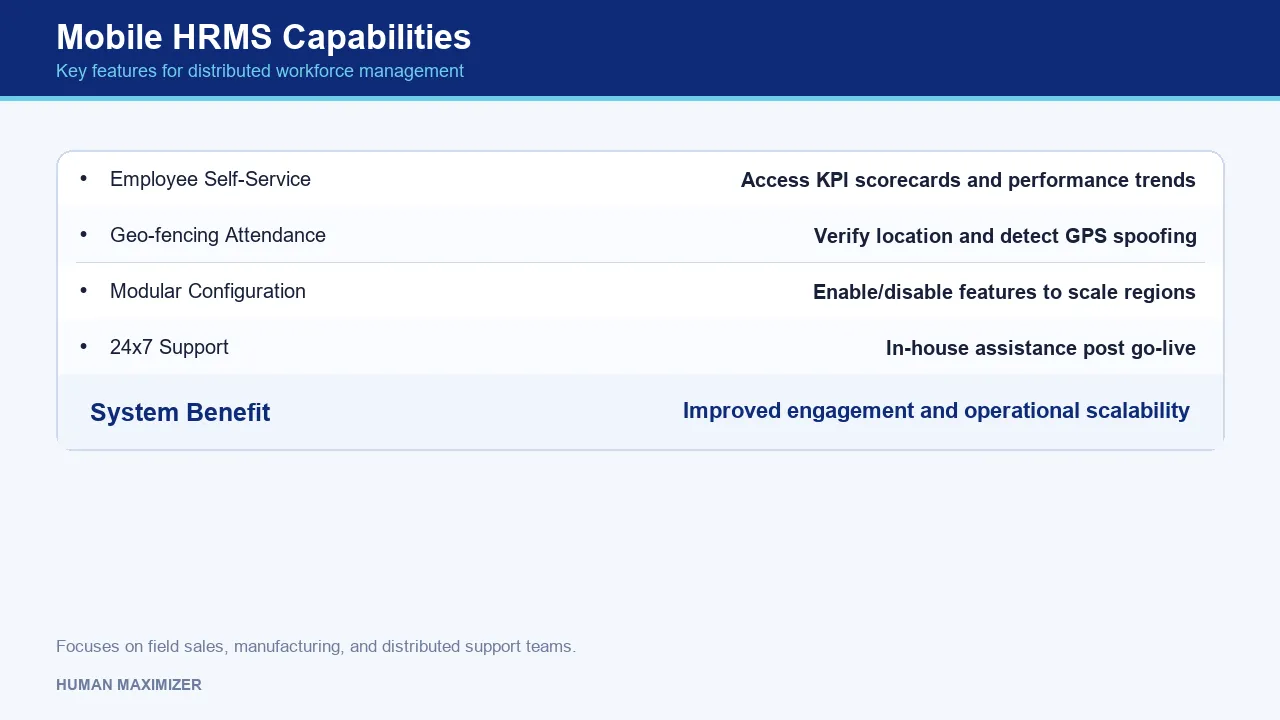
Our employee-facing mobile app is in production use, and it matters most for the teams head office sees least. Field sales, multi-site manufacturing, distributed support. Geo-fencing lets management verify attendance against the location an employee was actually assigned to, and detects a mocked or faked GPS position, which is the specific failure mode that separates real location-based attendance management from theatre. Modules can be switched on or off as usage changes, so scaling the system to a new region is a configuration change rather than a fresh implementation. Support runs 24x7 from the in-house team, including after go-live.
Data Security, Encryption and Where Employee Records Live
Employee performance data is more sensitive than payroll data, not less. A salary figure is a number; a rating history is a judgement that can follow someone for years. Ask any vendor four concrete questions: where the data physically resides, whether it is encrypted in transit and at rest, what role-based access controls apply to rating records specifically, and which ISO/IEC certifications cover both the hosting and the application. India data residency is a fair thing to ask for in writing, and so is deletion. Under the DPDP Act, 2023, an employee's rights over their own personal data do not pause for the HR department's convenience.
A security page with a padlock graphic answers none of that. A named control with a named owner does.
Migrating Legacy Performance Data Without Importing the Mess
The demo always looks easy. Month two of live data is where the project gets judged, and what breaks it is almost never the interface, but dirty master data: three spellings of one department, designations that no longer exist, employees mapped to managers who left in 2023, and appraisal history with no consistent rating scale.
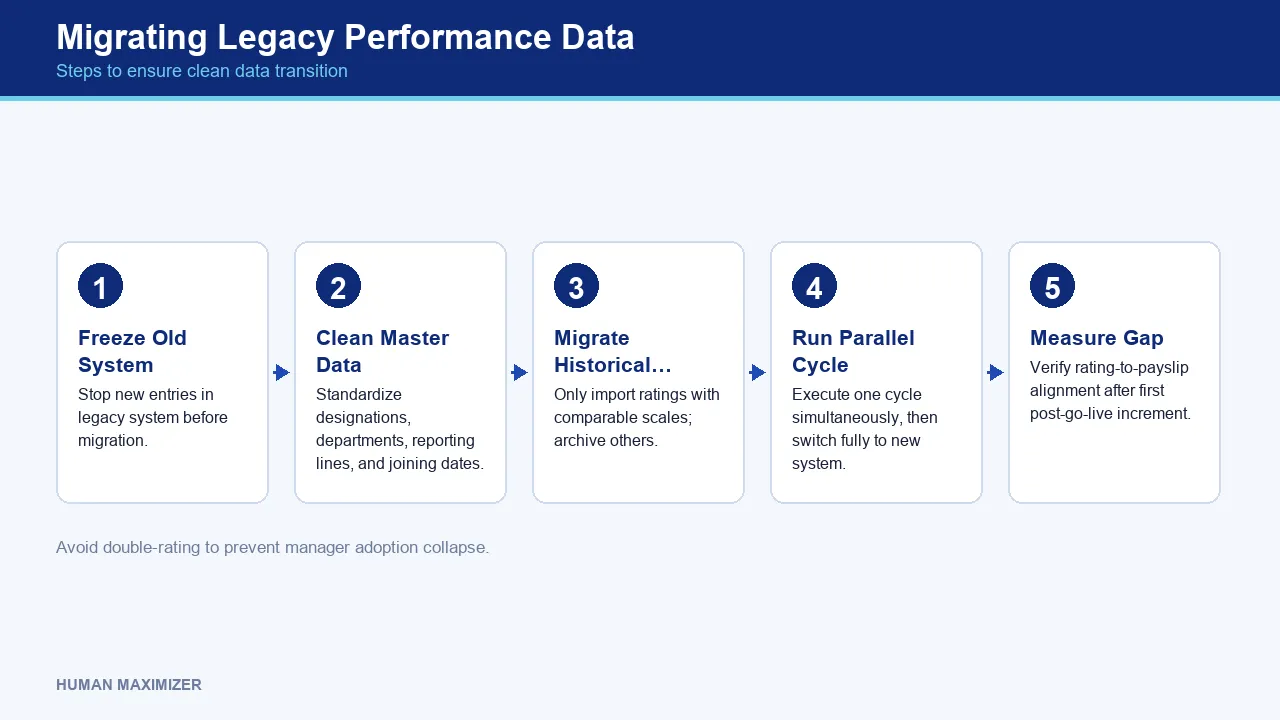
A workable sequence:
- Freeze the old system for new entries before you migrate anything.
- Clean the master data first: designations, departments, reporting lines, date of joining. Nothing downstream is right if these are wrong.
- Migrate historical ratings only where the scale is comparable. Where it is not, archive the file and start the new scale clean, with a note on the record.
- Run one cycle in parallel, then stop. Adoption collapses when managers have to do the same rating twice, and asking them to is the most reliable way to lose a rollout.
- Re-measure the rating-to-payslip gap after the first post-go-live increment. That is your actual proof, and it is the only HR automation claim worth making to your own board.
Where This Does Not Help
Continuous tracking will not fix a manager who avoids a difficult conversation. The system can surface that a goal has not moved for six weeks; it cannot supply the twenty minutes of honesty that follows. For bias, structure does more work than software, which is why we wrote separately about building appraisals that hold up under scrutiny in startups.
Two further limits worth stating plainly. Roles with long or unpredictable output cycles, early-stage R&D and long-sales-cycle enterprise selling among them, are poorly served by monthly rating cadences, and forcing one produces noise that looks like data. And a rating history should never be the sole input into a termination decision; in India that is both an employee-relations mistake and a legal exposure, because documentation density is not the same thing as fairness.
Frequently Asked Questions
How does a cloud HRMS improve employee performance tracking? By making the record continuous instead of retrospective. KPI templates are defined per designation up front, managers rate against them each period, and the history stays queryable, so a performance review draws on dated entries rather than the last six weeks of memory. HR analytics then aggregate those ratings by team, department or designation for workforce management decisions.
What are the real cost benefits for an Indian SME? Mostly removed work rather than a smaller licence fee: no server, no AMC, no vendor visit for each statutory change, and far less re-keying between appraisal and payroll. Check what a quoted per-user price actually includes before you compare, because implementation charges and gated modules are where a published price and the real cost diverge.
Can it work with the payroll process we already run in India? Ask for something stronger than integration: attendance, leave and payroll reading the same record, so an increment approved after an appraisal needs no re-entry before the PF filing on the 15th. If two systems genuinely must sync, ask exactly when the sync runs and what happens to a mid-month revision that arrives after it.
Is cloud storage safe for sensitive employee records? It can be safer than an unmonitored on-premise server, provided you verify the specifics: encryption at rest and in transit, role-based access to rating data, data residency, certification scope, and a documented deletion process. The hosting model matters less than whether anyone owns those controls by name.
Conclusion
Go back to the question at the top: which of last year's ratings could your managers defend with a date. If the answer is still none, another appraisal form will not change it. What will is a shorter distance between the moment a manager makes a judgement and the moment that judgement reaches a payslip, correctly, before a PF deadline that does not care how busy March was. Ready to stop re-keying increments from a spreadsheet into payroll? Book a quick call with our team and we will walk you through an increment moving from rating to payslip on a single record.
About the Author & Reviewer
Nishant Tandon — Co-founder & Lead Partner, Razor Infotech
Nishant Tandon is Co-founder and Lead Partner at Razor Infotech, with over a decade in IT, customer support and business operations, helping SMEs achieve cost efficiency, stronger customer experience and scalable, sustainable growth.
Connect on LinkedIn
Reviewed & approved by Sameer Hameed — Founder & Chairman, Razor Infotech
Sameer Hameed is the Founder & Chairman of Razor Infotech, where he is guiding the creation of Human Maximizer. An entrepreneur across technology, real estate, mining and travel, he builds organisations on clarity, trust and responsible growth — on the belief that businesses grow only when the people behind them grow.
Connect on LinkedIn
Human Maximizer is built by Razor Infotech in New Delhi, India (founded 2019). About Human Maximizer.
Keep reading
HR Strategy
Maximizing Revenue per Employee (RPE)
How to shift your focus from headcount to efficiency. Learn how to leverage HRMS software for revenue growth to optimize your mid-market performance.
14 min read
HR Strategy
HR Mobile App India: Beyond Attendance
The essential features that transform an HR mobile app for employees from a simple clock-in tool into a powerful hub for productivity and engagement.
15 min read
HR Strategy
Modular HRMS India: Modular HRMS Software
How modular HRMS software allows your business to scale efficiently by adding or removing features as your team grows. Learn to optimize your HR...
16 min read