
Payroll
The Sync Myth: What Attendance and Payroll Integration Really Means
Why manual data transfers cause costly salary errors. Learn how automated attendance and payroll integration ensures accuracy and saves hours...

Nishant Tandon
Co-founder & Lead Partner, Razor Infotech · 14 min read · · Updated
Ask any HR software vendor whether attendance flows into payroll automatically, and you will get a yes. Ask a narrower question: what happens on the 26th when a branch manager approves a backdated leave for the 19th, after the attendance export has already been pasted into the salary sheet? The answers get longer, vaguer, and eventually arrive at a person. Somebody re-runs the export. Somebody re-checks the loss-of-pay column. That gap between "the systems are integrated" and "a human re-does it" is where most salary errors in Indian companies are actually born, and it is why we treat Attendance Management and payroll as one continuous record rather than two systems exchanging files.
The word "sync" is doing too much work. A sync implies two independent systems politely agreeing. What payroll actually needs is a single data spine: one authoritative record of presence, absence, leave, overtime and regularisation, from which the salary calculation reads directly, with no intermediate file and no intermediate person.
Does Attendance and Payroll Integration Happen Automatically? Not Usually
Most Indian mid-market setups have three moving parts: a biometric device or mobile check-in, a leave tracker (often a shared sheet), and a payroll engine. Vendors sell "integration" across all three. In practice, integration comes in three very different grades, and buyers rarely ask which one they are getting.
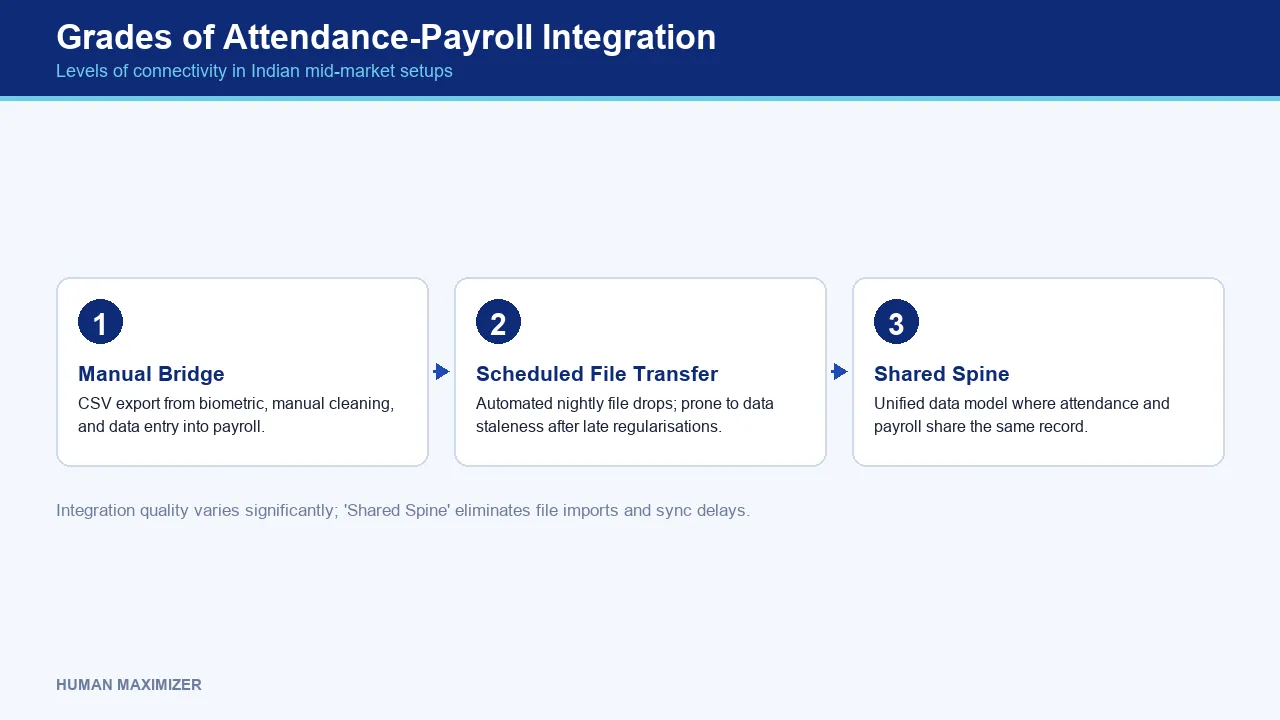
The first grade is a manual bridge. The biometric machine produces a CSV, someone cleans it, someone else pastes it into the payroll input template. This is called integration in almost every sales conversation. It is not integration; it is data entry with a shorter walk.
The second grade is scheduled file transfer. The attendance system drops a flat file on a server every night, payroll picks it up in the morning. Better. But a flat file is a snapshot, and snapshots go stale the moment a regularisation is approved after the drop. When a correction lands on the 27th and the file was written on the 25th, payroll is computing on facts that are two days out of date and nobody gets an alert.
The third grade is a shared spine, where attendance events and payroll inputs live in the same data model. There is no file. There is no import. A leave approval on the 19th changes the LOP count for the period immediately, and the payroll input reflects it because it is reading the same record, not a copy of it.
API, Flat File, or Manual Bridge: The Plumbing Nobody Evaluates
Competing articles on this topic skip the plumbing entirely and go straight to benefits. That is backwards. The failure mode you inherit is decided by the transport method, not by the feature list.
Flat-file uploads
Cheap, universally supported, and the reason most reconciliation exists. Every flat file needs a field mapping, and every mapping needs maintenance. Add a night shift, and the shift code in the export does not exist in the payroll master. The upload succeeds. The overtime calculation silently drops. You find out on the 30th, from an employee.
API-based synchronisation
Real-time or near-real-time, and it handles the awkward cases better because it can push a correction as an event rather than a whole new file. The tradeoff is dependency: if the API credentials expire during a long weekend, data synchronisation stops quietly. Good implementations alarm on silence. Many do not.
A single record, no transport at all
If attendance, Leave Management and Payroll sit inside one platform, there is nothing to transport. This is the only architecture where "automatic" is literally true, because there is no second copy that can disagree with the first. It is also the option that forces the hardest decision during migration, which we come back to below.
The Attendance-to-Payroll Chain of Custody
Borrow a term from evidence handling. In a courtroom, a piece of evidence is only admissible if you can show an unbroken chain of custody: who collected it, who held it, when it was sealed, and who can prove it was not altered. A salary calculation deserves the same standard, because a payslip is a legal document filed against statutory returns.
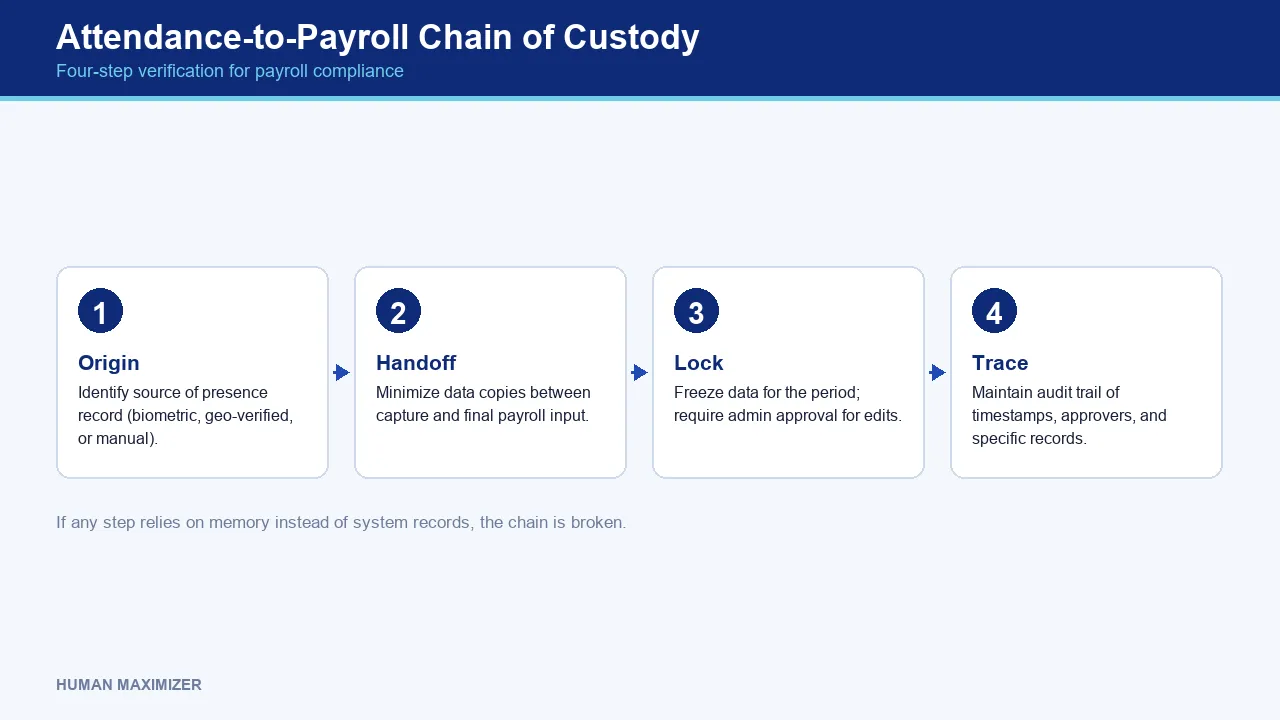
Run every attendance fact in your organisation through four questions. If any one of them lands on a person's memory instead of a system record, that is your leak.
Origin. Where did this presence record come from, and can the system prove it? A biometric punch, a geo-verified mobile check-in, a manager's manual mark. Each is acceptable. Each must be labelled. A record that cannot name its own source is an assertion, not evidence. Our geo-fencing check-ins reject a mocked GPS location at the point of capture, which matters precisely because the alternative is discovering it in an audit six months later.
Handoff. How many times is this fact copied between capture and the salary line? Every copy is a chance for payroll input errors. Count the copies honestly, including the WhatsApp message from the site supervisor listing who was absent.
Lock. Is there a moment when the period is declared final, and does that moment actually freeze the data? An attendance lock says: this month is closed for payroll. After it, punch edits and HR corrections require a payroll admin's permission and a recorded reason. Without a lock, a late edit can rewrite a period whose payslips already exist.
Trace. Six months later, can you reconstruct why an employee was paid 22 days instead of 23? Not "probably a leave", but the specific record, the approver, and the timestamp. If you cannot, you are not compliant, you are lucky.
Most teams pass Origin, fail Handoff, and have never implemented Lock.
Why Manual Reconciliation Is a Compliance Exposure, Not Just a Time Cost
Here is the part that a global HR vendor cannot write, because it depends on Indian salary structure law.
Under the Code on Wages, basic pay must constitute at least 50% of total remuneration, with penalties attached to non-compliance. That structure is what PF-eligible wages are computed from. So when a loss-of-pay day is wrong, the error does not stop at net salary. It moves through basic, through PF-eligible wages, into the 12% employee contribution and the ECR you file by the 15th of the following month. ESI eligibility, which turns on a monthly gross wage threshold, can flip for an employee whose gross drops below the line because of LOP that was itself mis-keyed. Professional tax slabs in several states are gross-linked too, and vary state to state.
A copy-paste error in an attendance sheet is therefore not a payslip problem. It is a filed-return problem, in five statutes at once, and returns are much harder to unwind than payslips.
Now put a number on the manual side, and do it in the open so you can argue with it. Take a 400-person company across three branches. Verifying one attendance row per employee against the leave register and the regularisation emails, at roughly 30 seconds a row, is 200 minutes: a bit over three hours for one clean pass. Nobody gets one clean pass. Two passes, plus chasing the twenty or so rows that do not agree at ten minutes each, and you have spent nine to ten hours of your most senior payroll person's month before a single salary is computed. Halve the 30-second estimate if your registers are tidier than most. The conclusion holds, and it gets worse as you add branches, because the reconciliation burden grows faster than headcount when every location handles its inputs its own way. That compounding cost is what disconnected HR data actually charges you.
What an Integrated HR and Payroll System Does With an Exception
Benefits lists are easy to write and easy to ignore, so look at a failure instead.
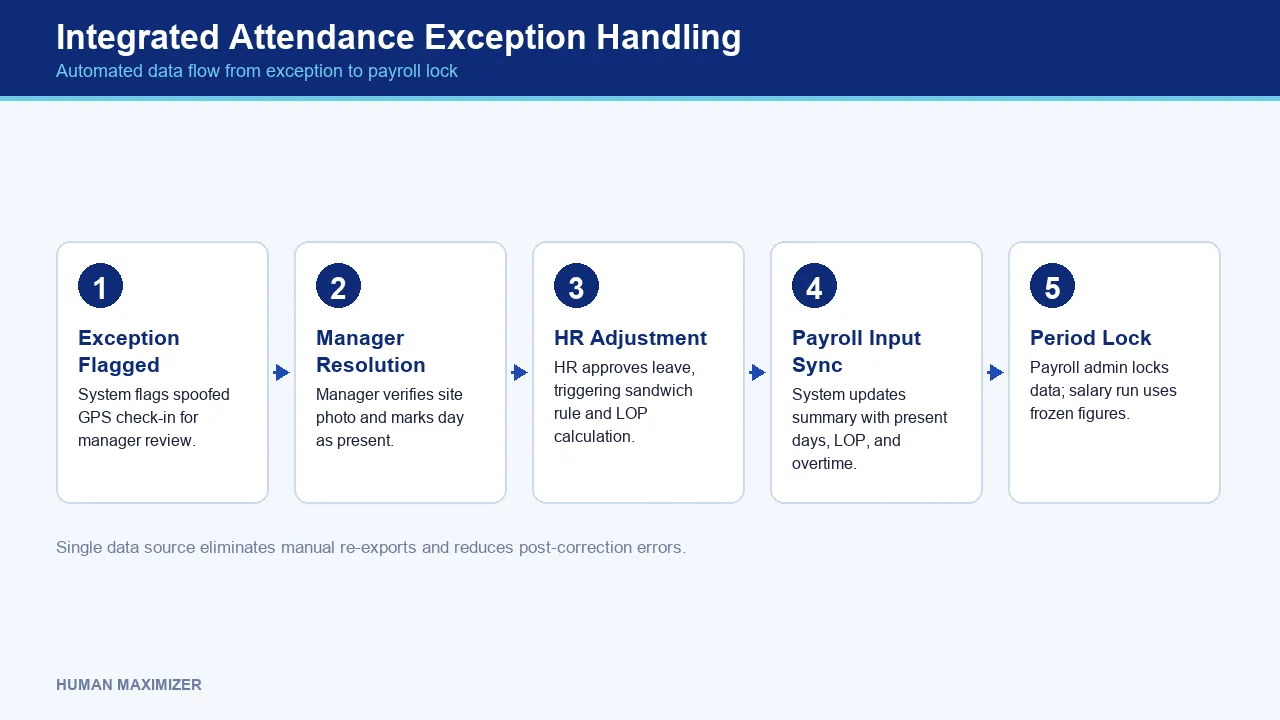
A field technician in Rajkot checks in from a client site at 9:12 AM on the 19th. His phone's GPS is spoofed by an app; the check-in is flagged and held, not silently accepted. His manager sees the flag the same day, speaks to him, and marks the day present after the technician sends a site photo. On the 24th, HR approves a half-day leave for the same employee on the 22nd, which falls between two absences and triggers the sandwich rule, adding an LOP day nobody had counted. Overtime from the 20th, 4.5 hours across two evenings, is already sitting in the same record.
None of that reaches payroll as a file. The attendance summary for the period holds present days, LOP days, overtime hours and comp-off earned, and the payroll input reads it directly. On the 26th, the payroll admin locks the period. The salary run computes on frozen numbers. Where this matters is the thing that did not happen: nobody re-exported anything after the 24th correction, and nobody had to remember that the correction existed.
Across 24 clients reviewed in July 2026, monthly payroll corrections after go-live ran at three, against fifteen before. That is not a claim about how good the software is. It is a claim about how many corrections survive when there is only one copy of the data.
Real-Time Labour Costing, Before the Bank File
A second-order effect of the single spine gets almost no coverage: you can see labour cost while the month is still running.
When overtime and LOP are computed continuously rather than assembled on the 25th, a plant head can look at accumulated overtime on the 14th and change the roster for the second half of the month. That is a decision. Overtime discovered on the 26th is only a bill. Roster Management and live attendance dashboards turn a month-end number into a mid-month control, and for manufacturing and logistics operations running on thin margins, that visibility is worth more than the hours saved on reconciliation.
Moving Off Spreadsheets Without Breaking a Cycle
The transition is where most projects fail, and it is the phase competitors write least about.
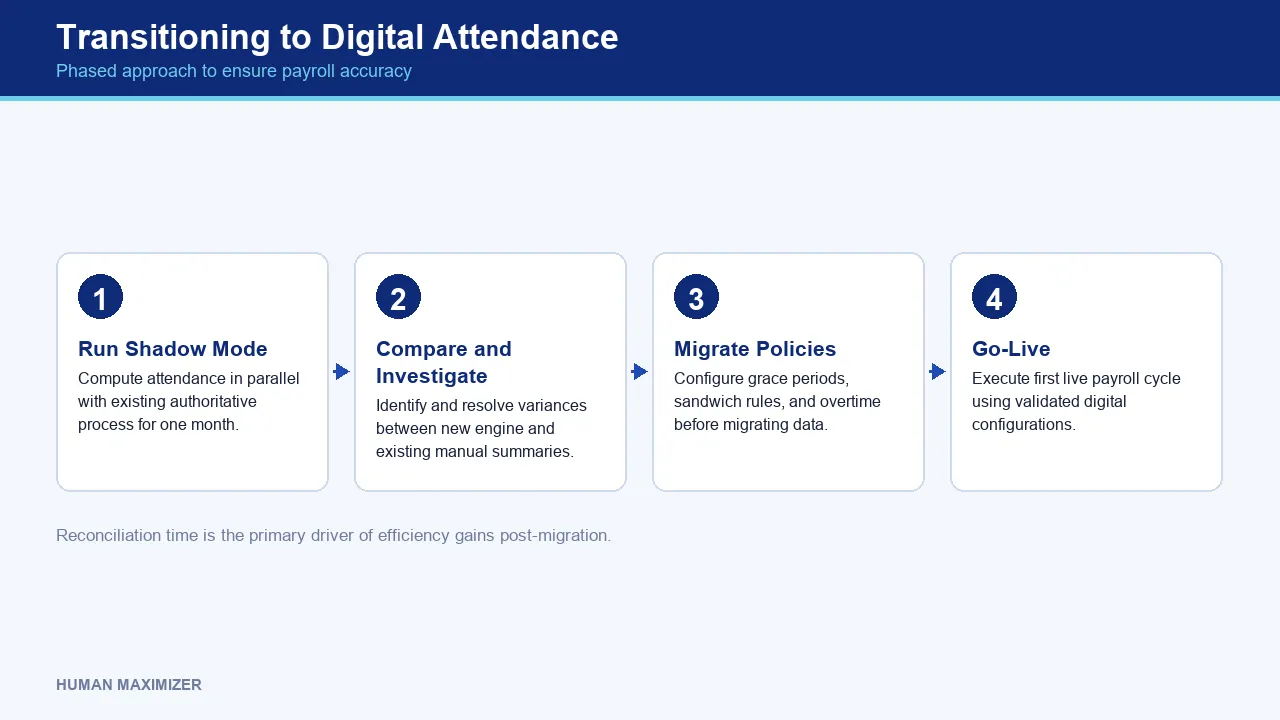
Do not cut over cold. Run shadow mode: the new attendance engine computes the period in parallel while your existing process stays authoritative. Compare the two summaries for a full month, employee by employee, and investigate every variance. The variances are the point. They will surface policy rules nobody had written down: how your Nagpur unit treats a half-day before a holiday, whether the 8-minute grace on late marks is real or informal.
Then migrate policies before you migrate data. Shift definitions, grace periods, sandwich-rule behaviour and overtime eligibility have to be configured and signed off before the first live payroll, because a wrong rule applied consistently is worse than a manual process applied carelessly. Across 46 implementations reviewed in July 2026, deployment averaged 7 to 10 days, and across 32 of them, the first payroll cycle after go-live took about four hours against roughly two days on the previous system. Most of that gain is the reconciliation step disappearing, not the calculation getting faster. Calculation was never the slow part. If you are starting from paper, our guide on moving from a manual attendance register to digital records covers the capture side; the statutory mechanics are laid out in our walkthrough of payroll processing in India.
Where Automation Genuinely Stops
Integration removes re-keying. It does not remove judgment, and pretending otherwise sets buyers up for disappointment.
A contested attendance record still needs a human. When an employee says the biometric device did not register their punch on a day the machine logged nothing, no algorithm can adjudicate that. The system's job is to make the dispute traceable and route it to a manager quickly, not to decide it.
Unwritten local practice will break your first automated run. Informal grace given to a long-serving supervisor, a shift that "everyone knows" ends early on Saturdays, a site where the last punch is habitually recorded by the security guard. Automation exposes these instantly and unflatteringly, and the fix is a policy decision, not a configuration change.
Third-party payroll disbursement still needs reconciliation of a different kind. If salaries are computed in one system and paid through an accounting package or bank portal, integration ends at the bank advice file. That handoff deserves its own controls.
And a candid one: employees rarely argue about the net figure. They argue about the component nobody explained. A perfectly integrated system that produces an unexplained deduction line will still generate the same queries, which is why the payslip breakdown and a working self-service view matter as much as the plumbing behind them.
Frequently Asked Questions
How does attendance data flow into payroll systems? Through one of three routes: manual export and import, a scheduled flat file or API transfer, or a shared data model where payroll reads the attendance record directly. Only the third is genuinely automatic. The first two both introduce a copy, and every copy can go stale between the transfer and the salary run.
Why is manual reconciliation a risk for HR teams? Because errors do not stop at net pay. A wrong loss-of-pay day changes gross wages, which changes PF-eligible wages, ESI eligibility and professional tax, all of which are filed with statutory authorities on fixed deadlines. Correcting a payslip is easy; correcting a filed return is not.
Does integration reduce payroll processing time, and by how much? It removes the reconciliation step, which for most mid-market teams is the largest single block of month-end effort. The calculation itself was never slow. Measure your own baseline by timing how long your team spends verifying attendance against leave records before payroll opens, and compare that to zero.
What should we lock down before the first automated payroll run? Shift definitions, grace periods, half-day rules, sandwich-rule behaviour, overtime eligibility and the attendance lock date. Configure and sign these off in writing, then run one month in parallel with your existing process and investigate every variance before you trust the new numbers.
Conclusion
Go back to the question that started this: what happens when a manager approves a backdated leave on the 26th? On a spine, nothing dramatic happens. The LOP count changes, the payroll input changes with it, and if the period is already locked, the correction is held and flagged rather than lost. On a copy-based setup, that same approval either gets caught by a person who remembers it or does not get caught at all, and it turns up in a PF return filed on the 15th of next month.
That is the choice, stated plainly. Not a feature comparison, a question about whether your salary data has one version or several. If you want to see what a single attendance-to-payroll record looks like in a live run, take a closer look at Human Maximizer.
About the Author & Reviewer
Nishant Tandon — Co-founder & Lead Partner, Razor Infotech
Nishant Tandon is Co-founder and Lead Partner at Razor Infotech, with over a decade in IT, customer support and business operations, helping SMEs achieve cost efficiency, stronger customer experience and scalable, sustainable growth.
Connect on LinkedIn
Reviewed & approved by Sameer Hameed — Founder & Chairman, Razor Infotech
Sameer Hameed is the Founder & Chairman of Razor Infotech, where he is guiding the creation of Human Maximizer. An entrepreneur across technology, real estate, mining and travel, he builds organisations on clarity, trust and responsible growth — on the belief that businesses grow only when the people behind them grow.
Connect on LinkedIn
Human Maximizer is built by Razor Infotech in New Delhi, India (founded 2019). About Human Maximizer.
Keep reading

HR Strategy
Employee attendance tracking software
Why aggressive surveillance tools damage company culture. Learn how to balance accountability and employee trust using modern field force tracking...
13 min read
HR Strategy
Stop Measuring Attendance: A Guide to Outcome Velocity
Hours logged say nothing about work delivered. What outcome velocity measures, how it differs from attendance, and how to shift your metrics.
14 min read
Payroll
Payroll Consultant vs Payroll Software
Stop overpaying for manual processing. Discover if your business needs a dedicated payroll consultant or the efficiency of payroll software...
18 min read