
HR Strategy
An Inspector's View of Moving a Manual Attendance Register to Digital
Stop wasting time on manual logs. Discover how a digital attendance management system eliminates payroll errors and boosts workforce productivity...

Chandan Watts
Technical Product Manager, Human Maximizer (Razor Infotech) · 17 min read · · Updated
A paper muster roll is a claim about what happened rather than a record of it, written down later, usually by someone who was not standing at the gate. Most of the time that claim is honest and roughly right. The problem is that "roughly right" is a fine standard for a wall calendar and a poor one for a statutory register, and when a labour inspector or a resigning employee's final settlement puts pressure on it, roughly right collapses. Moving a manual attendance register to digital is usually sold as a time-saving exercise. We think that undersells it. At Human Maximizer we have come to see it as an evidence problem first, which is why Attendance Management is designed around what a record has to prove, not just what it has to store.
Here is the part almost nobody writes about: a digital system can be worse than paper if you build it carelessly. A register with a scratched-out entry and an initial next to it is visibly a corrected record. A clean spreadsheet export with no edit history looks perfect and proves nothing, because anyone examining it has to ask who could have changed it and when. Paper wears its edits. Software has to be made to.
Why Your Paper Muster Roll Is a Liability, Not Just a Chore
Attendance in India is a statutory record, not an internal management preference. The Factories Act, 1948 requires occupiers to keep a register of adult workers showing, for each worker, the nature of the work and the shift group they belong to, and it prohibits employing a worker who is not entered in that register. State Shops and Establishments legislation imposes parallel obligations on offices and retail establishments, with its own formats and its own inspection rights. The Code on Wages, 2019, administered by the Ministry of Labour and Employment, continues the requirement to maintain registers of employees covering attendance and wage particulars, and contemplates them being kept electronically. Central-government registers and returns now move through the Ministry's Shram Suvidha portal, which assumes an electronic record on your side rather than a book at the gate.
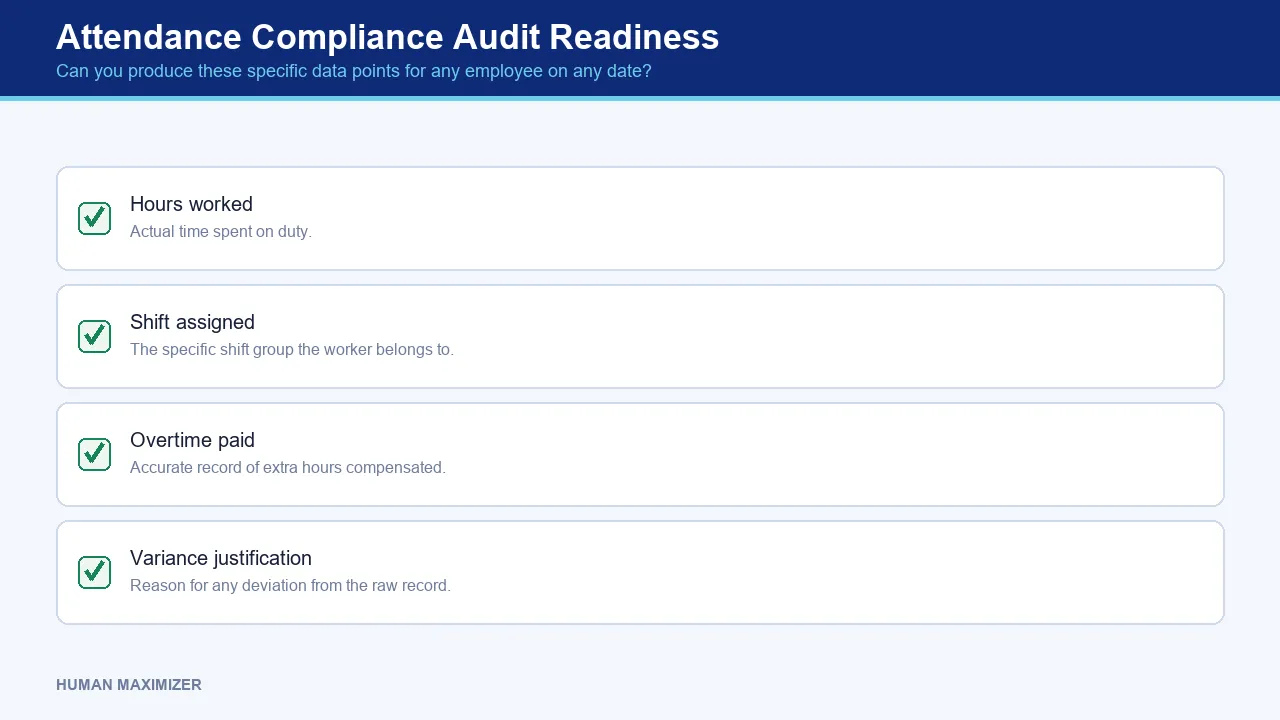
At an inspection, nobody asks whether you have attendance data. The question is narrower and much harder to answer. Can you produce, for a specific person on a specific date, the hours worked, the shift assigned, the overtime paid, and the reason any of those figures differ from what the raw record first showed?
Paper struggles with that last one. Small businesses running on registers and Excel sheets routinely report wrong timings and proxy attendance as ordinary features of the month rather than exceptions. Everyone names buddy punching. The costlier problem is quieter: a supervisor filling in Saturday from memory on Monday, or overtime rounded to a comfortable number because nobody wanted the argument. None of that is fraud. All of it becomes indefensible under questioning, and all of it flows into wages.
The Inspection-Grade Record: What a Digital Attendance Log Must Prove
Digitising is the easy half. Producing an inspection-grade record is the point. We use that phrase internally as a standard rather than a product name, and it means something specific: for any employee, on any date, the system can answer five questions without a human reconstructing the answer from memory.
Who
The record identifies a person, not a device and not a signature that could have been made by anyone within arm's reach. This is where biometric attendance and face-based kiosks earn their place, not because fingerprints are magic, but because identity becomes an attribute of the punch instead of an assumption layered on afterwards.
When and where
A timestamp the employee cannot back-date, and for field or multi-site staff, a location boundary attached to it. Geo-fencing does that job for teams who never see an office terminal. One caution we would repeat to anyone: a location check confirms that a phone crossed a line on a map. It does not confirm effort, and it should never be presented to employees as if it does.
Against which shift
An eleven-hour day means nothing until you know the shift it was measured against. Overtime, late marks, grace periods and night-shift rules all derive from the roster, so shift records and attendance have to live in the same system. When rosters sit in a WhatsApp group and punches sit in a device, every overtime calculation becomes an argument. Roster Management exists precisely so the shift is a fact the calculation can reference.
Who changed it, and why
This is the one most implementations get wrong, and it is the one that decides an audit. Corrections are normal. Devices fail during power cuts. A new joiner is not enrolled on the terminal yet. The requirement is not that corrections never happen; it is that every correction carries a requester, an approver, a reason and a timestamp, and that the original value survives underneath. A system that lets HR silently overwrite a punch has replaced a scratched-out register entry with something less honest.
Whether the period is closed
Once a month's attendance has fed a payroll batch, it should be locked, and reopening it should require an explicit permission and a recorded reason, plus a check for payslips that already exist. Attendance data that stays permanently editable is a working file, not a record.
Judge any attendance system you are evaluating against those five. Most demos answer the first three beautifully and go quiet on the last two. Those last two are also where your team's month actually disappears, so before comparing any system to the register, it is worth putting a defensible number on what the register already costs you.
What Actually Changes When a Manual Attendance Register Goes Digital
Run the arithmetic yourself rather than accepting a vendor's savings claim, including ours.
Take a 200-person unit. Reading the register and tallying present days against the leave record takes, conservatively, 90 seconds per employee per month. That is 300 minutes, or five hours, before a single dispute. Then assume one record in eight needs a query: a missing signature, or an overtime entry that does not match the supervisor's recollection. Twenty-five queries at six minutes each is another two and a half hours, spread across four days of interruptions. Call it seven and a half hours per cycle, every cycle, and none of it produces anything.
Adjust those rates to your own team. Halve them if you like, and the conclusion holds, because the seven hours are not really the cost. What you buy with them is a number you still cannot defend, since the underlying record was never any better than the memory of the person who filled it in.
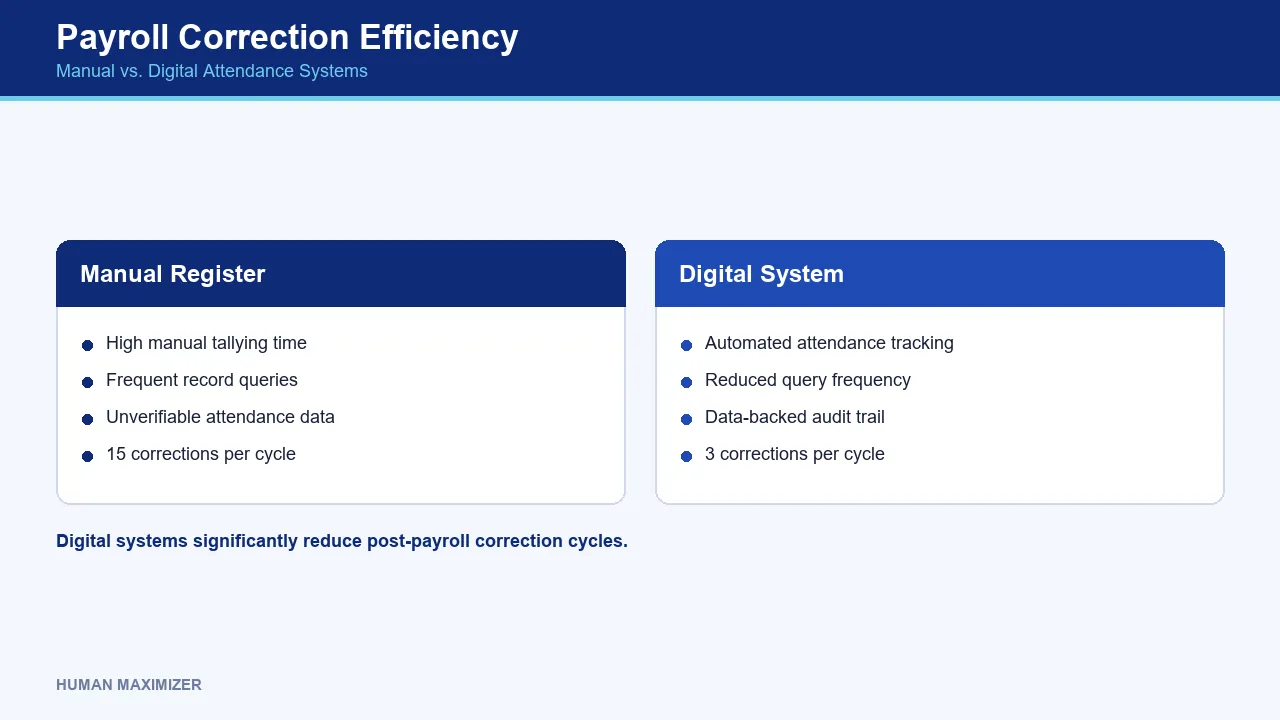
Across 24 client accounts in an internal review completed in July 2026, monthly payroll corrections after go-live ran at three per cycle against fifteen before. Corrections are the honest metric here. They are what happens when attendance and payroll disagree, and they are the thing a manual register generates endlessly.
How that figure was produced. It comes from our own account records, not a survey.
A correction is counted as an adjustment logged against a payroll batch after the run was closed. We compared the cycles immediately before go-live with the cycles after. Only the 24 accounts where we held clean data for both periods are included, which is why the sample is smaller than our client base. No client is named and we do not publish per-client results. More about the team behind the product is on the Human Maximizer about page.
Migration in Practice: From Punch Cards to Biometric Attendance Integration
Attendance software migration fails on questions of ownership far more often than on technology. The rollout that stalls is rarely the one with a difficult device; it is the one where nobody has been made responsible for deciding how the old shift codes map to the new ones, so the question bounces between HR and operations for three weeks while finance waits and the go-live date passes.
Before you touch hardware, settle the data. Every legacy shift code and leave-type abbreviation needs a named owner and a documented mapping, and so does every site code. One person signs it off. If that person does not exist, you are not ready.
Decide the punch channel per population, not per company. Plant and warehouse staff on fixed biometric terminals at the gate. Office staff on mobile or web. Field technicians on a mobile app with a location boundary. Kiosk-style face recognition where hands are gloved or wet and fingerprint readers fail all day. A single channel imposed on everyone is the most common reason a rollout is quietly abandoned in month two. Our own take on why device-first deployments struggle is set out in more detail in this piece on employee attendance tracking software.
Run parallel for one full cycle. Keep the register alive alongside the new system for a month and compare the two outputs line by line before anything touches payroll. The differences you find are the point of the exercise. They tell you which policy rules were configured wrong, and they surface the informal practices that were never written down anywhere.
Then cut over, and lock the old register. Not shred it. Statutory registers carry retention obligations, and the paper remains the record for the period it covered.
Implementation across 46 client rollouts in the first half of 2026 averaged seven to ten days, measured from kickoff to first live cycle on the same internal-records basis as the correction figure above. The parallel cycle is what sits inside that window, and skipping it is how organisations end up doing their reconciliation after payday instead of before it.
Where Attendance Meets Payroll: Ending the Reconciliation Round
The reason attendance errors hurt is that they do not stay attendance errors for long. They become wage errors. Present days and loss-of-pay days are the two numbers that convert a month of punches into a salary, and when they arrive in payroll as a typed figure from a spreadsheet, every downstream calculation inherits whatever was wrong upstream. Provident fund contributions are computed on basic and dearness allowance; ESI eligibility turns on a monthly gross wage ceiling. Neither of those catches an attendance mistake. Both carry it, into a return that has already been filed.
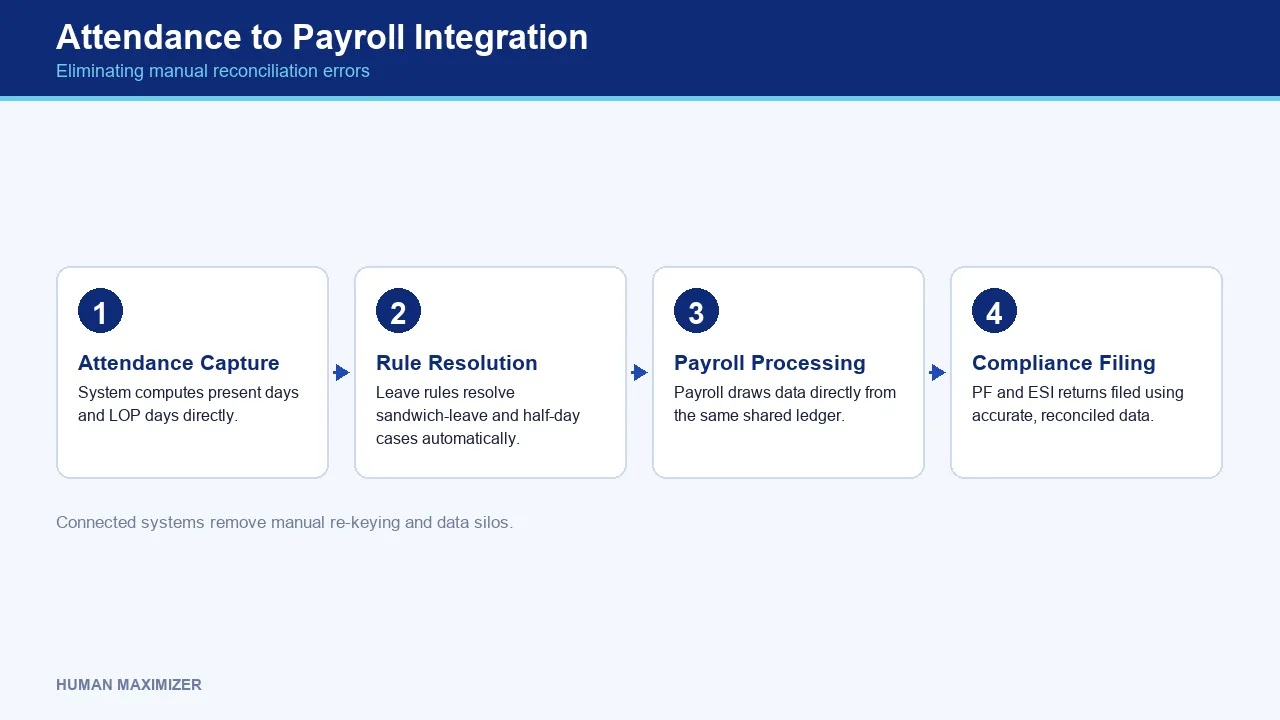
Connected systems remove the handover entirely. Attendance computes present and LOP days directly, leave rules resolve the sandwich-leave and half-day cases that cause most of the disagreement, and Payroll draws from the same ledger rather than a re-keyed summary. Nobody emails a file. There is nothing to reconcile because there are not two versions.
That is also the practical argument against assembling this from separate point tools. Data silos between an attendance device and a payroll package that only learn about each other by email are where errors get manufactured, a cost we have written about at length in our guide to choosing the best HRMS software in India.
What Happens When Something Goes Wrong
The honest test of an attendance system is the broken day, not the clean one. What follows is a worked illustration built from the failure modes these systems are designed to handle, rather than a report of any particular incident.
A gate terminal at a plant loses power for two hours during the morning shift. Forty-one workers walk in unrecorded. In a register world, this is discovered at month-end and resolved by a supervisor writing forty-one entries from memory, which is exactly the sort of record that cannot survive a question.
In a connected system, the day is flagged as an exception the same morning: punch-in missing against an assigned shift. The employee or the supervisor raises a correction request with a reason. The manager approves it in the mobile app. The day recalculates, present days update, and the correction is stored with requester, approver, reason and time, sitting underneath the original blank rather than replacing it invisibly. When the period is confirmed and locked against the payroll batch, that whole chain is exportable. An inspector asking why a worker shows a full day when the device log shows nothing gets an answer in seconds instead of a shrug.
That is the difference we would ask anyone to weigh, and it is worth more than the hours saved.
Storing Biometric Data Responsibly
Cloud-based attendance solves the disaster-recovery problem that nobody thinks about until a register is lost to a flood or to a departing manager's desk drawer. It introduces a different obligation. Biometric templates and location trails are personal data under the Digital Personal Data Protection Act, 2023, which means employees are entitled to notice about what is collected and why, and consent has to be real rather than assumed from the fact that someone touched a scanner to get through a door.
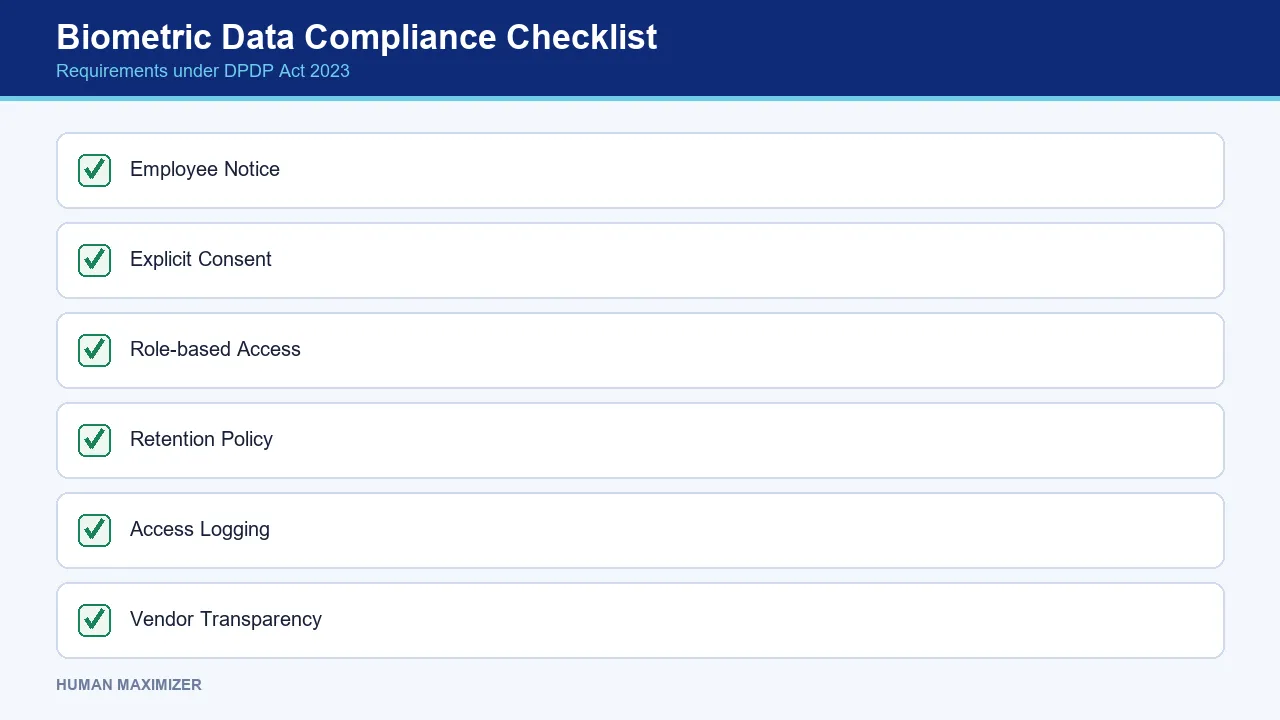
Practical minimums we would insist on: role-based access so a supervisor sees their own team and not the whole plant, and retention rules that match your statutory register obligations rather than "forever". An access log showing who pulled which report matters just as much. If a vendor cannot tell you where the data is hosted and who inside their organisation can read it, that is your answer.
Winning Over the Skeptics
Resistance to digital attendance is usually about fairness rather than technology, and it is usually justified, because the first version of any new system catches things the old one forgave.
Say so directly. The supervisor who used to round a 9:12 arrival down to 9:00 was not being dishonest; they were absorbing a policy that was never designed for the reality of local trains and factory bus routes. If your grace period is five minutes on paper and twenty in practice, configure twenty, or change the policy openly. Do not let the software enforce a rule the organisation never actually agreed to and then blame the software.
Two things reduce friction more than any communication plan. Give employees visibility of their own record from day one, so they can see what the system thinks and challenge it before payday rather than after. Then route disputes through a trackable channel with a response commitment instead of a WhatsApp message to whoever answers, which is the job Ticket Management does. Train supervisors alongside both. The research on digital attendance rollouts keeps landing on the same two determinants of acceptance: whether people were genuinely trained on the tool, and whether technical failures on the devices got fixed quickly instead of being absorbed as a fact of working life.
When we were building this product, the team spoke with HR leaders, managing directors and founders across Indian companies. The complaint that came up most often had nothing to do with features: they were being blamed for numbers they had inherited from a register they never filled in.
Where a Digital System Will Not Help You
It will not fix a policy you have not written down. Automated attendance software applies rules consistently. If your overtime rule is genuinely "whatever the plant head decides that week", software will either force you to define it or record your inconsistency with unhelpful precision.
It will not settle a genuine dispute about work done off-system. A technician who spent the day at a client site with no signal, or a driver on a long haul, needs a manager's judgement and an approved manual entry. The system's job is to make that judgement visible and attributable, not to pretend the judgement was unnecessary.
It cannot make a badly designed shift pattern humane. Perfect visibility into a roster that gives people nine-hour turnarounds between shifts tells you clearly that you have a problem. It does not solve it.
And it will not substitute for advice on your specific statutory obligations. Register formats and retention periods vary by state Shops and Establishments rules and by whether you fall under the Factories Act. Confirm your formats against the applicable rules before you switch off the paper.
Frequently Asked Questions
Is a digital attendance system compliant with Indian labour laws? Yes, provided it produces the records the applicable statute requires in the prescribed particulars and you can reproduce them on demand. The Code on Wages, 2019 contemplates registers being maintained electronically, so the medium itself is not the issue. What decides it is whether every entry can be attributed to a named person and held for the statutory retention period. On the central-government side, registers and returns run through the Ministry of Labour's Shram Suvidha unified portal, while your state's Shops and Establishments rules govern the format specifics for offices and retail.
Do we need biometric hardware, or is an online attendance tracking system on mobile enough? It depends on the population. Fixed-site staff at a single gate are well served by a terminal. Distributed teams are not, and forcing them onto one is the usual cause of failed adoption. Most organisations end up running mobile punch with a location boundary for field staff alongside devices at fixed sites, with every channel writing to one record.
What do we do with the old paper registers once we go digital? Keep them. The register remains the statutory record for the period it covered, and retention obligations run from the applicable Factories Act or state Shops and Establishments rules, not from the date you installed new software. Store the closed volumes properly and note in your migration documentation which date the digital record takes over, because that boundary is the first thing an inspector will ask about.
Our biometric device is offline for a week. Does that break our compliance? Not by itself. What breaks it is a week of days reconstructed later with no trace of who reconstructed them. Log the outage. Then mark the affected days as exceptions in the system and push each one through a normal correction with a named approver and a stated reason, so the gap is documented rather than papered over.
Conclusion
Go back to the corrected entry in the register, the one with the scratched-out figure and a supervisor's initial beside it. It exists because something real happened and somebody fixed the record afterwards. That correction is fine. What is not fine is that the paper cannot tell you who made it, when, or why, and neither can a digital system built to look tidy instead of defensible.
Get that one thing right and the hours take care of themselves. Get it wrong and you have paid for software that produces the same undefendable number faster.
Want an attendance record that survives an inspection instead of merely surviving the month? See how we built it at Human Maximizer.
About the Author & Reviewer
Chandan Watts — Technical Product Manager, Human Maximizer (Razor Infotech)
Chandan Watts is Technical Product Manager at Razor Infotech, building the Human Maximizer HR platform. After years leading customer-experience and team operations at JindalX and Radical Minds, he focuses on how teams actually work day to day — and how small workflow gaps quietly slow an entire team down.
Connect on LinkedIn
Reviewed & approved by Sameer Hameed — Founder & Chairman, Razor Infotech
Sameer Hameed is the Founder & Chairman of Razor Infotech, where he is guiding the creation of Human Maximizer. An entrepreneur across technology, real estate, mining and travel, he builds organisations on clarity, trust and responsible growth — on the belief that businesses grow only when the people behind them grow.
Connect on LinkedIn
Human Maximizer is built by Razor Infotech in New Delhi, India (founded 2019). About Human Maximizer.
Keep reading

HR Strategy
Employee attendance tracking software
Why aggressive surveillance tools damage company culture. Learn how to balance accountability and employee trust using modern field force tracking...
13 min read
HR Strategy
Fake GPS Attendance Detection
How advanced geo-fencing attendance software identifies fake location apps and GPS spoofing to ensure accurate, tamper-proof field force tracking...
20 min read
HR Strategy
HRMS Migration: greythr alternative india
greytHR Alternative India: How to streamline your transition to a new platform. Learn the essential steps for an HRMS migration...
17 min read