
HR Strategy
The Migration Audit Your greytHR Alternative in India Needs
greytHR Alternative India: How to streamline your transition to a new platform. Learn the essential steps for an HRMS migration...

Insha Hamid
Head of HR in Research & Content, Human Maximizer · 17 min read · · Updated
It's 10:00 AM on the 25th, the PF challan is due in three days, and the export your payroll manager pulled twenty minutes ago has come back with 209 rows where there should be 214. Nobody can say which five went missing. That is an audit problem wearing a software costume, and it is usually the moment an HR leader realises the plan for moving to a greytHR alternative in India never had a reconciliation step in it. We built our Payroll module after watching that failure mode repeat across the market, and the fix is not a better import wizard.
Treat an HRMS switch like a financial audit and everything changes. An auditor never asks "did the file transfer?" An auditor asks whether the closing balance in the old system equals the opening balance in the new one, line by line, and whether you can prove it. Almost nobody applies that discipline to employee data. They apply it to money, then move the ledger that generates the money with a CSV and a prayer.
The Migration Ledger: The Four Balances That Must Tie Out
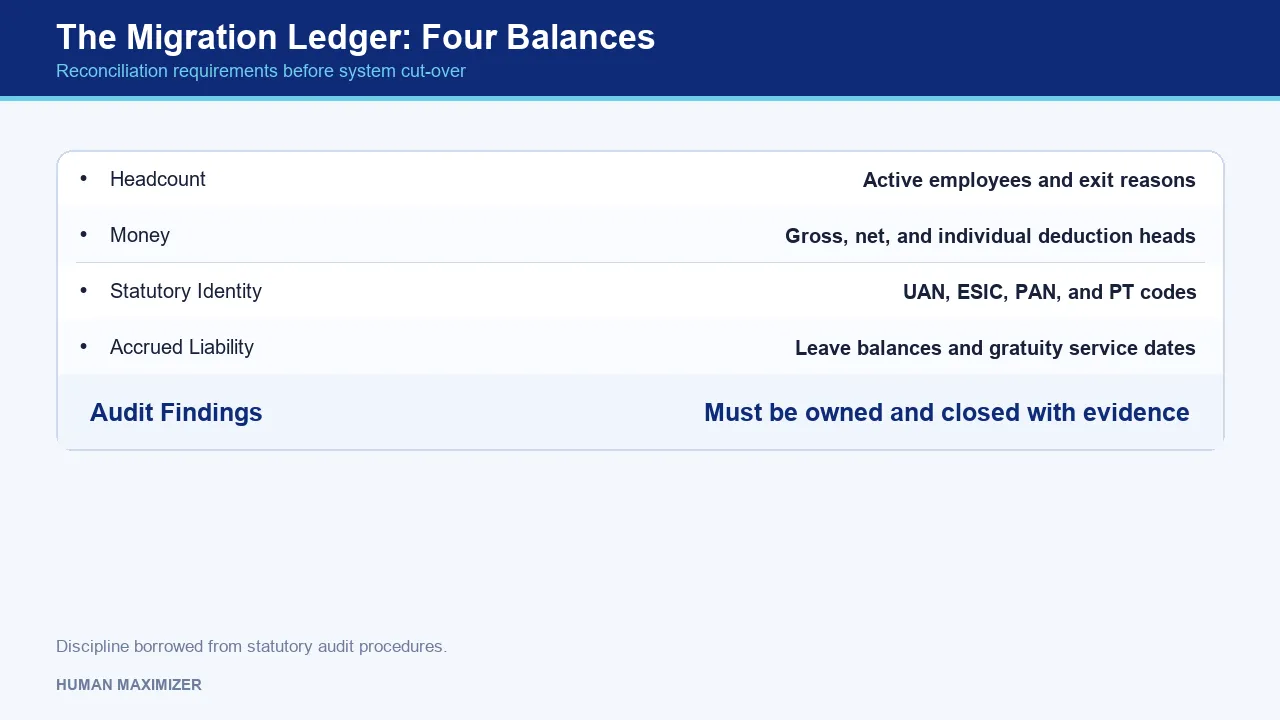
Most guides to switching HR software hand you a project plan. A project plan tells you what to do next. It says nothing about whether what you did was correct. What follows is a reconciliation model instead: four balances that must tie out between the old system and the new one before you cut over. The discipline is borrowed wholesale from a statutory audit.
Balance 1 — Headcount
Active employees in the old system must equal active employees in the new one, and any difference has to be explained by name rather than by count. Five missing rows is not "a rounding issue". Somebody was hired mid-cycle, or a person marked inactive in one place is still active in the other. Reconcile the exit reasons too: an employee flagged resigned in the source and absconded in the target has a different full and final settlement waiting for them.
Balance 2 — Money
Gross and net for the last completed month, in both systems, then every deduction head separately. Not the total. Each head. A ₹200 professional tax variance across 200 employees hides comfortably inside a matching gross figure and surfaces four months later as a state-level notice.
Balance 3 — Statutory identity
UAN, ESIC IP number, PAN, PT state code. These are keys, not attributes. If a UAN arrives with its leading zero stripped by a spreadsheet, that employee's PF contribution posts to nobody.
Balance 4 — Accrued liability
Leave balances and gratuity-eligible service dates. Nobody reconciles these two, because neither shows up on a payslip. Both are real money sitting on your books.
Any balance that fails to tie is a finding. Findings get owned by a named person and closed with evidence, exactly as they would in a statutory audit. That is the entire framework, and you can run it on a whiteboard.
The Hidden Costs of Switching, Beyond the Subscription Fee
The sticker price is the easy part. Published pricing for Indian SME platforms generally lands in a per-user, per-month band, and ours is open: Launchpad is free, with paid plans from ₹49 to ₹112 per user per month billed yearly, all listed on our pricing page. Most vendors quote on request. Ask for the annual number in writing before you compare anything.
The costs that actually hurt sit elsewhere.
Parallel-run labour. For one month you run payroll twice. That is real hours from your payroll manager during the busiest week of their month. Model it yourself: if a payroll admin spends four hours on a monthly run and the parallel month doubles that, you are buying eight hours of skilled time, once. Adjust the four-hour figure to whatever your own close actually takes and the conclusion holds. Skipping the parallel month is what costs you.
Data cleanup. This is where timelines slip, not configuration. Migrations stall on the questions nobody owns. Somebody has to decide whether "Sr. Executive - Ops" and "Senior Executive Operations" are one designation or two, and until a person with authority says "merge them", the calendar does not move. Configuration takes days. Deciding takes weeks.
Duplicate work during the transition. Managers asked to approve the same leave request in two systems stop approving in either. Adoption dies here, quietly, and you discover it when the first month of attendance data turns out to be unusable.
History you cannot take with you. Payslip archives, Form 16s, old appraisal records. Export them as PDFs and store them yourself before the old contract lapses. Once the subscription ends, retrieving a three-year-old payslip for an employee's home loan application becomes a support ticket with a company you no longer pay.
Our own implementations run 7 to 10 days on average, measured across 46 rollouts to July 2026. That covers configuration and data load. The cleanup that precedes it is yours, and it is the part worth budgeting for.
Comparing Approaches Before You Pick a greytHR Alternative in India
The Indian market has genuinely credible options. Keka, factoHR, Zimyo, Pocket HRMS and HROne all serve mid-market teams, and greytHR itself remains a competent payroll engine. Ranking them by star rating gets you nowhere, because those ratings measure satisfaction with different jobs. What matters is which architectural approach fits how your company actually runs.
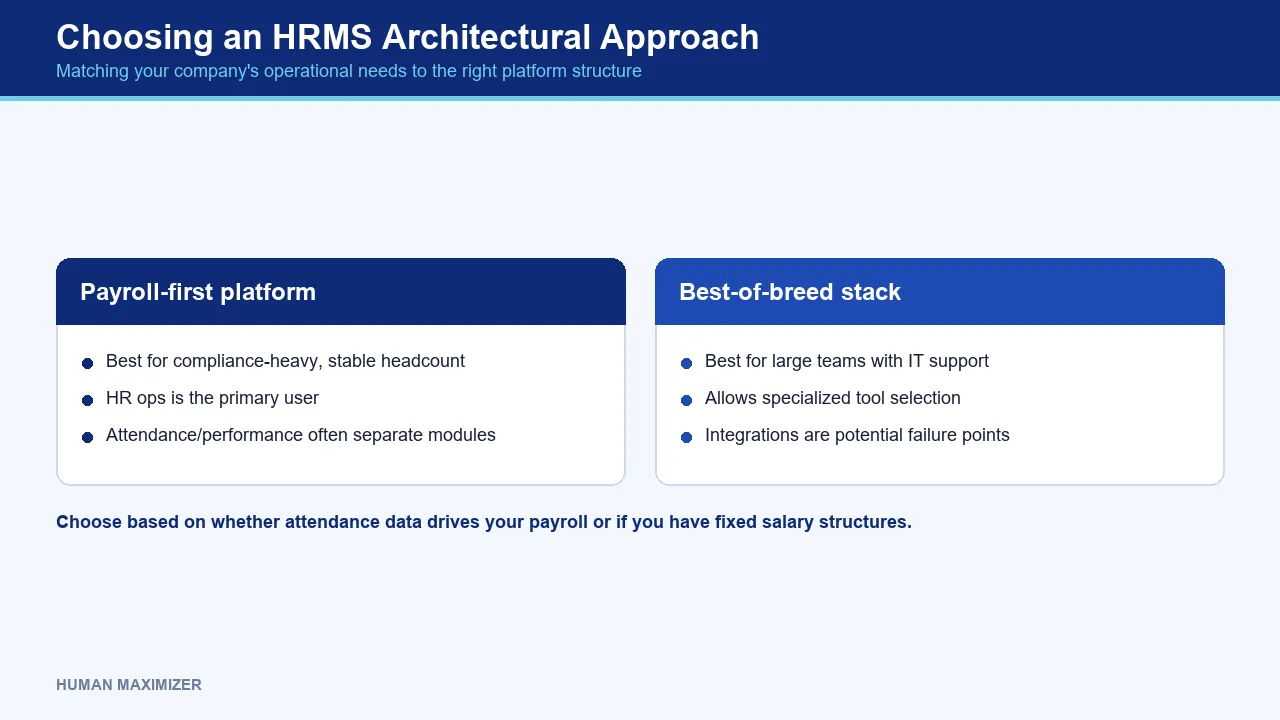
| Approach | Where it fits | The tradeoff |
|---|---|---|
| Payroll-first platform | Compliance-heavy operations with stable headcount, where HR ops is the primary user | Attendance and performance are usually bolt-ons or separate purchases |
| Best-of-breed stack | Large teams with an IT function to own the integrations | Every integration is a failure point, and cross-system reconciliation stays manual |
| Unified cloud-based HRMS | Growing SMEs where attendance drives payroll and managers log in daily | You accept one vendor's opinion on how each module should work |
| Employee Self Service (ESS)-led lightweight tool | Distributed or field teams where self-service adoption is the goal | Statutory depth is often thinner; verify PT state coverage specifically |
One question usually decides it: does attendance data drive your payroll? For a manufacturing unit in Visakhapatnam running rotating shifts with overtime and geo-fenced punches at several gates, the answer is yes, and every hour spent reconciling attendance exports into a separate payroll tool becomes a recurring tax. Our own position is argued at length in our comparison of HRMS options in India, and we are not a neutral party. Read it as a stated case, not a survey.
For a professional services firm with fixed salaries and no shift complexity, a payroll-first tool may genuinely be enough. Buying a unified platform you will never use is its own kind of waste.
The Statutory Data Transfer Protocol: PF, ESI and PT
Almost every comparison article skips this section. It is the one that generates penalties.
PF and the UAN chain
The employee's share is 12% of basic plus DA, and the employer's statutory liability stops at a ceiling of ₹15,000 a month of basic plus DA, though many employers contribute on full wages by policy. Both figures are published by the Employees' Provident Fund Organisation. Your new system has to know which convention you follow, per employee, because the two produce different challans for identical salaries.
Carry these across and verify each individually: UAN, member ID, date of joining as declared to EPFO, the wage-ceiling convention, and any employee carrying a prior exit-date entry. ECR filing and payment fall due on the 15th of the following month. Plan the cutover so your first ECR from the new system has a full working week of slack before that date. Not two days.
ESI
ESIC applies coverage below a monthly gross wage of ₹21,000. The trap is mid-year crossings: an employee who crosses the threshold partway through a contribution period stays covered until that period ends. Drop the in-period flag during a statutory data transfer and you will under-deduct, with a retrospective correction waiting.
Professional tax
PT is a state levy, several states impose none, and the Constitution caps it at ₹2,500 a year. Slabs vary by state, and by gender in a few of them. If you operate across states, PT is the single most commonly misconfigured thing after a switch, because the mapping is per-location and nobody bothers checking a branch with four people in it. Check the small locations first.
Basic pay structure
The Ministry of Labour and Employment sets the expectation under the Code on Wages that basic pay holds at least half of total remuneration. A migration is the natural moment to test whether your structures comply, since you are already touching every salary record. Most teams find at least one legacy band that does not.
Mapping Data Without Corrupting It
Data mapping is the unglamorous core of any HRMS data migration, and it fails in predictable ways.
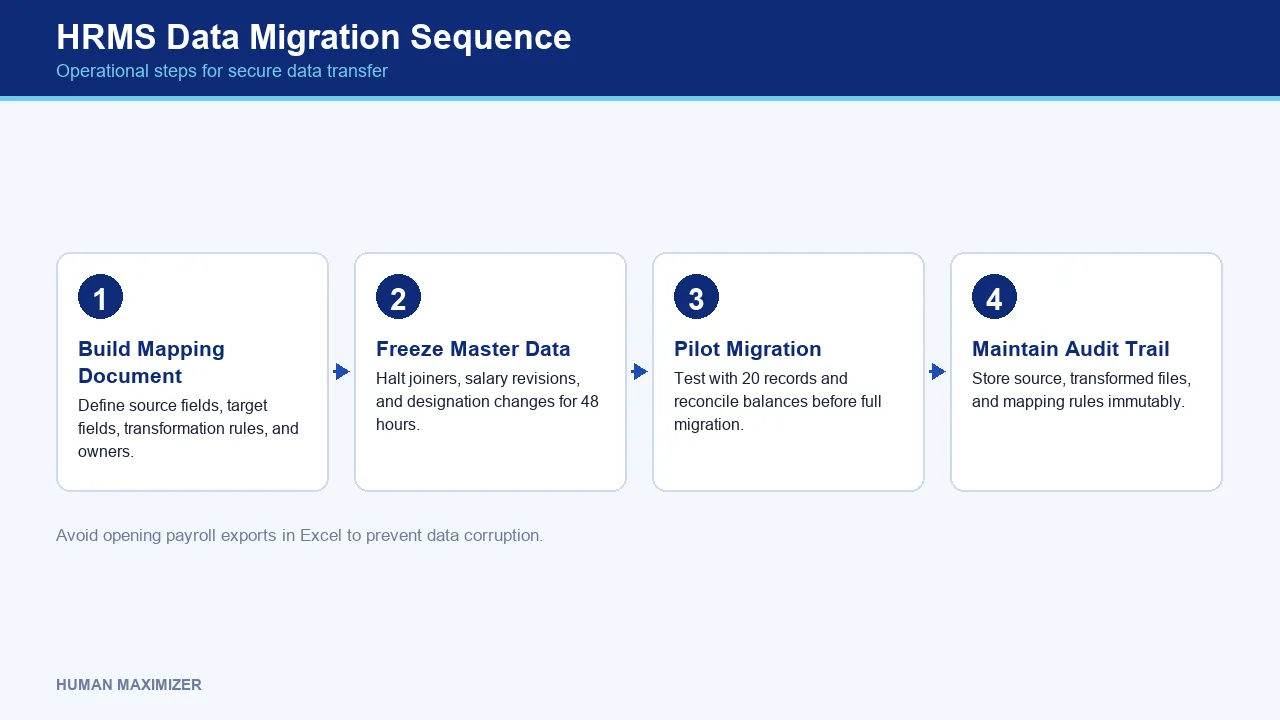
Build the mapping document before you export anything. One row per field in the old system, one column for the target field, one for the transformation rule, one for the owner. If a field has no target, decide explicitly whether it dies or gets parked in a custom field. The fields nobody maps turn out to be the ones that mattered.
Never open a payroll export in a spreadsheet. Excel will helpfully reformat a date and strip the leading zero off a UAN without telling you, then convert a long alphanumeric string into scientific notation. Work in the raw file, or in a tool that treats every column as text.
Freeze master data during the transfer window. No new joiners, no salary revisions, no designation changes for the 48 hours you are moving. If a revision genuinely cannot wait, log it and apply it by hand in both systems.
Pilot with one department. Twenty records, fully reconciled against all four balances, before you touch the other 200. A failure at twenty records costs an afternoon. The same failure at two hundred costs you the month.
Keep an audit trail. Every transformation should be reproducible. When someone asks in November why an employee's date of joining shifted by a day, you need to point at a rule rather than a memory. Store the source export next to the transformed file and the mapping document, immutably.
The operational sequencing is written out in more detail in our HRMS migration playbook for Indian HR teams, including the sign-off gates that stop cleanup from drifting.
The Parallel Run: The Month You Do Not Skip
Here is the practice that separates a controlled changeover from a gamble, and it is astonishing how rarely migration advice mentions it. Run one full payroll cycle in both systems, on identical input data, and reconcile the outputs before you pay anyone from the new one.
Not a sample. Not a test employee. The whole month.
What you compare: gross per employee, net per employee, then each deduction head on its own. Head counts by PF status and by ESI status, then by PT state. Leave balances once the cycle closes.
What an acceptable variance looks like: zero on statutory heads. A one-rupee rounding difference on net pay is tolerable if you can explain the rounding rule. Anything you cannot explain is a finding, not a variance.
Who signs it off: the payroll manager plus one finance representative, in writing, before cutover. This sounds bureaucratic. It is the same signature discipline you already apply to a bank reconciliation, and it exists because whoever runs the numbers should not be the only person approving them.
Once the parallel payroll run ties out, cut over cleanly. Do not keep both systems alive for three months "just to be safe". That is precisely the duplicate-work trap that kills manager adoption, and it means neither system is ever the source of truth.
What Happens After Go-Live
A migration is judged on the second month, not the first. In our own deployments, the first payroll cycle after go-live takes roughly 4 hours against 2 days on the previous system, measured across 32 implementations to July 2026, while monthly payroll corrections fell from 15 to 3 across 24 of them over the same period. Those figures come from configured systems with reconciled data, and the research history behind how we build and measure is on our About page. A rushed cutover will not produce them, and we would rather say so plainly than let you be surprised.
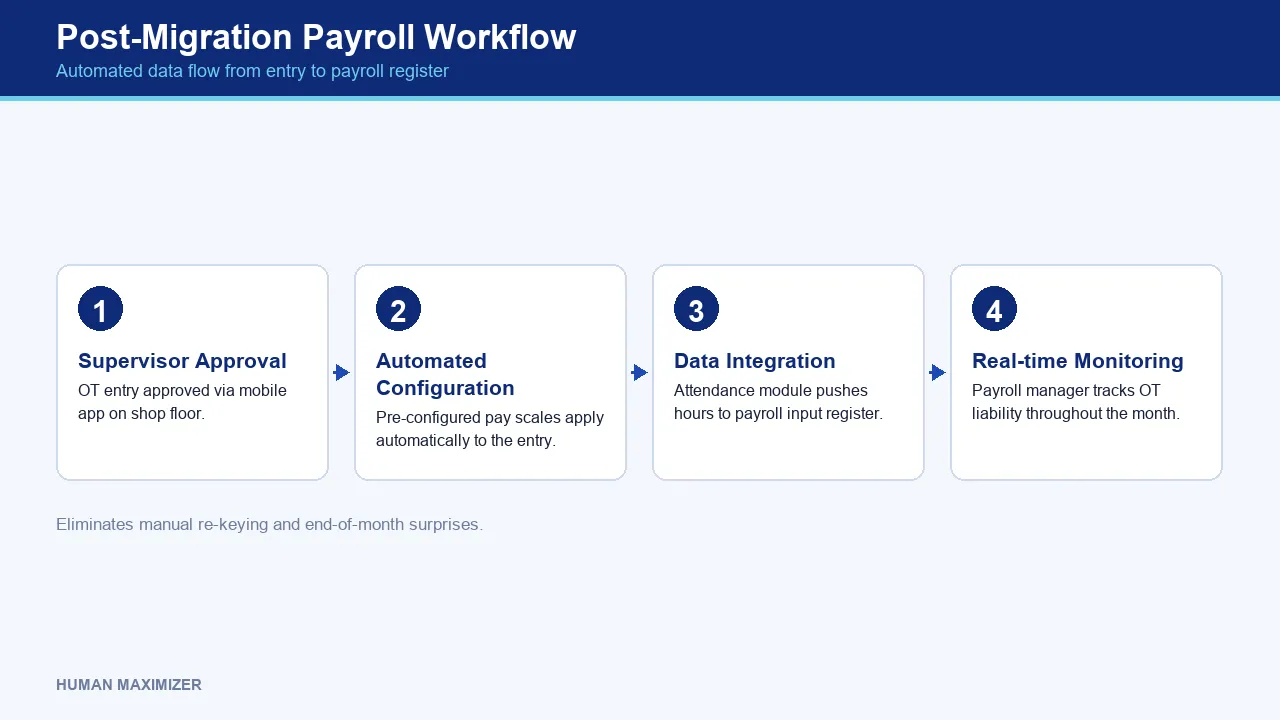
The workflow that makes the difference is mundane. A supervisor at a plant approves an overtime entry from the shop floor on the mobile app; the pay scale already configured for that team applies automatically, Attendance Management passes the hours into the payroll input register with no re-keying, and the payroll manager watches the OT liability build through the month instead of discovering it on the 28th. A mid-month salary revision behaves the same way: one entry updates the record, and the arrears calculation, the revised PF base and the revision letter all follow from it. When an employee asks why their PT deduction changed, the question goes into Ticket Management with an SLA timer against it rather than into someone's WhatsApp at 9 PM.
That last one matters more than it sounds. Post-migration query volume spikes hard, and if those queries have nowhere structured to land, your HR team spends the first month answering the same question forty times with no record that they ever did.
What HR Managers Actually Report About Switching
Public review platforms covering Indian HRMS products show a consistent split, and it rewards careful reading: complaints cluster around support responsiveness and configuration flexibility rather than core payroll accuracy. Most established Indian platforms calculate PF and TDS correctly. What people write reviews about is how long it took to get a custom report, or whether support picked up during their payroll week.
So when you check references, ask a narrow question. Not "are you happy with it." Ask what happened the last time their payroll run broke on the 28th, and how fast someone responded. That answer tells you more than any star rating.
When we were building this product, we sat with over 50 Indian HR managers and payroll specialists to map what really breaks in their month. The complaint that surfaced most often was about waiting, not about features.
Where This Approach Has Limits
The audit-style migration suits most teams. It is not universal, and pretending otherwise would be dishonest.
If you have fewer than about 25 employees on fixed salaries with no shift or overtime complexity, a full parallel run is over-engineering. Reconcile the four balances, verify the statutory identifiers, cut over. The formality will cost more than the risk it removes.
If your existing payroll carries known, unresolved historical errors, say a PF base that was wrong for eighteen months or PT that was never deducted in one state, migration will surface them. Do not reconcile the new system to the old one's mistakes. That is a correction exercise with your CA, sequenced before the switch rather than during it.
And if you are mid-way through an EPFO or ESIC inquiry, do not migrate at all. Finish it on the system that produced the records under scrutiny.
One candid caution about our own numbers: the implementation range we publish assumes your data arrives clean. When designation masters or salary structures need a decision from someone with authority, the calendar is set by how fast that decision gets made, not by us. A two-week rollout can quietly become a two-month one because one mapping question sat unanswered in an inbox.
Frequently Asked Questions
Is it difficult to migrate payroll data from greytHR to another platform? The export itself is usually straightforward, since most Indian HRMS products offer standard employee and payroll exports. Difficulty lives in the mapping and the reconciliation, which is why the data mapping discipline deserves more of your budget than the file transfer does. Plan for cleanup and verification, not for the download.
How does greytHR compare to Keka or factoHR when I'm changing payroll software? Comparing them brand by brand produces a stalemate, because all three handle Indian labor laws and payroll automation competently for their target segment. The useful comparison is architectural, which is why the approach-based matrix sorts them by whether attendance drives your payroll rather than by feature count.
Will my employees' PF and ESI history transfer to the new system? No, and it does not need to. Contribution history sits with EPFO and ESIC against the UAN and IP number, not inside your HRMS. What must transfer perfectly are the identifiers themselves along with the wage-ceiling convention you follow, because a wrong UAN posts a real contribution to nobody.
When in the month should we cut over? Immediately after a completed payroll cycle, with the parallel run performed on that same closed month. Cutting over mid-month splits attendance and leave data across two systems, which is the single hardest reconciliation of the lot.
Conclusion
Go back to that export on the 25th, the one that returned 209 rows for 214 employees. Under the ledger approach, that file never reaches an import screen, because the headcount balance fails at the first check and the five missing names get identified while there is still a working week left before the PF deadline on the 15th. The export did not cause the crisis; the missing reconciliation step did.
Skip the parallel month and the bill simply arrives later with interest attached. A short-paid PF challan accrues from the due date, and EPFO will find it. Reconcile first.
Planning a payroll migration and want the four balances applied to your actual data before anything moves? Talk to our team at Human Maximizer and we will walk the ledger with you.
About the Author & Reviewer
Insha Hamid — Head of HR in Research & Content, Human Maximizer
Insha Hamid heads HR research and content for Human Maximizer at Razor Infotech, covering people operations and Indian workplace compliance — translating regulatory change and workplace research into guidance HR teams can act on.
Connect on LinkedIn
Reviewed & approved by Sameer Hameed — Founder & Chairman, Razor Infotech
Sameer Hameed is the Founder & Chairman of Razor Infotech, where he is guiding the creation of Human Maximizer. An entrepreneur across technology, real estate, mining and travel, he builds organisations on clarity, trust and responsible growth — on the belief that businesses grow only when the people behind them grow.
Connect on LinkedIn
Human Maximizer is built by Razor Infotech in New Delhi, India (founded 2019). About Human Maximizer.
Keep reading
HR Strategy
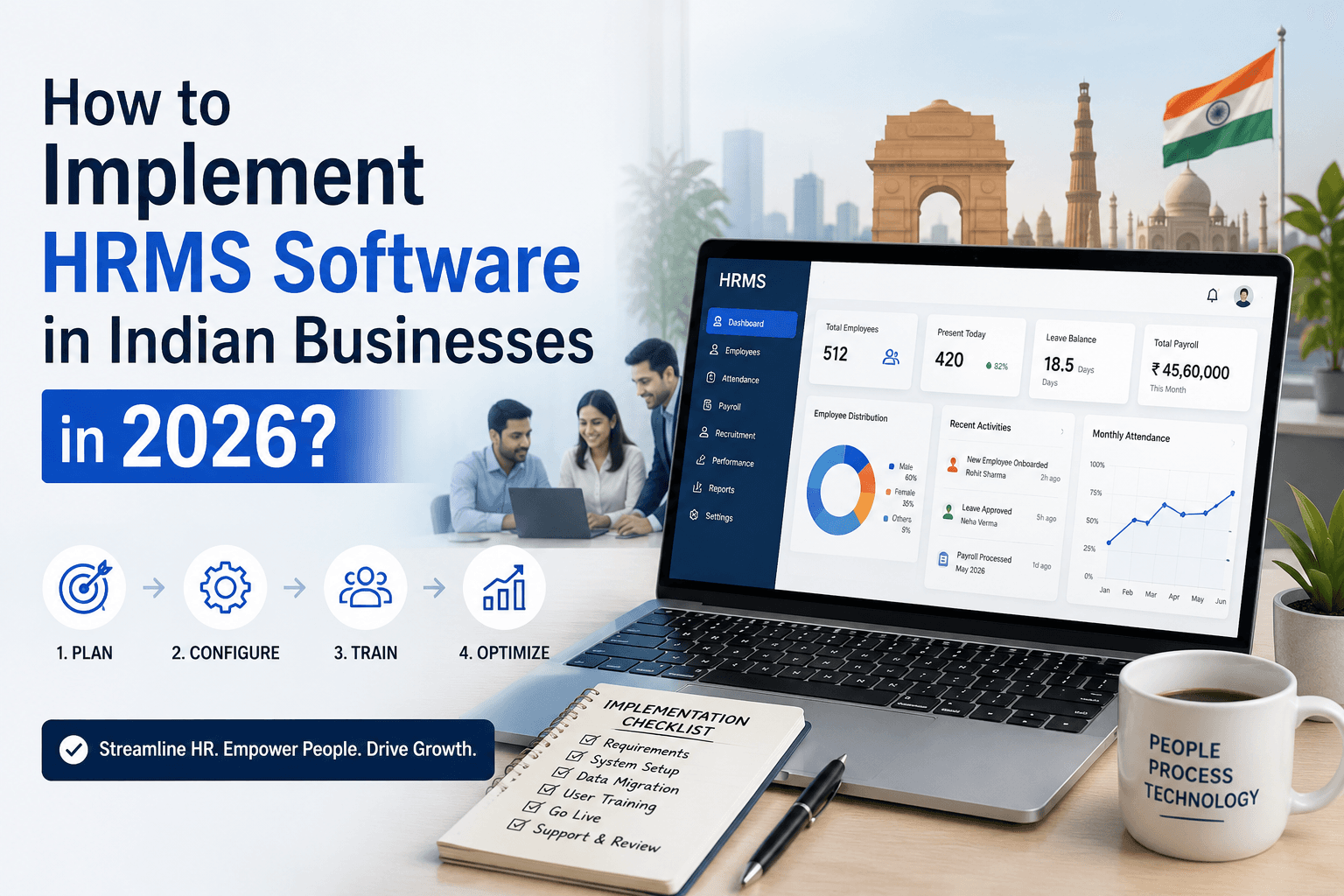
How to Implement HRMS Software in Indian Businesses in 2026?
Failing to implement HRMS? Find out how long HRMS implementation takes to automate payroll, compliance & improve employee experience. Book a demo with Human Maximizer.
5 min read
HR Strategy
HRMS Support After Implementation
The essential service levels and technical assistance you should demand from your vendor regarding HRMS post-implementation support for your business.
20 min read
HR Strategy
Keka alternative india
Keka Alternative India: The critical steps for an HRMS software migration. Learn how to audit your payroll data and ensure...
20 min read