
HR Strategy
Why Bloated HR Stacks Cost More Than a Modular HRMS in India
How modular HRMS software allows your business to scale efficiently by adding or removing features as your team grows. Learn to optimize your HR...

Chandan Watts
Technical Product Manager, Human Maximizer (Razor Infotech) · 16 min read · · Updated

The quote on your desk lists eleven modules. In year one you will use four. That gap between what you are billed for and what you actually switch on is the real argument for a modular HRMS in India, and it is a budgeting argument long before it is a features argument. Most buying guides treat modularity as a convenience: nice, flexible, tick the box. We read it differently. Every module you activate ahead of need is a fixed monthly cost attached to a workflow that does not exist yet, and the only module that genuinely cannot wait is Payroll, because statutory liability starts on a date the government picks, not on the date you feel ready.
A composite worth holding in mind, assembled from the kinds of conversations that recur rather than from any one company: a 26-person product firm in Jaipur, three months old on the revenue side, running salaries out of a spreadsheet. The HR lead wants attendance tracking because field staff are reporting hours by WhatsApp. Finance wants nothing that costs more than the CA does. And the vendor's proposal bundles performance reviews, learning content and an engagement survey tool into the same line item. Nobody in that room disagrees about the software. They disagree about the timing.
The All-in-One Trap: Paying Today for the Company You Will Be in 2029
Bundled suites are priced against your eventual complexity. That is rational for the vendor and expensive for you, because your complexity arrives in steps and the invoice arrives monthly. A 25-person company does not need succession planning. It needs a clean employee record, attendance that feeds salary calculation, and PF and ESI filed on time.
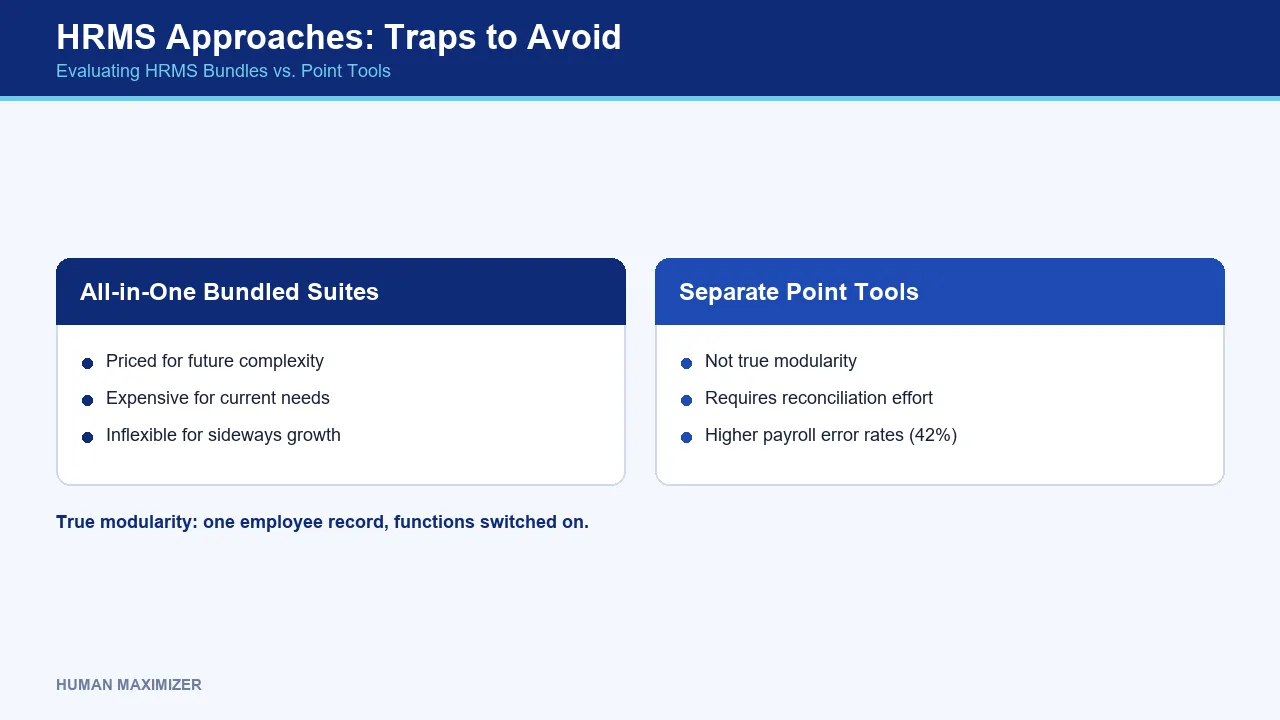
The scalability problem people complain about is usually the reverse of what they describe. Systems rarely break because they cannot handle more employees; they break because the organisation grew sideways into shift work, or multi-state operations, or a second legal entity, and the platform was sold as one indivisible block that cannot bend. We wrote about that failure mode at length in our piece on why all-in-one HRMS for Indian startups fails to scale.
There is a second trap, and it is the more expensive one. Some buyers avoid the bundle by assembling four separate point tools instead: one for attendance, one for payroll, a spreadsheet for leave, an app for expenses. That is not modularity. That is a reconciliation job with a subscription attached. Gartner's work on HR technology puts the cost of that choice in plain terms: unified HCM platforms reduce payroll error rates by 42% versus point-solution stacks. Modular means one employee record with functions switched on above it. Anything else is a stack.
The Three-Year Math: What Modular HRMS Pricing in India Actually Saves
Nobody publishes this arithmetic, so here it is, with every assumption exposed so you can argue with it.
The assumptions
Take a company at 25 employees in year one, 60 in year two, 120 in year three. Assume a bundled suite quoted at ₹150 per employee per month, everything included. That is my assumption, not any vendor's published rate: replace it with the number on your own proposal. Against it, put a modular path that starts with core records, attendance and payroll, adds leave and rostering in year two, and adds performance and productivity tracking in year three. Our own published tiers give that path real numbers, all listed on the Human Maximizer pricing page.
The arithmetic
| Year | Headcount | Modular tier | Modular cost for the year | Flat bundle at ₹150 |
|---|---|---|---|---|
| 1 | 25 | ₹49/user | 25 × ₹49 × 12 = ₹14,700 | ₹45,000 |
| 2 | 60 | ₹82/user | 60 × ₹82 × 12 = ₹59,040 | ₹1,08,000 |
| 3 | 120 | ₹112/user | 120 × ₹112 × 12 = ₹1,61,280 | ₹2,16,000 |
| Three-year total | ₹2,35,020 | ₹3,69,000 |
Key takeaway: the gap is ₹1,33,980 across three years, which at this stage is roughly a junior hire or eighteen months of the compliance retainer you were trying to avoid paying twice. It rests on one stated assumption, the ₹150 flat bundle. Swap in the rate on your actual quote and you can redo the whole table in a minute. Note also that the advantage is largest in year one and thins every year after: this is a deferral, not a discount.
Where the saving disappears
Look at year three again. Modular per-user cost has climbed to ₹112 against a bundle at ₹150. The gap has narrowed from three-to-one to something much less dramatic. Per module pricing is front-loaded by design: the discount is largest when you are smallest, and it decays every time you switch something on.
So the honest rule is this. If you can name the month you will need performance reviews, engagement tooling and a learning library, and that month is inside eighteen from now, run the bundle numbers seriously. If you cannot name it, you are forecasting, and modular is the cheaper way to be wrong. Our breakdown of HRMS pricing models in India goes deeper on how per-employee and per-module billing interact.
The Module Payback Month
Here is the test we would apply to any module before switching it on. Call it the Module Payback Month: the number of months a module takes to return its own activation cost, given what it actually gives back in hours.
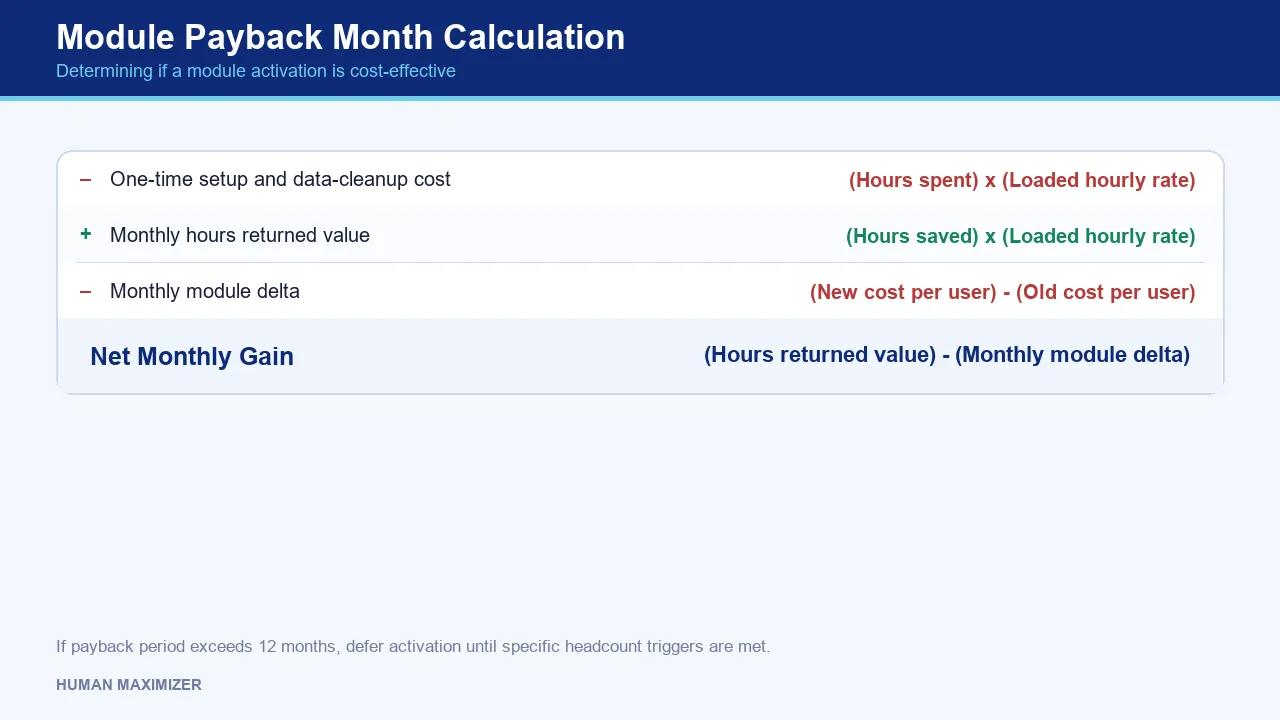
Module Payback Month = (one-time setup and data-cleanup cost) ÷ (monthly hours returned × loaded hourly cost − monthly module delta)
Worked, for adding Attendance Management at 60 employees:
- Monthly delta: ₹82 − ₹49 = ₹33 per user, so ₹1,980 a month.
- One-time cost: roughly 20 hours cleaning up shift masters and employee IDs, at a loaded internal rate of ₹500 an hour, so ₹10,000.
- Hours returned monthly: 6 hours of muster-roll reconciliation plus 3 hours chasing attendance inputs before payroll closes. Nine hours, or ₹4,500.
- Net monthly gain: ₹4,500 − ₹1,980 = ₹2,520.
- Payback: ₹10,000 ÷ ₹2,520 ≈ 4 months.
Adjust the hourly rate to whatever your finance head actually uses. The conclusion survives it. And the reason the number matters is the threshold it implies: any module with a payback month past twelve is a module you are buying for a company you do not have yet. Park it. Write the trigger condition into your notes instead, something like "activate rostering when field headcount crosses 40", and revisit at renewal.
Adding Modules Mid-Contract: What Actually Happens
This is the part vendors describe as plug-and-play and buyers experience as a fortnight of confusion. The technical work is genuinely small. The organisational work is not.
The sequence
- Commercial change first. A module addition changes your per-employee rate from a specific billing date. Get the new rate, the effective date, and the proration method in writing before anything is enabled. Contract flexibility is a clause, not a vibe.
- Provisioning. On a cloud-based HRMS the module is a permission flag against your tenant. Enabling it takes minutes and requires no new instance, no reinstall, no downtime for existing users.
- Master data mapping. The real work. A leave module needs a holiday calendar, leave types, accrual rules and opening balances. An attendance module needs shifts, week-offs and geofence centres.
- Backfill. Decide how much history moves in. Opening balances only, or twelve months of transactions? This decision drives the whole timeline.
- Parallel run. One cycle where the old method and the new module both run, and you compare outputs before you trust the new one.
The checklist to run before you switch anything on
- Who signs off the opening balances, by name, and by what date?
- Which existing spreadsheet becomes read-only the day the module goes live?
- Does the new module need data that no current system holds? (Leave accrual usually does.)
- What is the rollback if the parallel run disagrees?
- Which employee-facing communication goes out, and from whom?
Across 46 implementations reviewed up to July 2026, our go-lives averaged 7 to 10 days. Nearly all of the variance sat in items one and two on that list. Configuration is fast. Getting a named person to approve leave balances is not.
What to Buy First: India Decides the Order for You
Elsewhere, buying sequence is a matter of taste. In India it is largely settled by statute, which is the part global buying guides skip.
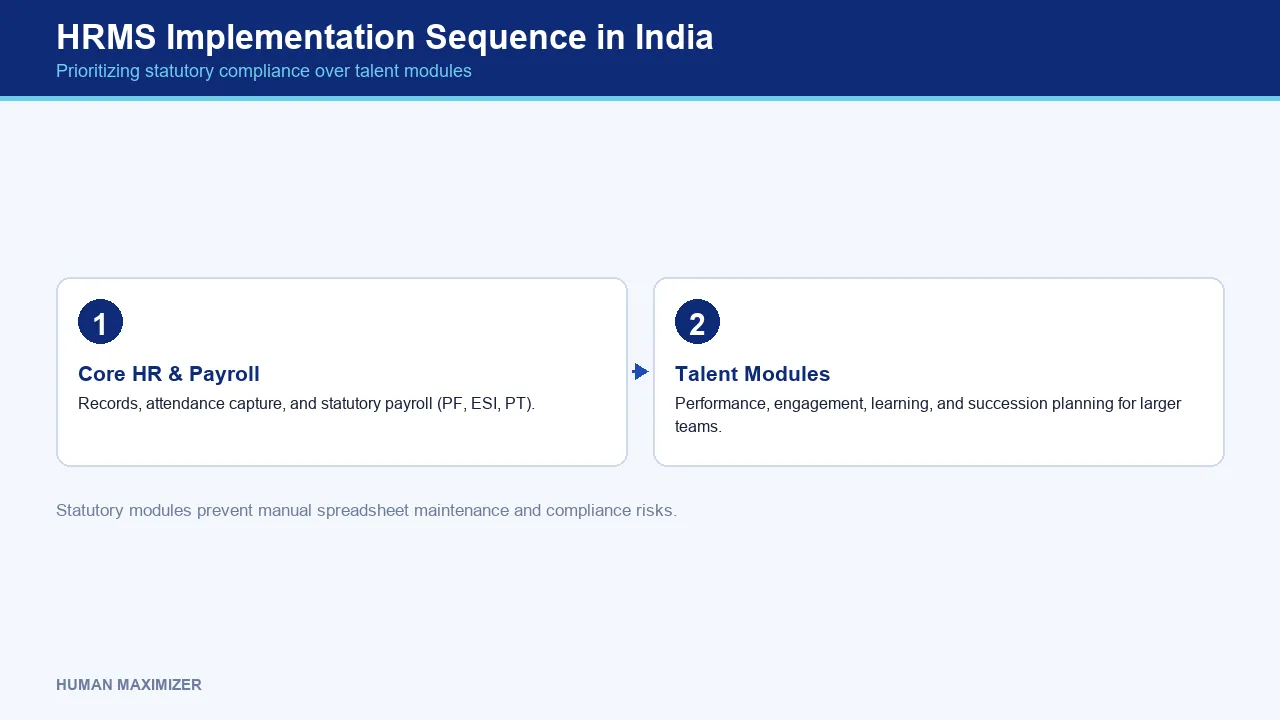
Provident fund contributions run at 12% of basic plus dearness allowance, with the employer's statutory liability pegged to a wage ceiling of ₹15,000 a month, and the ECR filing and payment falling due on the 15th of the following month. ESI applies to employees below a gross wage of ₹21,000 a month. Professional tax is state-specific, constitutionally capped at ₹2,500 a year, and levied by some states and not others. The Code on Wages carries an expectation that basic pay sits at no less than half of total remuneration, which quietly determines your entire PF exposure.
None of that waits for your growth plan. So the first tranche is Core HR records, attendance capture, and statutory payroll. Everything else, from performance cycles to engagement, learning and succession, is a talent module, and talent modules reward you only once you have enough people and enough history for the output to mean something. Running appraisals across nine employees is a conversation, not a software problem.
Deferring the statutory tranche is where the punishment lands, though. While building Human Maximizer, our founding team sat with HR leaders, managing directors and founders at Indian companies to find out what actually hurt, and the complaint that kept surfacing was rarely a missing feature. It was that the compliance numbers existed somewhere but had to be exported and re-keyed by hand every time anyone wanted a report out of them. A statutory module you skipped is a spreadsheet you maintain manually at exactly the moment an inspector asks for one.
The Migration Problem Nobody Quotes For
Add a module in month 20 and you inherit 20 months of history that lives somewhere else. This is the cost that never appears in the proposal.
Three things go wrong reliably. Opening balances get entered from a spreadsheet nobody reconciled, so leave liability is wrong from day one and stays wrong. Employee identifiers do not match between the old attendance device export and the HR master, so a slice of records fails to map and gets corrected by hand, one row at a time. And historical data stays in the old tool, which means any year-on-year comparison requires two logins.
The fix is unglamorous. Clean the master data before the module goes live, not after. Teams that do this recover the weeks that teams who skip it lose on the other side, and it is the single most reliable predictor of whether an implementation lands on schedule. A shared, governed employee record, which is what Employee Data Management exists to hold, is what makes module addition an activation rather than a migration.
Comparing Scalable HRMS Solutions in India by Architecture, Not Brand
Ranked lists are written for the writer. Compare architectures instead, then check which vendors sit in the shape you need. Names that appear on modular shortlists in India include Darwinbox, factoHR, Zimyo, Qandle and Pocket HRMS, alongside us; what matters is which of the four patterns below each one is actually selling you.
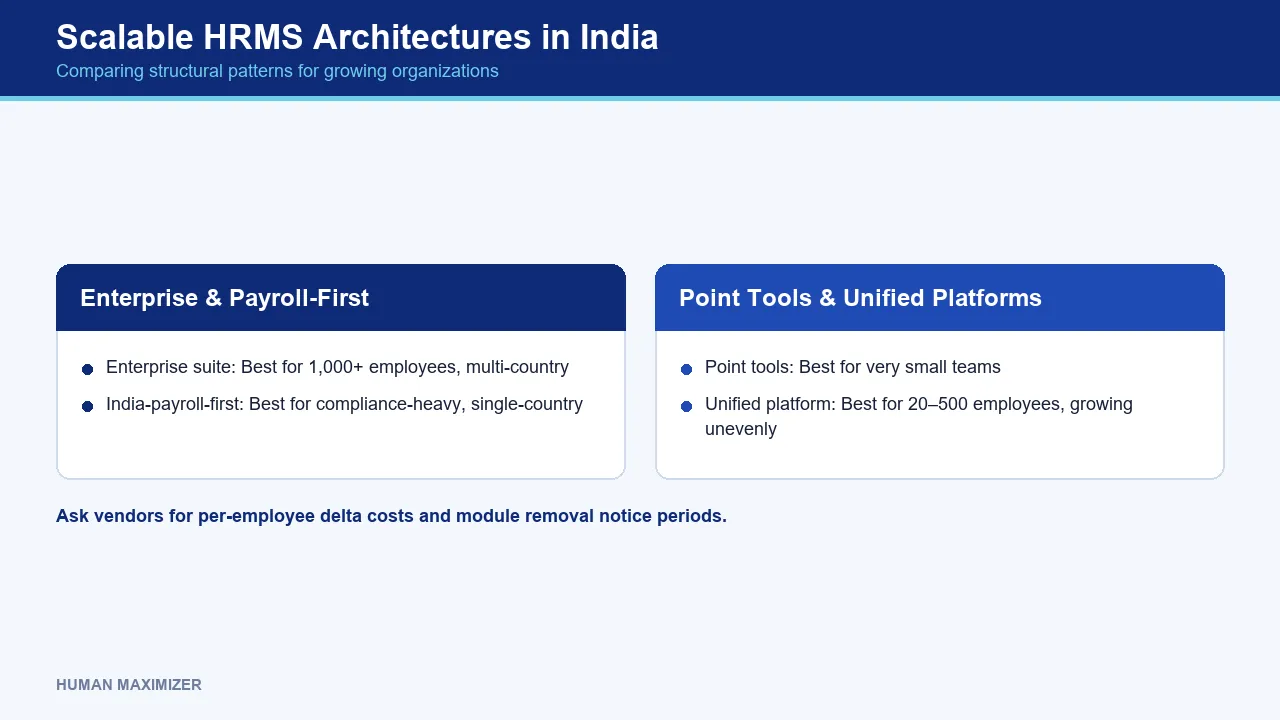
| Architecture | Best fit | Watch for |
|---|---|---|
| Enterprise suite, modules bundled | 1,000+ employees, multi-country | Cost of unused talent modules in early years |
| India-payroll-first, add-ons around it | Compliance-heavy, single-country | Depth of non-payroll modules |
| Point tools stitched together | Very small teams, one problem at a time | Reconciliation cost; see the Gartner payroll-error finding above |
| Unified platform, per-module activation | 20–500 employees, growing unevenly | Whether "modular" means one record or four |
For every vendor on your shortlist, ask one question in writing: what is the per-employee delta to add a named module, and what is the notice period to remove it? Customizable HR software in India is common; genuine contract flexibility is rarer, and the second question is the one that reveals it.
Where Modularity Stops Helping
Being straight about this matters more than the pitch.
You usually cannot scale down instantly. Removing a module is a renewal-date action with notice, not a switch you flip in a bad month. If your headcount is seasonal, negotiate that clause at signing or accept that you are paying through the trough.
Some modules are not optional in practice. Payroll without attendance means somebody re-keys hours every cycle, which reintroduces exactly the error rate you bought software to remove. Buying payroll alone looks cheaper and rarely is.
And if your growth is genuinely predictable, say a funded company with a signed hiring plan taking you to 200 people in eighteen months, the modular saving compresses to very little, as the year-three line in the table above shows. Say so to your vendor and negotiate the bundle instead.
How This Looks Inside Human Maximizer
Pricing here is per employee and moves with which modules are switched on, which is why the range runs from ₹49 to ₹112 rather than sitting at one number, with a free Launchpad tier to start. Modules can be added or removed as usage changes.
A concrete example of what activation looks like. A firm running only records and payroll hits 40 field staff and turns on attendance with geo-fencing. Shifts and geofence centres get mapped against the existing employee master, so no new employee list is created. Punches then arrive with a location check that flags a mocked or faked GPS position rather than accepting it, and those verified hours land directly in the payroll input for the same cycle. No export, no re-entry, no second reconciliation. Across the 24 clients reviewed to July 2026, monthly payroll corrections fell from 15 to 3, and the absence of manual attendance transfer is a large part of why. Support runs 24x7 from the in-house team, including after go-live, and a dedicated compliance team tracks statutory changes for the platform.
What we do not claim: the system does not autonomously monitor government portals and update itself, and it does not verify identity against government databases. People do that work, and we would rather tell you which is which now than after you sign.
Frequently Asked Questions
Can I add HR modules as my company grows? Yes, on any platform built as one tenant with permission-controlled modules. Activation itself is quick; the work is in master data setup and opening balances. Confirm the per-employee price delta and the effective billing date in writing before you enable anything.
Is modular pricing actually cheaper for small businesses? In the early years, substantially. Using the three-year table above, growing from 25 to 120 people on published modular tiers against an assumed flat bundle of ₹150 per employee per month, the gap comes to ₹1,33,980. Change that ₹150 assumption to whatever your own quote says and the number moves with it. The advantage narrows sharply once you have switched most modules on, so the saving is really a function of how long you can honestly defer.
How easy is it to scale down modules? Harder than scaling up, and this is where buyers get caught. Removals typically take effect at renewal and need notice. If your headcount swings seasonally, negotiate a downgrade clause before signing rather than after.
Does a modular HRMS create integration problems? Only if the modules are separate products wearing one brand. When every module reads and writes the same employee record, adding one is a configuration change, not an integration project. Ask the vendor whether attendance and payroll share a record or exchange a file; the answer tells you everything.
Conclusion
Back to that Jaipur firm and its three-way disagreement. The finance head was right that a performance suite at 26 employees is money spent on a future org chart. The HR lead was right that attendance could not wait, because hours reported over WhatsApp become salary errors within one cycle. Both positions fit on the same invoice, which is the entire point: buy the statutory floor now, write down the trigger for everything else, and let the bill follow the headcount instead of leading it.
The consequence of getting this wrong is not abstract. PF and the ECR are due on the 15th of every month regardless of which modules you deferred, and a company that skipped attendance to save ₹33 per employee is the company reconstructing a wage register by hand the first time someone asks for one. Working out which modules to switch on first, and when? Talk it through with us.
About the Author & Reviewer
Chandan Watts — Technical Product Manager, Human Maximizer (Razor Infotech)
Chandan Watts is Technical Product Manager at Razor Infotech, building the Human Maximizer HR platform. After years leading customer-experience and team operations at JindalX and Radical Minds, he focuses on how teams actually work day to day — and how small workflow gaps quietly slow an entire team down.
Connect on LinkedIn
Reviewed & approved by Sameer Hameed — Founder & Chairman, Razor Infotech
Sameer Hameed is the Founder & Chairman of Razor Infotech, where he is guiding the creation of Human Maximizer. An entrepreneur across technology, real estate, mining and travel, he builds organisations on clarity, trust and responsible growth — on the belief that businesses grow only when the people behind them grow.
Connect on LinkedIn
Human Maximizer is built by Razor Infotech in New Delhi, India (founded 2019). About Human Maximizer.
Keep reading

HR Strategy
HRMS Pricing Model India
The financial impact of per-employee versus fixed-fee structures. Learn how to evaluate HRMS pricing models in India to ensure long-term cost...
15 min read
HR Strategy
HRMS Support After Implementation
The essential service levels and technical assistance you should demand from your vendor regarding HRMS post-implementation support for your business.
20 min read
HR Strategy
Fake GPS Attendance Detection
How advanced geo-fencing attendance software identifies fake location apps and GPS spoofing to ensure accurate, tamper-proof field force tracking...
20 min read