
HR Strategy
Per Employee or Fixed? HRMS Pricing Models in India, Decoded
The financial impact of per-employee versus fixed-fee structures. Learn how to evaluate HRMS pricing models in India to ensure long-term cost...

Insha Hamid
Head of HR in Research & Content, Human Maximizer · 15 min read ·

Fifteen people joined in the middle of last quarter and the HRMS invoice climbed by a fifth. Nothing malfunctioned; the contract did precisely what it said it would do. The mistake happened months earlier, when the company budgeted for HR software and Payroll the way it budgets for office rent, when the honest comparison is closer to the electricity bill. That is the argument running through this piece: choosing an HRMS pricing model in India has less to do with which vendor is cheapest at today's headcount and more to do with which contract shape survives the headcount you will be carrying fourteen months from now. We think that lens changes most of the standard answers.
What Your HRMS Pricing Model in India Is Actually Counting
Ask a vendor "how much per employee?" and you will get a number. Ask "which employees?" and the conversation gets interesting.
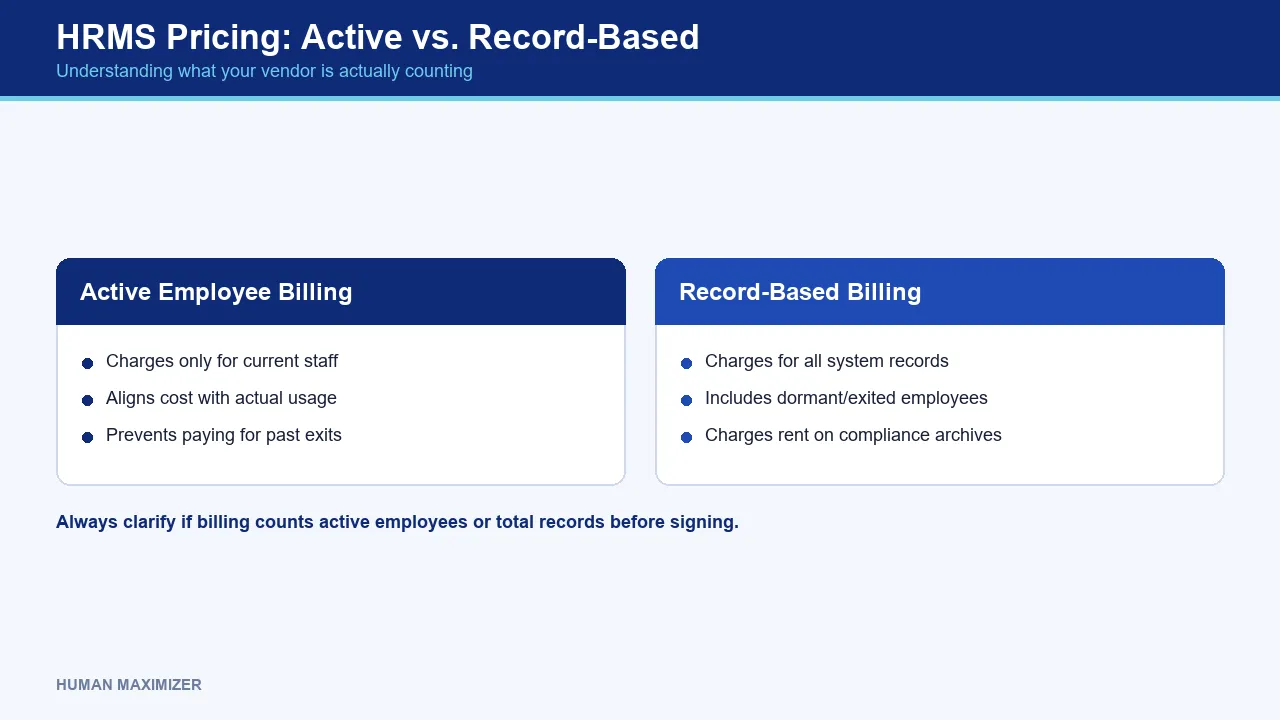
Here is the part almost no Indian pricing article covers. Your billable headcount is rarely the same as your working headcount, and in India the gap is structural rather than accidental. An employee who resigns in April does not vanish from your system in May. You are still holding their payroll history, PF and ESI records, wage register entries, Form 16 data and full-and-final documentation, because statutory retention obligations do not care that the person left. If a contract bills per employee record rather than per active employee, you are paying every month for people who left two years ago.
Put numbers on it so you can argue with them. Take a 200-person firm that loses and replaces 20 people a year. After three years the system holds 60 dormant records alongside 200 live ones. At a quoted ₹90 per employee per month, those dormant records cost ₹5,400 a month, or ₹64,800 a year, against an active-employee bill of ₹2,16,000. Change the attrition assumption to whatever your own exit register says and the shape of the answer does not move: record-based billing charges you rent on your own compliance archive.
Then there is a second uneven layer. Your compliance load is not distributed evenly across your workforce, though per-employee billing charges as though it were. PF contributions are calculated on basic plus DA at 12%, with the employer's statutory liability pegged to a wage ceiling of ₹15,000 a month under the scheme rules published by EPFO, while ESI applies only below a monthly gross wage of ₹21,000 under the scheme administered by ESIC. So a factory in Coimbatore with 300 workers under both thresholds carries a very different processing burden from a 300-person product company where almost nobody is ESI-covered. Same headcount. Same per-employee quote, usually. Very different value delivered.
Two questions belong in your first vendor call, before any number is discussed: does billing count active employees or total records, and can inactive records be archived without losing statutory reporting? Get both in writing.
Per Employee or Fixed Fee: Matching the Model to Your Headcount Curve
Per-employee-per-month (PEPM) pricing is the default in the Indian mid-market, and for good reason: it is honest at small scale and it lets a 40-person firm buy real software. Flat-fee and banded licensing, where you pay one price for a range like 101 to 250 employees, shows up more often at enterprise scale and in annual on-premise or private-cloud contracts. Both models deliver the same core functionality. The cost dynamics diverge sharply depending on company size, workforce complexity and growth trajectory, and companies with a genuinely stable headcount often prefer a flat structure for the single reason that it makes the budget line predictable a year out.
| Your situation | Per-employee (PEPM) | Flat or banded fee | What to watch |
|---|---|---|---|
| Under 25 people, stable | Usually best value; you pay only for what you have | Overpriced; you subsidise unused capacity | Minimum-seat floors (often 10 seats billed regardless) |
| 25–100, predictable growth | Works well; budget scales linearly and legibly | Reasonable if the band is wide | Whether the price per seat drops as you cross tiers |
| 25–100 with seasonal spikes | Dangerous; festive or harvest hiring inflates the bill | Strong fit; the spike is absorbed inside the band | Whether you can ever come back down a band |
| 100–500, hiring fast | Predictable per head, unpredictable in total | Best fit if bands are generous; you buy headroom | The jump between bands, which can be brutal |
| Field, contract or shift-heavy | Punishing if contractors count as billable seats | Better, if the band counts entities not individuals | The definition of "user" versus "employee" |
The useful generalisation: PEPM suits companies whose headcount moves smoothly, and banded pricing suits companies whose headcount moves in steps. Most Indian SMEs believe they are the former and behave like the latter.
Implementation Fees Versus Subscription Fees
This is the single largest blind spot in Indian HRMS buying, and it is where a good-looking quote goes wrong. Buyers compare per-employee rates across three vendors, pick the lowest, then receive a separate one-time implementation invoice that can equal several months of subscription. It is rarely a scam, just a separate line item that never made it onto the comparison spreadsheet.
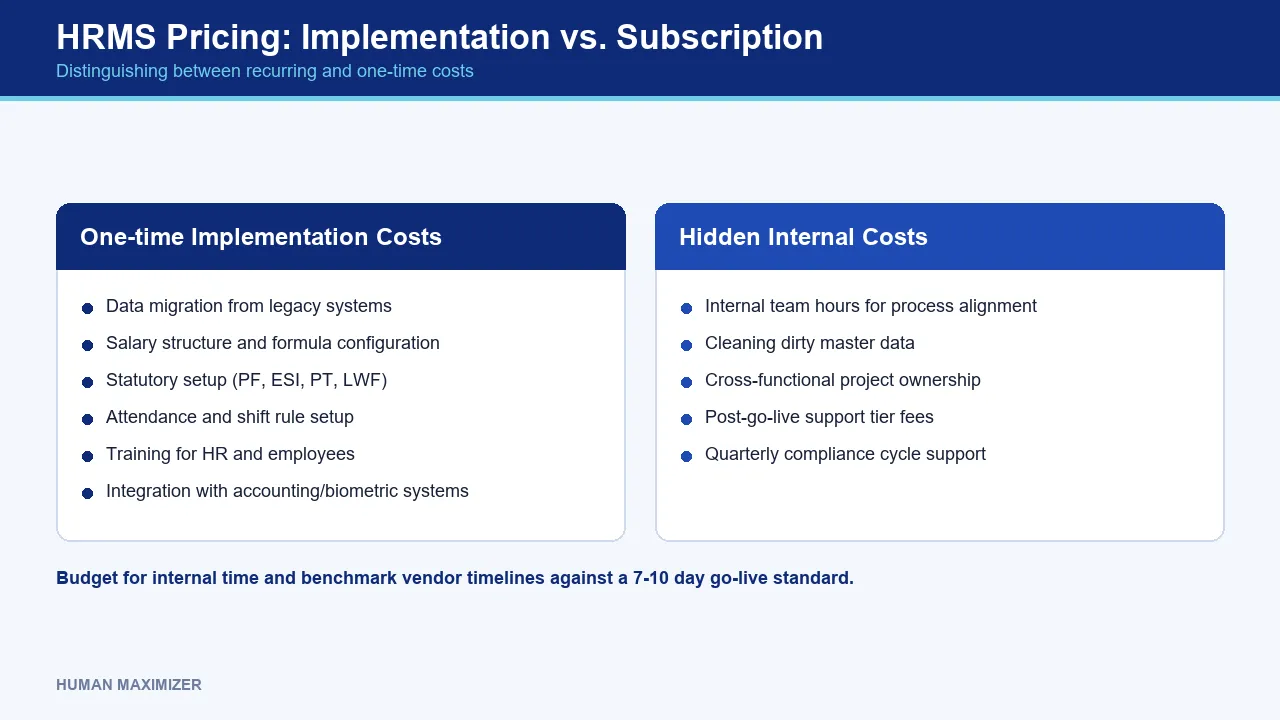
The one-time costs that belong in your comparison
Data migration from Excel and legacy systems. Salary structure configuration, including component definitions, formula setup and old-versus-new tax regime handling. Statutory setup: PF, ESI, professional tax slabs for every state you operate in, LWF. Attendance policy and shift rule configuration. Training for HR, managers and employees. Integration work with your accounting system or biometric devices.
The costs nobody quotes at all
Your own team's hours. The messy part of a rollout is almost never the interface; it is that HR, operations and finance have to agree on one version of a process they have each been running differently. Migration pain comes from dirty master data far more often than from an unfamiliar system, and implementation projects tend to stall quietly when ownership across those three functions is left vague. Budget internal time deliberately, and read our HRMS implementation timeline guide before you accept a six-month project plan. Across 46 implementations completed up to July 2026, our own published go-live record averaged 7 to 10 days, which is a useful benchmark to hold any vendor's estimate against.
Also ask what post-go-live support costs. Some contracts price the first ninety days as included and then move you to a paid support tier, which is exactly when your first quarterly compliance cycle lands. That period is when a pricing model quietly reveals its real cost.
Contract Elasticity: The Clause That Decides Your Mid-Year Bill
Every vendor will scale up with you instantly. The harder question, and the one that decides your mid-year bill, is whether the agreement flexes downward as readily as it flexes upward. Call it contract elasticity. It is the property we would optimise a contract for, and it almost never appears on a feature comparison.
Test it with three specific questions. When headcount rises mid-cycle, is the addition pro-rated from the joining date or billed for the full month? When headcount falls, does the bill reduce at the next billing date, at renewal, or never? And is there a contractual floor below which you keep paying regardless?
Run the arithmetic on a plausible invented case, not a customer of ours: a 90-person services firm in Indore adds 30 people for a six-month project. Under a rigid annual contract with an upward-only ratchet, those 30 seats are billed for the remaining term even though the project ends in month six. At a ₹90 per-employee rate, that is roughly ₹16,200 of pure waste. Under an elastic contract, the same 30 seats cost ₹16,200 and then stop. Same vendor, same rate card, entirely different outcome, decided by one clause.
Ask for pro-rated additions, quarterly true-downs, and a written statement of the floor. A vendor that will only flex one way is selling a growth tax dressed as a subscription.
Total Cost of Ownership: Run the Arithmetic Yourself
Do not accept a TCO figure from a deck. Calculate it. The inputs are all things you already know, and the formula is simple enough to argue with:
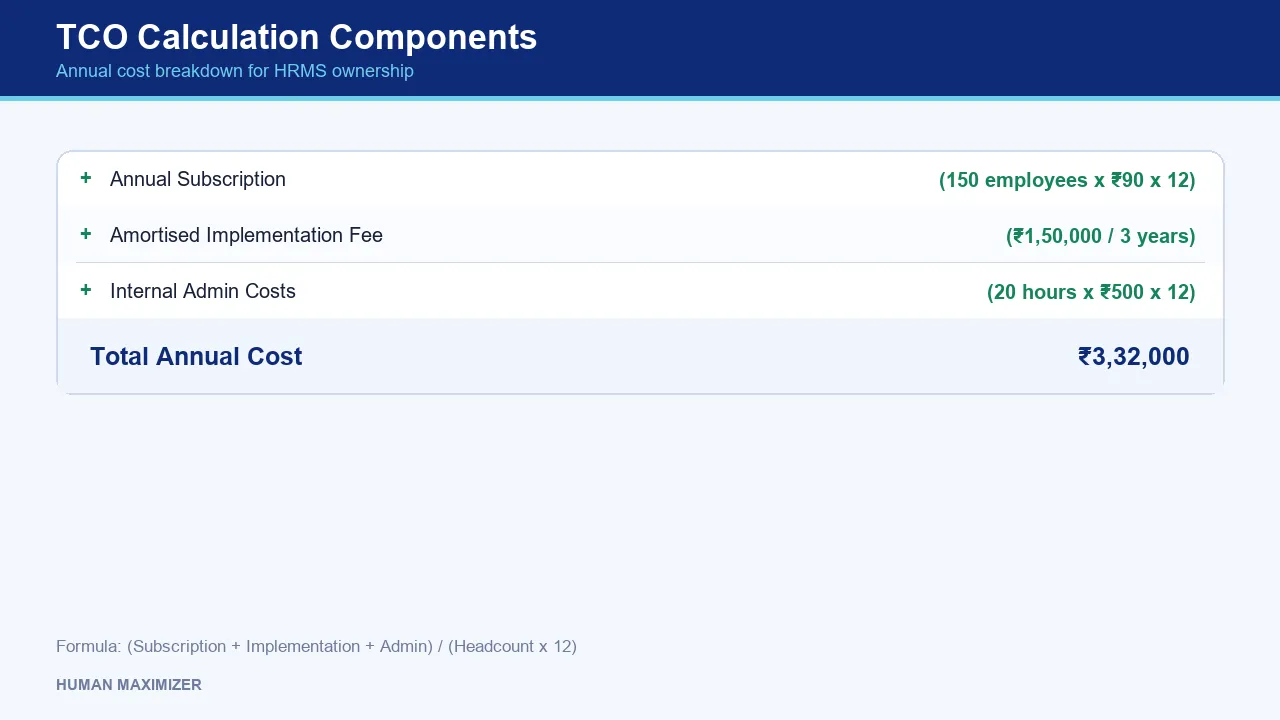
Loaded cost per employee per month = (annual subscription + implementation fee ÷ contract years + annual internal admin hours × loaded hourly cost) ÷ (average headcount × 12)
Work it through with plausible assumptions. Say 150 employees at a quoted ₹90 per employee per month: ₹1,62,000 a year. Implementation quoted at ₹1,50,000, amortised over a three-year term, adds ₹50,000 a year. Your HR team spends 20 hours a month on system administration, reconciliation and payroll queries; at a loaded internal cost of ₹500 an hour, that is ₹1,20,000 a year. Total: ₹3,32,000. Divide by 150 employees over 12 months and your true cost is about ₹184 per employee per month, not ₹90.
The subscription is under half of it. Adjust any assumption to match your own numbers and the conclusion holds, which is why the ROI question is really a question about that third term. If Attendance Management feeds payroll without re-keying, those 20 hours fall. In our own aggregate client data up to July 2026, monthly payroll corrections dropped from 15 to 3 across 24 accounts, and across 32 accounts the first payroll cycle after go-live took about 4 hours against 2 days on the previous system. Set that against the cost of a missed PF ECR deadline, which EPFO fixes at the 15th of the following month. Interest and damages on a late remittance dwarf the difference between any two vendor quotes.
Why Two 200-Person Companies Get Different Quotes, and How to Negotiate Yours
Module scope is the biggest variable. A company running only core HR, leave and attendance is buying a different product from one running payroll with multi-state statutory processing, geo-fenced field attendance, rostering and overtime rules. Number of legal entities, states of operation, employee categories, integrations and data volume all move the price, and so does contract length. Company size cuts both ways: larger headcount usually buys a lower per-seat rate but attracts higher implementation effort, because complexity rather than headcount drives setup cost. Our longer piece on how complexity quietly inflates an HRMS bill applies directly here.
When you negotiate, trade things that cost the vendor little and protect you a lot:
- Fix the rate card for the full term, including the price of seats you add later. Otherwise year-two additions get repriced.
- Cap the annual renewal increase at a named percentage rather than "as per prevailing rates."
- Get the definition of a billable user in writing: active employees only, with archived exits excluded.
- Ask for implementation to be milestone-linked, with the final tranche released after your first successful payroll run, not at go-live.
- Negotiate modules, not discounts. A vendor will often add a module for a term at no cost more readily than cut the headline rate, and the module is worth more to you.
- Secure a data-export clause: full export in a usable format, at no charge, at any time. This is your exit cost, and it is cheapest to negotiate before you sign.
Longer commitments buy real leverage. Just pair them with the elasticity clauses above, or you have traded flexibility for a discount you will pay back in unused seats.
Where This Thinking Has Limits
Below roughly 15 employees, this entire analysis is over-engineering. Buy the simplest thing, use a free tier, revisit at 30 people.
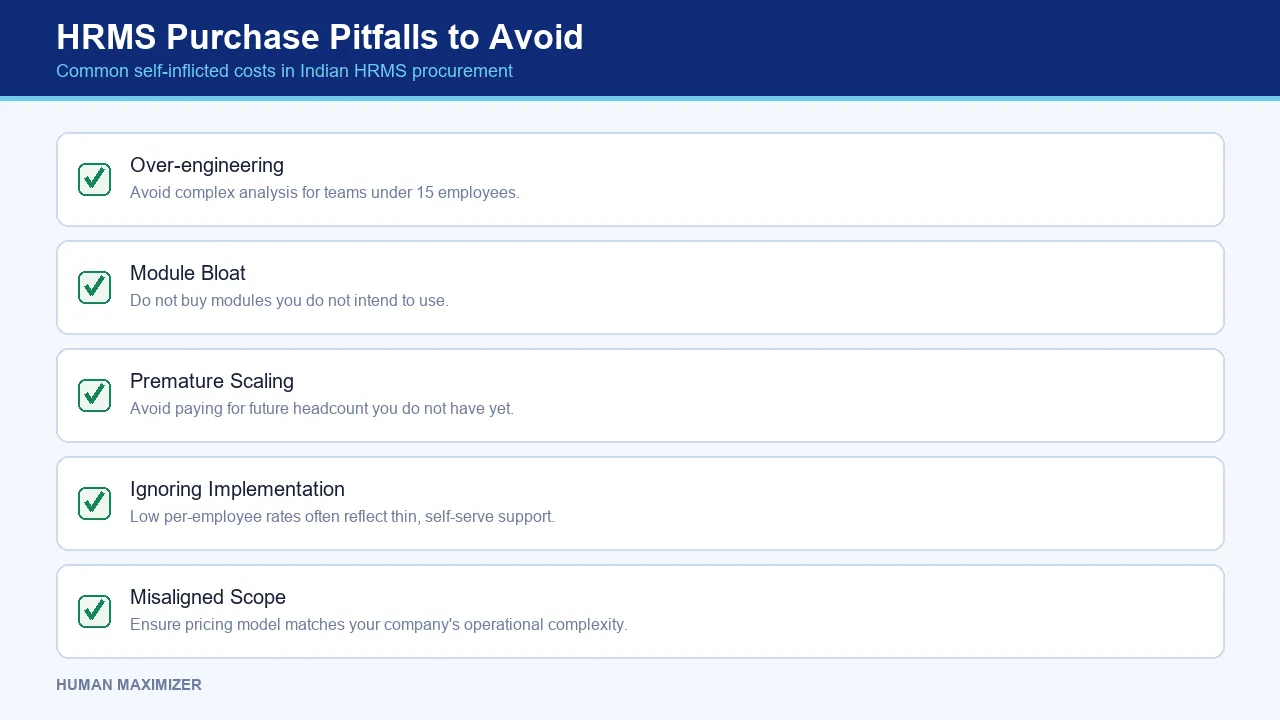
Elasticity clauses cannot rescue a badly scoped purchase either. If you buy nine modules and use three, no billing structure makes that efficient, and buying for the org chart you expect in two years while paying for it today is the most common self-inflicted cost we come across.
And a candid one: cheap per-employee pricing is sometimes cheap because implementation is thin. A low rate attached to a self-serve setup is a genuine saving for a 25-person company with clean data and a genuine cost for a 250-person company running four states and three shift patterns. Price and effort do not disappear, they relocate.
How We Price Human Maximizer
We price per employee, and which modules you switch on moves the number, because geo-fencing, payroll and attendance are not the same amount of software. Modules can be added or removed as your usage changes, which is the elasticity point made concrete rather than promised.
Human Maximizer pricing, published: Launchpad ₹0 (free), Ignite ₹49, Pulse ₹52, Pulse Plus ₹82, Apex ₹112 per user per month, billed yearly with 10 users included, plus a 5-year Legacy bundle. → See the full pricing page — the live source of truth, not a sales call.
Consider what a mid-quarter intake of 15 people actually looks like. Before: HR creates 15 records in a spreadsheet, emails IT for access, chases documents over WhatsApp, and finance discovers the headcount change when the invoice arrives. After: the joiners complete Employee Self Onboarding themselves, which has brought onboarding down from 5 to 7 days to 1 to 2 days; their salary structures pick up an existing template; attendance and payroll stay in sync without re-entry; and the billing change is visible to finance on the same dashboard HR is working in. The cost of growth stops being a surprise, which was the real problem all along.
Frequently Asked Questions
What is the difference between PEPM and fixed pricing? PEPM charges a set amount for each employee each month, so the bill tracks headcount directly. Fixed or banded pricing charges one amount for a headcount range, so the bill only changes when you cross a band boundary. PEPM is more precise at small scale; banded pricing is more predictable when hiring is lumpy.
Are there hidden costs beyond the monthly subscription? Yes, and they are usually one-time rather than hidden: data migration, statutory and salary configuration, integrations, training, and sometimes paid support after an initial included period. Add your own team's hours to that list, because internal administration time is frequently the largest single component of total cost of ownership.
How do vendors handle employee count changes mid-year? It varies more than buyers expect, which is why it belongs in the contract rather than the conversation. Ask specifically whether additions are pro-rated from the joining date, whether reductions take effect at the next billing cycle or only at renewal, and whether a minimum seat count applies.
Does company size change the price per employee? Usually yes, downward, as volume rises. But implementation cost tracks complexity rather than headcount, so a 300-person single-state company can pay less to set up than a 120-person business operating across four states with shift-based staff.
Conclusion
That cost-optimisation email arrives because the invoice moved without warning, not because the software is expensive. Fix the warning and you fix most of the argument: know whether you are billed on active employees or stored records, know what implementation costs before you compare rate cards, and get the downward flex written in alongside the upward one. Do those three things and you can add fifteen people mid-quarter without anyone reaching for the cost folder.
Want pricing that moves with your headcount instead of against it? See how Human Maximizer works.
About the Author & Reviewer
Insha Hamid — Head of HR in Research & Content, Human Maximizer
Insha Hamid heads HR research and content for Human Maximizer at Razor Infotech, covering people operations and Indian workplace compliance — translating regulatory change and workplace research into guidance HR teams can act on.
Connect on LinkedIn
Reviewed & approved by Sameer Hameed — Founder & Chairman, Razor Infotech
Sameer Hameed is the Founder & Chairman of Razor Infotech, where he is guiding the creation of Human Maximizer. An entrepreneur across technology, real estate, mining and travel, he builds organisations on clarity, trust and responsible growth — on the belief that businesses grow only when the people behind them grow.
Connect on LinkedIn
Human Maximizer is built by Razor Infotech in New Delhi, India (founded 2019). About Human Maximizer.
Keep reading
HR Strategy
HRMS Support After Implementation
The essential service levels and technical assistance you should demand from your vendor regarding HRMS post-implementation support for your business.
20 min read
HR Strategy
Fake GPS Attendance Detection
How advanced geo-fencing attendance software identifies fake location apps and GPS spoofing to ensure accurate, tamper-proof field force tracking...
20 min read
HR Strategy
Manual Attendance Register to Digital
Stop wasting time on manual logs. Discover how a digital attendance management system eliminates payroll errors and boosts workforce productivity...
17 min read