
HR Strategy
Hrms implementation timeline india: Avoid the 6-Month Trap
Stop overestimating your rollout speed. Discover a realistic 12-week HRMS implementation timeline designed for Indian HR teams to ensure system...

Insha Hamid
Head of HR in Research & Content, Human Maximizer · 13 min read · · Updated
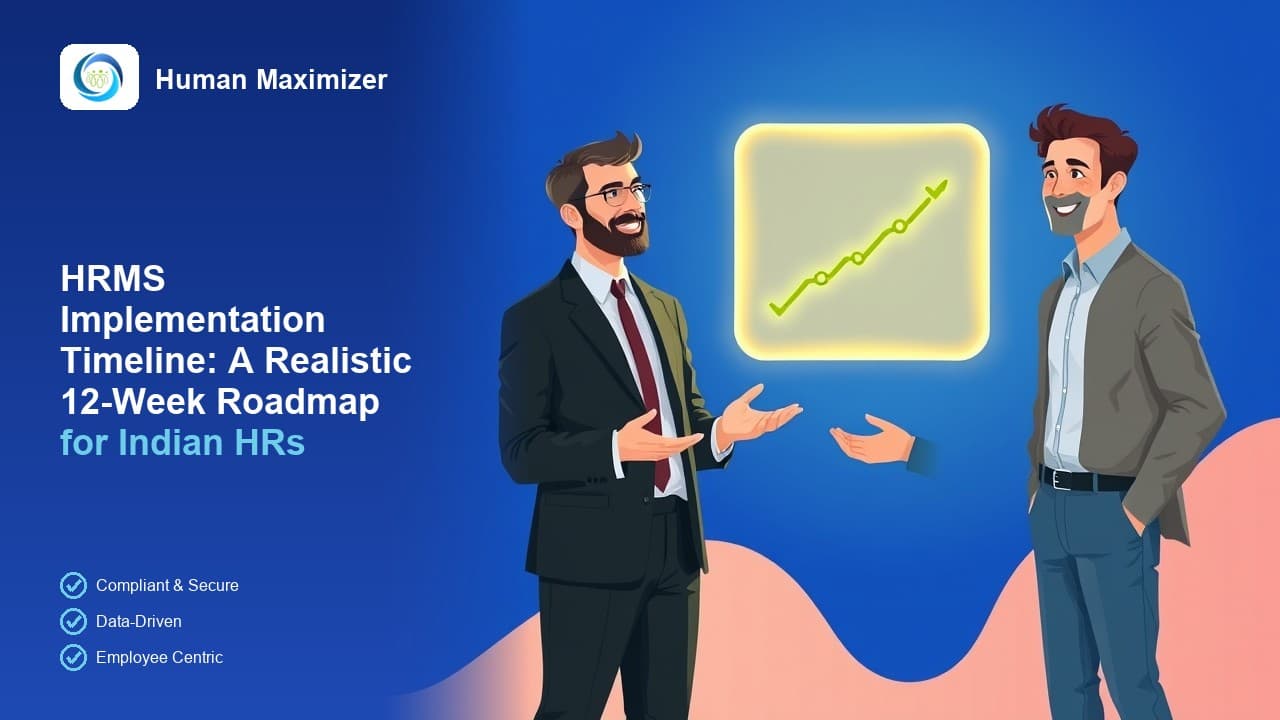
"Plug-and-play" is the phrase that quietly wrecks more HRMS projects than any software bug ever will. A vendor demos a clean dashboard, quotes four weeks, and the buyer files the whole thing under "IT task." Then the payroll manager is cross-referencing three spreadsheets to reconcile Professional Tax across four states, the master data refuses to map, and the CEO starts asking why the go-live date has already slipped twice. That distance between the demo and the deployment is the real subject here: a realistic HRMS implementation timeline in India, planned around a 12-week window instead of the six-month drift most teams actually live through. At Human Maximizer, teams consistently find enough of these projects up close to know the schedule rarely dies from a technical fault. It dies from decisions nobody made on time.
The Reality Check: Why Indian HRMS Projects Stall
The software installs in an afternoon. The organisation does not.
The hard part of any rollout is almost never the configuration screen. It is getting three departments to agree on one version of a single process, and then getting someone senior to sign it off in writing. Finance wants the salary structure locked one way. HR wants leave encashment handled another. The plant head wants shift rules that contradict both. Every unresolved argument becomes what we call sign-off debt: a pile of small, deferred decisions that looks harmless in week two and detonates in week eight, when the system needs a definitive answer and nobody will give one.
Realistic ranges make this visible. A typical HR and payroll rollout runs six to twelve weeks end to end, while India-specific estimates stretch from three weeks for a lean startup to twelve months for a large enterprise depending on headcount and data complexity. A 60-person trading firm on clean data can genuinely go live in three to four weeks. A 600-person multi-plant manufacturer with contract labour and four state registrations will not, and pretending otherwise is how the six-month trap starts.
Vendor relationships fray the same way. When a milestone slips, the reflex is to blame the vendor, but the honest post-mortem usually finds the delay upstream: a policy still stuck in "we'll finalise it next week." Manage your HRMS vendor onboarding like a joint project with a shared tracker, not a support ticket you raised. Name one internal owner who can actually decide, and give the vendor a single point of contact instead of five people forwarding contradictory emails.
The 12-Week Roadmap: From Spreadsheet Chaos to Cloud Compliance
Here is the HR software deployment plan we would hand a mid-market Indian SME, broken into four phases. Treat the weeks as a spine, not a straitjacket. Compress them if your data is clean and your policies are already documented; stretch them if you are unwinding a decade of spreadsheet workarounds.
Weeks 1–2: Discovery and process lock. Map every policy that touches pay: attendance rules, leave types, overtime eligibility, reimbursement heads, notice periods per grade. This is where you pay down sign-off debt before it accrues. Get written approval on the salary structure and the leave policy now, from Finance and HR both.
Weeks 3–5: Data preparation and migration. Clean the employee master database, standardise formats, and load a test batch into the cloud-based HR software before the full migration. More on why this phase silently eats projects below.
Weeks 6–8: Payroll configuration and compliance setup. Configure PF, ESI, Professional Tax slabs per state, TDS, and statutory registers. Run at least one parallel payroll against last month's manually processed numbers and reconcile to the rupee.
Weeks 9–11: User acceptance testing and training. Real HR users, real scenarios, real edge cases. Not a scripted click-through.
Week 12: Controlled go-live. First live payroll run with the vendor on standby, followed by two weeks of hypercare.
For an enterprise above a thousand employees, roughly double each phase and add a pilot department before the full cutover. The rising adoption of eHRMS modules across Indian public deployments between 2021 and 2023 shows the direction of travel, but scale is exactly what turns a tidy 12-week plan into a 12-month one if you skip the discipline of the early phases.
Data Hygiene: The Silent Killer of Implementation
Configuration is fast. Data migration is what quietly runs the clock down.
Most Indian SMEs are not migrating from an old HRMS. They are migrating from a folder of Excel files maintained by whoever happened to own payroll that year. Names spelled three ways. PAN fields with trailing spaces. Date of joining in four formats. Bank account numbers stored as text so the leading zero survives. None of this matters until you try to load it, and then every inconsistency becomes a failed row.
Clean before you load. Build the employee master database as a single validated sheet: one row per employee, mandatory fields for PAN, Aadhaar, UAN, bank details, date of joining, department, and salary structure. Run a bulk upload with per-row feedback so you fix the four rows that failed without re-loading the 196 that succeeded. Our Employee Data Management and CSV bulk-upload tools are built for exactly this messy reality, but the tool only rewards data you have already de-duplicated. Garbage in, delayed go-live out.
One honest rule from experience: never migrate history you cannot reconcile. Bring in current, clean master data plus the current financial year's payroll. Archive the rest as read-only records. Teams that insist on importing eight years of half-broken history lose weeks and gain nothing an auditor will actually ask for.
Curious how a clean migration looks end to end? Book a walkthrough and we will show you the per-row validation on real sample data.
Configuring for the Indian Regulatory Landscape
This is where a global HRMS blog stops being useful and an India-specific one earns its keep. Statutory compliance is not a settings tab. It is the reason the project exists.
Payroll configuration in India means mapping the Code on Wages, 2019, which consolidated four separate wage laws into a single definition of "wages" that directly affects your PF and gratuity base. It means Professional Tax at state-specific slabs, ESI thresholds, TDS under the correct regime, and statutory registers that a labour inspector can ask for without notice. The Code on Social Security similarly reshapes how gratuity and PF obligations are computed, and your system needs to reflect the definitions your state currently enforces.
Data protection now sits alongside all of it. The Digital Personal Data Protection Act, 2023 treats employee salary, identity, and bank data as personal data you are obligated to safeguard, with the compliance rules rolling out in stages. A rollout that dumps sensitive employee records into loosely governed spreadsheets is not just messy; it is a growing legal exposure. Cloud-based HR software with role-based access and an audit trail is a large part of how HR teams get ahead of that requirement.
Before: month-end close means one person reconciling PT across four states in parallel spreadsheets, keying TDS by hand, and hoping the PF base matches the wage definition. A single slab change mid-year quietly breaks three formulas nobody notices until an inspection.
After: the state slab lives in configuration, Payroll reads it automatically, and Attendance Management feeds verified days straight into the calculation. When a statutory value changes, you update one field, not forty cells. Our in-house compliance team tracks these statutory shifts so the platform reflects them, though final sign-off on your specific slab mapping always stays with your finance lead.
UAT and Change Management: Winning Over the Skeptics
User acceptance testing is not a formality you rubber-stamp in week eleven. It is the last cheap moment to find a broken assumption before it hits a real salary slip.
Run UAT with the people who will actually use the system, against scenarios that break things: the employee who transferred states mid-month, the one on loss-of-pay for nine days, the resignation with an unserved notice period. If Leave Management miscalculates encashment for that resignation, you want to know it in a test, not from an angry ex-employee's WhatsApp message.
Change management is the quieter half, and the half most technical vendors ignore. A payroll clerk who has run the same Excel macro for six years does not resist the new system because it is worse. They resist because their hard-won expertise suddenly looks obsolete, and nobody has told them what their role becomes. Address that directly. Show them the fifteen manual reconciliations the system now absorbs, and reframe the job around the judgment calls software cannot make. Skip the single 40-slide PDF; short recorded walkthroughs for the three tasks each role does daily land far better.
When This Timeline Does Not Hold
Honesty matters more than a tidy 12-week promise, so here is where the plan bends.
Heavy customisation breaks it. If you need bespoke approval routing across seven grades or non-standard salary structures per business unit, add weeks and expect it. Contract-labour-heavy manufacturing under CLRA obligations rarely fits a clean SME window either; multi-plant, multi-shift setups need a pilot site first. And if your leadership cannot free one internal owner to make decisions, no roadmap survives, because the bottleneck was never the software. Automation also cannot adjudicate a genuinely ambiguous policy question. When two departments read the same rule differently, that needs a human ruling, ideally documented, before configuration can proceed.
The HRMS Implementation Tracker (Copy This)
The single thing most Indian HR teams lack is not a longer timeline. It is a shared, honest tracker that makes sign-off debt visible before it compounds. Copy this into a sheet and update the owner and status columns weekly. It is the whole discipline in one grid.
| Week | Milestone | Owner | Statutory / Data dependency | Sign-off needed |
|---|---|---|---|---|
| 1–2 | Process & policy mapping | HR lead | Leave, OT, notice-period rules | HR + Finance |
| 3–5 | Master data cleanup & test load | HR + IT | PAN, UAN, PT state, bank details | Data owner |
| 6–8 | Payroll & compliance config | Payroll lead | Code on Wages base, PT slabs, TDS, ESI | Finance head |
| 9–11 | UAT (edge cases) & training | HR + dept heads | Transfer, LOP, F&F scenarios | Process owners |
| 12 | Go-live + hypercare | Project owner | DPDP-aligned access controls | Leadership |
The tracker's value is not the rows. It is the "Sign-off needed" column, which forces a name and a date onto every decision that would otherwise drift. A blank in that column three weeks running is your early warning that the project is sliding toward the six-month trap, no matter what the demo promised.
The Step-by-Step HRMS Implementation Process
A structured implementation process prevents the common drift into a six-month project. You must treat the transition as a sequence of dependencies rather than a single software installation.
First, establish your Statutory Baseline. Before configuring the software, document your compliance requirements. For instance, if you have employees earning a basic salary above the ₹15,000 threshold (EPFO), you must decide if the system should cap the employer's PF contribution at that limit or calculate it on the full basic pay. If you assume a manual audit takes 2 minutes per employee record to verify these statutory inputs, a 500-employee firm requires roughly 16 hours of dedicated data validation. Adjust this time estimate based on your current headcount; the conclusion remains that failing to validate these inputs before migration leads to payroll errors that are difficult to reverse.
Second, execute the Parallel Run. Never switch systems without running the new HRMS alongside your existing manual process for at least one full pay cycle. During this phase, reconcile your statutory deductions—such as ESI for employees with gross wages below ₹21,000 (ESIC)—against your manual calculations. If the system output deviates from your manual sheet, investigate the configuration immediately rather than assuming it is a software glitch.
Third, formalize the User Acceptance Testing (UAT). Do not let the vendor perform the testing. Assign your payroll administrator to process a dummy "Full and Final" settlement for a hypothetical employee. Under the Code on Wages, you are expected to settle dues within 2 working days of the last working day. If your system cannot generate the required statutory registers within this window during UAT, your process is not ready for go-live. Finally, conduct a "dry run" of the ECR filing process to ensure the system generates the correct file format for the EPFO portal by the 15th of the following month. By validating these specific compliance milestones, you move from "installing software" to "deploying a compliant payroll engine."
Frequently Asked Questions
How long does HRMS implementation take for Indian SMEs versus enterprises? A clean-data SME of 50 to 200 people can realistically go live in three to six weeks, and most mid-market rollouts land in the six-to-twelve-week range. Enterprises above a thousand employees, with multi-state registrations and legacy data, should plan for several months and a phased, pilot-first cutover.
What are the most common reasons HRMS implementations get delayed in India? Unfinished policy decisions, dirty spreadsheet data, and multi-state statutory complexity, in that order. The software configures quickly; what stalls projects is departments not agreeing on one process and no internal owner empowered to sign off.
How do Indian statutory requirements affect HRMS setup? They shape the entire payroll configuration. You must map the Code on Wages definition of wages, state-wise Professional Tax slabs, PF, ESI, and TDS, plus safeguard employee data in line with the DPDP Act. Getting these right during configuration is the difference between a compliant go-live and a reconstruction after your first inspection.
Why does data cleaning matter so much before migration? Because a cloud-based system rejects inconsistent data. Duplicate names, malformed PANs, and mixed date formats each become failed rows. Cleaning the employee master database into one validated sheet before loading is what makes a smooth go-live possible instead of a debugging marathon.
How do I ensure my payroll data is accurate before migrating to a new HRMS?
Perform a manual audit of your current employee master data, specifically verifying basic pay components against the 50% rule under the Code on Wages. Run a parallel payroll cycle in the new system for one month and reconcile every statutory deduction, such as PF and ESI, against your existing manual records before the final cutover.
The Payroll Manager, Twelve Weeks Later
Return to that payroll manager and the four states of Professional Tax. In the six-month version, they are still reconciling by hand in month five, and the "plug-and-play" HRMS is a line item leadership regrets. In the 12-week version, the slabs sit in configuration, the salary run reconciles to the rupee against the parallel test, and the sign-off column on the tracker is clean. The difference was never the software. It was refusing to let unmade decisions pile up in the dark.
Under the DPDP Act's staggered enforcement, the cost of the slow version is no longer just wasted quarters of finance time. It is holding sensitive employee data in ungoverned spreadsheets while the compliance clock runs. A disciplined 12-week rollout is how you close that window before it closes on you. If your last implementation drifted past the demo's promises, let's map a realistic one together.
About the Author & Reviewer
Insha Hamid — Head of HR in Research & Content, Human Maximizer
Insha Hamid heads HR research and content for Human Maximizer at Razor Infotech, covering people operations and Indian workplace compliance — translating regulatory change and workplace research into guidance HR teams can act on.
Connect on LinkedIn
Reviewed & approved by Sameer Hameed — Founder & Chairman, Razor Infotech
Sameer Hameed is the Founder & Chairman of Razor Infotech, where he is guiding the creation of Human Maximizer. An entrepreneur across technology, real estate, mining and travel, he builds organisations on clarity, trust and responsible growth — on the belief that businesses grow only when the people behind them grow.
Connect on LinkedIn
Human Maximizer is built by Razor Infotech in New Delhi, India (founded 2019). About Human Maximizer.
Keep reading
HR Strategy
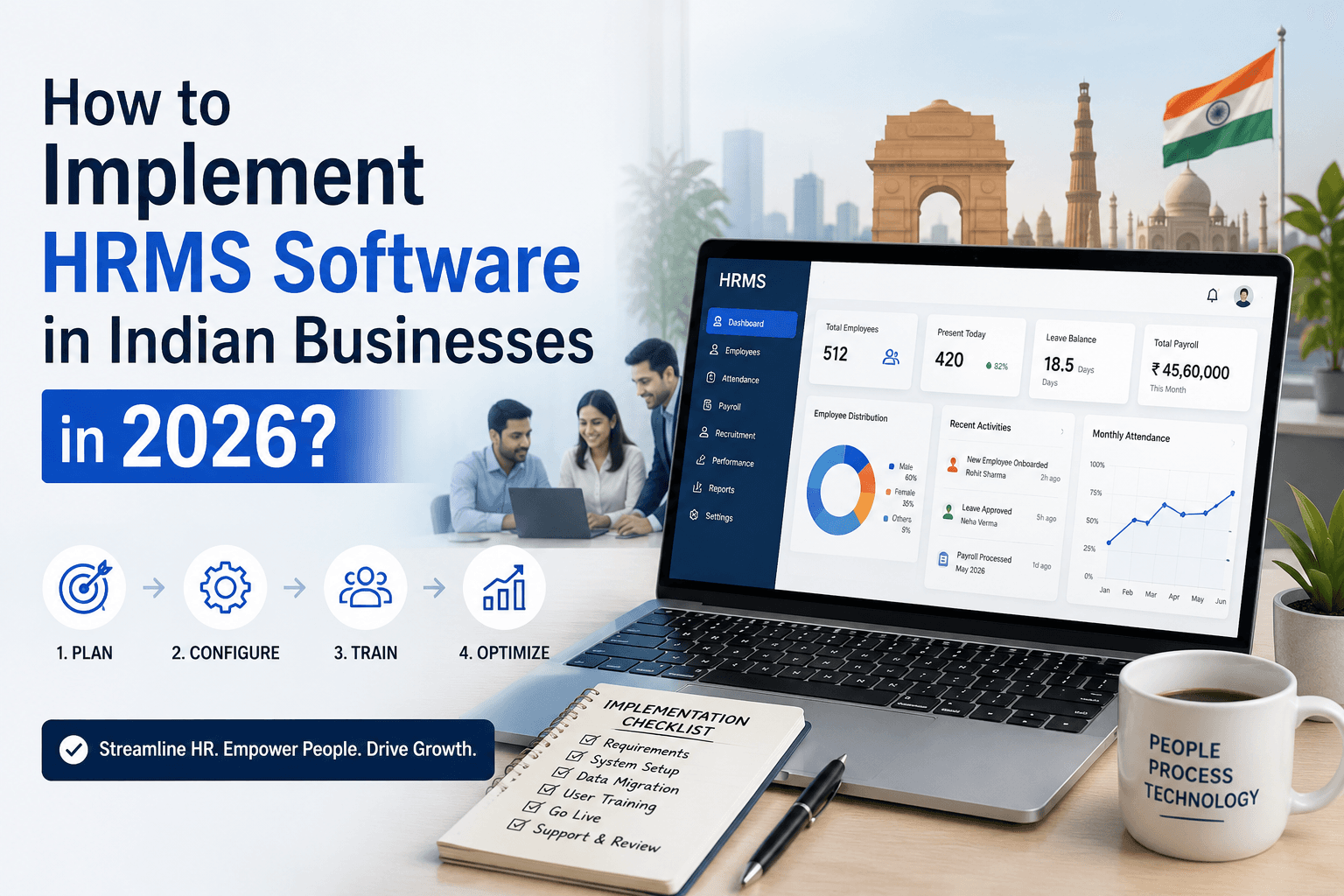
How to Implement HRMS Software in Indian Businesses in 2026?
Failing to implement HRMS? Find out how long HRMS implementation takes to automate payroll, compliance & improve employee experience. Book a demo with Human Maximizer.
5 min read
HR Strategy
Smooth HRMS Migration Process: Indian HR Playbook
Execute an HRMS migration process. Learn how to transition your Indian workforce, secure data, and maintain productivity during the switch.
9 min read
HR Strategy
Breaking Growth Barr: current hr software scalability issues
Overcome common tech bottlenecks as you scale. Discover how to optimize your HRMS software in India to streamline payroll, compliance, and workforce management.
12 min read