
HR Strategy
Breaking Growth Barr: current hr software scalability issues
Overcome common tech bottlenecks as you scale. Discover how to optimize your HRMS software in India to streamline payroll, compliance, and workforce management.

Nishant Tandon
Co-founder & Lead Partner, Razor Infotech · 12 min read · · Updated
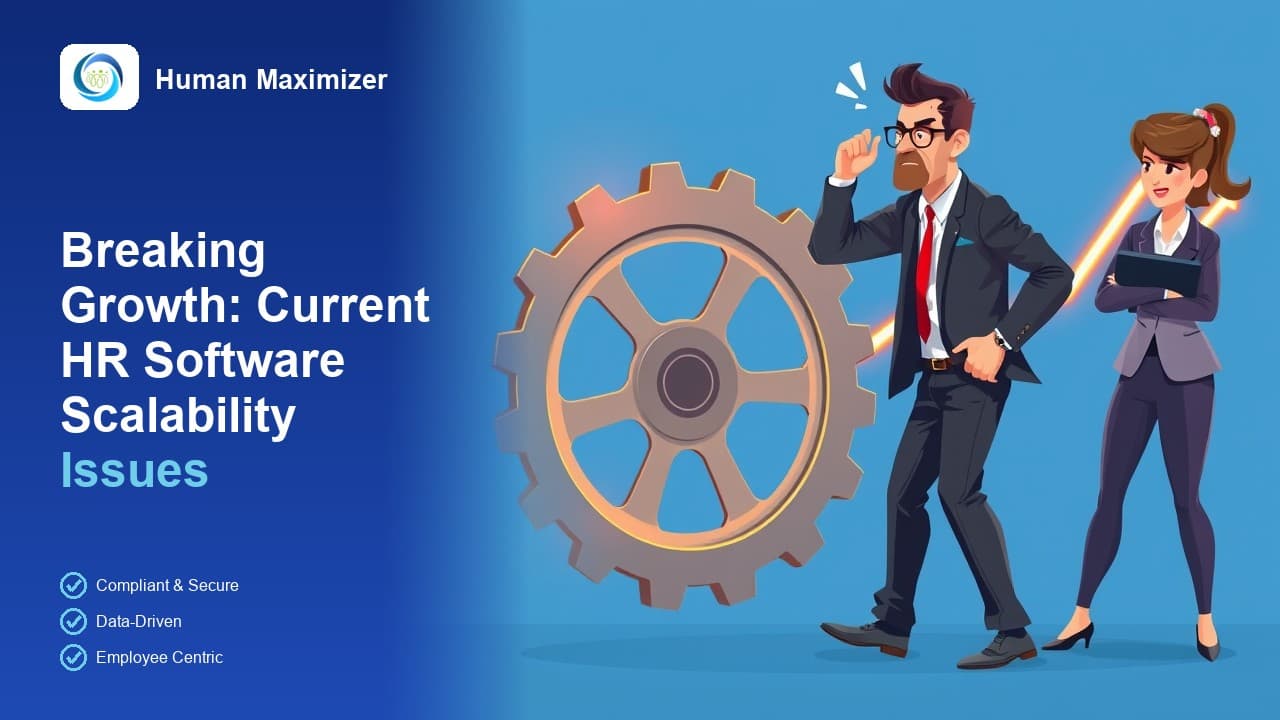
A payroll manager reconciling provident fund and ESI contributions for 450 employees by hand, across three states, on a Friday afternoon, because the bulk upload crashed halfway through. That is what the spreadsheet ceiling looks like from the inside. The current HR software scalability issues that sink growing Indian companies almost never announce themselves at 50 people. They wait quietly. Then, somewhere between 200 and 500 heads, the spreadsheet math and the bolted-together point tools stop holding, and a routine payroll close becomes a weekend of firefighting. When we built Human Maximizer, we spoke with HR leaders, managing directors and founders across Indian companies to map exactly where this cliff sits, and the answer was consistent: it is not headcount that breaks the system, it is what headcount does to compliance.
That distinction is the spine of this article. Scaling HR software in India is a structural pivot rather than a hardware upgrade or a bigger licence pack, a move away from a model that silently accumulates what we call statutory compliance debt — the growing gap between what the law expects you to prove and what your tooling can actually generate on demand.
The 50-to-500 Trap: Why Your Current HR Software Is Breaking
The reason the crash feels sudden is that small scale hides bad structure. At 20 to 30 people, HR runs on spreadsheets, informal agreements, and the founder's personal judgment — and everything works, not because the system is good, but because the scale conceals the gaps. One person remembers who is on probation. One tab holds every salary. Nobody notices the missing audit trail because nobody has ever been asked for it.
Growth removes that cover. Add a second office in another state and you inherit a different professional tax slab. Cross the PF and ESI thresholds and voluntary becomes mandatory. The signs of a failing legacy setup are boringly predictable (and, based on our analysis of 50-plus mid-market migrations, they cluster in the same order): payroll takes longer each month instead of shorter, the same VLOOKUP breaks every quarter, a bulk import of 300 rows times out, and two people quietly keep "their own" version of the master sheet because they don't trust the shared one. None of these is fatal alone. Together they mean your people data no longer has one record everyone trusts, which is the first thing an auditor or a labour inspector will ask you to produce.
Defining Scalability: More Than Adding User Licences
Vendors love to answer "is it scalable?" with "yes, add as many users as you like." That is capacity, not scalability. A system can hold 5,000 employee records and still fall apart the moment your workforce becomes genuinely complex.
Real scalability in the Indian context is the ability to absorb new rules, not just new rows. When you open a Chennai unit alongside your Gurugram office, can the system apply Tamil Nadu's professional tax logic without someone hard-coding a formula? When a factory shifts to rotating night shifts, does overtime calculation and comp-off crediting follow automatically, or does a human recompute it? Scalable HRMS solutions in India are defined by how gracefully they absorb multi-state statutory variation and shift complexity while managing the full employee lifecycle as headcount climbs. Planning for future growth means asking whether the platform can model the company you will be in two years, not the one you are today. A cloud-based HRMS earns the label "scalable" only when configuration changes replace re-engineering.
The Compliance Minefield: Where Statutory Debt Accumulates
Here is the point most global tools miss, and it is worth sitting with. Ask an international HRMS vendor about Form 16 and you often get silence, because those platforms are built on assumptions that break the moment you run a 300-person company in India rather than a 3,000-person one in San Francisco. Provident fund logic, ESI thresholds, state professional tax, TDS, gratuity — these are not edge cases here. They are the core.
Statutory compliance debt behaves like technical debt. Every month your system can't correctly split basic pay, apply the right PF ceiling, or generate a clean challan trail, you take on a small liability. It costs nothing that month. It compounds. The bill arrives all at once, usually as an inspection notice or an acquisition due-diligence request, and by then you are reconstructing eighteen months of records by hand. The obligations themselves are not optional: PF contributions are governed by the EPFO and ESI by the ESIC, and both run on returns your system must be able to produce accurately at any moment. A platform that treats Indian statutory compliance as a plugin rather than a foundation is quietly funding your future penalty.
Curious how automated multi-state statutory handling actually looks in a live payroll run? See it in action.
Integration: When Attendance, Payroll, and Data Stop Talking
Scaling exposes every seam between your tools. In a 50-person setup, a manager might export attendance to CSV, email it to payroll, and someone keys it into a salary sheet. At 400 people, that handoff is where errors breed. One employee's basic salary drives their PF contribution, their tax withholding, and their gratuity accrual. Change it in one place and forget the others, and the mistake propagates silently until someone's Form 16 is wrong.
Workforce data integration is what stops that. When Attendance Management feeds the same record that Payroll reads, and Leave Management draws on one shared ledger, a shift correction on Tuesday shows up correctly in the salary run on the 30th without a single re-entry. A unified HR tech stack removes the reconciliation tax that grows linearly with headcount. Point tools each solve one job well and leave the joins to you. That works until the joins outnumber the people.
The Migration Hurdle: Moving Data Without Losing the Audit Trail
The switch itself is where good intentions stall, and it is rarely for the reason people expect. Configuration is fast. Sign-offs and edge-case decisions are what actually eat the timeline. Migrations stall on the questions nobody owns: who maps the old designation codes to the new ones, whose salary history is authoritative when two sheets disagree, and what happens to the leave balance of someone mid-notice-period.
One lesson we keep relearning is that teams who clean their master data before go-live save the weeks they would otherwise burn afterwards. The dirty-data problem does not migrate away; it migrates with you. Preserving the audit trail matters most for statutory records — you need continuity of PF numbers, salary revisions, and leave ledgers, because a broken history is itself a compliance gap. Treat migration as a records-integrity project, not an IT copy-paste, and the audit trail survives the move intact.
A Scale-Readiness Checklist You Can Actually Use
Before you evaluate any enterprise HR software in India, run your current setup against these questions. If you answer "no" or "not sure" to three or more, your compliance debt is already accruing:
- Can you produce a clean wage register and PF/ESI challan trail for any single month in under ten minutes?
- Does adding an office in a new state apply that state's PT slab automatically, or does someone edit a formula?
- Does an attendance correction flow into payroll without manual re-entry?
- Is there exactly one authoritative record per employee, with change history?
- Can a bulk action on 500 records complete without timing out?
- Can employees self-serve payslips and leave balances, or does every query land on HR?
User Adoption and Interface Fatigue
A technically perfect system that people route around is a failed rollout. This is the failure mode nobody puts in the sales deck: HR loves the new platform, and 400 employees keep pinging the same three people on WhatsApp for their leave balance because opening the app feels like more effort than sending a message. Adoption dies in friction.
At scale, the interface has to serve four audiences at once — employees, managers, HR, and admins — each seeing only what their role allows. An employee self-service portal only reduces HR's load if checking a payslip or applying for leave takes seconds on a phone. Here is the honest limitation worth stating plainly: the best-architected platform in the market will not fix a scaling problem if the day-to-day screens are so cluttered that people default back to email and spreadsheets. At 500 people, mobile-first and role-aware simplicity decides whether the system gets used or gets bypassed. It stopped being a nicety a few hundred hires ago.
Future-Proofing: Where AI and Automation Genuinely Help
There is real hype to cut through here, so let me be precise about what actually scales HR operations and what is marketing. Payroll processing automation is the workhorse. Automating the statutory calculation, the challan generation, and the payslip run is where scaling companies recover the most time, and where accuracy stops depending on one exhausted person's attention on the 29th.
Predictive analytics has a narrower, honest role: surfacing patterns in attrition, overtime spend, or attendance so HR can act before month-end rather than explain the number afterwards. What we would not tell you is that AI runs your compliance for you. It doesn't. Statutory interpretation, an ambiguous multi-state PT question, a disputed final settlement — these still need human judgment, and often a chartered accountant. Automation removes the repetitive load so your team spends its hours on the decisions that genuinely need a person. That is the realistic ceiling of HR automation for scaling companies, and it is a high one.
Where Switching Platforms Won't Save You
A new system is not always the answer, and it is fair to say so. If your master data is genuinely dirty — duplicate records, missing PANs, patchy salary history — no platform migration cleans that for you; you carry the mess across. If you are a single-state team under 50 people with stable headcount, the spreadsheet ceiling may still be a year away, and a full HRMS could be more tool than you need today. And for the truly ambiguous statutory calls that come with multi-state operations, software applies the rule but does not decide the interpretation. That still belongs to your compliance advisor.
Frequently Asked Questions
How do I know if my current HR software can handle 3x growth? Run a bulk action at scale, not a demo with ten records. If a 500-row import times out, if payroll takes longer each month, or if adding a new-state slab needs a developer, the system is showing its ceiling. Capacity for records is easy; absorbing new rules without re-engineering is the real test.
What are the signs a legacy HR system is failing to scale? Watch for parallel spreadsheets people trust more than the official system, payroll cycles that lengthen instead of shorten, repeated reconciliation between attendance and salary, and an inability to produce a clean audit trail quickly. These are symptoms of statutory compliance debt accumulating underneath.
What about remote and hybrid workforce compliance when you scale? This is the edge case that surprises fast-growing teams. A distributed workforce means employees may trigger professional tax and state-specific obligations based on where they actually work, not just where you registered the company. Attendance for remote staff also gets murky without location context, which is where geo-fencing and a clear work-location field on each employee record matter more than they did when everyone sat in one office.
How does HR software scalability affect statutory compliance in India? Directly. As headcount and locations grow, you take on multi-state PF, ESI, and professional tax obligations. A system that can't apply these rules automatically forces manual workarounds, and every manual workaround is a future error waiting for an audit. Scalability here means the platform absorbs new statutory rules as configuration, not as a project.
The Friday That Doesn't Repeat
Go back to that payroll manager, reconciling PF and ESI for 450 people by hand because the upload died. In a properly scaled setup, that Friday simply does not exist. Attendance has already fed payroll, the multi-state statutory logic has already run, and the challan trail is generated and stored the moment the cycle closes. That is the shift a scalable platform like Human Maximizer is built for. If you want to see whether it fits your stack before your next growth phase, book a 15-minute Human Maximizer demo. The cost of postponing is not abstract: under India's tightening enforcement, the compliance debt you carry through the 50-to-500 phase eventually gets called in, and the interest is paid in reconstructed records and penalty notices. The cheaper Friday is the one you set up now.
About the Author & Reviewer
Nishant Tandon — Co-founder & Lead Partner, Razor Infotech
Nishant Tandon is Co-founder and Lead Partner at Razor Infotech, with over a decade in IT, customer support and business operations, helping SMEs achieve cost efficiency, stronger customer experience and scalable, sustainable growth.
Connect on LinkedIn
Reviewed & approved by Sameer Hameed — Founder & Chairman, Razor Infotech
Sameer Hameed is the Founder & Chairman of Razor Infotech, where he is guiding the creation of Human Maximizer. An entrepreneur across technology, real estate, mining and travel, he builds organisations on clarity, trust and responsible growth — on the belief that businesses grow only when the people behind them grow.
Connect on LinkedIn
Human Maximizer is built by Razor Infotech in New Delhi, India (founded 2019). About Human Maximizer.
Keep reading
HR Strategy
Appraisal Software India: Beyond Annual Reviews
How to select the best appraisal software India has to offer. Streamline your performance review cycles and align employee goals with business growth.
13 min read
HR Strategy
Whem Shift Management: Ending Roster Chaos
Stop roster clashes with WHEM shift management. Get a step-by-step guide to automating your staff schedules while staying compliant with Indian labor laws.
14 min read
HR Strategy
Employee attendance tracking software
Why aggressive surveillance tools damage company culture. Learn how to balance accountability and employee trust using modern field force tracking...
13 min read