
Payroll
Beyond the Basic Pay: What a Salary Slip Format in India Must Show
The essential components of a compliant salary slip format in India. Learn how to structure earnings and deductions to ensure payroll transparency...

Insha Hamid
Head of HR in Research & Content, Human Maximizer · 16 min read ·
CTC is a promise, and the salary slip is the receipt. The two almost never show the same number. Most HR teams find this out when a developer puts a printed payslip on the desk and asks why gross earnings read ₹85,000 when the offer letter's ₹11.68 lakh works out to roughly ₹97,300 a month. Nobody has been underpaid. But if your salary slip format cannot explain that gap line by line, a routine Payroll query becomes a trust problem, and occasionally a legal one.
We built that developer and those figures as an illustration for this article, so the arithmetic can be followed. They are not anyone's actual payroll. We return to the ₹12,300 gap further down and close it to the rupee.
Our argument is simple. A payslip is not a courtesy document or a design exercise. It is evidence of what was earned, what was withheld, and under which law.
The Traceback Test: What a Compliant Salary Slip Format Has to Prove
Free templates treat payslip components as a list of boxes to fill. We use a stricter check and call it the Traceback Test: for every line on the slip, can you name the source document it came from? If a line cannot be traced, it is a liability.

| Line on the slip | Traces back to | What goes wrong when it doesn't |
|---|---|---|
| Earnings heads and amounts | Appointment letter or latest revision letter | Disputes over what was promised |
| Paid days and loss of pay | Attendance and leave records | Deductions nobody can justify |
| PF, ESI, professional tax, TDS | Monthly returns and challans | Mismatches found during inspection or at Form 16 time |
| Net pay and payment date | Bank transfer advice | No proof that wages were paid on time |
The identification block
Every slip needs the employer's legal name and address, and the employee's name, employee code, designation, department and date of joining. Add the identifiers that statutory systems use: PAN, UAN for provident fund, the ESI number where applicable, and bank account details, usually masked. The employer's TAN belongs on TDS paperwork, and many companies print it on the slip as well.
These fields are only as accurate as the master record behind them. A slip with a misspelt name or an outdated PAN is usually an Employee Data Management problem, not a payroll one.
Pay period, paid days and payment date
State the wage period, the total days in it, the days paid, and the date the salary was credited. This is the line an inspector reads first. It is also the line most home-made templates leave out.
Earnings: Basic, HRA and the Variable Pay Trap
Earnings sit on the left of the slip. They hold most of the confusion.
Basic salary versus gross earnings
Basic salary is the fixed core of pay. PF, gratuity and several other calculations are built on it. HRA sits beside it and matters most to employees who claim rent exemption under the old tax regime. Special allowance is the balancing figure: whatever remains after the named heads are filled.
Gross earnings are the total of every earnings head for the month, before any deduction. Basic is one component. Gross is the sum. Employees confuse the two constantly, so the slip should show a clear subtotal.
The balancing figure is where the Code on Wages, 2019 bites. Its definition of wages, in Section 2(y), expects basic pay and dearness allowance to make up at least half of total remuneration. If the excluded allowances cross the halfway mark, the excess is treated as wages anyway. A slip with a thin basic and a fat special allowance documents that imbalance every single month. Our guide to salary restructuring under the new wage code covers the fix.
Where variable pay belongs
Performance bonuses cause two recurring mistakes. One is spreading an annual variable across twelve months of gross, which shows money that has not been earned yet. The other is folding a paid bonus into special allowance, where it disappears.
Do neither. Show variable pay as its own line, only in the month it is paid, with the period it relates to. TDS on it falls in that month too, which explains the "why is my tax so high in April" ticket. A separate line answers the question before it is asked.
Statutory Deductions: PF, ESI, Professional Tax and TDS
Deductions sit on the right. Each one has a rule behind it.

Under the Employees' Provident Funds Scheme, the employee's PF deduction is ₹12 for every ₹100 of basic plus dearness allowance. The employer's mandatory liability is calculated on a statutory wage ceiling of ₹15,000 a month, though many employers contribute on full basic. The slip should make clear which basis applies. The matching return, the ECR, is due by the 15th of the following month, and the slip figure must agree with it. EPFO publishes the current contribution rates and filing calendar on its own site, epfindia.gov.in, and that is the place to confirm them before a formula gets hard-coded into a template.
The ESI deduction applies only where monthly gross wages are within ESIC's threshold of ₹21,000. Above that, the line should be absent or zero, not left ambiguous.
Professional tax is a state levy. Article 276 of the Constitution caps it at ₹2,500 a year, and several states levy none. A company with staff in more than one state will have different amounts on otherwise identical slips. That is correct, not an error.
TDS is income tax withheld on salary. It depends on the employee's chosen regime and declarations, so it varies more than any other line.
Voluntary items such as loan EMIs, advances and insurance top-ups go below the statutory ones, each under its own name.
Gross to Net Pay: The Arithmetic, Worked Line by Line
Net pay is gross earnings minus total deductions. Here is our illustrative developer's month, with every assumption stated.
| Earnings | Amount (₹) | Deductions | Amount (₹) |
|---|---|---|---|
| Basic salary | 45,000 | PF (on the ₹15,000 ceiling) | 1,800 |
| HRA | 18,000 | Professional tax (assumed) | 200 |
| Special allowance | 22,000 | TDS (assumed) | 3,000 |
| Gross earnings | 85,000 | Total deductions | 5,000 |
| Net pay | 80,000 |
The TDS and professional tax figures are placeholders to show the method. Substitute your own and the structure still holds.
Now add one day of loss of pay in a 30-day month. Earned gross becomes ₹85,000 × 29 ÷ 30, or ₹82,167, and net pay falls to ₹77,167. That ₹2,833 traces straight back to an attendance record, so Attendance Management and payroll cannot live in separate spreadsheets. Payslip disputes rarely start on payday. Most begin days earlier, in an attendance exception nobody flagged.
Closing the CTC gap
The developer's question has a three-line answer:
- Employer PF: ₹1,800 a month.
- Gratuity provision: ₹45,000 × 15 ÷ 26 is about ₹25,962 a year, or ₹2,163 a month.
- Annual variable pay: ₹1,00,000, or ₹8,333 a month, paid only when earned.
Together that is about ₹12,300 a month. It is part of CTC and correctly absent from gross. A good slip, or an annexure to it, shows these employer-side items so the conversation takes two minutes.
Why Lenders and Visa Officers Read the Payslip
Outside the company, the payslip is proof of income. Banks ask for recent slips before sanctioning a home loan or credit card. Lenders read gross earnings to judge the size of the income, and net pay to judge what the borrower can actually repay each month. Visa officers use the slips to confirm stable employment and to cross-check them against bank statements.
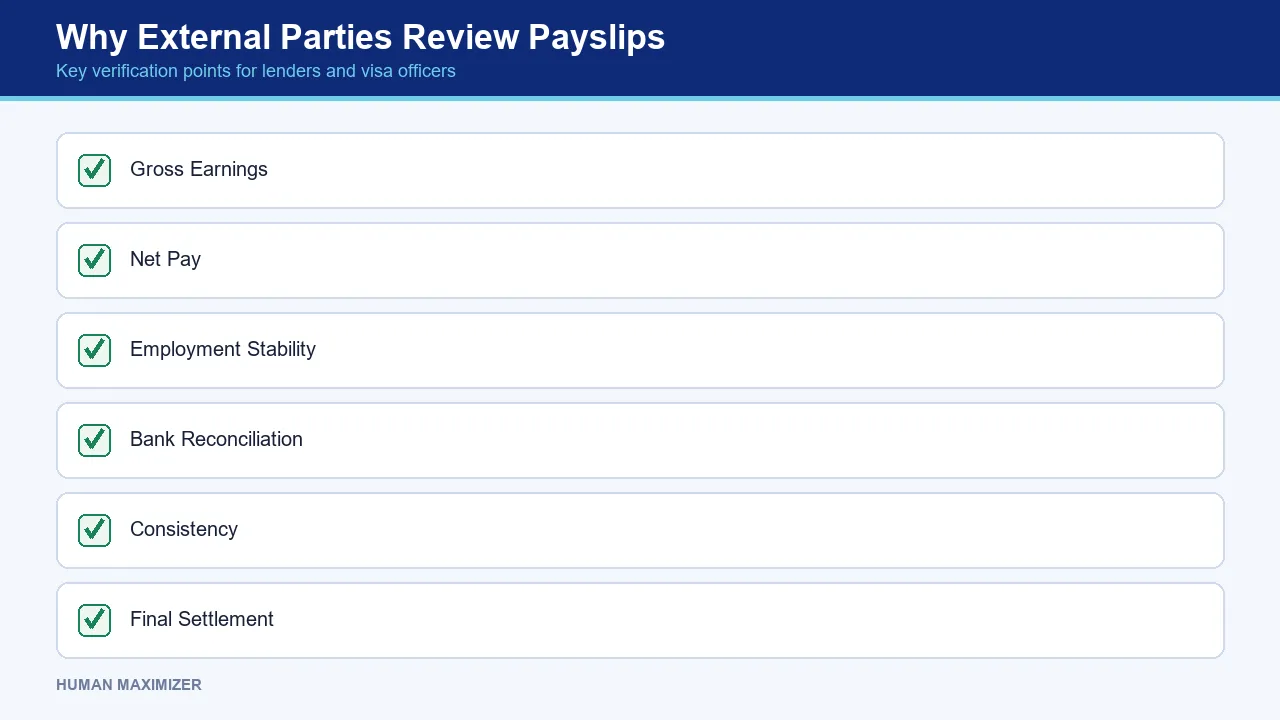
Both readers check consistency. If the amounts change without explanation from month to month, or the slip's net pay does not match the bank credit, the application stalls and the employee comes back to HR for a letter.
The last slip matters most. The final payslip issued at exit is what the next employer and the next lender will see. The Code on Wages expects settlement within two working days of the last working day, which leaves little room for a manual scramble. Our explainer on the FFS full form in salary walks through what that final statement should contain.
The Wage Slip Under the Code on Wages, and the Privacy Gap
What the Code adds
The older wage laws already required wage slips in many establishments. The Code on Wages carries that duty forward and allows the slip to be issued electronically. The central rules prescribe a wage slip form, published as Form V. The Ministry of Labour and Employment hosts the Code and the rules framed under it on its own site (labour.gov.in). We are pointing you to the ministry's site and not to a single PDF on purpose: the documents there get revised and re-filed, and the version you adopt should be the current one. Confirm the form number and fields in your own state's rules too, because states frame their own.
The fields are plain: establishment, employee, wage period, rate of wages by component, attendance, overtime, gross wages, deductions and net wages paid. So a wage slip under the Code on Wages is close to the format described above, with one difference in emphasis. It shows the split between wages and allowances, so the halfway rule can be checked from the slip itself. For the wider picture, see our briefing on India's new labour codes for HR leaders.
What a Form V style wage slip looks like
Below is our own mockup, filled with the illustrative developer's month. It follows the fields listed above and is not a reproduction of the gazetted form, so check it against the rules notified for your state before adopting it.
WAGE SLIP (Form V style mockup)

Name of establishment : [Employer legal name]
Address               : [Registered address]
Wage period           : 01 to 30 [Month, Year]

Name of employee      : [Name]
Designation           : Software Developer
UAN                   : XXXX XXXX 1234
Bank account          : XXXXXX5678

RATE OF WAGES PAYABLE
  Basic                       ₹45,000
  Dearness allowance          ₹0
  Other allowances            ₹40,000

Total attendance / days paid  30 of 30
Overtime wages                ₹0
GROSS WAGES PAYABLE           ₹85,000

DEDUCTIONS
  Provident fund              ₹1,800
  ESI                         Not applicable
  Others (PT ₹200, TDS ₹3,000) ₹3,200
TOTAL DEDUCTIONS              ₹5,000

NET WAGES PAID                ₹80,000
Date of payment               [DD/MM/YYYY]

Signature of employer / payroll in-charge
Notice what the layout forces into view. Basic and dearness allowance sit on their own lines above "other allowances", so anyone holding the slip can see whether wages clear the halfway mark. Here they do: ₹45,000 against ₹40,000.
Digital payslips and data privacy
A payslip carries a PAN, a UAN, a bank account number and a salary on one page. Mailing it as an open PDF to a personal inbox, or forwarding it on WhatsApp because someone needed it "urgently for the bank", exposes all of that at once. This is personal data under the Digital Personal Data Protection Act, 2023, and the employer is the one answerable for it.
Three practical rules follow:
- Deliver slips through a login-gated portal, not as attachments.
- Limit access by role.
- Mask identifiers for anyone who does not need them.
In Human Maximizer, an employee sees only their own payslip and HR needs a specific payroll permission to see others. A reporting manager does not see a subordinate's slip by default.
Access rules are half the picture. The other half is how the data is stored and moved, and it is worth putting two questions to any payroll vendor, ourselves included. Is payslip data encrypted at rest and in transit, and to what standard? AES-256 at rest and TLS in transit are the usual benchmarks. And has an outside auditor checked the controls, through a SOC 2 report or an ISO 27001 certificate? Ask to see the document. A logo on a website is not evidence.
A Payslip Format for India You Can Copy into Excel, Word or PDF
We have not attached a file to this article. The layout below pastes directly into a spreadsheet, and that is the honest version of a download.
| Section | Fields |
|---|---|
| Header | Employer name and address, "Salary slip for [month, year]" |
| Employee details | Name, code, designation, department, date of joining, PAN, UAN, ESI number, bank account (masked) |
| Period | Total days, paid days, loss-of-pay days, payment date |
| Earnings | Basic salary, DA, HRA, special allowance, overtime, variable pay (own line), gross earnings |
| Deductions | PF, ESI, professional tax, TDS, loans and advances, total deductions |
| Footer | Net pay in figures and words, employer contributions for information |
Choosing the file type
A salary slip format in Excel works as the calculation layer: formulas for gross, deductions and net, with one sheet per month. Word is suitable only for one-off letters, since nothing in it calculates. Employees should receive a salary slip format in PDF, because banks and embassies expect a fixed document.
A pre-release payslip checklist
Run this before slips go out each month. It is the Traceback Test in working form, and it is the part of this article worth bookmarking.
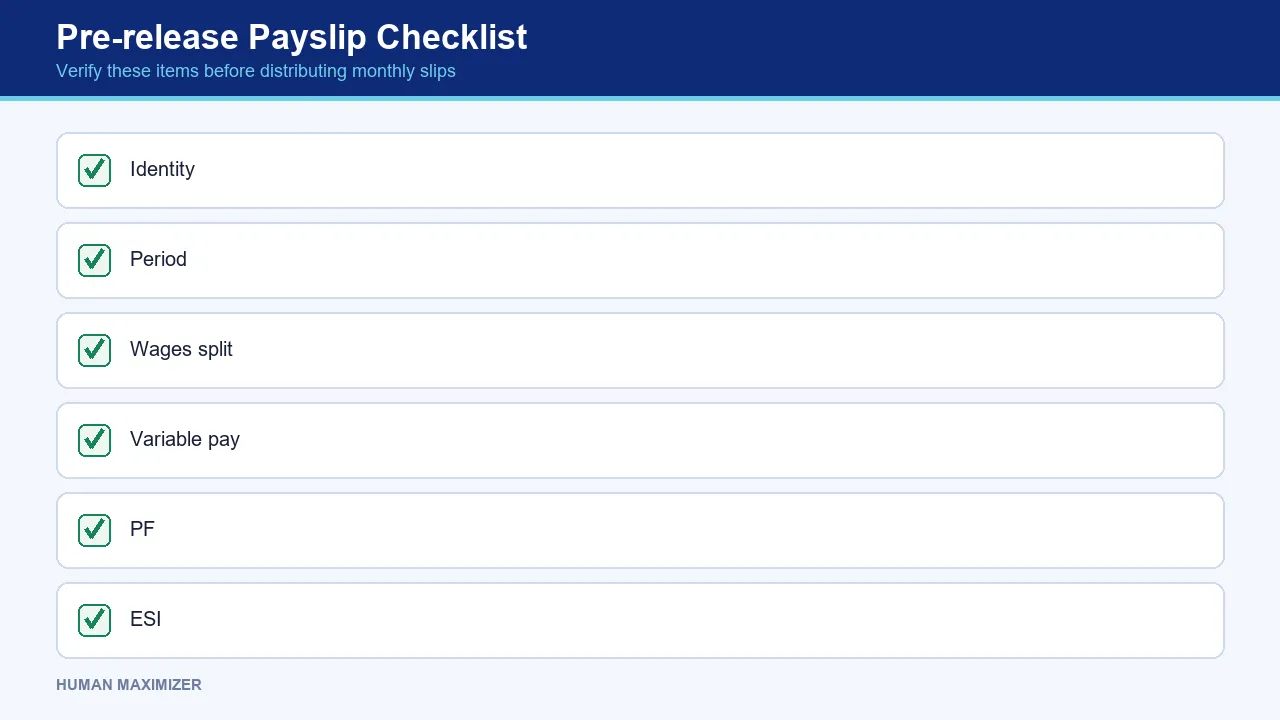
| Check | Pass condition |
|---|---|
| Identity | Name, PAN and UAN match the employee master record |
| Period | Wage period, paid days and payment date are all printed |
| Wages split | Basic plus DA is at least half of total remuneration |
| Variable pay | Shown on its own line, only in the month paid |
| PF | Slip figure agrees with the ECR for the month |
| ESI | Present only where gross is within ₹21,000 |
| Professional tax | Matches the slab for the employee's state |
| Net pay | Equals the bank credit to the rupee |
| Delivery | Sent through a login, not as an open attachment |
When the spreadsheet stops coping
Excel fails without warning. A salary revision keyed into one sheet and not another can take three people two days to trace back.
In our Payroll module, a CTC change creates a new versioned revision and the old one is preserved. Each monthly batch also runs a pre-check for pending leaves, regularisations, overtime approvals and missing attendance. If it finds any, the batch waits until they are resolved, so the edge case is caught before slips go out. The payslip PDF is then rendered from a template.
In a review of 24 client accounts completed in July 2026, monthly payroll corrections fell from 15 to 3.
A note on how to read that figure. It is an aggregate from our own internal evidence review, no individual client's numbers are published, and it has not been audited by a third party. We do not have a public methodology page for it, so weigh it as a vendor's own reporting: useful as a direction, not as a benchmark for your payroll.
The questions that remain should go through a queue. Ticket Management gives payslip queries an owner and a status, where a chat thread gives them neither.
What a Clean Format Cannot Fix
A template documents your salary structure. It does not correct it. If basic pay sits well under half of remuneration, a well-formatted slip only makes the problem easier to read. Restructuring is a decision for finance and your CA, with take-home and PF cost consequences to model first.
Variable pay disputes need judgement. Software can show the bonus on its own line. It cannot decide whether the target was met.
State rules also differ. Professional tax slabs, wage slip forms and labour welfare fund rules vary by state. Our in-house compliance team tracks statutory changes for the platform, but someone in your organisation still has to read the rules for each state where you employ people.
Frequently Asked Questions
What are the mandatory components of a salary slip in India? The contents come from the wage slip rules, not from one universal layout. In practice a slip must identify the employer and employee, state the wage period and days paid, break earnings into components, list each deduction, and show net wages paid.
How do you calculate net pay from gross salary? Add every earnings head for the month to get gross earnings, after adjusting for loss of pay. Subtract PF, ESI where applicable, professional tax, TDS and any voluntary deductions. The remainder is net pay and should match the bank credit exactly.
What is the difference between basic salary and gross earnings? Basic salary is one fixed component, and statutory calculations such as PF and gratuity are based on it. Gross earnings are the total of basic, HRA, special allowance and every other earning before deductions.
Why does CTC not match the gross on my payslip? CTC includes employer-side costs such as employer PF, gratuity provision and variable pay that is not paid monthly. Gross shows only what was earned in that month.
Conclusion
Go back to the printed payslip on the desk. The developer's ₹12,300 gap was employer PF, a gratuity provision and unpaid variable, and none of it was hidden. The slip simply could not show it. A format that passes the Traceback Test answers that question on the page. If we were auditing one thing before the next close, it would be whether every line on your slip can name its source document. If you want payslips that trace themselves back to attendance, revisions and returns, see how Human Maximizer handles it.
About the Author & Reviewer
Insha Hamid — Head of HR in Research & Content, Human Maximizer
Insha Hamid heads HR research and content for Human Maximizer at Razor Infotech, covering people operations and Indian workplace compliance — translating regulatory change and workplace research into guidance HR teams can act on.
Connect on LinkedIn
Reviewed & approved by Sameer Hameed — Founder & Chairman, Razor Infotech
Sameer Hameed is the Founder & Chairman of Razor Infotech, where he is guiding the creation of Human Maximizer. An entrepreneur across technology, real estate, mining and travel, he builds organisations on clarity, trust and responsible growth — on the belief that businesses grow only when the people behind them grow.
Connect on LinkedIn
Human Maximizer is built by Razor Infotech in New Delhi, India (founded 2019). About Human Maximizer.
Keep reading

Payroll
FFS Means
FFS Means: How to streamline your full and final settlement process in India. Learn to calculate terminal benefits accurately while ensuring...
14 min read
Payroll
Beyond the Resignation: FFS Fullform
FFS Fullform: How to calculate Full and Final Settlement for Indian employees accurately. Discover the key components, statutory requirements...
15 min read
Payroll
Attendance Payroll Integration: Sync Myth
Why manual data transfers cause costly salary errors. Learn how automated attendance and payroll integration ensures accuracy and saves hours...
14 min read