
Payroll
Beyond the Resignation: FFS Fullform in Indian Payroll, Explained
FFS Fullform: How to calculate Full and Final Settlement for Indian employees accurately. Discover the key components, statutory requirements...

Nishant Tandon
Co-founder & Lead Partner, Razor Infotech · 15 min read ·

The laptop went back on the last day. The clearance form was signed, the team said goodbye, and six weeks later the bank account is still quiet. If you have searched the FFS fullform after an exit like that, the answer you want is not the surgical one or the engineering one that dominates the results page. In payroll, FFS is Full and Final Settlement: the closing reconciliation of everything an employer owes a departing employee and everything the employee owes back. It is the last entry in a working relationship, and while building Payroll for Indian companies, our team found it is the entry that goes wrong most often.
Most articles treat this as a definition problem. It is really a sequencing problem, and that distinction is the whole argument of this guide.
FFS Fullform in Payroll: What Full and Final Settlement Actually Covers
The acronym is used loosely elsewhere. Outside HR, FFS turns up as facial feminization surgery in healthcare and as fitness-for-service in pipeline engineering, which is why a plain search returns three unrelated worlds. Inside an Indian payroll department it means exactly one thing.
Full and Final Settlement is a two-sided calculation performed once, at separation, covering the period from the last completed payroll cycle through the last working day. On one side sit unpaid salary, leave encashment, gratuity where the employee qualifies, pro-rata bonus, reimbursements not yet claimed, and notice pay if the company is buying out the notice. On the other side sit income tax, professional tax, provident fund adjustments, loan or advance recovery, and notice-period recovery when the employee left short.
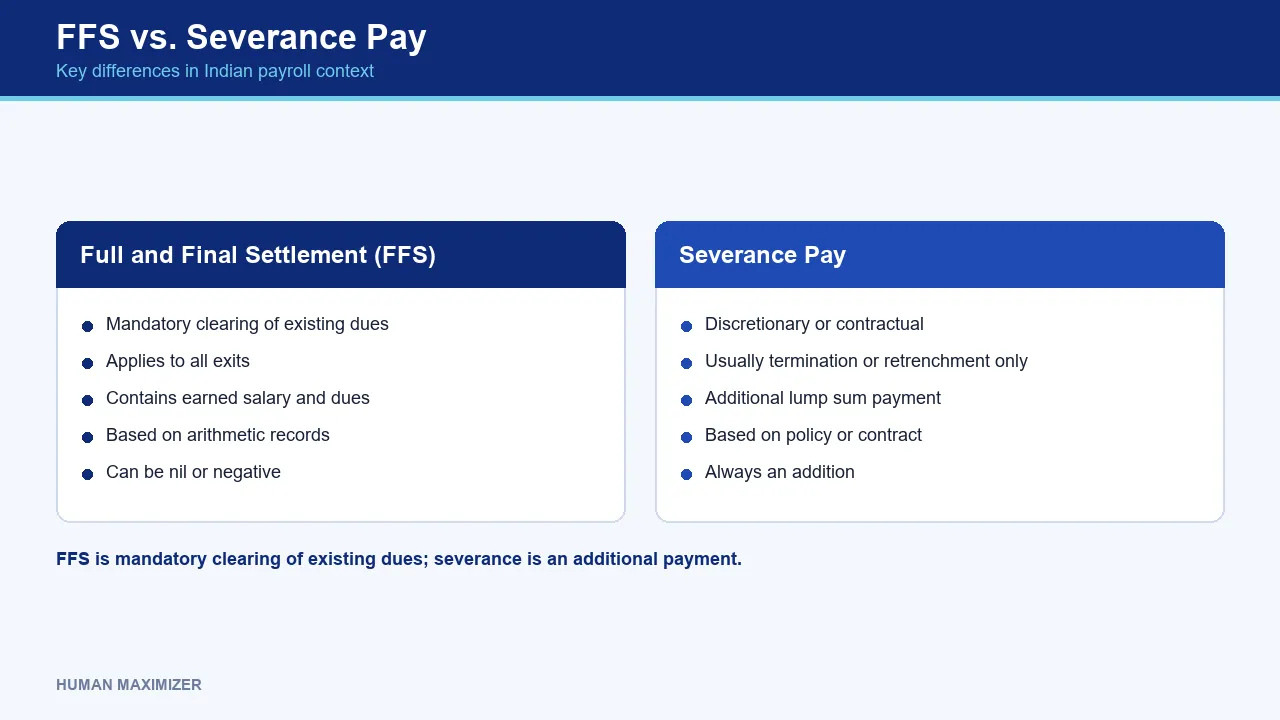
An employee exit settlement is different from severance pay, and confusing the two causes real trouble. Severance is discretionary or contractual, paid on termination or retrenchment. FFS is the mandatory clearing of dues that already exist. A retrenched employee may receive both; a resigning employee usually receives only the settlement.
| Full and Final Settlement (FFS) | Severance Pay | |
|---|---|---|
| Nature | Mandatory clearing of existing dues | Discretionary or contractual |
| When it applies | Every exit: resignation, termination, retirement, retrenchment | Usually termination or retrenchment only |
| What it contains | Earned salary, leave encashment, gratuity, bonus, minus recoveries | An additional lump sum, often expressed in months of pay |
| Basis of amount | Arithmetic from attendance, leave and salary records | Policy, contract, or negotiated settlement |
| Can it be nil or negative? | Yes, when recoveries exceed earnings | No, it is an addition by definition |
| Governed by | Wage payment law, gratuity law, company policy | Contract and, in retrenchment cases, industrial law |
The Exit Ledger: Structure the Settlement Before You Calculate It
Teams rarely get stuck on the formula. Sit with HR and finance during any rollout and the arithmetic is almost never the blocker; the blocker is that three systems disagree about the last working day, or a salary revision was applied in a spreadsheet and never in the system of record. A single off-system revision can take three people two days to trace back.
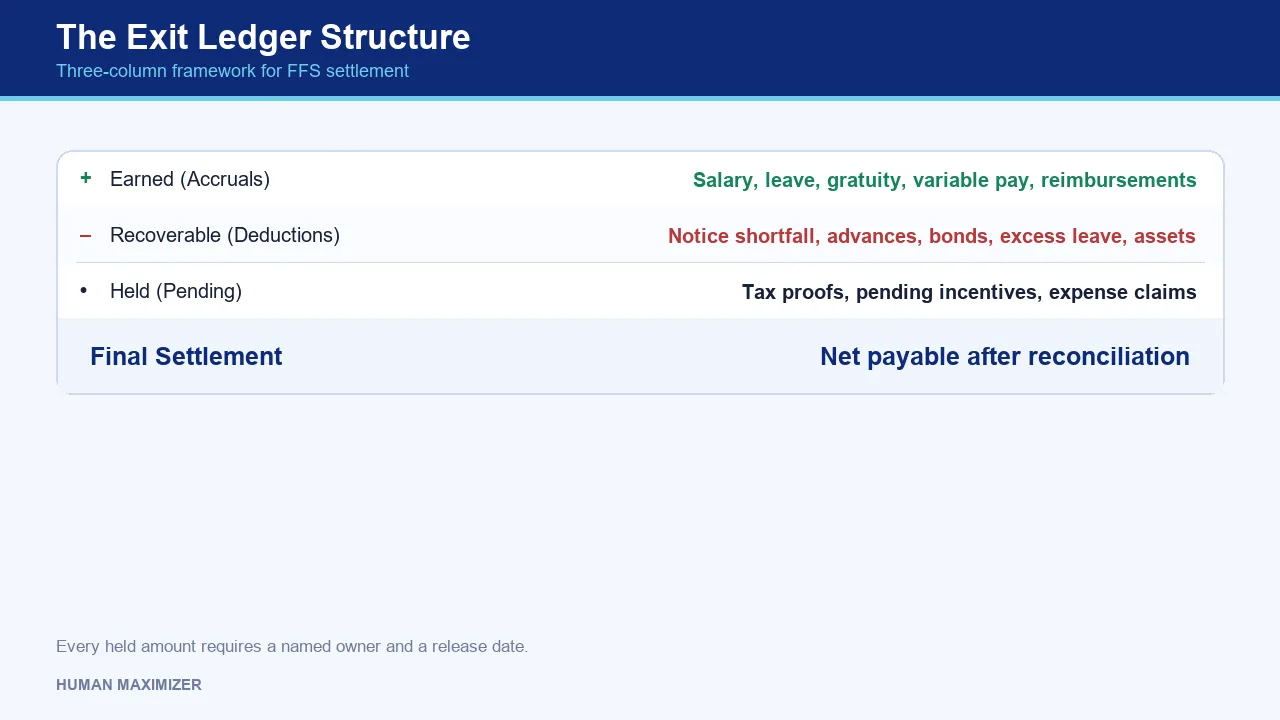
So before any number, structure the case as a ledger with three columns. We call it the Exit Ledger, and the point of it is that the third column is the one nobody models.
Column one: Earned
Everything the employee has already worked for or accrued. Unpaid salary for the part-month, encashable leave balance, gratuity if service qualifies, pro-rata variable pay per policy, unclaimed reimbursements. Each of these should be a separate line with its own basis, never a lump sum. A settlement statement that reads "final dues: ₹2,14,000" is an assertion dressed up as a statement.
Column two: Recoverable
Notice-period shortfall, salary advances, education or relocation bonds, excess leave consumed beyond accrual, unreturned assets valued per policy. These are legitimate, and they are also the single biggest source of exit disputes, because employees almost never see them coming.
Column three: Held
Amounts that genuinely cannot be computed on the last working day. Investment proof reconciliation for tax, a quarterly incentive that closes after the exit, an expense claim still in approval. Here is the rule that makes the ledger worth using: every held amount needs a named owner and a release date. A hold without a date is a dispute in slow motion, and it is how a thirty-day settlement becomes a ninety-day one.
Full and Final Settlement Calculation, Worked Line by Line
Take an operations executive leaving a manufacturing firm in Mysuru after seven completed years. Last drawn basic plus DA is ₹40,000 a month, monthly gross ₹65,000. Last working day falls on the 22nd. Contractual notice is 60 days; 22 were served. Eighteen days of earned leave remain. The numbers below are a model, not a client's data, so adjust each input to your own policy and follow the arithmetic yourself.
Unpaid salary. Twenty-two days of a 30-day month at ₹65,000 gross: 65,000 ÷ 30 × 22 = ₹47,666.
Leave encashment. Encashment is normally computed on basic plus DA, not gross. The divisor is a policy decision, and this is where arguments start. On a 26-day basis, 40,000 ÷ 26 = ₹1,538.46 per day, times 18 days = ₹27,692. Switch the divisor to 30 calendar days and the same 18 days pay ₹24,000, a difference of ₹3,692 on one exit. If your leave policy does not name the divisor in writing, fix that before your next exit. Whatever your rule, the accrual balance behind it has to be the live one from Leave Management, not a figure someone maintained separately.
Gratuity. For establishments covered by the Payment of Gratuity Act, the statutory formula is 15 days' wages multiplied by completed years of service, divided by 26, with five years of continuous service as the qualifying condition, waived on death or disablement. So: 40,000 × 15 ÷ 26 = ₹23,077 per year, times 7 years = ₹1,61,538.
Notice period pay. The employee served 22 of 60 days, leaving 38 days short. At ₹65,000 ÷ 30 = ₹2,166.67 per day, recovery is ₹82,333. Run the other direction and it flips: if the company waives the balance notice and pays in lieu, the same 38 days become an addition instead.
Earned side: ₹2,36,896. Recoverable side: ₹82,333, before statutory deductions on the taxable components. Notice how close the recovery comes to wiping out everything except gratuity. On shorter tenures, where gratuity has not vested at all, the recoverable column can exceed the earned one and the statement lands on the employee's desk showing nothing payable. That conversation goes far better when the numbers were shown at resignation acceptance rather than sprung six weeks later.
Statutory Dues Nobody Can Waive
Some lines in the ledger are not negotiable between employer and employee, whatever the appointment letter says.
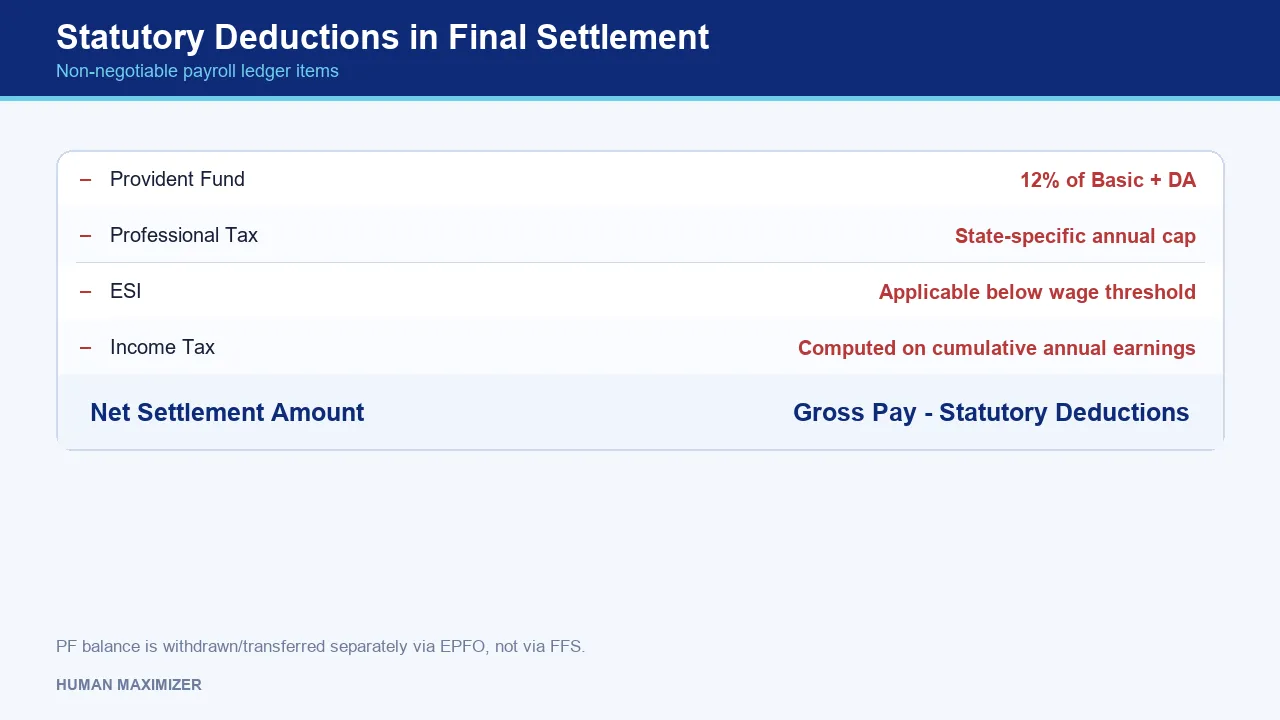
Provident fund contributions continue through the final month. Per EPFO's published rules, the employee contribution is 12% of basic plus DA, and the employer's statutory liability is capped at a wage ceiling of ₹15,000 per month unless the establishment has opted to contribute on full wages. The accumulated balance is not paid out through FFS at all; the employee withdraws or transfers it separately, and telling a departing employee otherwise creates a false expectation you will hear about later.
Professional tax applies in the states that levy it, is constitutionally capped at a modest annual maximum, and several states charge none. ESI applies only below a monthly wage threshold and is deducted for the final month if the employee was covered. Income tax on the settlement is computed against the year's cumulative earnings, which is precisely why mid-year exits get messy: the employee may not have submitted investment proofs, and payroll must decide whether to compute tax without them or hold the reconciliation until proofs arrive. Our note on statutory compliance basics for growing companies covers the wider set of filings these deductions feed into.
Form 16 is a separate matter from the settlement itself. It is issued after the financial year closes, covering the period the employee was on your books, and it does not travel with the final payslip. Employees ask for both on day one anyway. A settlement statement that says so in writing prevents a fortnight of follow-up emails.
The Legal Clock: Two Working Days Against a 45-Day Habit
Here is the India-specific point that most guides step around. The Code on Wages sets the expectation that all dues be settled within two working days of the last working day, and the same code pushes basic pay toward at least 50% of total remuneration, which quietly raises gratuity and encashment exposure on every future exit.
Two working days. Meanwhile the practical calendar most Indian employers run on is 30 to 45 days, and often longer, because asset return, IT clearance, manager sign-off, department no-dues, finance approval, and the next payroll cycle are all treated as prerequisites to starting the calculation.
That gap is an ordering failure rather than a discipline failure. The clock starts at the last working day, but the data needed to compute the settlement is only assembled after the last working day. Under that sequence, an employer is structurally late no matter how hard the team works. The correction is to run the Exit Ledger from the day the resignation is accepted, not from the day the employee walks out. Notice dates, leave balance, gratuity eligibility and loan outstandings are all knowable at acceptance. Only the final part-month attendance is not. We have written more on what the 48-hour settlement rule demands operationally if you are rebuilding your exit process around it.
How the FFS Process in Payroll Runs When Something Goes Wrong
Exception handling is the honest test of any settlement workflow, so consider the ordinary case where the ledger does not balance.
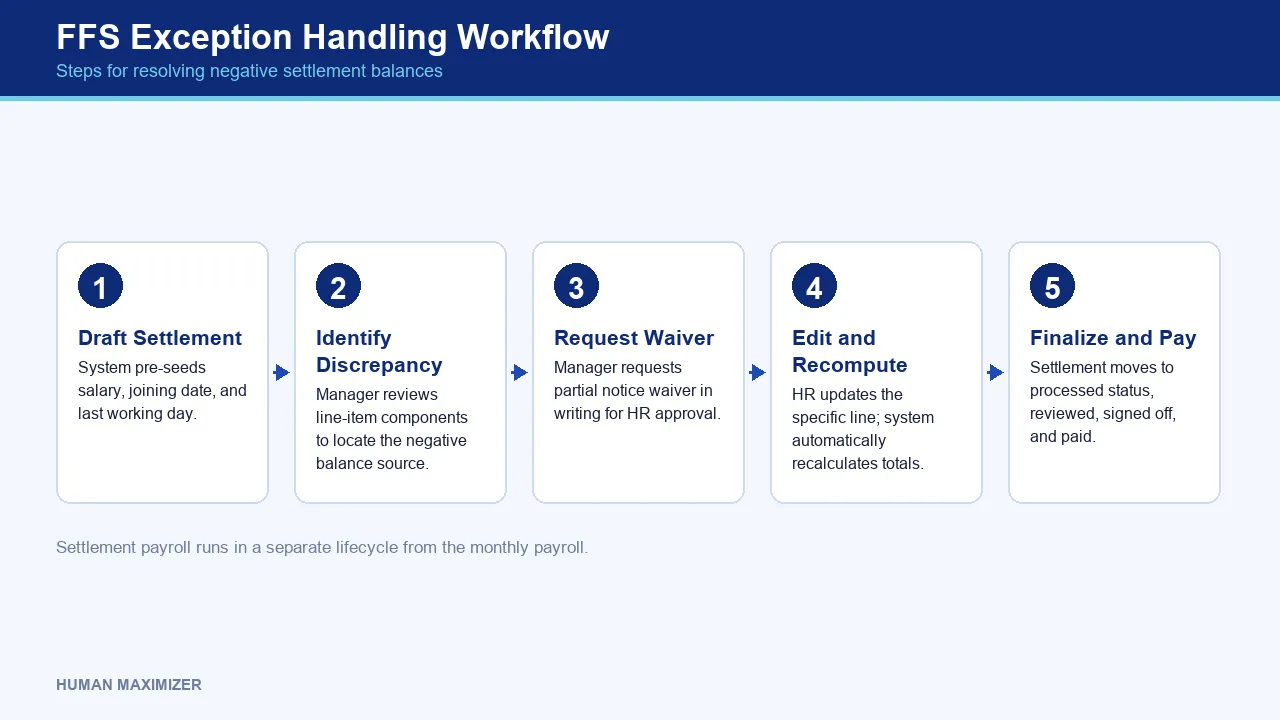
A resignation is accepted with a last working day of 22 August. The settlement is drafted immediately, pre-seeded with salary, joining date and last working day already on record, so nobody re-keys what the system holds. The draft shows a notice shortfall of 38 days and a net payable that has gone negative. Because every component sits on its own line rather than inside a lump sum, the manager can see precisely which line caused it and request a partial notice waiver in writing. HR edits that single line; gross settlement, total deductions and net payable recompute on save, so the totals never drift from the components. The corrected settlement moves to Processed, then into its own settlement payroll batch with a separate lifecycle from the monthly run. Marking it paid is a distinct step, which means the statement can be reviewed and signed off before any money moves.
What changes when the calculation starts earlier
The reason this sequencing matters shows up in the calendar rather than the arithmetic. Walk through a 45-day exit process and count where the days actually go: roughly a week waiting for the department no-dues, another for asset return and IT clearance, then the settlement joins the queue for the next monthly payroll run, which may be three weeks out. The calculation itself takes an afternoon. Everything else is waiting.
Move the ledger to resignation acceptance and those waits run in parallel with the notice period instead of after it. Asset return, clearance and leave reconciliation all have 30 or 60 days of runway. What remains on the last working day is the final part-month attendance and a review of the held column. That is the difference between a process that closes in days and one that closes in weeks, and it is a change in ordering, not in effort.
This is what the resignation and settlement workflow inside Human Maximizer is built to do, and it is deliberately unglamorous. Across 24 client accounts reviewed in July 2026, monthly payroll corrections fell from 15 to 3 per month. Most of that came from the same source: fewer figures being maintained outside the system in the first place. Attendance and payroll sync automatically here, so the part-month calculation is not a manual re-entry. If you want the broader mechanics, our guide to payroll processing in India covers the monthly cycle that a settlement branches off from.
Where Automation Stops and Judgement Starts
Automating the settlement calculation does not settle every question, and pretending otherwise is how vendors lose trust.
Whether notice-period recovery can be adjusted against gratuity is genuinely contested ground, and it is not a switch to flip in software. Several employers treat gratuity as protected and recover only from other components. Take that one to counsel rather than to a configuration screen.
Terminations for misconduct sit outside the ordinary flow. If a disciplinary proceeding or an inquiry under POSH is open, the settlement may need to be held on legal advice, and the ledger's Held column should carry that with an owner and a review date rather than disappearing into someone's inbox.
An exit interview is not a clearance step and should never be allowed to become one. Settlements commonly stall for weeks because a calendar invite could not be arranged between three busy people. Feedback and money are separate processes; gate one on the other and you have converted a compliance obligation into a scheduling problem.
Frequently Asked Questions
What is the full form of FFS in HR? FFS stands for Full and Final Settlement, the closing calculation of all dues between an employer and a departing employee. It covers unpaid salary, leave encashment, gratuity, bonuses and reimbursements on one side, and tax, professional tax, loan recovery and notice shortfall on the other.
Is leave encashment part of FFS? Yes. Unused encashable leave is settled as part of the final payout, normally calculated on basic plus DA rather than gross. The per-day divisor, 26 or 30, is a company policy decision and should be stated explicitly in your leave policy, because it materially changes the amount.
What is the legal timeline for receiving FFS in India? The Code on Wages sets the expectation of settlement within two working days of the last working day. Actual industry practice runs far longer, typically 30 to 45 days, which means most manual exit processes are non-compliant by design rather than by neglect.
How does notice period pay affect the settlement? It cuts both ways. If the employer buys out the notice, notice pay is added to the earned side. If the employee leaves short of the contractual notice, the shortfall is recovered from the payable amount, and on short tenures with no vested gratuity that recovery can leave nothing payable at all.
Does the employee's PF balance get paid through FFS? No. Provident fund accumulations are withdrawn or transferred by the employee directly through EPFO. The settlement covers only the final month's contribution and any recovery, not the accumulated corpus.
Conclusion
Six weeks of silence after the last working day is almost never caused by a difficult calculation. It is caused by a process that starts computing on the wrong day. Move the Exit Ledger to the moment the resignation is accepted, give every held amount a name and a release date, and the two-working-day expectation in the Code on Wages stops being aspirational. Leave it where it is, and the risk is no longer just an annoyed ex-employee: it is a statutory timeline your process cannot meet on its best day.
Want exits that close on the last working day instead of forty-five days later? Talk to our team.
About the Author & Reviewer
Nishant Tandon — Co-founder & Lead Partner, Razor Infotech
Nishant Tandon is Co-founder and Lead Partner at Razor Infotech, with over a decade in IT, customer support and business operations, helping SMEs achieve cost efficiency, stronger customer experience and scalable, sustainable growth.
Connect on LinkedIn
Reviewed & approved by Sameer Hameed — Founder & Chairman, Razor Infotech
Sameer Hameed is the Founder & Chairman of Razor Infotech, where he is guiding the creation of Human Maximizer. An entrepreneur across technology, real estate, mining and travel, he builds organisations on clarity, trust and responsible growth — on the belief that businesses grow only when the people behind them grow.
Connect on LinkedIn
Human Maximizer is built by Razor Infotech in New Delhi, India (founded 2019). About Human Maximizer.
Keep reading

Payroll
Attendance Payroll Integration: Sync Myth
Why manual data transfers cause costly salary errors. Learn how automated attendance and payroll integration ensures accuracy and saves hours...
14 min read
Payroll
Payroll Consultant vs Payroll Software
Stop overpaying for manual processing. Discover if your business needs a dedicated payroll consultant or the efficiency of payroll software...
18 min read
Payroll
Ffs full form in salary
FFS stands for Full and Final Settlement — the last payout when you leave a job. What it includes, how it is calculated, and the deadline to pay it.
8 min read