
Payroll
Beyond the Acronym: What FFS Means in India's Full and Final Settlement
FFS Means: How to streamline your full and final settlement process in India. Learn to calculate terminal benefits accurately while ensuring...

Chandan Watts
Technical Product Manager, Human Maximizer (Razor Infotech) · 14 min read ·

Type "ffs means" into Google and you will get an internet slang expansion, a surgical procedure, and a SIDBI fund scheme before anyone tells you what it means on an Indian payslip. For an HR or payroll professional, FFS means Full and Final Settlement: the closing statement of account between an employer and a departing employee, covering everything owed in both directions up to the last working day. It is the only payroll event that doubles as a legal record, and our team treats it less like a final payslip and more like a small audit file that has to survive scrutiny from three very different readers. The departing employee. A conciliation officer, if it ever gets that far. And an assessing officer, years later. That is why we build Payroll around component-level settlement records rather than a single closing figure.
The gap between those two framings is where most disputes start. A resignation lands on a Friday evening, the employee asks for their money by Monday, and HR reaches for a spreadsheet. What leaves the building a few weeks later is a net number with no working shown. That is the document a labour court will read.
What FFS Means in Indian Payroll, and What It Is Not
Full and Final Settlement is the complete financial closure of the employment relationship: everything the company owes the employee, minus everything the employee owes the company. It applies to every separation type, not just resignations. Termination, retirement, retrenchment, end of a fixed term, and the closure of an establishment all trigger the same obligation.

Gratuity and leave encashment are components that sit inside a settlement rather than alternative names for it, and the final month's salary is only one line among several. A settlement for someone who leaves on the 14th of the month contains a part-month salary line, but it also contains accrued entitlements that have been building for years and deductions that have been sitting quietly in a loan ledger. If you want the mechanics walked through end to end, our step-by-step guide to the FnF process in India covers the operational sequence; this piece is about the compliance exposure underneath it.
One thing worth naming plainly: employee exit settlement is the single payroll transaction most likely to be read by someone outside your company.
The Legal Clock Starts on the Last Working Day
Here is where the stakes change. Under the Code on Wages, the expectation for clearing wages on separation is within two working days of the last working day, rather than the 30 to 45 days most Indian organisations still run on. Treat that as a statutory timeline, not a process preference. A settlement sitting in a finance queue on day 40 is sitting there visibly.
If you read one companion piece before redesigning your exit workflow, make it our breakdown of what 48-hour FFS compliance actually demands of a payroll stack, because the timeline is the constraint everything else bends around.
Most HR teams we speak with are not resisting the deadline. They are structurally unable to meet it, because their exit process only begins on the last working day: that is when clearances get chased, when someone asks IT whether the laptop came back, when leave balance is reconciled against a muster roll. Two working days cannot absorb a process that starts from zero. The settlement has to be pre-computed during the notice period and released on exit, which is a different operating model, not a faster version of the same one.
State Shops and Establishments Acts add their own wage-payment timelines on top, and they differ. A Haryana establishment in Faridabad and a Karnataka one do not read identically. Map the states you operate in rather than assuming the central rule is the whole answer.
FFS Calculation in Payroll: Both Sides of the Ledger
A defensible settlement shows every line, every basis of computation, and every source document. No lump sums.

What the company owes
Unpaid salary for the worked portion of the final month. Leave encashment on the eligible balance, computed on the wage base your policy specifies. Gratuity, where service qualifies. Pro-rata bonus under the Payment of Bonus Act. Notice pay, where the company is the one buying out notice. Reimbursements, incentives and variable pay that have crystallised but not been disbursed.
What the employee owes
Notice period recovery, where the employee served short. Loan and salary-advance balances. Unreturned asset value. Excess leave availed. Statutory deductions still apply to the settlement: professional tax where the state levies it, income tax, and any PF adjustment. Employee PF contribution runs at 12% of basic plus DA under EPFO's published contribution rates, and the final month's contribution has to reach the ECR for that month like any other.
A worked example you can argue with
Illustrative scenario, not a client: an employee in Faridabad on ₹60,000 monthly gross, with basic plus DA at ₹30,000, leaves on the 14th of a 30-day month after six completed years. She served 30 days of a 60-day notice period and carries 12 days of encashable leave.
- Unpaid salary: 14/30 × ₹60,000 = ₹28,000
- Leave encashment at basic/26 per day: ₹30,000 ÷ 26 = ₹1,153.85 × 12 = ₹13,846
- Gratuity, using 15 days' wages × completed years ÷ 26: (₹30,000 × 15 ÷ 26) × 6 = ₹1,03,846
- Notice period recovery, 30 days short, recovered on gross per the contract: (₹60,000)
Gross settlement ₹1,45,692, less recovery, leaves ₹85,692 before professional tax and TDS.
Now change one assumption. Recover the shortfall on basic instead of gross and the recovery halves to ₹30,000, moving the net by ₹30,000 on a single employee. Whichever base your appointment letter specifies, apply it the same way every time. Inconsistency across two exits in the same quarter is exactly the pattern that turns an individual grievance into a class of them.
Gratuity and the Rest of the Terminal Benefits
Gratuity qualifies after five years of continuous service under the Payment of Gratuity Act, waived entirely on death or disablement. Forfeiture for misconduct is possible under the Act but narrow, and it is a decision that needs documented grounds, not an HR judgement call made during a clearance review.
Terminal benefits extend past gratuity. The employee's PF account needs to be either withdrawn or transferred, and their exit date must be marked correctly in the EPFO portal; a missing exit date is one of the most common reasons an ex-employee's claim gets stuck months later, and they will call your HR team about it long after they have stopped being your employee. ESI coverage, where the employee's gross sat below the ₹21,000 monthly threshold, ends on the last working day with its own reporting. Group insurance, superannuation and any NPS contributions each have a separate closure path.
Leave Management matters more here than it looks. If encashable balance is calculated from a spreadsheet maintained in parallel to the system of record, the encashment line becomes the second number in the settlement an employee will challenge.
The Settlement Dossier: What a Defensible Exit File Contains
We use a simple internal standard: every settlement must produce a dossier where each line can be traced to a rule and a document. If a line cannot be traced, it does not go on the statement.
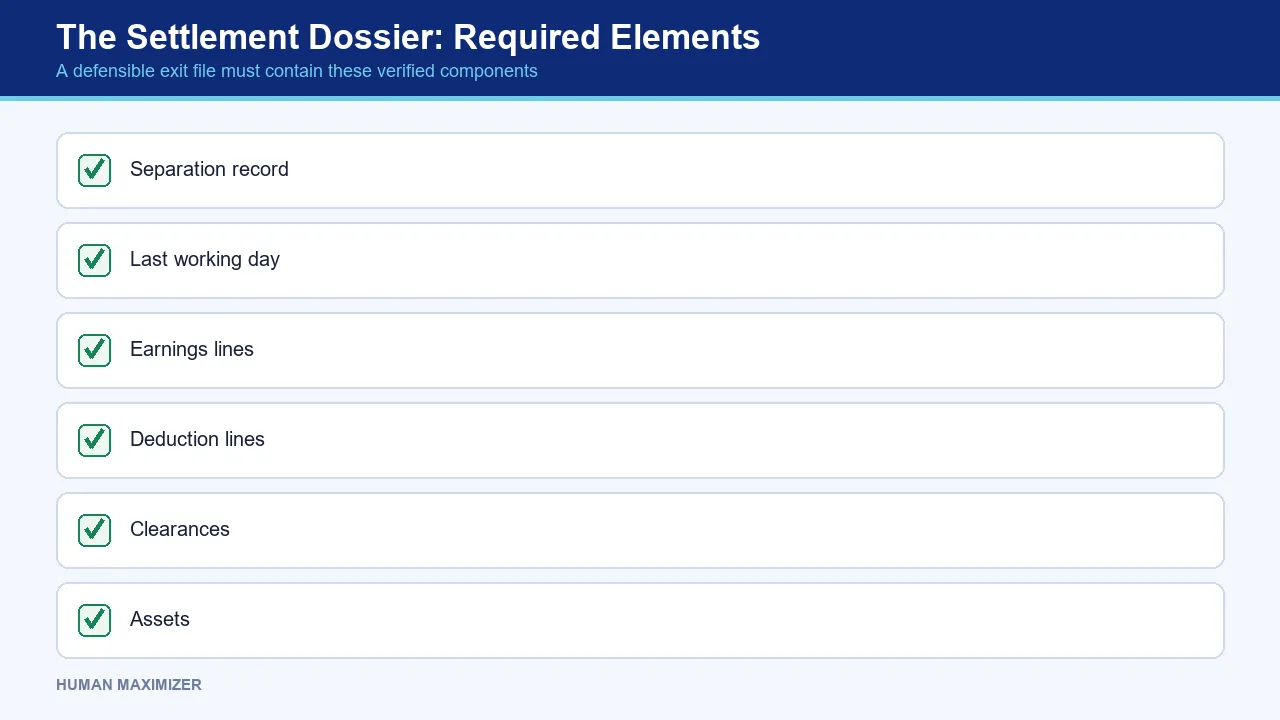
| Dossier element | What it must show | Source of truth |
|---|---|---|
| Separation record | Type (resignation / termination / retirement), date accepted, approver chain | Approved resignation workflow |
| Last working day | Confirmed date, notice served vs required | Appointment letter + approval record |
| Earnings lines | Each component with its formula and base | Payroll master, leave ledger, service record |
| Deduction lines | Each recovery with its contractual authority | Loan ledger, asset register, contract clause |
| Clearances | IT, Finance, Admin, HR, each marked with who and when | Clearance workflow |
| Assets | Laptop, ID card, access card, other, each confirmed | Asset register |
| Exit interview | Completed, date, conducted by | Exit record |
| Statutory closure | PF exit date marked, ESI closure, PT state, TDS computed | Statutory filings |
| Final documents | Relieving letter, experience letter, Form 16, settlement statement | Document repository |
| Payment | Transaction reference, date released against last working day | Payment batch |
Ten rows. A departing employee who receives a statement built this way argues with the policy, not with you. Something HR leads tell us consistently: people almost never dispute the net figure. They dispute the one component nobody explained.
Relieving Letter, Clearances, and the Documents That Follow
The relieving letter confirms the employment ended and when; the experience letter confirms tenure and designation. Withholding a relieving letter as leverage against a disputed recovery is common practice and a poor one, because it converts a payroll disagreement into an employability grievance that a conciliation officer will read unsympathetically.
Clearance is the part that usually breaks. Run it as four parallel lanes rather than a sequential email chain: IT for access revocation and devices, Finance for loans and advances, Admin for physical assets and ID, HR for documents and formalities. Each lane gets a status and a timestamp. When no single lane owns everything, no leaver walks out with unfinished business that surfaces three months later. The exit interview belongs in this file too, marked complete with a date, because it is also the record that a separation was voluntary.
Tax Treatment: The Part Most Guides Skip
Gratuity is exempt under Section 10(10) up to the notified ceiling for covered employees, with the balance taxable as salary. Leave encashment received on separation by a non-government employee is exempt under Section 10(10AA) up to a government-notified limit; encashment taken during service is fully taxable. Check the current notified limits at the time of the settlement rather than carrying forward last year's number in a template.
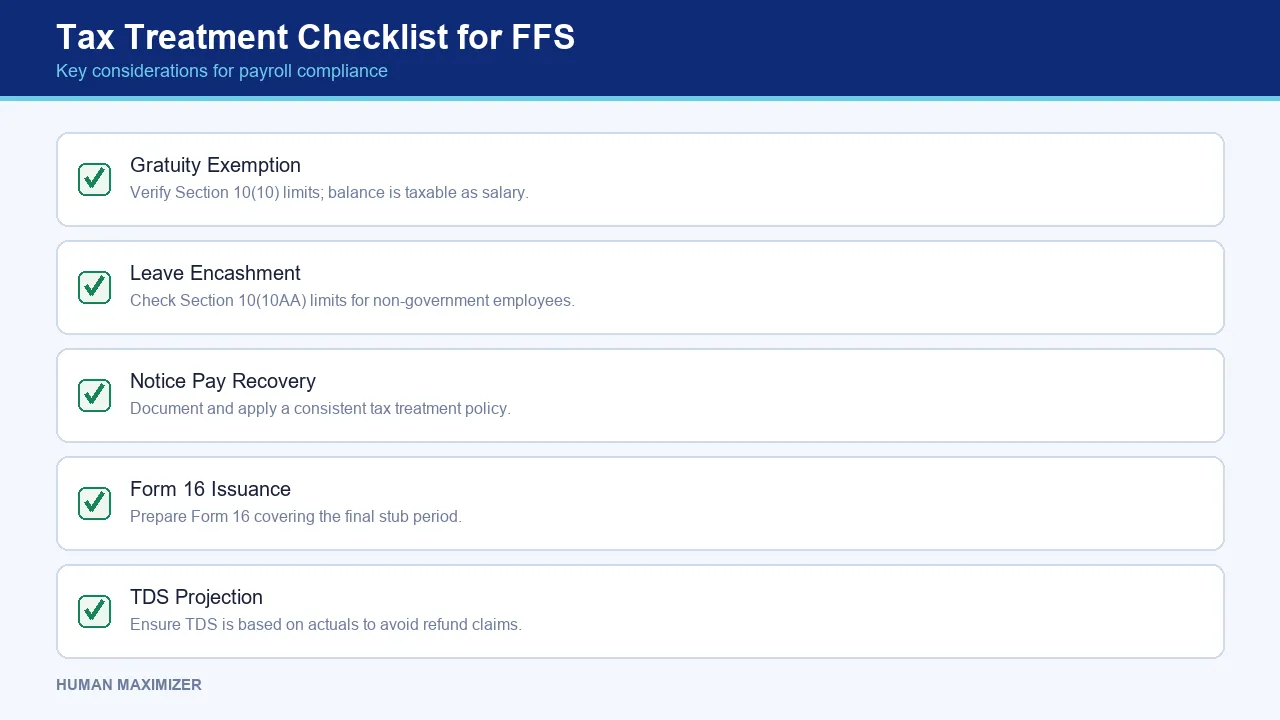
The genuinely contested item is notice pay recovery. Whether the recovered amount reduces taxable salary has gone both ways at tribunal level, and payroll teams handle it inconsistently even within the same company. Pick a position, document the reasoning, and apply it to every exit in the financial year. Also remember the departing employee needs a Form 16 covering the stub period, and will likely give their next employer a Form 12B. A settlement where TDS was computed on a full-year projection that never materialised produces a refund claim and an irritated phone call.
Where the System Earns Its Keep, and Where It Does Not
Picture the exception rather than the happy path. A resignation is approved, and the settlement record is created automatically the moment the last approver signs off. HR opens it to find salary, joining date and last working day already populated. They enter leave encashment and the loan balance, and the gross, total deductions and net payable recompute on every save, so a single edited line never leaves the totals stale. Finance has not marked its clearance lane. The asset register shows the access card outstanding. The settlement can be reviewed and signed off, but "Processed" and "Mark Paid" are separate states, so nothing moves to the bank until both are resolved. When payroll pulls the batch, any settlement older than 45 days is flagged overdue before it is paid, not after. That is how Human Maximizer handles the resignation and settlement flow, and it is the same reasoning behind our broader approach to employee exit management software.
Across a sample of 24 mid-market clients reviewed in July 2026, monthly payroll corrections fell from 15 to 3 after moving onto our platform. Fewer corrections upstream means fewer disputed components downstream, because a settlement inherits whatever accuracy the preceding 12 payroll runs had. Supporting records live in Employee Data Management, so the relieving letter and settlement statement are retrievable years later when someone actually asks for them.
Where automation stops
Gratuity forfeiture for misconduct is a legal determination rather than a workflow state, and no payroll engine should make it for you. Where gratuity is funded through an approved trust or an LIC group scheme, the payout timing sits with the fund, and HR can compute the entitlement on day one and still not control the release date. A settlement being contested in conciliation should be frozen by a human, not processed on schedule because a 45-day timer fired. And notice recovery where the appointment letter conflicts with certified standing orders needs counsel, not a configured rule.
Frequently Asked Questions
What is the difference between notice period buyout and notice period recovery? A buyout is the company paying the employee in lieu of notice it chooses not to have them serve, so it appears as an earning line called notice pay. Recovery is the reverse: the employee leaves short of their contractual notice, and the shortfall is deducted. Both are priced off the notice clause in the appointment letter, but they land on opposite sides of the settlement, and mislabelling one as the other changes both the net payable and the TDS treatment. Where a new employer reimburses the shortfall, the recovery still runs against your employee, not against the incoming company.
Is FFS the same as gratuity or leave encashment? No. Both are components that appear inside a settlement only when the employee qualifies. A valid settlement can contain neither, for instance where service is under five years and the leave balance is nil.
Can an employer withhold a settlement until the employee returns company assets? Unreturned asset value can be deducted as a recovery line where the contract authorises it, which is the defensible route. Holding back the entire settlement indefinitely to force a return is a weaker position, because the wage-payment timeline applies to the undisputed portion regardless of the dispute over one laptop.
What happens if the EPFO exit date is never marked? The employee's withdrawal or transfer claim sits blocked, often discovered months after they have left and usually resolved by your HR team rather than theirs. Marking the date of exit at settlement time, alongside the ESI and professional tax closures, removes a support ticket you would otherwise field much later.
Conclusion
The internet will keep telling you that FFS means something else. Inside an Indian payroll function it means a dated, itemised, traceable closure of an employment contract, and under the Code on Wages the clock on it is measured in working days rather than weeks. Teams still running exits on a 30-day spreadsheet cycle are operating a process the statute no longer contemplates, and every exit handled that way leaves behind a record someone outside the company may read first. Want settlements that are already computed before the last working day arrives? See how Human Maximizer handles it.
About the Author & Reviewer
Chandan Watts — Technical Product Manager, Human Maximizer (Razor Infotech)
Chandan Watts is Technical Product Manager at Razor Infotech, building the Human Maximizer HR platform. After years leading customer-experience and team operations at JindalX and Radical Minds, he focuses on how teams actually work day to day — and how small workflow gaps quietly slow an entire team down.
Connect on LinkedIn
Reviewed & approved by Sameer Hameed — Founder & Chairman, Razor Infotech
Sameer Hameed is the Founder & Chairman of Razor Infotech, where he is guiding the creation of Human Maximizer. An entrepreneur across technology, real estate, mining and travel, he builds organisations on clarity, trust and responsible growth — on the belief that businesses grow only when the people behind them grow.
Connect on LinkedIn
Human Maximizer is built by Razor Infotech in New Delhi, India (founded 2019). About Human Maximizer.
Keep reading
Payroll
Beyond the Resignation: FFS Fullform
FFS Fullform: How to calculate Full and Final Settlement for Indian employees accurately. Discover the key components, statutory requirements...
15 min read
Payroll
Attendance Payroll Integration: Sync Myth
Why manual data transfers cause costly salary errors. Learn how automated attendance and payroll integration ensures accuracy and saves hours...
14 min read
Payroll
Payroll Consultant vs Payroll Software
Stop overpaying for manual processing. Discover if your business needs a dedicated payroll consultant or the efficiency of payroll software...
18 min read