
HR Strategy
Ditching the Geofence: Field Force Tracking Software Built on Trust
How to move beyond restrictive monitoring. Learn how modern field force tracking software builds high-velocity teams through trust...

Nishant Tandon
Co-founder & Lead Partner, Razor Infotech · 12 min read · · Updated

A geofence can confirm that a phone crossed a line on a map. It cannot confirm that a sales visit went well, or that a rep made a smart call under pressure. Yet most field force tracking software in India is bought and enforced as if the line were the point. Managers get a dot on a screen; reps get a manager who calls four times a day asking "where are you?"; and everyone quietly agrees the tool is a leash. At Human Maximizer, we built our Geo-Fencing capability around a different premise: location data should answer questions automatically so that nobody has to ask them out loud. This article is about that shift, from surveillance to what we call contextual trust, and why it is the difference between a field team that reports activity and one that produces velocity.
This is not a soft, culture-deck argument. The research on team performance keeps reaching the same verdict: trust-first management outperforms oversight on hard outcomes. Field teams are no exception. They are simply the teams where employers find it easiest to substitute monitoring for trust, because the worker is out of sight.
Why the Digital Leash Slows Field Teams Down
Surveillance-style tracking fails on its own terms. A rep who knows every idle minute is logged learns to manage the log, not the territory. Fake visits get planned around fence boundaries. Phones stay in the office bag of a colleague. None of this is hypothetical; it is the predictable response of intelligent adults to being policed.
There is a quieter cost too. Amy Edmondson's research shows that teams with high psychological safety learn faster, surface errors sooner, and innovate more than low-safety teams. A rep who fears the location log will not tell you a client meeting collapsed. They will log it as "completed" and let you find out at quarter end. In India's high-churn field roles, where a departing rep takes a territory's relationship map with them, that silence compounds: you lose the truth first and the person second.
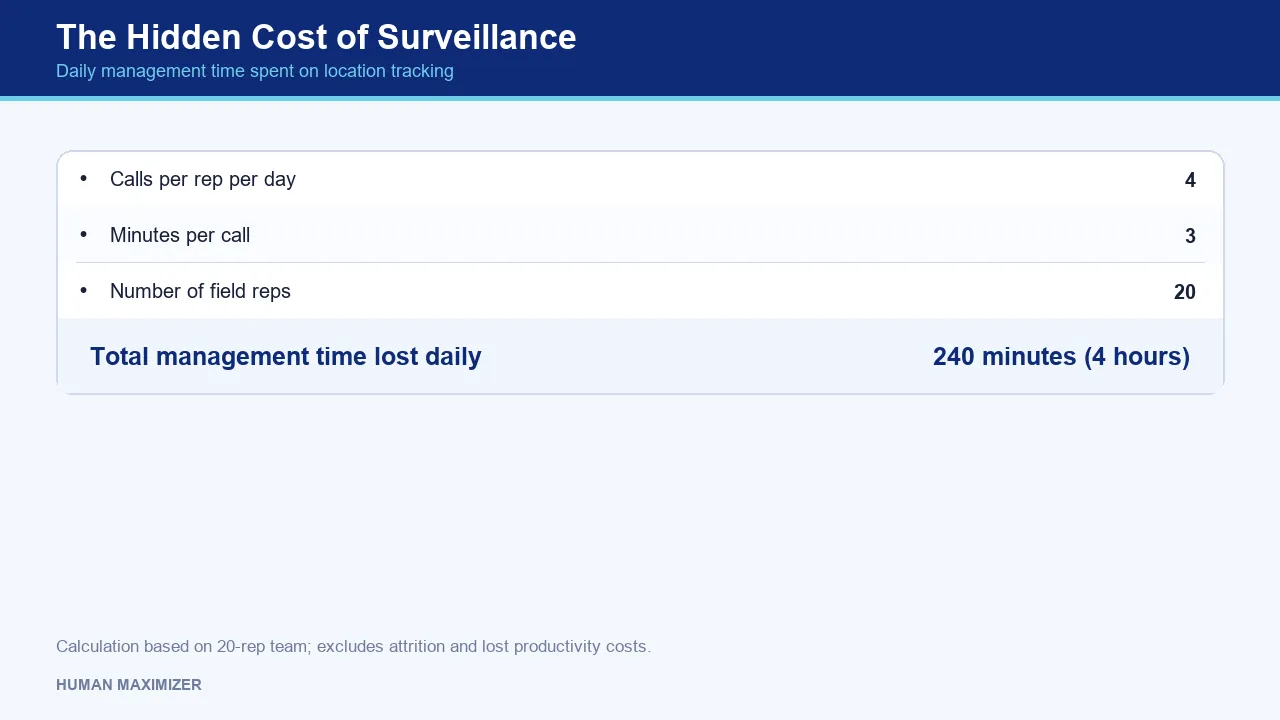
Then there is the arithmetic of interrogation itself. Assume a manager makes four "where are you?" calls per rep per day, at three minutes each, across a 20-rep team. That is 4 × 3 × 20 = 240 minutes, four full hours of management time daily, spent collecting information a system could surface silently. Adjust the call count to your own team and the conclusion barely moves. The leash is expensive even before you count attrition.
How Field Force Tracking Software Builds Contextual Trust
Contextual trust is the organizing idea we kept returning to while building the product: track the context of the work, not the body of the worker. In practice it rests on three properties.
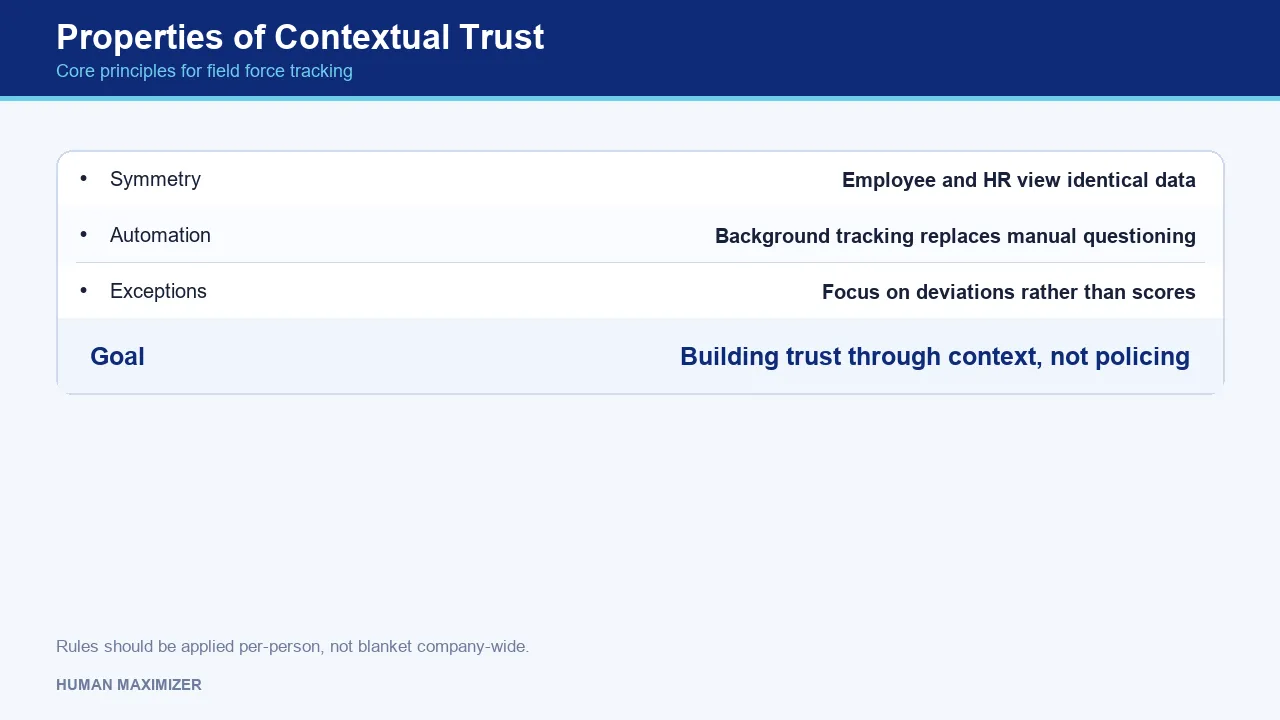
Symmetry. The employee sees exactly what HR sees. In Human Maximizer, the punch screen shows a live map with the office circle and the employee's own dot, green when inside, red when outside. There is no "the app says I'm not here but I'm standing right here" argument, because both sides are looking at the same picture.
Automation over interrogation. Employee location tracking should replace questions, not generate them. Our geofencing runs in the background with no UI required during the day. Walk out of the fenced area for a cup of tea, and a break starts. Walk back in, and it ends, with the duration recorded. If you were already on a manual break, the system does nothing; it never double-counts. The rep is never punished for stepping outside the fence. At most they get a soft "break limit exceeded" note if cumulative break minutes pass the day's allowance.
Exceptions over scores. Operations teams do not need one big behaviour score. They need to know which three of ninety field events today deviated from plan. A single number invites policing; an exception list invites problem-solving.
The per-person rule, not the blanket rule
One design decision matters more than any feature list: tracking rules should be per person, not per company. A showroom employee can sit on a "within office radius" punch rule while a travelling rep is on "any location", where every punch still goes through a deliberate map-and-confirm step so nothing is logged by accident. Blanket rules are what turn geofencing attendance software into a grievance machine.
Work Orders, Routes, and the Case for Autonomy
High-velocity field work is mostly a sequencing problem. Who visits which client, and in what order? Software that treats reps as pins to be watched contributes nothing here. Software that treats them as owners of a route contributes a great deal: the day's visits and task states live in one place, and Task Management records progress as it happens rather than in a 6 p.m. reconstruction call.
Roster discipline matters just as much for distributed teams. When shift patterns and territory coverage are planned once in a shared roster, a manager designs the week in advance instead of renegotiating it daily over WhatsApp. Autonomy is not the absence of structure. It is structure agreed in advance, so the rep spends the day executing instead of reporting.
Field sales automation software earns its keep at exactly this layer: visit plans and their outcomes flowing through the same system that handles attendance, so nobody maintains two versions of the truth.
The Mobile-First Field Experience
A field employee tracking app is judged in the field, one-handed, on patchy 4G. If punching in takes four screens, reps will batch their honesty. Human Maximizer's mobile app carries full functionality, so a rep can punch with GPS verification, then check leave balances or their own attendance record without touching a laptop. That last part is underrated: when Attendance Management lets employees audit their own data, most month-end disputes resolve before they become tickets.
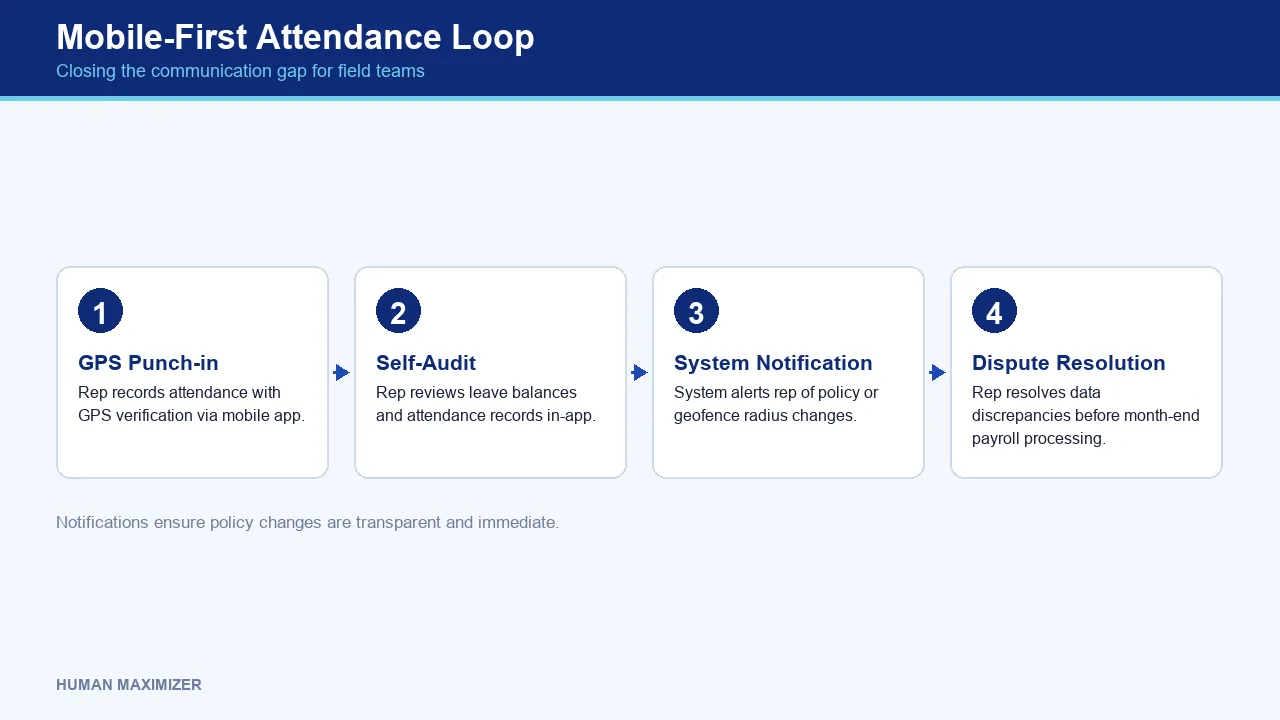
Notifications close the loop. Every time geofencing is enabled or disabled for an employee, they get a notification with the new radius and a direct link to their attendance page. Policy changes are announced by the system, not discovered at payroll. For a deeper look at how mobile check-in data should flow into pay, our guide to employee attendance tracking software walks through the full chain.
Reporting for Performance, Not Policing
Automated reporting is where good intentions usually die. Teams often discover the problem during review cycles: activity looks healthy, deliverables do not. And the gap between what the dashboard shows and the real state of work tends to widen fastest in the second month after rollout, once people have learned which behaviours the dashboard rewards.
The fix is to report on work movement, not worker movement. Productivity Lens tracks team output through task completion rates and milestone progression using aggregated metadata, no screenshots, no keystrokes. For a field team, that means the question shifts from "was the rep inside the fence at 11:40?" to "which accounts have stalled between visit two and visit three?" The first question polices a person. The second one finds revenue. We have written more broadly on this distinction in our guide to measuring productivity without surveillance.
Choosing a Field Team Management System for Indian Operations
Sales force automation in India has its own realities: multilingual teams, and two-wheeler routes that GPS maps optimistically. In the run-up to our 2019 launch, we spoke with HR leaders, managing directors and founders across Indian companies across manufacturing, trading and professional services to map how field attendance actually breaks; that research provenance is on our about page. The objection to tracking was almost never the GPS itself. It was asymmetry: being watched without being able to see, and being questioned about data they could not inspect.
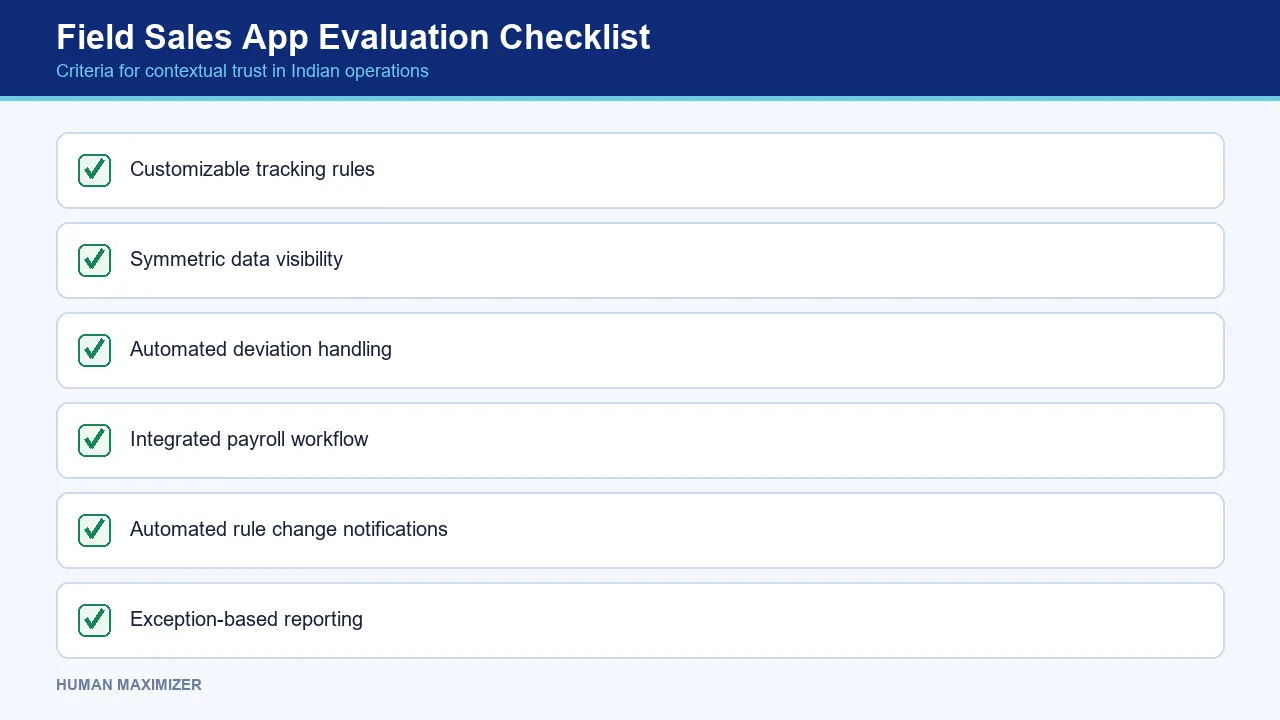
A buyer's checklist for contextual trust
Put these questions to any field sales monitoring app before you sign:
- Can tracking rules be set per employee, so field staff and office teams are not forced through one policy?
- Does the employee see the same location picture the admin sees, at punch time?
- Are breaks and out-of-fence events handled automatically, or does every deviation require an explanation?
- Do location events flow into the same attendance and payroll chain, or do you reconcile two systems monthly?
- When a rule changes, is the affected employee notified automatically, with specifics?
- Does reporting surface exceptions and stalled work, or just an activity score?
That fourth question has statutory teeth in India. PF contributions and the ECR filing are due by the 15th of the following month, so a field team whose attendance needs manual reconciliation is a field team flirting with a missed statutory deadline every single month.
India already has capable dedicated field-tracking tools; Lystloc and FieldAssist are among the better-known names, and the checklist above applies to them exactly as it applies to us. Where the category genuinely falls down is the generic GPS tracker, vehicle telematics rebadged as an employee app: it answers the symmetry question with silence, because it was never designed to show the tracked person anything. A vendor who cannot answer the symmetry and notification questions is selling you a leash with a dashboard.
Where Location Data Should Stop
Honesty requires naming the limits. Location data alone should never drive a performance review; a rep covering a dense urban beat and one covering three districts will produce incomparable movement patterns, and only a human conversation can weigh them. Emergency-response roles, such as service technicians on breakdown calls, break fence logic entirely and belong on an any-location rule from day one. And under India's Digital Personal Data Protection Act, 2023, lawful processing is tied to a specific stated purpose, which makes an employee's location trail, collected beyond what attendance and pay require, a liability rather than an asset. Track what feeds attendance and pay. Resist the urge to store the rest.
Frequently Asked Questions
Can field tracking software work without intrusive monitoring? Yes, if it is designed for symmetry and automation. Background GPS that triggers attendance events automatically, visible equally to the employee and the employer, verifies work context without screenshots or keystroke logging.
What are the benefits of GPS-based attendance systems? Verified check-ins end buddy punching and location disputes, and clean data from a GPS-based attendance management system flows straight into payroll without month-end reconciliation. The larger benefit is managerial: managers stop spending hours a day asking for locations the system already knows.
How should an Indian business choose field force management software? Start with rule flexibility: field reps and office staff should be able to sit on different punch policies inside one system. Then confirm that employees are notified automatically when their tracking rules change, and that location events feed the same attendance and payroll chain rather than a separate silo.
What features are essential for sales force automation? Visit and task management with route-aware day planning, plus GPS-verified check-ins that flow into attendance. Reporting should track account progression rather than raw activity. The essential non-feature is restraint: no capability that forces reps to justify normal human movement.
Conclusion
Come back to that dot crossing a line on a map. It was never the point. What field leaders actually need is to know where work is stuck, and what field reps actually need is to be trusted with everything else. Field team productivity tools that get this right make the "where are you?" call obsolete, and the payoff is the arithmetic we ran earlier: even if you halve our assumed call volume, a 20-rep team hands its managers back two hours a day, every working day. Run the model on your own numbers; the conclusion survives the adjustment. That reclaimed time is the velocity everyone was buying software to find in the first place. Ready to retire the digital leash without losing visibility? See how Human Maximizer handles field teams, or write to us for a walkthrough built around your own routes.
About the Author & Reviewer
Nishant Tandon — Co-founder & Lead Partner, Razor Infotech
Nishant Tandon is Co-founder and Lead Partner at Razor Infotech, with over a decade in IT, customer support and business operations, helping SMEs achieve cost efficiency, stronger customer experience and scalable, sustainable growth.
Connect on LinkedIn
Reviewed & approved by Sameer Hameed — Founder & Chairman, Razor Infotech
Sameer Hameed is the Founder & Chairman of Razor Infotech, where he is guiding the creation of Human Maximizer. An entrepreneur across technology, real estate, mining and travel, he builds organisations on clarity, trust and responsible growth — on the belief that businesses grow only when the people behind them grow.
Connect on LinkedIn
Human Maximizer is built by Razor Infotech in New Delhi, India (founded 2019). About Human Maximizer.
Keep reading

HR Strategy
Employee Lifecycle Management System
Discover how to streamline every stage of the talent journey. Learn to leverage employee lifecycle management software to boost retention and HR...
13 min read
HR Strategy
Hr software employee productivity
How to boost workforce output through strategic HR software implementation. Learn the essential steps to drive adoption and efficiency...
13 min read
HR Strategy
Workforce Productivity Software
Why your current workforce productivity software might be masking critical performance gaps and learn how to gain true visibility into team output...
13 min read