
Payroll
Beyond the Salary Slip: A Salary Certificate Format Banks Accept
The essential components of a professional salary certificate format. Learn when employees need one and how to automate issuance using Human...

Chandan Watts
Technical Product Manager, Human Maximizer (Razor Infotech) · 15 min read ·

A salary certificate is the one pay document your HR team writes freehand, which is why it is the one most likely to disagree with everything else in the employee's file. Payslips come out of Payroll. Form 16 comes out of the TDS return. The certificate usually comes out of a Word file last edited for someone else, and a salary certificate format that looks fine on screen can still fail at a bank counter because one figure does not match the papers stapled behind it.
Picture an operations analyst at a freight forwarding firm in Kochi with a Schengen visa appointment on Monday morning. She asks for the certificate on Friday. HR types her salary from memory of her offer letter, a director signs a scanned copy, and the consulate's checklist turns out to want an original on letterhead with a stamp. That Kochi story is an illustration we built for this article, not a record of one real employee, but most HR teams have lived some version of it.
Our argument is simple. Treat the certificate as a declaration the company will be asked to stand behind, not as a favour typed between meetings.
Salary Certificate vs. Payslip: Why One Cannot Replace the Other
A payslip is a monthly statutory record. It shows what was earned and deducted for one pay period, and Indian wage laws expect employers to issue it and keep the underlying registers. A salary certificate is a declaration issued on request. It summarises a person's employment and pay as of a date, addressed to a third party, over the signature of someone authorised to speak for the company.

That difference matters for HR compliance. A payslip is evidence of a transaction that already happened. A certificate is a statement the company is making now, and the bank or consulate will hold the company to it. If you want the payslip side in detail, our guide to the salary slip format in India covers each component.
Two neighbours get confused with it:
- Employment verification letter: confirms that the person works for you, their designation and their date of joining. Salary is optional. It is employment proof, not income proof.
- Form 16: the TDS certificate under the Income-tax Act. It is annual and statutory, and it cannot be drafted to suit a purpose.
Lenders typically ask for the certificate alongside recent payslips and bank statements, not instead of them. Which is exactly where the trouble starts.
What a Valid Salary Certificate Must Include
Employee and employer details
The essentials are the employee's full name as it appears on their PAN or passport, employee ID, designation, department, date of joining and employment status (probation, confirmed, fixed-term). On the employer side, the certificate needs the company's legal name and registered address, plus a contact number and official email that a verifier can actually reach.
The salary breakdown: gross, net and CTC
Most rejected certificates fail here, because "salary" means three different numbers. A worked example makes it visible.
Illustrative scenario: an employee earns a basic of ₹35,000, HRA of ₹14,000 and a special allowance of ₹21,000. Gross salary is ₹70,000 a month. Assume PF is contributed on full basic, so the employee's share, at the statutory rate on basic plus DA under the Employees' Provident Funds Scheme, 1952, is ₹4,200. Add TDS of ₹3,000 and professional tax of ₹200, and net salary is ₹62,600. The employer's matching PF of ₹4,200 a month takes annual CTC to ₹8,90,400 before any gratuity provision.
So there are three honest answers to "what does she earn": ₹74,200 a month if you divide CTC by twelve, ₹70,000 gross, ₹62,600 net. Only the last one appears in her bank statement. A certificate that states "monthly salary ₹74,200" matches nothing the bank is holding. Change the assumptions to your own structure and the gap remains.
State all three, labelled, with statutory deductions listed separately. If your structure was recently reworked so that basic is at least half of total remuneration, the component split on the certificate must follow the revised structure. Our piece on salary restructuring under the new wage code explains why take-home moves even when CTC does not.
Purpose, date and reference number
Name the purpose and the addressee. Date it. Give it a reference number that you log, because a verification call three weeks later will quote that number and someone on your team needs to find the copy.
The Trail Test: An HR Pre-Issuance Checklist
We use one rule before any certificate leaves the building, and we call it the Trail Test: every figure and fact on the certificate must trace to a document the verifier already has, or can ask for. If a line has no trail, it does not go on the page.

| Line on the certificate | Must match | Where it usually breaks |
|---|---|---|
| Name and designation | Passport or PAN, latest appointment or promotion letter | Promotion processed in payroll, letter never issued |
| Date of joining | Employee master record, PF records | Group transfer date used instead of original joining date |
| Gross salary | Earnings total on the latest payslips | CTC divided by twelve typed as gross |
| Net salary | Salary credit in the bank statement | A month with arrears, a bonus or an unusual deduction picked as "typical" |
| Deductions | PF, TDS and PT lines on the payslip | Deductions omitted, so net cannot be reconciled |
| Annual figure | Form 16 or the current structure | Last year's figure used after a mid-year revision |
Two India-specific traps deserve a mention. In states where professional tax is recovered half-yearly, Kerala being one, net pay dips in the recovery months, so "net salary" should be stated for a normal month and described as such. And if a payslip was corrected and reissued after the employee had already downloaded the first version, two payslips for the same month are now in circulation. The employee will hand over whichever they saved.
That second trap is more common than it sounds. When our team traces a mismatched certificate backwards, the origin is usually a late attendance or salary input that forced a correction near payroll cutoff. In a review of 24 client payroll setups completed in July 2026, monthly payroll corrections fell from 15 to 3 once attendance and salary inputs sat in one system. That figure comes from our own internal review of those setups. No published case study sits behind it, so read it as our observation and not as an audited result. Fewer corrections mean fewer stray payslips for a certificate to contradict.
Pull the figures from the employee master in Core HR and the latest processed payslip. Never from the offer letter.
Letterheads and Signatures: Digital vs. Wet Ink
Is a company letterhead mandatory?
No statute prescribes a salary certificate, so no statute prescribes its letterhead. In practice it is non-negotiable. Verifiers expect a certificate issued on company letterhead with an authorised signature, seal and date. For companies, Section 12 of the Companies Act, 2013 already requires the name, registered office address, CIN and contact details on business letters, so a letterhead missing the CIN is a small red flag of its own.
Three kinds of "signed"
This is where most guidance goes vague, so here it is plainly.
A wet ink signature on printed letterhead with the company stamp is the safest choice for consulates and for many branch-level loan desks. Their checklists often ask for originals.
Pasting a scanned signature image into a PDF does not make it a digital signature. The image proves nothing about who signed, and it is the format most likely to be queried.
True digital signatures are a different thing altogether. Issued by a licensed certifying authority or applied through Aadhaar eSign, they have legal recognition under the Information Technology Act, 2000. Section 3 of that Act covers authenticating an electronic record with a digital signature, Section 3A extends this to other notified electronic signature techniques, and Section 5 provides that where a law requires a signature, an electronic signature satisfies it. You can read those sections yourself by searching the Act by name on India Code, the government's repository of central legislation. Such a signature can also be validated inside the PDF itself, which a scanned image never can. Acceptance of these signatures is growing. Accepted by law and accepted by a particular visa counter are different things, though.
So read the institution's checklist first. If it is silent, issue a wet-signed original and offer a digitally signed PDF as a second copy.
Who is the authorised HR signatory?
Whoever the company has authorised: typically the HR head, a director, the proprietor or a named authorised signatory. Print their name, designation and direct contact beneath the signature. Choose someone who will be reachable when the verification call comes, because an unanswered call can stall a loan as surely as a wrong figure.
Salary Certificate Format for a Bank Loan vs. a Visa Application
The base facts stay the same. The emphasis changes.
For a bank loan
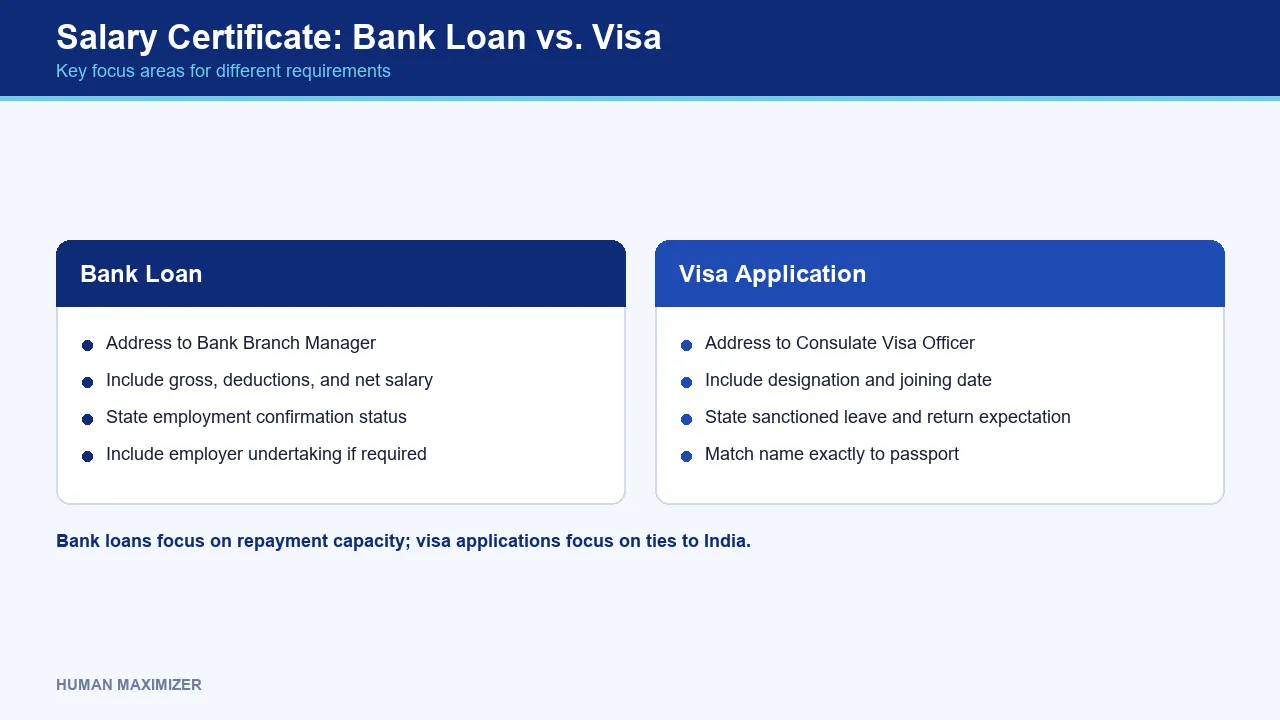
Address it to the branch manager of the named bank. Lenders care about repayment capacity, so give gross salary, itemised deductions and net salary, with amounts in figures and words, and state whether the employee is confirmed. Some banks supply their own proforma, sometimes with an undertaking that the employer will route salary to a particular account or inform the bank on exit. That undertaking is a commitment by the company, and it needs sign-off beyond HR.
For a visa application
Address it to the visa officer of the relevant consulate. Consulates care about ties to India: designation, date of joining, salary, sanctioned leave dates and the expectation that the employee resumes work afterwards. Keep it to one page. Match the name to the passport, character for character.
Former employees ask too, usually for a new employer or a pending loan. State the last drawn salary and the last working day, and keep it consistent with their settlement papers. Our explainer on the FFS full form in salary covers what the full and final statement contains.
Legal Compliance and Verification Standards in India
There is no central law that says "issue a salary certificate in this form". The obligations sit one layer down. State Shops and Establishments Acts and the Code on Wages, 2019 (Section 50 deals with records, registers and wage slips) require employers to maintain wage registers and issue wage slips, and those records are what a certificate must agree with. An inflated or careless certificate is a false statement on company letterhead, handed to a lender who relies on it. That is the legal exposure, and it lands on the signatory as well as the employee.
A note on checking the register rules: the labour codes and the rules framed under them are published on the Ministry of Labour and Employment's portal. The registers and wage slip format that apply to your establishment also depend on your state's rules, so confirm against both before you rely on a summary, including this one.
Three habits keep you safe. Keep a register of every certificate issued, with its reference number and a retained copy. Issue only on a written request from the employee, since salary is their personal data. And confirm figures to a verifier only through official channels, against the reference number, never by reading out fresh numbers over the phone.
A Copy-Ready Salary Certificate Format in Word
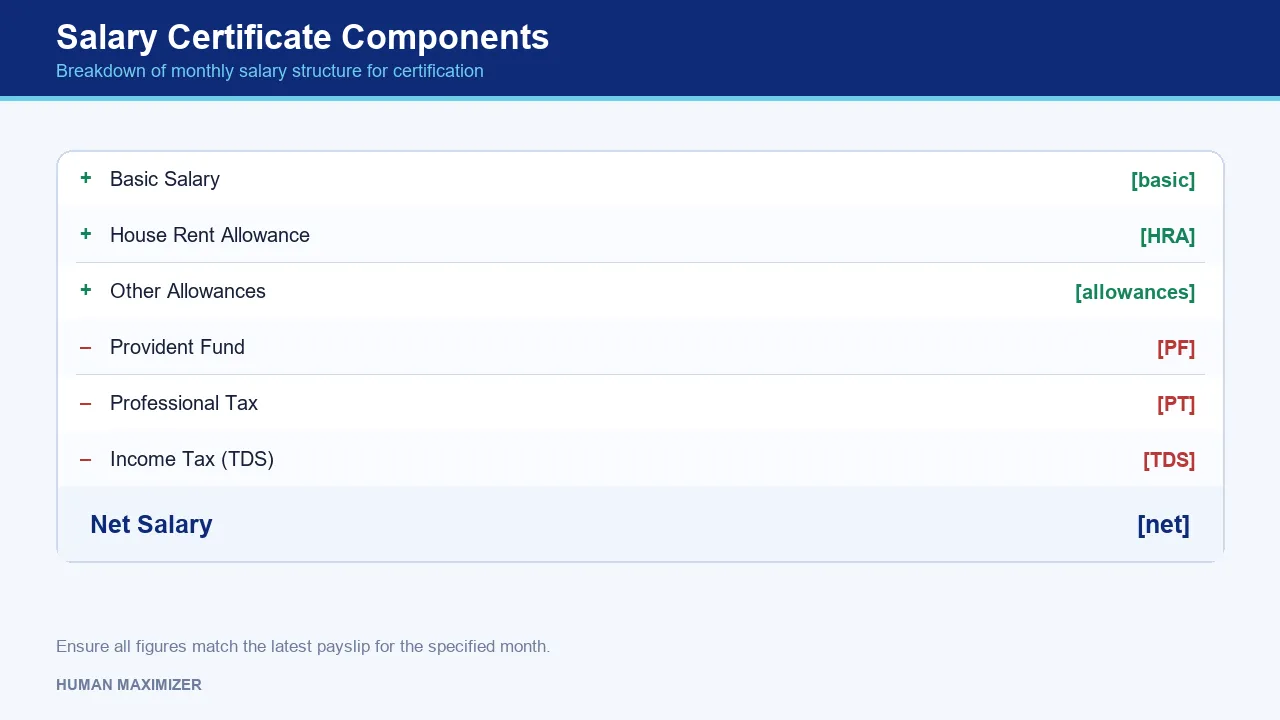
Paste this into Word on your letterhead, fill the brackets from the latest payslip, and save the signed version as PDF.
[COMPANY LETTERHEAD: legal name, registered address, CIN, phone, email]

Reference No: [HR/SC/2026/___]                     Date: [DD Month YYYY]

To,
[The Branch Manager, Bank and Branch / The Visa Officer, Consulate]

SALARY CERTIFICATE

This is to certify that [Mr/Ms Full Name], Employee ID [___], has been
employed with [Company Legal Name] since [date of joining] and currently
holds the position of [designation] in the [department] department as a
[confirmed / probationary / fixed-term] employee.

Monthly salary details as per the payslip for [Month YYYY]:

  Basic salary                 ₹ [basic]
  House rent allowance         ₹ [HRA]
  Other allowances             ₹ [allowances]
  Gross salary                 ₹ [gross]
  Less: Provident fund         ₹ [PF]
  Less: Professional tax       ₹ [PT]
  Less: Income tax (TDS)       ₹ [TDS]
  Net salary                   ₹ [net]  (Rupees [in words] only)

Annual cost to company (CTC): ₹ [annual CTC]

[Loan version] This certificate is issued at the employee's request for
submission to [bank name] in connection with a [home/personal] loan.

[Visa version] [He/She] has been granted leave from [date] to [date] and
is expected to resume duties on [date]. This certificate is issued at the
employee's request for a visa application.

The company undertakes no financial liability by issuing this certificate.

For [Company Legal Name]

[Signature and company seal]
[Name of signatory]
[Designation] | [Direct phone] | [Official email]
Where a Template Stops Helping
A template solves formatting, not judgment. Three situations need a person.
If the bank or consulate has its own format, theirs wins. Do not argue that yours is better.
If the employee is serving notice, or their pay is partly on hold pending a clearance, the certificate must not imply a stability that does not exist. What to disclose is a decision for the HR head, and sometimes for legal counsel.
Software has a limit as well, including ours. Human Maximizer keeps the sources in agreement: salary structures are versioned, so a revision creates a new record and preserves the old one, and payslips download as PDFs from the same data. Take an employee whose pay was revised in the middle of the quarter. The request arrives as a ticket in Ticket Management instead of a WhatsApp message. HR opens the current revision and sees that two of the last three payslips predate it, so the certificate states the revised salary with its effective date. The bank's question is answered before it is asked. Drafting and signing still belong to an authorised person. The platform does not sign for you.
Frequently Asked Questions
What details must be included in a salary certificate? The employee's name, ID, designation and date of joining, followed by gross salary, itemised deductions, net salary and annual CTC. Add the purpose, addressee, date and reference number, then the signature, seal and contact details of the authorised signatory.
What is the difference between a salary certificate and a payslip? A payslip records one month's earnings and deductions and is issued every pay cycle. A salary certificate is issued on request, summarises pay and employment as of a date, and is addressed to a third party such as a bank.
Will a bank accept a digitally signed salary certificate? A valid digital signature is legally recognised under the Information Technology Act, 2000, but acceptance depends on the lender and sometimes the branch. A scanned signature image is not a digital signature. When in doubt, issue a wet-signed original on letterhead.
Who can sign a salary certificate? Anyone the company has authorised, usually the HR head, a director or the proprietor. The signatory's name, designation and contact details should be printed, because verifiers call.
Conclusion
Go back to the analyst in Kochi. Her certificate did not need better wording. It needed a net salary that matched her bank credit, a gross figure that matched her payslips, and an original signature because her consulate asked for one. Each of those could have been settled on Friday afternoon, in about the time it takes to read one checklist. A mismatch gets found either way. It can be found at your desk, or at a visa counter with a flight already booked.
We built this guide so the first is easier. Stop manually reconciling salary data—see how Human Maximizer automates the source of truth for your certificates.
About the Author & Reviewer
Chandan Watts — Technical Product Manager, Human Maximizer (Razor Infotech)
Chandan Watts is Technical Product Manager at Razor Infotech, building the Human Maximizer HR platform. After years leading customer-experience and team operations at JindalX and Radical Minds, he focuses on how teams actually work day to day — and how small workflow gaps quietly slow an entire team down.
Connect on LinkedIn
Reviewed & approved by Sameer Hameed — Founder & Chairman, Razor Infotech
Sameer Hameed is the Founder & Chairman of Razor Infotech, where he is guiding the creation of Human Maximizer. An entrepreneur across technology, real estate, mining and travel, he builds organisations on clarity, trust and responsible growth — on the belief that businesses grow only when the people behind them grow.
Connect on LinkedIn
Human Maximizer is built by Razor Infotech in New Delhi, India (founded 2019). About Human Maximizer.
Keep reading

Payroll
Salary Slip Format in India
How to structure your payroll for transparency and compliance. Learn the essential components required in a professional salary slip format in India.
16 min read
Payroll
FFS Means
FFS Means: How to streamline your full and final settlement process in India. Learn to calculate terminal benefits accurately while ensuring...
14 min read
Payroll
Beyond the Resignation: FFS Fullform
FFS Fullform: How to calculate Full and Final Settlement for Indian employees accurately. Discover the key components, statutory requirements...
15 min read