
HR Strategy
Beyond the Black Box: ethical AI in HR
How CPOs can implement predictive analytics while maintaining transparency. Learn to mitigate bias and build lasting employee trust with AI in HR...

Chandan Watts
Technical Product Manager, Human Maximizer (Razor Infotech) · 8 min read · · Updated

Imagine your top-performing regional manager in Coimbatore is flagged as "low-potential" by an automated performance algorithm. The data shows they have taken significantly more leaves than their peers. The model, lacking cultural context, interprets this as a lack of commitment. It ignores that these leaves were tied to essential caregiving responsibilities within an extended family structure, a reality common in the Indian workforce. You are now staring at a biased output. This could alienate a leader, damage morale, and expose your firm to discriminatory practice claims.
This is the hidden danger of predictive HR analytics. When we rely on opaque models, we mistake statistical correlation for objective truth. For HR leaders in India, the challenge is ensuring that the technology we deploy respects the human nuance that makes our teams successful.
The DPDP Act Reality Check: Why Your AI Vendor’s Black Box is a Liability
In the rush to automate, many organizations overlook the legal gravity of their data choices. The Digital Personal Data Protection (DPDP) Act, 2023 mandates that data processing must be transparent, lawful, and purpose-specific. If your AI vendor provides a "black box" solution where you cannot explain why an algorithm flagged an employee for termination or performance improvement, you are operating outside the Act’s spirit of accountability.
A recurring pattern is this play out in our own work. HR teams often adopt "off-the-shelf" models trained on global datasets, which carry biases baked into their architecture. Under the DPDP framework, you, as the Data Fiduciary, are responsible for the outcomes of these tools. If an algorithm systematically disadvantages a specific demographic due to flawed training data, the liability remains with your organization. Before you enable a predictive feature, ask your vendor: What is the training data source, and can we audit the weighting of these variables? If the answer is "proprietary," you are carrying a risk you cannot control.
The Bias Audit: A CPO’s Step-by-Step Playbook for ethical AI in HR
To implement ethical AI in HR, you must move from passive consumption to active governance. We suggest an audit process that forces transparency at every stage of the decision-making lifecycle.
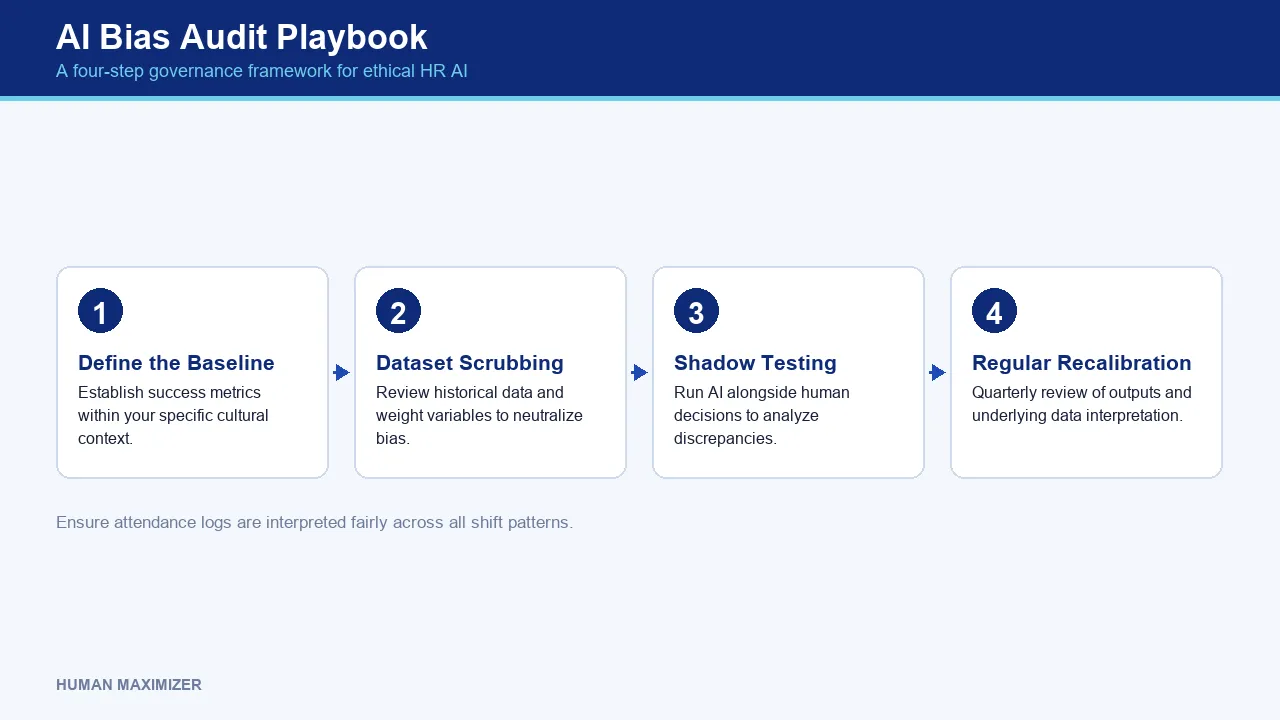
- Define the Baseline: Before letting an algorithm run, define what "success" looks like in your specific cultural context. Are you tracking output or merely presenteeism?
- Dataset Scrubbing: Review your historical data. If your past hiring or promotion records show a gender or regional skew, your AI will learn to replicate those patterns. You must intentionally weight these variables to neutralize historical bias.
- Shadow Testing: Run the AI in parallel with human decision-making. If the AI suggests a candidate for promotion that a human manager would never select, analyze the "why." Often, the AI is picking up on superficial patterns rather than genuine performance indicators.
- Regular Recalibration: Algorithms are not "set and forget." Every quarter, review the outputs. If the model consistently flags a specific department for issues, verify if the underlying data, such as Attendance Management logs, is being interpreted fairly across different shift patterns.
Real-World Risk Table: Black Box vs. Transparent Outcomes
| Feature | Black Box AI Outcome | Transparent AI Outcome |
|---|---|---|
| Performance Flag | Automated, unexplained penalty | Data-backed insight for manager discussion |
| Data Source | Opaque, global training sets | Localized, verified organizational data |
| Accountability | Vendor-locked, high legal risk | HR-governed, DPDP-compliant |
| Employee Trust | Surveillance-based, low safety | Output-focused, high transparency |
Beyond the Code: Drafting an AI Ethics Charter for the Indian Workforce
Technology is only as ethical as the charter that governs it. An AI Ethics Charter for your firm should be a cultural manifesto. It must outline that AI in your organization is an augmentation tool, never a final arbiter of a person’s career.

At Human Maximizer, our Productivity Lens is designed to track task completion and milestone progression through aggregated metadata, not by monitoring keystrokes. By focusing on output rather than surveillance, we help managers identify where work is stuck without intruding on the employee's agency. This distinction is vital. Google’s Project Aristotle demonstrated that psychological safety is the most significant factor in high-performing teams. When employees feel surveilled by opaque algorithms, psychological safety evaporates. Innovation suffers.
The Trust Paradox: Balancing AI Efficiency with Human-Centric Management
There is a fundamental tension between the cold precision of predictive HR analytics and the messy, human reality of office life. Amy Edmondson’s research emphasizes that teams that surface errors early and learn fast are the ones that thrive. If your AI is set up to punish "anomalies" in performance, you will train your employees to hide their struggles rather than solve them.

A common finding is that teams adopt new workflows faster when the benefit shows up in the same week. This is why RACI Dashboards and clear Ticket Management systems often build more trust than predictive models. They provide clarity on ownership and resolution, which empowers staff.
Cross-Functional Governance: Aligning Legal, IT, and HR Stakeholders
Building an ethical AI practice requires a committee. Your CPO should sit down with Legal to discuss DPDP compliance, IT to review data security, and HR to define the "human override" protocol. This alignment is essential because the psychological safety of your teams depends on knowing that automated systems are governed by human oversight.
- The Human Override Protocol: Every automated decision that impacts an employee’s pay or role must have a clearly defined path for human appeal. A performance flag triggered by a system glitch should be reversible within 24 hours via a manager-led override.
- Transparency Logs: Maintain a record of why specific AI-driven changes were implemented. If you change a performance scoring variable, document the reasoning.
- Continuous Feedback Loop: Engage employees in the process. When a new tool is introduced, be transparent about what it does and what it doesn't do.
Identifying and Mitigating AI Bias in HR Decisions
AI bias in HR decisions occurs when algorithms inadvertently perpetuate historical inequalities or favor specific demographics based on flawed training data. In the Indian context, this often manifests as 'proxy discrimination.' For instance, an algorithm might penalize candidates from specific educational institutions or regions, effectively filtering out talent based on socioeconomic background rather than actual competency. Because these models learn from past hiring and promotion patterns, they often codify the unconscious preferences of previous human decision-makers. If your historical data shows a preference for candidates from certain urban centers, the AI will likely downgrade applicants from Tier-2 or Tier-3 cities, even when their skills are identical.
To mitigate this, HR teams must perform 'feature importance' analysis. This involves identifying which variables the AI relies on most heavily to reach a conclusion. If the model assigns high weight to factors like 'years of experience' or 'gap in employment' without context, it may unfairly disadvantage women returning to the workforce after maternity leave. You must actively intervene by de-weighting these proxies and ensuring the model focuses on skill-based assessments or verified performance metrics. Furthermore, bias often hides in the 'noise' of unstructured data, such as performance review comments. If managers have historically used gendered language in their feedback, the AI will learn to associate those terms with high or low performance. Regularly testing your model against a diverse 'test set' of hypothetical candidates, who differ only in protected characteristics like gender or age, will reveal if the system is producing disparate outcomes. Ultimately, the goal is to ensure that the AI acts as a neutral filter, not a mirror reflecting the biases of your organization's past.
FAQ
How can HR leaders identify bias in predictive AI models? HR leaders should conduct regular "shadow testing" where AI outputs are compared against human-led decisions to spot discrepancies. If the AI consistently flags specific demographics, it is a clear signal that the underlying training data contains historical bias.
What are the core pillars of an ethical AI framework for HR? The core pillars include transparency in data usage, accountability for automated decisions, and the inclusion of a human-in-the-loop override protocol. These ensure that technology serves as an augmentation tool.
How does AI integration impact employee trust and workplace culture? AI integration can either enhance or destroy trust depending on whether it focuses on surveillance or output. When tools prioritize transparency, they foster psychological safety.
How to balance AI-driven efficiency with human-centric decision making? Balance is achieved by treating AI as a diagnostic tool that highlights where work is stuck. Always ensure that managers retain the final authority to interpret AI insights within the context of an employee's unique situation.
The risk of "black box" management is that it creates cultural debt, a gap between your stated values and your actual algorithmic behavior. As we navigate this transition, the goal should be to build a system where technology serves to illuminate human potential rather than categorize it. If your current HR system treats people as data points rather than partners, it is time to reassess your stack. Curious how a transparent, output-focused system works in practice? See it live.
How can I tell if my HR software is biased against certain employee groups?
You should conduct a disparate impact analysis by comparing the AI's recommendations across different demographic groups, such as gender, age, or region. If the system consistently flags one group for lower performance or fewer promotion opportunities despite similar output metrics, it is likely relying on biased historical data.
About the Author & Reviewer
Chandan Watts — Technical Product Manager, Human Maximizer (Razor Infotech)
Chandan Watts is Technical Product Manager at Razor Infotech, building the Human Maximizer HR platform. After years leading customer-experience and team operations at JindalX and Radical Minds, he focuses on how teams actually work day to day — and how small workflow gaps quietly slow an entire team down.
Connect on LinkedIn
Reviewed & approved by Sameer Hameed — Founder & Chairman, Razor Infotech
Sameer Hameed is the Founder & Chairman of Razor Infotech, where he is guiding the creation of Human Maximizer. An entrepreneur across technology, real estate, mining and travel, he builds organisations on clarity, trust and responsible growth — on the belief that businesses grow only when the people behind them grow.
Connect on LinkedIn
Human Maximizer is built by Razor Infotech in New Delhi, India (founded 2019). About Human Maximizer.
Keep reading
HR Strategy
Stop Digitizing Chaos: Why You Need HR Automation Software
Stop merely digitizing manual tasks. Discover how modern HR automation software eliminates administrative work to help your team focus on high-impact strategy.
8 min read
HR Strategy
Task management software: Stop Losing Billable Hours
Why confusing task tracking with project oversight drains your budget. Learn how to choose the right task management software to boost team efficiency.
9 min read
HR Strategy
Hrms implementation timeline india: Avoid the 6-Month Trap
Stop overestimating your rollout speed. Discover a realistic 12-week HRMS implementation timeline designed for Indian HR teams to ensure system...
13 min read