
Employee Engagement
A Practical Guide to Skills-Based Hiring in India 2026
How to hire on demonstrated skill instead of degree and pedigree — scorecards, structured tasks, and interview changes that hold up in India.

Richa Thakur
Content Writer · 5 min read · · Updated
A 90-person Bangalore SaaS company recently shared its last three engineering hires with us. None had a CS degree from a tier-1 college. One was a self-taught developer with a strong GitHub portfolio. Another was a mechanical engineer who reskilled through online programs. The third had dropped out of college to ship a side project that now has paying customers. Two years ago, none of those candidates would have passed the company's resume filter. In 2026, they are at the top of the funnel.
What we are seeing: The same pattern is showing up across Indian hiring teams. Looking across the job descriptions posted by Human Maximizer customers between early 2024 and early 2026, roughly one in three launched in 2026 dropped the formal degree requirement entirely. Two years ago, that number was under ten percent.
Hiring used to be a filter on credentials: the right degree, the right college, the right years on a resume. That filter is breaking. Indian employers are increasingly hiring on what a candidate can demonstrably do, not where they studied.
Consider a real tradeoff Indian hiring managers face weekly: a candidate with a design degree and a thin portfolio, versus a self-taught designer with shipped work and live products. Degree-based hiring ranks the first higher. Skills-based hiring ranks second. The second is usually the better hire.
Obviously, an individual with skills, potential, creativity, and innovation will be your top priority for the required job role. This is where skill-based hiring plays a significant role in the hiring process.
By prioritising what candidates can actually do over where they studied or what their prior experience is, recruiters can create a stronger talent pool.
Whether you're confused about how it works, how to implement it, what the challenges are, how it differs from conventional processes, or what role AI plays in skill-based hiring, this guide will clear all your doubts.
In this guide, you'll understand the following:
• What is the actual definition?
• Why are leading companies like Google and Apple choosing this method over traditional ones?
• What is the role of technology in the skill-based hiring process?
• How Indian SMEs and startups can implement it practically.
• Real frameworks, tools, and step-by-step migration plans.
What is Skill-Based Hiring?
Skill-based hiring is a recruitment strategy adopted by HR professionals and employers to select an individual based on skills, decision-making, and problem-solving capabilities over degrees, portfolios, CVs, resumes, job titles, and prior experience.
Traditional hiring often filters out candidates based on arbitrary requirements, such as where they completed their higher and secondary education, which college they selected, how they crafted their resumes and portfolios, and so on.
According to the TestGorilla 2025 State of Skills-Based Hiring report (a survey of UK and US employers), 85% of employers now use skills-based hiring, up from 81% in 2024 and 73% in 2023.
Skill-based hiring supports organisations in several ways:
Internal mobility across the organisation
Increased retention rate
Improves the quality of hire
Reduces bias and promotes greater diversity
Why is Skill-Based Hiring Growing in 2026?
Skill-based hiring is the future of talent acquisition and gives organisations a measurable way to evaluate ability. It gives organisations a hiring framework built for how fast roles and skills now change.
Leading companies like Apple and Google are shifting towards skills-based recruitment to innovate their business operations and achieve measurable results. Here are the major reasons for the shift in 2026:
• Develops Talent Strategy: Companies gain access to a more diverse and action-oriented workforce.
• Enhances Hiring Quality: Employees are hired based on demonstrated skills through skill tests, evaluations, and multiple rounds.
• Eliminates Hiring Bias: By focusing on objective assessments, recruiters ensure fairness, consistency and structured evaluation.
• Improves Employee Retention: Employees hired based on their capabilities drive better engagement, stronger performance, and reduced attrition.
Why India is moving faster: India produces roughly 1.5 million engineering graduates a year, and employability surveys put the ready-to-deploy rate near 45%. When the degree no longer predicts capability, companies that keep using it pay a hidden tax in mis-hires and 90-day attrition. This is why India is moving faster than the global average.
What is the Difference Between Skill-Based Hiring and Degree-Based Hiring?
For over a decade, companies were heavily dependent on college degrees and certificates while hiring candidates for specific roles. But now what actually matters is how many results you're delivering at the workplace.
While degree-based hiring focuses on traditional educational credentials, skill-based hiring evaluates abilities, adaptability, and job readiness. Here is the main difference between the two:
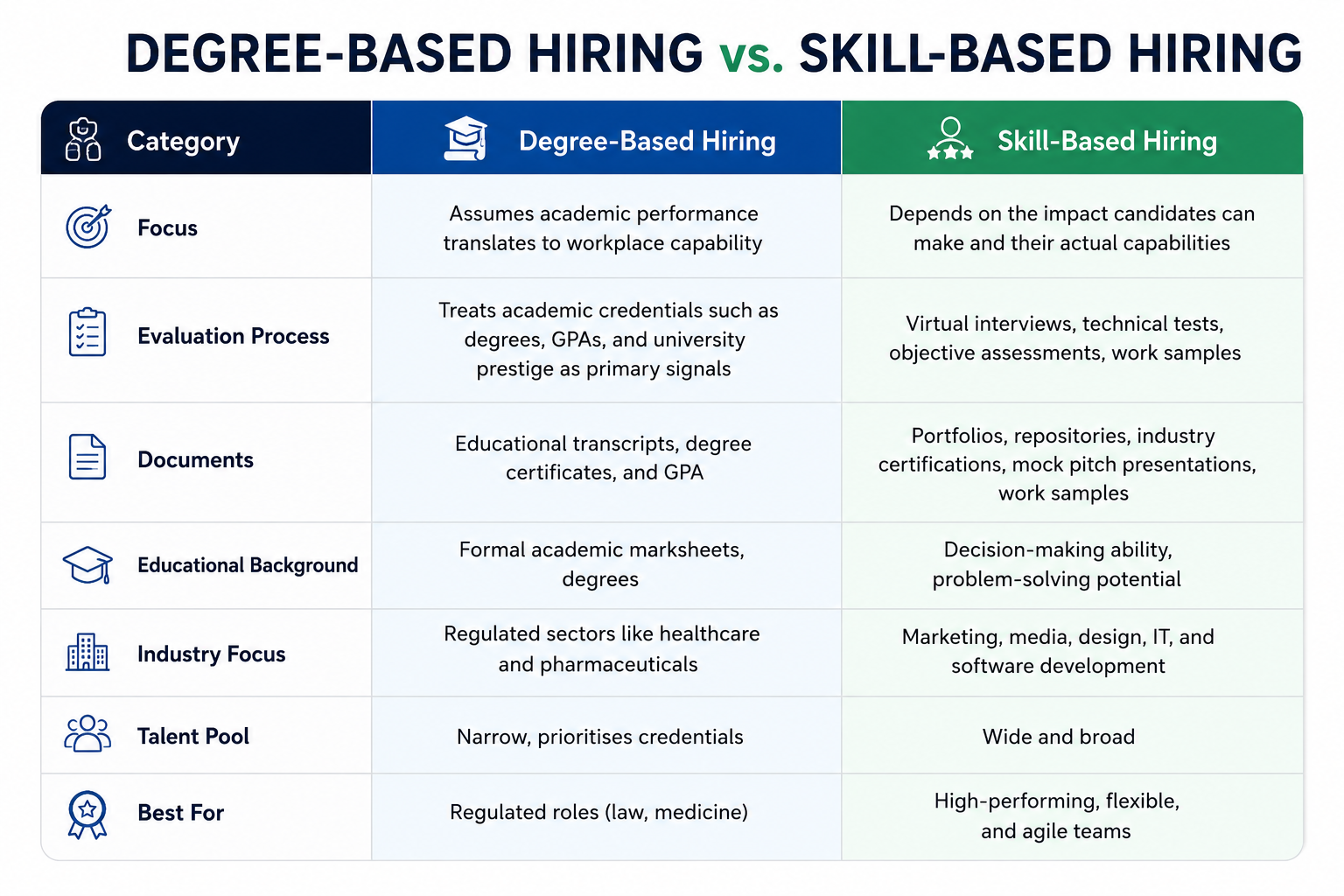
The Human Maximizer 6-Layer Skills-First Hiring Stack
We have codified what works into a six-layer framework. Each layer builds on the one below it. Skipping a layer is the most common reason skills-based hiring fails in year one.
Layer 1: Job Architecture
Rewrite job descriptions as skills, not titles. Replace "Senior Software Engineer with 5+ years of experience and B.Tech CS required" with a list of six to eight specific, evaluable skills written as observable behaviours like "Designs and ships production-grade microservices" or "Writes unit tests achieving 80%+ coverage."
Layer 2: Skills Taxonomy
Build a controlled vocabulary of skills used across your organisation. Without this, every hiring manager invents their own skill list, and the data becomes unusable. Most companies start with 200 to 400 skills mapped to 10 to 15 job families.
Layer 3: Assessment Design
For each skill, define how it will be evaluated. Code submissions for technical skills. Case studies for analytical roles. Live problem-solving for senior roles. Written exercises for communication-heavy roles. The rule is simple: if a skill cannot be observed, it cannot be evaluated.
Layer 4: Hiring Manager Calibration
Train every hiring manager on the rubric. Run calibration sessions where three to four managers score the same candidate independently, then compare and reconcile differences. This is the single highest-ROI activity in the migration. Skipping it produces inconsistent scoring and erodes trust in the new process.
Layer 5: Tool Stack Integration
Connect your assessment tools to your ATS and HRMS so assessment scores flow into the hiring decision, the offer, the onboarding plan, and the 90-day performance review. Without this connection, skills data dies in a silo. This is the layer Human Maximizer is built for.
Layer 6: Internal Mobility Loop
Use the same skills taxonomy for internal moves, promotions, and learning recommendations. This is where skills-based hiring stops being a recruiting initiative and becomes a workforce strategy.
What are the Challenges of Skill-Based Hiring?
While skill-based hiring can transform the workforce and take the organisation to the next level, the most difficult part is identifying and gathering the right skills that help in achieving the desired results and supporting innovation.
Difficulty in Assessing Skills: Recruiters may find it challenging to measure technical expertise, soft skills, and problem-solving ability during the hiring process.
Increased Time in Recruitment: Conducting skill assessments, assignments, technical tests, and practical interviews can lengthen the hiring timeline.
Risk of Overlooking Foundational Knowledge: Focusing only on skills may result in overlooking candidates who possess deep industry knowledge through formal education.
Delay in Adaptation: Transitioning to a skills-first hiring approach often requires redesigning job descriptions, recruitment workflows, and HR policies.
Technology and Assessment Costs: Implementing advanced assessment tools and AI-powered screening systems can increase recruitment costs for small and medium-sized businesses.
Balancing Skills with Cultural Fit: A candidate may possess strong technical skills but struggle to align with the company culture and communication style.
Resource: Download our free Skills-Based Hiring Migration Checklist, the exact 6-week roadmap we run with new Human Maximizer customers.
How Does AI Support Skill-Based Hiring?
Skill-based hiring is reshaping the way companies recruit candidates. For years, a college degree and certifications were essential to get a specific job. Today, you can still get the job with the right skills and capabilities required for the role, even without a traditional educational background.
In TestGorilla's 2025 survey, 63% of employers said finding great talent is harder than it was a year ago. The skills gap is widening faster than degree-based hiring can keep up with.
Here are several ways AI is supporting skill-based hiring:
Automated Candidate Sourcing: Scans resumes, social media, and databases to identify ideal candidates.
Smart Screening and Matching reduce time to hire by filtering large volumes of applications based on qualifications and skills.
Improved Candidate Experience: Chatbots answer repeated questions and guide candidates through the application process.
Data-Driven Insights: AI monitors labour trends in real time, helping businesses adjust their hiring strategies based on current salaries, demand and skill availability.
Content Creation: Crafts job descriptions, researches trends, and supports recruitment marketing strategies.
Best AI-Powered Skills Assessment Tools in 2026
The assessment tool market has matured significantly. Here is how the leading platforms compare for the Indian market in 2026:
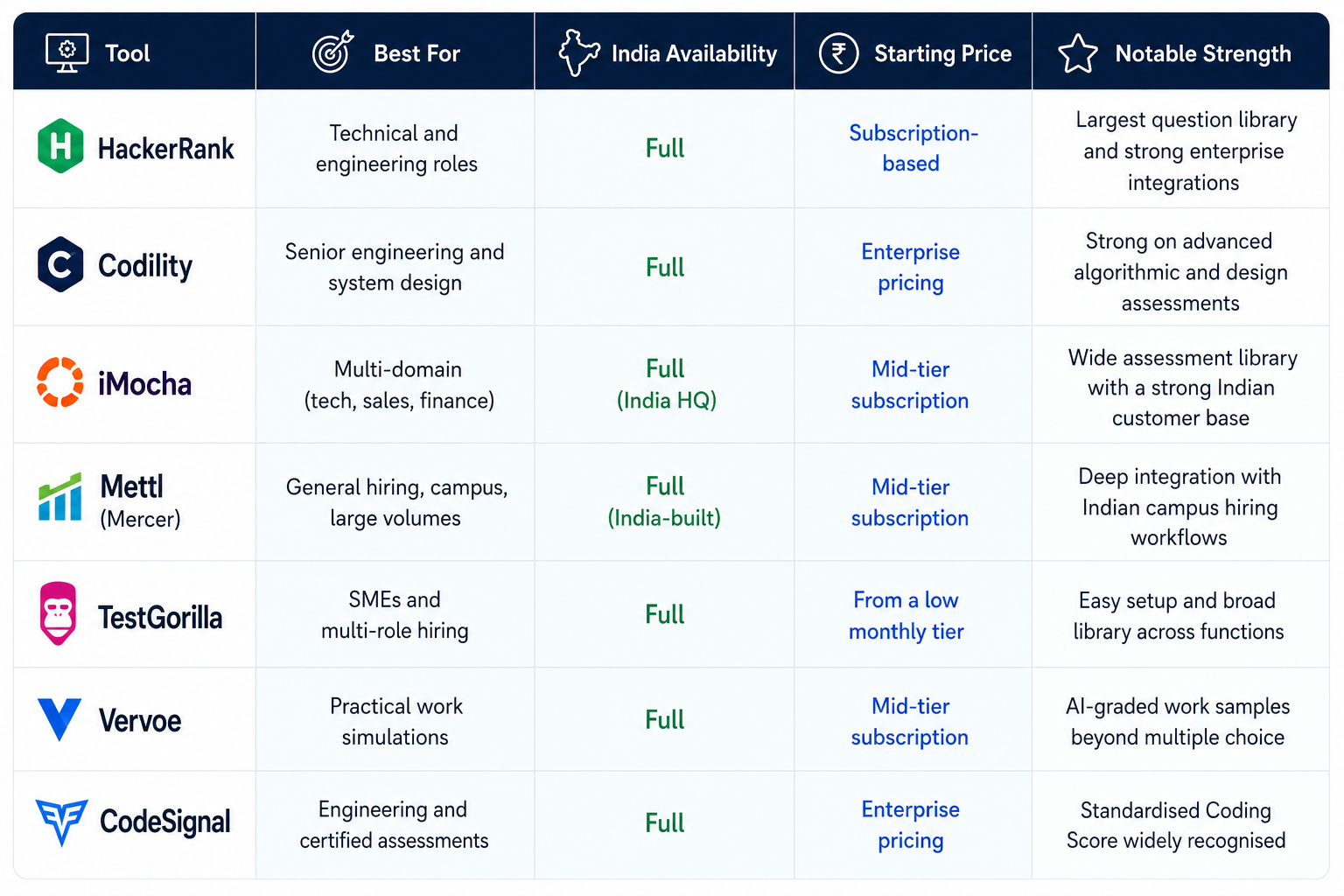
How to choose: Match the tool to the role and the volume. High-volume engineering hiring favours HackerRank or Mettl. Multi-role SME hiring favours TestGorilla or iMocha. Senior or specialised hiring favours Codility or Vervoe.
Where Human Maximizer fits: Human Maximizer is not an assessment tool. It is the HRMS and ATS layer that integrates with the tools above, so assessment scores flow into candidate records, hiring decisions, onboarding workflows, and post-hire performance data.
How Recruiters Can Shift to Skill-Based Hiring?
Skill-based hiring is closely tied to technology and the growing demands of today's workforce. It evaluates candidates based on abilities, potential, knowledge, and skills rather than their previous job role, certificates, or marksheets.
The main goals for recruiters are:
How to identify a capable individual
How many results can they deliver in a specific period
What are their key areas of expertise beyond the job role
Here's how recruiters can shift from a conventional method towards a skill-based approach:
Increase the Diversity of the Talent Pipeline
Support candidates from overlooked groups and showcase their skills by shifting the focus away from formal education and prior experience.
Identify Top-Talented Candidates
Instead of relying on mark sheets or prior experience, test candidates' skills directly for the required job role.
Widen Your Search
Skill-based hiring helps you find new talent and creative minds who would otherwise be missed when companies compete only for the same conventional candidates.
How to Implement Skills-Based Hiring in India: A 6-Week Migration Plan?
Here is the exact sequence we run with Human Maximizer customers transitioning from degree-based to skills-based hiring. This works for companies between 50 and 2,000 employees.
Week 1 (Audit and Pick a Pilot Role)
Choose one job family for the pilot, usually engineering, growth, or design. Audit the last 12 months of hires: time-to-hire, 90-day performance, 12-month retention. This is your baseline.
Week 2 (Rewrite the Job Description)
Strip out degree requirements and years-of-experience floors. Replace them with six to eight evaluable skills written as observable behaviours. Get sign-off from the hiring manager and the function head.
Week 3 (Build the Assessment)
Design a 60 to 90-minute structured assessment scored against a 4-point rubric. For technical roles, integrate a tool like HackerRank, Codility, or iMocha. For non-technical roles, use a written case or work sample.
Week 4 (Calibrate the Hiring Panel)
Three to four interviewers score the same two anonymised submissions independently, then compare. Refine the rubric. This typically reduces interviewer score variance by 30 to 40%.
Week 5 (Launch the Pilot)
Open the role. Source from non-traditional channels: GitHub, LinkedIn skills filters, alumni networks of bootcamps and online programs, not just tier-1 colleges.
Week 6 (Review and Decide)
Compare your pilot funnel metrics against your baseline. Most companies see a 20 to 35% increase in qualified candidates and a 10 to 25% reduction in mis-hires within two quarters. Decide what to roll out to the next job family.
Skills-Based Hiring for Indian SMEs and Startups
This is the segment where skills-based hiring delivers the highest ROI, and also where founders most often hesitate because they assume it requires enterprise budgets. It does not.
The Cost Math for a 50-Person Indian SME
A typical small Indian company hiring 30 to 50 people a year can run a complete skills-based hiring operation for roughly ₹15,000 to ₹40,000 per month, all-in. The breakdown:
Assessment tool subscription: ₹8,000 to ₹20,000 per month (TestGorilla, iMocha, or Mettl basic tier)
ATS and HRMS with skills tracking: typically included in your HRMS platform if you are using Human Maximizer or equivalent
Hiring manager training: one-time cost of ₹25,000 to ₹50,000 for an external workshop, or free if done internally
Time investment: roughly 4 hours per hiring manager for the first month, dropping to 1 hour per month thereafter.
The Payback
The average mis-hire in a senior Indian SME role costs 1.5x to 2x the annual salary when you account for ramp time, opportunity cost, and replacement hiring. Reducing mis-hires by one or two per year typically pays back the entire skills-based hiring investment within 4 to 6 months.
Illustrative scenario, composed from patterns rather than a single customer: a Pune-based fintech switches its engineering hiring to a skills-first approach in early 2025. After three quarters, time-to-hire dropped from 47 days to 29 days, 90-day attrition fell from 18% to 7%, and the share of hires from non-tier-1 colleges rose from 22% to 61%, with no compromise on output quality measured by sprint velocity and code review scores.
For Startups Specifically
Two practical adjustments for startups with under 30 employees:
Use lightweight assessments: A 45-minute take-home project beats a 4-hour test for candidate experience.
Make the founder the calibrator: Founders are usually the strongest assessors of fit and capability. Use them.
Resource: Free template: Skills-Based Job Description for Indian SMEs. Available on request from the Human Maximizer team.
Final Thoughts
Skill-based hiring is not an option for the modern organisation; it's a strategic shift in how talent is evaluated and built. The data sums it up:
85% of global hiring teams now say they hire for skills over degrees, and 53% have removed degree requirements from at least some roles (TestGorilla, 2025). Our own platform data shows Indian adoption running ahead of that curve.
The hiring vision is now clear: build a skills taxonomy, rewrite job descriptions, avoid generic job titles, train hiring managers to understand the current scenario, and assess evidence over credentials.
Skill-based hiring is reshaping the modern recruitment process by helping organisations focus on practical capabilities, adaptability, and real-world performance rather than relying only on academic qualifications.
It comes with certain challenges and needs to be evaluated thoughtfully before implementation. Through proper skills assessments, identifying hiring gaps, and process standardisation, recruiters can build an effective strategy that creates a stronger, future-oriented workforce.
As organisations continue to grow, the demand for a modern recruitment model also rises, one that can view, assess, and manage the hiring process intelligently. This is where Human Maximizer comes in, combining the modern hiring process with a smart HRMS tool to streamline workforce management, employee engagement, and workforce planning.
Our 2028 prediction: By 2028, we expect three out of five new tech hires in India to be made without a degree filter, and skills graphs to replace org charts in workforce planning conversations. Companies that build the infrastructure now will compound the advantage for years.
Ready to rebuild your talent pool and take your business to the next level? Schedule a demo with Human Maximizer and see the software in action before implementation.
Frequently Asked Questions
How do you assess skills without a degree filter?
By checking portfolios, work samples, presentations, assignments, and technical interview rounds, you can assess an employee's skills without requiring a degree.
Which tools are best for skills-based hiring assessments?
For technical assessments, popular tools include HackerRank, Codility, and iMocha. For general multi-role skill assessments, TestGorilla and Mettl are widely used in India. For end-to-end hiring management, including ATS, candidate tracking, integration with assessment tools, and skills-based hiring workflows, HRMS platforms like Human Maximizer provide the connective layer that ties assessment results to hiring decisions and post-hire performance.
Is skill-based hiring legal in India?
Yes, skill-based hiring is completely legal in India. In fact, it is rapidly growing within modern Indian industries. Private companies and startups have the autonomy to evaluate candidates based on practical competencies, portfolios, and assessments rather than formal degrees.
Can skill-based hiring work for senior roles?
Yes. Skill-based hiring works efficiently for senior roles, where the approach shifts from quick assessments to evaluating complex work through real-life scenarios. This ensures candidates possess the required leadership and strategic competencies.
Does skill-based hiring improve retention?
Retention usually improves because people hired for what the role actually requires ramp faster and stall less. TestGorilla's data links skills-based hiring to lower mis-hire rates, which is the main driver of early attrition.
Is skill-based hiring suitable for startups?
For startups, it is often the single highest-used hiring change that is available. With small teams, one mis-hire is proportionally far more damaging, and skills assessments catch capability gaps that a confident interview can hide.
How long does it take to implement skills-based hiring?
A focused pilot on one job family takes around 6 weeks. A full organisational migration typically takes 6 to 9 months, depending on company size and how many job families you are transitioning.
Keep reading

HR Strategy
How to Adopt Skills-Based Hiring in India (2026)
Transition to skills-based hiring in India. Learn how to design skill assessments, reduce bias, and hire top talent with Human Maximizer.
12 min read
HR Strategy
Skills-Based Hiring in India: A 2026 Guide for SMEs
Degrees are a weak signal in a market full of credential inflation. A skills-based hiring framework for Indian SMEs, including DPDP compliance.
11 min read
Employee Engagement
Employee Database Management: Why Spreadsheets Are Hurting Your HR (2026)
Still managing your employee database on spreadsheets? Discover how spreadsheet errors are hurting your HR operations and why Human Maximizer HRMS is the smarter way to handle employee onboarding, offboarding, and data management.
5 min read